


More news on this day
Rhätische Bahn in Switzerland’s canton of Graubünden is advancing a package of operational and infrastructure measures designed to absorb significant traffic growth projected on its regional and tourist network by 2035.
Get the latest news straight to your inbox!
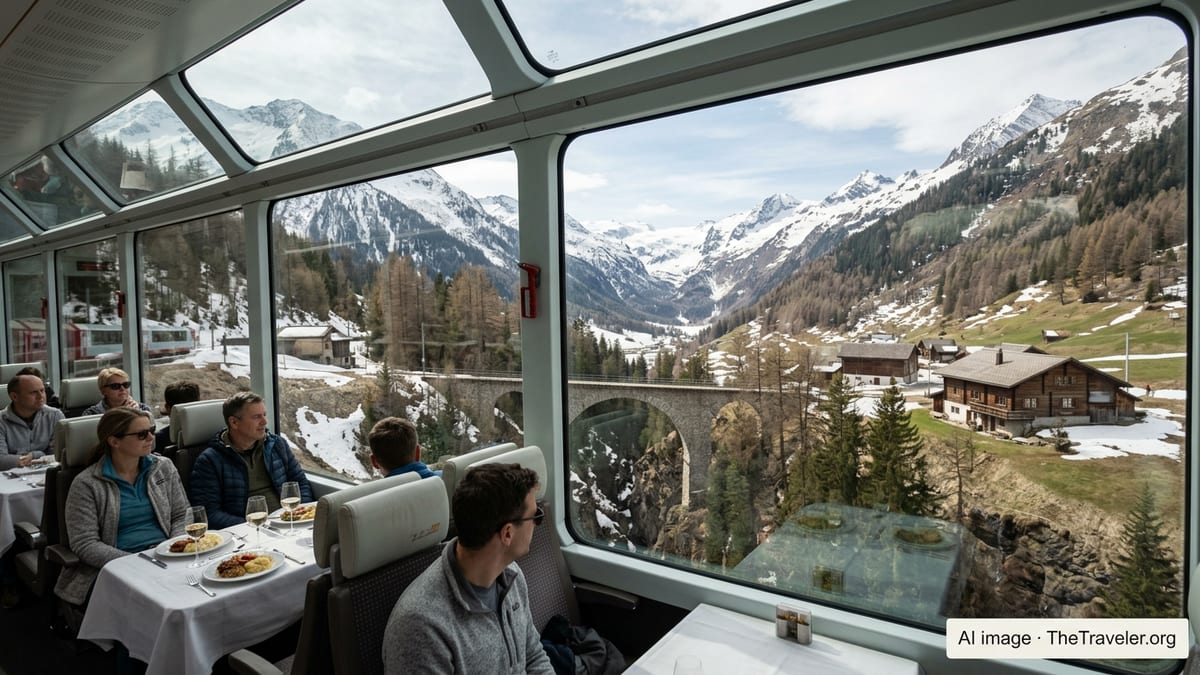
Forecasts point to robust demand across the RhB network
Studies commissioned for the Rhätische Bahn indicate sustained growth in both passenger and freight volumes over the coming decade, driven by tourism, regional commuting and car shuttle services through the Vereina tunnel. Publicly available planning documents describe the metre-gauge network as a backbone of mobility in Graubünden, with reliable services seen as essential for residents and visitors alike.
Analysis of line-by-line demand to 2035 suggests that multiple corridors will face capacity constraints unless services are intensified or infrastructure is upgraded. This applies in particular to routes radiating from Chur and Landquart, where RhB services function in practice as an S-Bahn style regional network, as well as to heavily marketed tourist lines that already attract strong seasonal peaks.
Projections also account for broader shifts in Swiss transport policy that are encouraging modal shift from road to rail. Federal strategies to expand rail capacity nationwide are expected to channel additional passengers and freight towards connecting regional networks such as RhB, adding further pressure on existing timetables and infrastructure.
These expectations of growth underpin the operator’s medium and long-term strategy. Rhätische Bahn has outlined a need to modernise its fleet, increase productivity and maintain its role as a key contributor to public transport in Graubünden, positioning the company to handle higher traffic without compromising punctuality or service quality.
National expansion step 2035 underpins capacity upgrades
Rhätische Bahn’s planning is closely tied to Switzerland’s national rail infrastructure programme known as the Expansion Step 2035. This federal package is intended to relieve bottlenecks, introduce more frequent interval services and create space for additional passenger and freight trains on key routes throughout the country.
According to publicly available information from federal transport authorities, the 2035 programme includes measures on major RhB corridors and at important interchange hubs in Graubünden. These investments are intended to improve connections between standard-gauge Swiss Federal Railways services and RhB’s metre-gauge network, particularly at nodes such as Landquart, which is slated for platform enhancements and better coordination between operators.
By integrating RhB into the broader national capacity strategy, planners aim to ensure that regional services in Graubünden can scale in line with increasing long-distance and interregional traffic. The coordinated approach is designed to avoid isolated bottlenecks that could undermine the benefits of nationwide investments, while preserving the reliability that underpins Switzerland’s clockface timetable system.
Funding for the Expansion Step 2035 is being channelled through Switzerland’s dedicated rail infrastructure financing mechanisms. For RhB, access to this framework provides a long-term financial and regulatory basis for implementing the upgrades required to support projected traffic growth.
Retica30+ to deliver denser regional and tourist services
At the cantonal level, Graubünden is implementing a comprehensive public transport concept branded Retica30 and Retica30+. Official documentation describes this initiative as a step-by-step expansion of rail and bus services across the canton, culminating by the 2035 timetable year in a broadly established half-hourly pattern on many lines.
For Rhätische Bahn, Retica30+ translates into more frequent trains on core corridors, new direct services and improved interchange nodes. One early milestone is the introduction of a half-hourly service between Chur and Ilanz, which is being supported by adjustments to bus timetables and stop patterns in the Surselva region so that feeder services synchronise with the new rail cadence.
The enhanced frequencies are expected to make public transport more attractive for everyday trips, helping to absorb commuter growth while also smoothing seasonal tourist peaks. More regular services can reduce crowding on individual trains and provide passengers with greater flexibility, which is particularly relevant in a region that caters to skiing, hiking and other outdoor activities sensitive to weather and daylight conditions.
Retica30+ also envisages a stronger integration of RhB’s role as an S-Bahn style system with regional buses and post buses. Planning documents highlight the goal of seamless door-to-door journeys, with coordinated timetables and shared hubs allowing passengers to transfer between modes with minimal waiting times.
Fleet renewal and operational changes to boost capacity
Planned traffic growth on the Rhätische Bahn network is not being addressed solely through infrastructure and timetable changes. Company strategy statements point to a substantial renewal of the rolling stock fleet as a central pillar of capacity expansion. Modern multiple units with higher seating capacity, improved acceleration and enhanced accessibility are being deployed to increase throughput on existing paths.
By standardising and modernising its fleet, RhB seeks to raise productivity and reduce maintenance complexity. Newer trains can support faster boarding and alighting, especially at busy tourist destinations and transfer points, which helps to maintain punctuality when services become more frequent. Higher energy efficiency also supports long-term operating cost control, which is crucial as train-kilometres increase.
Operational planning methods are also evolving to accommodate denser traffic. Scenario-based demand modelling, timetable simulations and refined path allocation are being used to identify where small adjustments in dwell times, crossing patterns on single-track sections or platform assignments can unlock additional capacity without major construction.
These operational improvements complement physical investments and are expected to play a significant role on constrained mountain sections where large-scale infrastructure expansion is difficult or environmentally sensitive. Together, they are intended to enable RhB to carry more passengers and freight while preserving the scenic qualities that are central to the network’s appeal.
Regional hubs and connectivity as levers for growth
Plans for handling traffic growth on Rhätische Bahn also emphasise the development of strong regional hubs. Landquart and Chur are highlighted in cantonal planning documents as multimodal nodes where standard-gauge, metre-gauge and bus networks intersect. Improvements to platforms, passenger flows and timetable coordination at these locations are seen as essential to maintaining smooth operations as the number of services increases.
By optimising these hubs, planners aim to shorten transfer times and make connections more robust, which is particularly important when services are intensified and margins for delay shrink. Better-designed interchanges also support forecast growth in leisure travel, as visitors arriving from other parts of Switzerland or neighbouring countries rely on straightforward transfers to reach resort areas served by RhB.
Enhanced connectivity is expected to reinforce the economic role of Rhätische Bahn in Graubünden. Publicly available strategic documents describe the railway as a key factor in regional development, supporting tourism, labour mobility and the movement of goods. As traffic grows, these functions are likely to become even more prominent, provided that the network can scale without performance degradation.
With national funding frameworks in place, a clear cantonal concept and ongoing fleet modernisation, Rhätische Bahn appears positioned to accommodate the significant traffic growth anticipated through 2035. The coming years will test how effectively this combination of infrastructure, service planning and operational optimisation can sustain the railway’s dual role as everyday transport provider and world-renowned tourist attraction.