


Nice is one of the few cities in the world where two giants of modern art each have a dedicated museum within a 20-minute walk of one another. With limited time, many visitors agonize over a single question: should you choose the Marc Chagall National Museum or the Matisse Museum. The answer depends less on abstract notions of “better” and more on the kind of art experience you want from your day in Nice.
Get the latest updates straight to your inbox!
Setting the Scene: Two Museums, Two Very Different Moods
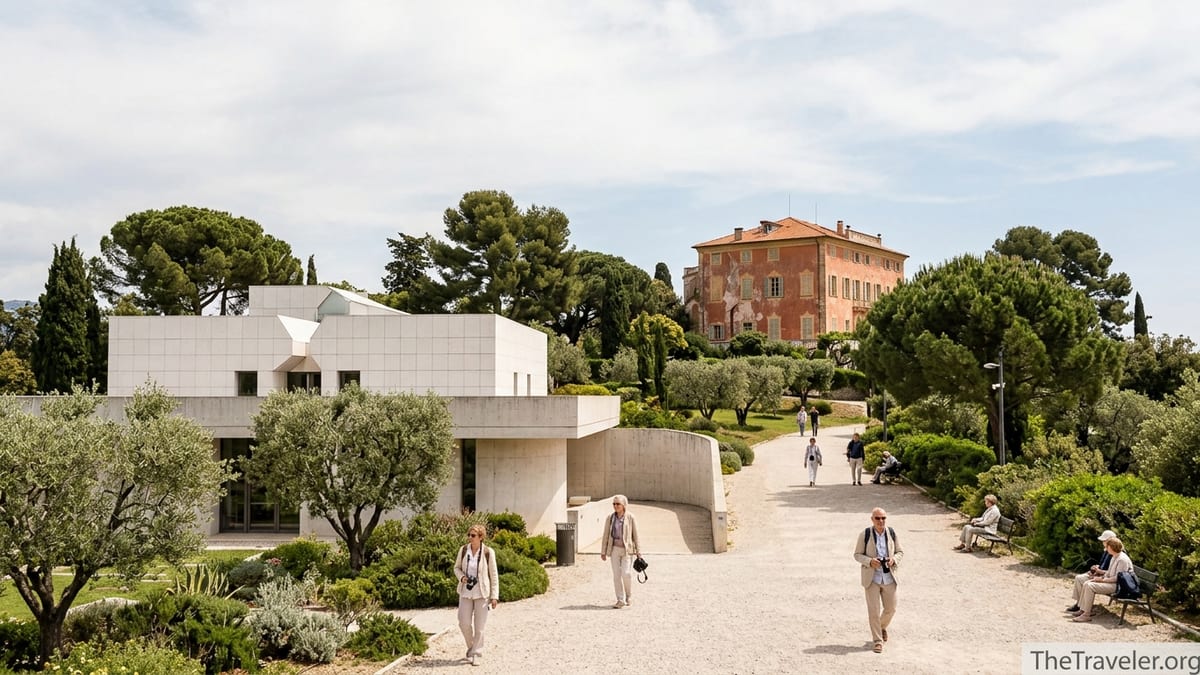
Both museums sit above central Nice on the leafy Cimiez hill, yet they feel strikingly different the moment you arrive. The Marc Chagall National Museum is compact and contemporary, a low white modernist building surrounded by Mediterranean gardens. Inside, light-filled galleries are purpose-built around Chagall’s luminous Biblical Message cycle, so the whole visit feels focused, cohesive and almost meditative.
The Matisse Museum, by contrast, occupies a 17th‑century Genoese villa painted deep terracotta with green shutters, facing olive groves and Roman ruins. Its interiors are more traditional: high ceilings, stone staircases and rooms that have been adapted rather than designed from scratch. The atmosphere is quieter and more scholarly, less about a single blockbuster series and more about tracing an artist’s life over decades.
In practical terms, most travelers find the Chagall museum takes 60 to 90 minutes to see at a relaxed pace, while the Matisse collection and its small temporary exhibitions tend to fill about 60 minutes, sometimes less for casual visitors. That matters if you are planning a packed Riviera itinerary: you could comfortably see both in a single half day, but if you only have time or energy for one, the vibe you prefer will guide your choice.
It is also worth noting that the Chagall museum is a national museum, while the Matisse Museum is run by the city of Nice. That administrative difference affects ticket prices and passes more than the on-site experience, but it explains why transport, discounts and combined tickets can look inconsistent at first glance.
Art Inside: What You Actually See
At the Marc Chagall National Museum, the experience is built around one of the largest public collections of Chagall’s work anywhere. The centerpiece is a series of monumental canvases illustrating stories from the Bible, bathed in saturated blues, reds and greens that seem to glow in the natural light. Even travelers who know little about Chagall often describe the visit as surprisingly emotional: floating figures, animals and lovers fill the walls, and the subject matter feels spiritual without requiring any religious background.
Beyond the main cycle, smaller rooms show works spanning Chagall’s long life: gouaches, stained-glass studies, mosaics and sketches for large religious commissions. One gallery often screens short documentary films that put his story into context, from his childhood in Belarus to wartime exile and his final years on the Riviera. If you enjoy seeing how an artist turns rough ideas into finished works, these studies and maquettes make the museum feel like a workshop as much as a gallery.
The Matisse Museum presents a different narrative arc. Rather than one towering series, you follow Matisse’s evolution from early paintings influenced by traditional realism, through his Fauvist explosion of color, then into his simplified late style. Expect a mix of oil paintings, drawings, prints, sculptures and personal objects. Many visitors are surprised by the modest scale of some works: instead of iconic “greatest hits” you might recognize from major Paris or New York shows, you often see experiments, studies and less familiar canvases that fill in the gaps of his story.
What makes the Matisse collection compelling is this sense of intimacy. You might see an early portrait hung near a quick charcoal line drawing, then a ceramic plate or a textile pattern that fed into his famous cut-outs. The museum also emphasizes Matisse’s deep connection with Nice and the surrounding coast, which he described as transforming his sense of light and color. For travelers curious about how place shapes art, that local tie can be a deciding factor in favor of the Matisse Museum.
Practicalities: Tickets, Passes and Value for Money
On the ground in 2026, the Chagall museum is generally the more expensive of the two. A standard adult ticket sits in the low teens in euros, and it is not included in the main Nice municipal museum pass that covers ten city-run museums such as the Matisse Museum, MAMAC and the Palais Lascaris. This separate status often surprises travelers who expected one card to unlock all of Nice’s art institutions.
The Matisse Museum, being municipal, is usually covered by the Nice museum pass, which costs around the mid‑teens in euros for 72 hours and allows multiple entries to participating museums. For visitors planning to see at least two or three city museums over a long weekend, this pass often pays for itself quickly. You can buy it at participating museums, and it is especially good value if you combine Matisse with MAMAC and the Museum of Fine Arts.
Several external guides and local travel writers note that a combined Chagall plus Matisse ticket is often available on site for a moderate supplement compared with the Chagall ticket alone, which can be smart if you know you will visit both within a couple of days. Options and prices do change, so it is wise to check current details at the tourist office in Nice or directly at the ticket desk when you arrive in Cimiez, especially in high summer when opening hours sometimes shift.
Budget-conscious travelers should also factor in concessions. European Union visitors under 26 often benefit from reduced or free entry at French national museums, which can tilt the value equation heavily toward Chagall. Meanwhile, residents of the Nice metropolitan area can apply for a free multi-year municipal museum card that gives them ongoing access to venues like the Matisse Museum at no cost, making local repeat visits a very different calculation from a one-off trip.
Getting There and Planning Your Day on Cimiez Hill
Both museums sit on or just off Boulevard de Cimiez, in a residential neighborhood above the city center. From the Old Town or the Promenade des Anglais, the journey by bus generally takes around 15 to 20 minutes, followed by a short walk. Routes can vary, but a common pattern is to ride a bus heading to Cimiez, get off near the Chagall museum first, then either walk uphill along the boulevard for about 15 minutes to reach the Matisse Museum, or hop back on the bus for a couple more stops.
The walk between the two is uphill but pleasant, passing Belle Époque villas, leafy sidewalks and occasional glimpses back toward the Baie des Anges. In hot weather, the climb can feel more demanding than it looks on a map, so many visitors prefer to start at the higher Matisse Museum and then stroll downhill to Chagall, finishing closer to central Nice. Taxis and ride-hailing services are easy enough to call if you tire of walking, though prices rise in peak season and at busy times of day.
Cimiez itself rewards lingering. Next to the Matisse Museum are the ruins of a Roman arena and baths, a Franciscan monastery, a small religious museum and a public park shaded by centuries-old olive trees where locals picnic on weekends. This cluster of sights makes Matisse an ideal anchor for a broader cultural half day: you can visit the museum, wander through the archaeological site, then relax under the trees with a takeaway pan bagnat from a bakery in town.
Because the Chagall museum is slightly closer to the city, some travelers choose to visit it on a separate day as part of a shorter outing, combining it with a stroll back down through the quieter residential streets to the Nice Liberation market or to the train station area. If you are sensitive to crowds, aim for weekday mornings outside school holidays, as both museums host tour groups and can feel noticeably busier around late morning and early afternoon.
Atmosphere, Interpretation and Visitor Experience
If you crave a clear narrative and rich interpretation, the Chagall museum usually comes out ahead. Explanatory panels introduce the themes of each room, audio guides are often available in multiple languages, and short films or multimedia displays help explain how specific works were created. Many reviews describe staff as welcoming and engaged, happy to answer questions and guide visitors through lesser-known parts of the collection such as the graphic works and stained-glass designs.
The layout at Chagall is straightforward: you progress through a series of white, light-filled rooms that each focus on related works, returning easily to previous canvases if something captures you. The architecture and landscape design work hard in the background to keep attention on the art: windows frame gardens, benches invite you to sit and look, and even the small on-site café and bookshop feel integrated into the flow of the visit rather than tacked on.
The Matisse Museum offers a quieter, sometimes more academic experience. Signage tends to emphasize chronology and context more than dramatic storytelling, and the collection has a more uneven rhythm: a room of drawings, then a cluster of smaller canvases, then display cases of letters or personal objects. For dedicated Matisse admirers, this is part of the charm, as you sense you are peeking into the artist’s working life rather than touring a greatest-hits gallery.
For casual travelers or families, however, the difference can be noticeable. Many people report being deeply moved or visually stunned by Chagall’s bold colors and dreamlike compositions even if they know little about modern art, whereas reactions to the Matisse Museum are more mixed. Some visitors love the subtlety and the sense of discovery; others, especially those expecting the iconic cut‑outs and large decorative panels seen in blockbuster exhibitions elsewhere, find the collection smaller than anticipated.
Who Will Love Which Museum
Choosing “better” really means choosing “better for you right now.” If you tend to respond strongly to color, emotion and narrative, the Chagall museum is usually the safer bet. Travelers who describe themselves as not particularly into art often leave talking about how unexpectedly moving the Biblical canvases were, or how the blues reminded them of the Mediterranean itself. Couples on a short city break often gravitate here because the experience is self-contained, easily digestible and beautiful to photograph without feeling like a long academic visit.
The Matisse Museum suits a different profile. If you already know some of Matisse’s work, enjoy drawing or design, or are curious about how an artist’s style evolves, you are more likely to appreciate the subtler pleasures of this collection. Design students and painters often linger in front of the line drawings and cut-out studies, and architecture fans relish the chance to explore a historic villa that itself feels tied to the Riviera aesthetic.
Families with children sometimes find Chagall more immediately engaging because of the bold colors and fantastical animals, though older kids with patience may appreciate Matisse’s sketches and the freedom to roam the olive gardens outside. Solo travelers on a longer Riviera stay often end up visiting both, sometimes even returning to one on a second day; it is not unusual to hear people say that they found Matisse intellectually satisfying but Chagall emotionally unforgettable, or vice versa depending on personal taste.
If you strongly prioritize local connection, Matisse has the edge: he spent years living and working in Nice, in several apartments that are still identifiable from the street. The museum makes a point of linking works to their nearby settings, from balconies overlooking the sea to interiors filled with North African textiles he collected. Chagall’s story, while very much tied to the region in his later life, feels more global and spiritual in tone.
Making the Most of Limited Time
Many travelers to Nice have just one or two full days in the city, often shared with day trips to Monaco, Antibes or hill towns like Eze and Saint-Paul-de-Vence. In that context, you may need to make a clear choice. If you only have two to three hours total, the most time-efficient plan is usually to pick the Chagall museum alone, or to combine the Matisse Museum with a relaxed picnic among the Roman ruins and olive trees without rushing between venues.
If you can dedicate a half day to Cimiez, a common and realistic itinerary is to start at the Matisse Museum around opening time, explore the archaeological site and monastery grounds, then walk or bus downhill to Chagall, finishing mid-afternoon back in central Nice. This sequence lets you use a municipal pass efficiently, enjoy the gardens while temperatures are cooler and tackle the more emotionally intense Chagall works after a break outdoors.
For visitors arriving on a cruise or quick day trip, time pressure can be intense. In that case, factor travel logistics carefully: allow time to get from the port or train station up to Cimiez and back, and build in at least 60 minutes inside whichever museum you choose. Many independent guides recommend pre-deciding your priority so you do not lose precious minutes debating on the sidewalk; if you suddenly find yourself with extra time, the walk between the two museums is an easy improvisation.
Weather is another underrated variable. On a blazing summer afternoon, those shaded gardens around the Matisse Museum can feel like a sanctuary after the crowded beachfront, and the cooler upstairs galleries make lingering more pleasant. On a cooler or rainy day, the self-contained, purpose-built Chagall museum, with its bright interior spaces, often feels more comfortable and atmospheric.
The Takeaway
In a direct showdown, the Marc Chagall National Museum generally delivers the more immediately impactful, emotionally resonant visit for the average traveler. Its focused collection, carefully designed architecture and strong interpretive material make it an easy recommendation, especially for first-time visitors to Nice who want one outstanding art experience without feeling overwhelmed.
The Matisse Museum, meanwhile, shines for those who already have a connection to Matisse, who enjoy tracing artistic evolution, or who are drawn to the broader setting of Cimiez with its olive groves and Roman remains. It may feel quieter and less spectacular at first glance, but for the right visitor it becomes a highlight of the trip, precisely because it feels more like entering an artist’s working world than a grand gallery.
If your schedule allows, the most satisfying solution is not to choose at all: dedicate a half day to the Cimiez hill, see both museums in one loop and let your own reactions decide which artist speaks more strongly to you. Nice is one of the rare places where you can walk between two such distinct visions of color, light and modern art in under twenty minutes, and that encounter, more than any verdict about which museum is “better,” is what makes this corner of the Riviera so compelling.
FAQ
Q1. If I only have time for one museum, should I choose Chagall or Matisse
If you want a powerful, visually striking experience with clear storytelling, the Marc Chagall National Museum is usually the better single choice for most visitors.
Q2. Can I realistically visit both museums in one day
Yes. Most travelers manage both easily in a half day by combining a morning at the Matisse Museum with an afternoon visit to the Chagall museum and walking or busing between them.
Q3. Is there a combined ticket for Chagall and the Matisse Museum
Combined options are often offered and can change over time. It is best to ask at the ticket desk of either museum when you arrive for current prices and conditions.
Q4. Which museum is better for someone who is not usually into art
The Chagall museum tends to appeal more to non-specialists because of its vivid colors, emotional themes and clear layout, which feel engaging even without prior art knowledge.
Q5. Which museum works best with the Nice municipal museum pass
The Matisse Museum is part of the city-run network usually included in the Nice museum pass, while the Chagall museum is national and typically requires a separate ticket.
Q6. How long should I plan to spend in each museum
Most visitors spend about 60 to 90 minutes at the Chagall museum and roughly 45 to 60 minutes at the Matisse Museum, depending on interest and crowd levels.
Q7. Are the museums suitable for children
Both welcome families, but many children respond more readily to Chagall’s bold colors and fantastical imagery. The olive gardens near the Matisse Museum are ideal for breaks and play.
Q8. Do I need to book tickets in advance
Advance booking is not always required, but in high season it can help avoid queues. Check current guidance with the Nice tourist office or directly with the museums before your visit.
Q9. Which museum is easier to photograph inside
Both have restrictions on flash and tripods, but the Chagall museum’s bright, modern galleries and large canvases usually make it easier to capture satisfying, well-lit photos.
Q10. If I am mainly interested in Nice’s history, which museum fits better
The Matisse Museum, set in a historic villa next to Roman ruins and a monastery, offers a stronger sense of the city’s layers of history alongside its art.