


The Marc Chagall National Museum in Nice is not just another stop on the Riviera museum circuit. Conceived with the artist’s direct involvement and built around a single monumental cycle of paintings, it offers one of Europe’s most intimate encounters with a major modern master. For today’s travelers and art lovers, this hilltop sanctuary above Nice continues to feel surprisingly contemporary, from the clarity of its architecture to the emotional charge of its color-drenched canvases.
Get the latest updates straight to your inbox!
A Museum Designed by the Artist, for His Viewers
Most museums of modern art are assembled long after an artist’s death, their works scattered among galleries and private collections. The Marc Chagall National Museum in Nice is different. Opened in 1973 in the presence of Chagall himself, it was purpose-built to house his Biblical Message cycle and to reflect his vision of how visitors should encounter it. The building sits quietly in a residential neighborhood above central Nice, about a 20-minute walk from the main train station or a short bus ride on the local line that stops at “Musée Chagall.”
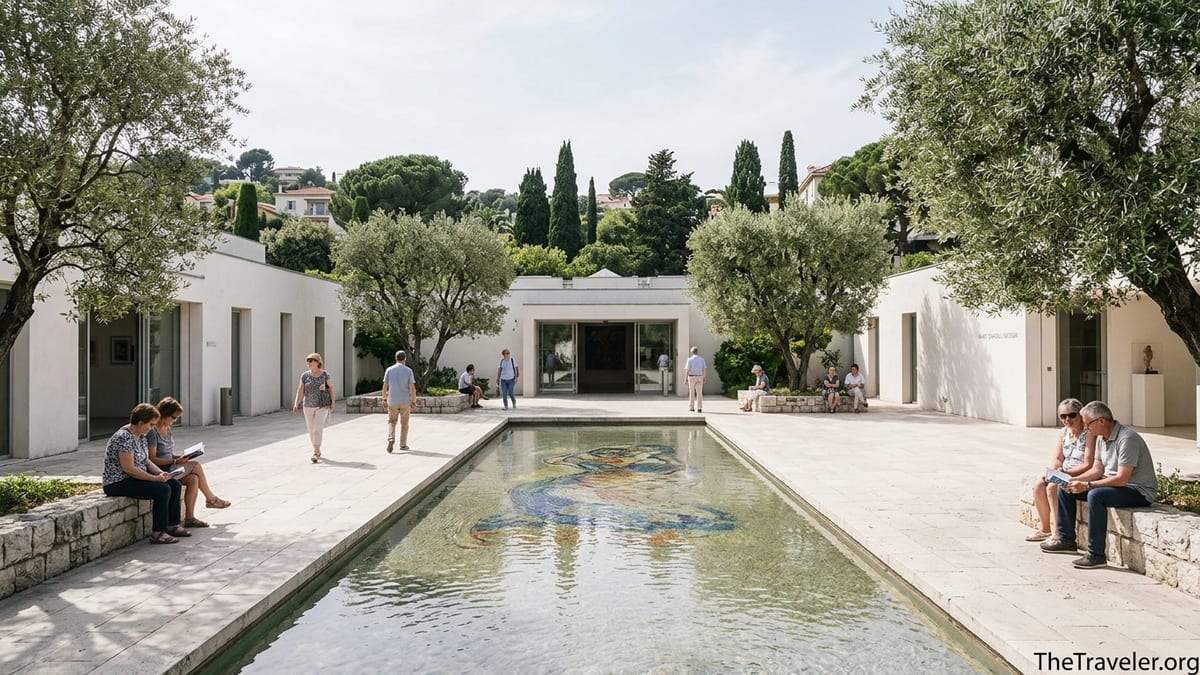
French architect André Hermant designed the complex as a low, white ensemble of pavilions wrapped around a garden courtyard, avoiding grand staircases or monumental facades. Inside, the main galleries are flooded with soft Mediterranean light, filtered to protect the paintings but bright enough that Chagall’s saturated reds, blues, and greens feel almost luminous. The layout encourages a slow loop rather than a linear march, allowing travelers to step close to individual paintings, then back up to absorb the cycle as a whole.
For modern art lovers used to the dense hanging of museums in Paris or New York, the sense of space is striking. Large benches and wide passages mean you can sit and contemplate a single canvas for ten or fifteen minutes without feeling rushed. On quieter weekday mornings outside peak summer, visitors often report having whole rooms nearly to themselves, a rarity for a museum that holds the world’s largest public collection of Chagall’s work.
This direct, almost domestic scale is precisely what makes the museum feel current. It anticipates the contemporary preference for slower, more immersive viewing instead of fast-paced “checklist tourism,” and it matches the expectations of travelers who build entire days around a single cultural site rather than racing through a dozen attractions.
The Biblical Message Cycle: Color, Emotion, and Narrative
The heart of the museum is the Biblical Message, a series of 17 large canvases on themes from Genesis and Exodus that Chagall donated to the French state under the condition that a dedicated museum be created in Nice. Instead of illustrating scripture literally, these paintings translate traditional stories into floating figures, upside-down animals, and dreamlike villages rendered in blazing color. Even visitors with no religious background often respond strongly to the emotional clarity of the works.
In the main hall, the Genesis paintings surround you on three walls. Scenes such as the Creation, Adam and Eve, and the story of Noah unfold in compositions dominated by deep blues and glowing greens. Travelers frequently comment on how the scale alters their sense of the familiar stories: figures that appear small and lyrical in reproductions become human-sized presences when you stand a few meters away. The brushwork, visible up close, reveals scratched-in details and layered pigments that rarely show up in books or posters.
Nearby, the Exodus canvases dramatize flight, exile, and hope, themes that resonate powerfully for 21st-century viewers familiar with images of displacement from today’s news. A traveler standing in front of the Crossing of the Red Sea can sense Chagall’s own story of migration from his childhood village in present-day Belarus to Paris, then to wartime exile and finally to the south of France. The paintings’ mix of anguish and consolation feels surprisingly modern, and many visitors describe them as more emotionally accessible than some of the abstract works across town at the Museum of Modern and Contemporary Art.
Audio guides, available for a modest fee at the ticket desk, provide commentary in several languages and are particularly useful if you want to connect the imagery with specific Bible episodes without doing prior research. For art students and serious enthusiasts, the guide’s focus on composition and color relationships helps unpack how Chagall borrows from Cubism, Fauvism, and Russian folk art while never fully belonging to any single movement.
Architecture, Light, and Garden: An Early Immersive Experience
Long before “immersive art experiences” became a marketing trend, the Marc Chagall National Museum offered a carefully choreographed journey through art, architecture, light, and landscape. As you move between galleries, large windows frame olive trees and stone paths outside, so that the Mediterranean garden becomes a kind of extension of Chagall’s painted worlds. In spring, the scent of jasmine and the sound of cicadas drift in through open doors, enriching the visit in a way no digital projection could replicate.
One of the museum’s most memorable spaces is the small pool in the central courtyard, where a mosaic designed by Chagall depicts the prophet Elijah ascending in a fiery chariot. Reflections of the sky ripple across the mosaic’s surface, and on a bright afternoon the surrounding white walls bounce light back onto the colored tesserae. Travelers often pause here between galleries, sitting on the low surrounding ledges to reset before returning indoors. It is a simple, analog form of immersion: your eye travels from a blue patch of sky above to an equally intense blue in the pool at your feet, echoing the vivid blues that dominate the museum’s stained glass.
Inside, the auditorium offers another kind of sensory experience. Designed as a concert hall as well as an exhibition space, it hosts chamber music performances by the Nice Philharmonic and visiting ensembles on many evenings throughout the year. Chagall created stained-glass windows for this room that depict the Creation of the World in swirling, jewel-like panels. If you catch a late-afternoon concert, the low sun can cause the entire space to glow in turquoise and violet, adding a visual layer that many regulars say is as important as the music itself.
For travelers accustomed to blockbuster digital shows based on Klimt or Van Gogh, the Chagall museum offers an alternative model of immersion: natural light, carefully framed views, and human-scale architecture that slow the pace of looking. It is a reminder that profound engagement with art does not require headsets or projection mapping, only the thoughtful alignment of painting, space, and time of day.
Why Chagall Still Speaks to 21st-Century Art Lovers
For some visitors used to the sharp lines of Minimalism or the cool irony of Conceptual art, Chagall’s floating lovers and folkloric animals can initially seem sentimental or old-fashioned. Yet spending an afternoon in Nice’s Chagall museum often shifts that perception. Up close, the paintings reveal how deeply they grapple with issues that remain urgent today: migration and homeland, religious identity and pluralism, memory and trauma, and the possibility of joy after catastrophe.
Chagall’s own biography reads like a compressed version of 20th-century upheaval: born into a Jewish family in an imperial Russian town, shaped by the Paris avant-garde, displaced by war and antisemitism, and finally settled in the south of France. The Biblical Message cycle, created in the decades after World War II, transforms these experiences into images of people crossing seas, searching for promised lands, and negotiating between earthly suffering and visions of peace. Modern visitors who have followed debates about refugees, borders, or interfaith dialogue often find these themes surprisingly current.
Chagall’s use of color also resonates strongly with contemporary sensibilities. In a world saturated with digital screens, his luminous ultramarines and acidic yellows feel almost analog, their intensity grounded in visible brushwork and material paint. Photographers and designers frequently visit the museum specifically to study his color harmonies, taking notes or quick phone snapshots for later reference in branding or interior projects back home.
Finally, for many travelers, Chagall offers an accessible gateway into modern art. Couples who might feel intimidated by the more experimental displays at major contemporary museums often report that Chagall’s narrative, figurative style helps them connect emotionally first, then appreciate the formal innovations later. Families with teenagers find that the mix of recognizable figures and surreal juxtapositions invites personal interpretations, sparking conversations about how art can tell complex stories without a single “correct” reading.
Practical Reasons This Museum Belongs on Your Nice Itinerary
Beyond art-historical significance, the Marc Chagall National Museum fits neatly into a modern traveler’s practical considerations. It is compact enough to explore in 90 minutes to two hours, yet rich enough to reward a half day if you linger. Standard adult admission is typically in the mid-teens in euros, with reduced rates for young adults, students, and groups, and children often benefit from free or very low-cost entry. Occasionally, a combined ticket with another regional museum, such as the Fernand Léger National Museum in Biot, offers extra value for visitors exploring the Riviera’s modern art trail.
Getting there is straightforward. From central Nice, you can walk uphill through quiet streets in around 20 to 25 minutes from the main railway station, or you can board a city bus that stops right by the entrance on Avenue Docteur Ménard. Many visitors choose to pair the Chagall museum with the nearby Matisse Museum in the Cimiez district, using a single bus route or rideshare to move between the two. Planning both on the same day creates a powerful dialogue: Chagall’s visionary narratives in the morning, Matisse’s serene cut-outs and interiors in the afternoon.
The museum is usually open daily except certain Tuesdays and major holidays, with slightly longer hours in high season. Mornings tend to be quieter, while mid-afternoons can see more tour groups, especially during summer and around major cruise ship arrivals. Buying tickets on-site is generally easy outside peak weeks in July and August, though checking current entry conditions before you travel is wise, as national museums in France sometimes adjust hours for renovation or special events.
On a practical note, the museum includes a bookshop where you can find well-produced catalogues, quality reproductions, and bilingual introductions to Chagall’s life and work, along with a small café or refreshment area that offers simple drinks and snacks. Prices for coffee or soft drinks are typical of French museum cafés rather than beach clubs, making it a good place to pause before heading back down into the bustle of central Nice or towards the Promenade des Anglais.
Connecting Chagall in Nice to a Wider Modern Art Journey
For modern art lovers traveling along the Côte d’Azur, the Chagall museum is more than a standalone attraction. It forms part of a wider network of sites that trace the Riviera’s role as a 20th-century laboratory for modernism. Within Nice itself, you can pair it with the Museum of Modern and Contemporary Art, which focuses more on post-1960 movements, or with the Matisse Museum, dedicated to another giant of color and light who settled in the city.
Beyond Nice, a short drive or bus ride takes you to the Fondation Maeght in Saint-Paul-de-Vence, where works by Miró, Giacometti, and other modern masters mingle with architecture and pine trees on a hillside. Chagall also left his mark there in the form of mosaics integrated into the buildings. Further afield, travelers can follow his trail to Reims or Metz to see his stained-glass windows in Gothic cathedrals, or to major institutions such as the Museum of Modern Art in New York or the Centre Pompidou in Paris, which display his earlier and later works.
Experiencing the Marc Chagall National Museum early in such a journey gives valuable context. Once you have stood in front of the full Biblical Message cycle and absorbed its recurring motifs, you start to recognize echoes of its iconography in smaller works elsewhere: a violinist hovering over a village in a New York canvas, or a pair of lovers floating above rooftops in Paris. The Nice museum functions almost like a key or legend for reading Chagall’s broader output across the world’s collections.
For travelers building itineraries around art, this makes Nice a natural anchor point. A long weekend might include a morning at Chagall, an afternoon at Matisse, a day trip to the Fondation Maeght, and an evening stroll through the old town and along the seafront. Even for those whose primary reason for visiting the Riviera is the beach, slotting the Chagall museum into a cloudy morning or a rest day from sunbathing can add a memorable cultural dimension to the trip.
The Takeaway
Half a century after its inauguration, the Marc Chagall National Museum in Nice still feels quietly radical. In an era of crowded mega-museums and flashy immersive shows, it offers an experience that is at once simpler and more profound: a thoughtfully designed space, a coherent body of work, and enough time and light to truly look. Travelers who make the short climb above central Nice find not only a deep dive into one artist’s world, but also a template for how modern art can be presented with clarity, intimacy, and respect for the viewer.
For today’s art lovers, that is precisely why the museum matters. It shows how color, narrative, and spiritual searching can remain powerful long after the historical moment that produced them has passed. Whether you are an experienced museum-goer or someone just beginning to explore modern art, stepping into Chagall’s world in Nice is likely to stay with you long after you have left the Mediterranean coast behind.
FAQ
Q1. Where is the Marc Chagall National Museum located in Nice?
The museum is situated in a quiet residential area above central Nice, on Avenue Docteur Ménard, about a 20 to 25 minute uphill walk from the main train station or a short ride on several city bus lines that stop near “Musée Chagall.”
Q2. How much time should I plan for a visit?
Most visitors are satisfied with around 90 minutes to two hours, which allows enough time to see the Biblical Message cycle, explore the garden and pool, and browse the temporary exhibition spaces without feeling rushed.
Q3. What is the main highlight for modern art lovers?
The central highlight is the Biblical Message cycle, 17 monumental paintings on themes from Genesis and Exodus, presented in a dedicated suite of rooms designed with Chagall’s direct input to maximize the impact of color, light, and narrative.
Q4. Are there temporary exhibitions in addition to the permanent collection?
Yes, the museum regularly organizes temporary exhibitions that place Chagall’s work in dialogue with other modern or contemporary artists, or that focus on specific aspects of his practice such as stained glass, mosaic, or his years on the Riviera.
Q5. Is the museum suitable for children and teenagers?
Many families find it very accessible for younger visitors, thanks to the vivid colors, recognizable figures, and relatively small size of the museum. Children often enjoy identifying animals, musicians, and angels in the paintings and exploring the outdoor courtyard.
Q6. When is the best time of day to visit?
Mornings on weekdays are usually the quietest, offering more space and calm to contemplate the works. Late afternoon visits can be very atmospheric when low sunlight enhances the stained-glass windows and the garden, though they may be busier in high season.
Q7. Can I combine the Chagall museum with other art sites in Nice in one day?
Yes, many travelers pair a morning at the Chagall museum with an afternoon at the Matisse Museum in Cimiez, or with a visit to the Museum of Modern and Contemporary Art downtown. Public transport and short taxi or rideshare journeys make these combinations easy.
Q8. Are photography and sketching allowed inside?
Non-flash photography for personal use is often permitted in many areas, though policies can change and certain temporary exhibitions may have restrictions. Discreet sketching is generally tolerated as long as it does not obstruct circulation or disturb other visitors.
Q9. Do I need to book tickets in advance?
Outside the peak summer months and major holidays, it is usually possible to buy tickets on arrival without long waits. During July and August, or when a major temporary exhibition is on, advance planning and checking current conditions before visiting is advisable.
Q10. Is the museum accessible to visitors with reduced mobility?
The museum’s single-story layout, ramps, and relatively gentle circulation make it broadly accessible, and staff can usually advise on the easiest routes and available facilities on arrival. Travelers with specific needs may wish to verify current accessibility details before their visit.