


Between the high-rise skyline of Nice and the glitter of Monaco, Beaulieu-sur-Mer could easily have gone the same way. Instead, this compact seaside town has become a quiet favorite of Riviera residents who come for its elegant beaches, Belle Epoque villas and the luxury of doing very little at all. For locals, Beaulieu is the rare stretch of coast where you still recognize people at the market, the sea is never far away and the pace stays resolutely unhurried, even in August.
Get the latest updates straight to your inbox!
A Riviera Village Between Glamour and Everyday Life
Beaulieu-sur-Mer sits in the so-called golden triangle with Villefranche-sur-Mer and Saint-Jean-Cap-Ferrat, on one of the most desirable pieces of coastline in France. Yet walk its streets on a weekday morning and it feels more like a neighborhood than a resort. Apartment blocks from the 1960s sit next to ornate Belle Epoque facades, and the loudest sounds are usually the bells from Saint-Michel church or the clink of coffee cups on Boulevard Marinoni.
Part of the appeal for locals is how practical the town is. The train station sits a few minutes’ walk from both the harbor and the central market square, meaning a commuter can dip in the sea at Petite Afrique beach at 8 am, then board a train and be in central Nice or Monaco in roughly 10 to 15 minutes. That kind of logistics matters when you live here year-round: Beaulieu feels like a small village, but it stays firmly plugged into the urban life of the Riviera.
The real estate may be among the priciest in France, but the town’s daily rhythm is not that of a gated enclave. Retirees reading local papers on café terraces, schoolchildren walking home with baguettes under their arms and shopkeepers chatting across the street give the center a lived-in feel. Many Nice or Monaco residents keep small pieds-à-terre here, using Beaulieu as their weekend escape when they need a slower pace and clearer water but do not want the full social performance of Cannes or Saint-Tropez.
Elegant Beaches Without the Crowd Crush
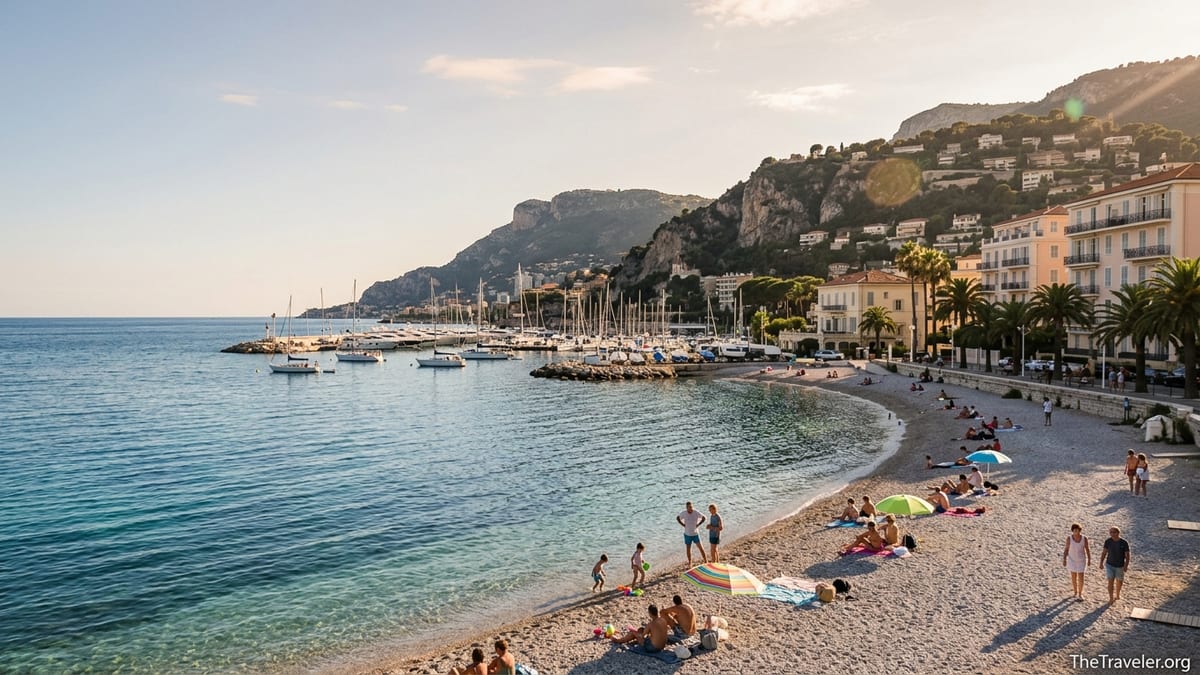
Locals often describe Beaulieu’s beaches as the Riviera “in miniature.” There are just two main strands, Plage des Fourmis and Plage de la Petite Afrique, but they cover many moods. Plage des Fourmis, on the Baie des Fourmis beneath Villa Kérylos, attracts morning swimmers who arrive with their own parasols and foldable chairs. By mid-morning, parents push strollers along the waterfront promenade while older residents slip into the calm, sheltered bay for their daily laps.
Petite Afrique, tucked at the eastern end of town against a backdrop of cliffs and towering pines, has a slightly more dramatic feel. Palm trees line the back of the beach, and the water here is particularly clear, with a turquoise tone that looks almost unreal on bright days. Public areas alternate with private beach clubs where a sun lounger and umbrella for the day typically cost less than in neighboring Cap Ferrat or Cannes, especially outside peak season. Locals like that they can still roll up with a towel and find a spot on the pebbles without feeling pushed out by rows of mattresses and bottle service.
Crucially, the beaches remain manageable in scale. There is rarely the shoulder-to-shoulder feeling you get on Nice’s central Promenade des Anglais in midsummer. At sunrise in June, you might share the sand with half a dozen people at most: a retired couple doing gentle aquagym, a restaurant worker from the port taking a quick dip before their shift and a few regulars who know each other by first name. It is exactly this sense of familiarity that locals value. They can treat the beach less as a performance stage and more as an extension of their backyard.
A Daily Market That Anchors Local Life
If the sea is Beaulieu’s natural anchor, the market on Place du Général de Gaulle is its social one. Running most mornings, with fuller stalls from Monday to Saturday, the covered hall and open-air stands bring in local producers selling seasonal fruit, vegetables, cheese, olives and flowers. Residents from neighboring Villefranche and Cap Ferrat often time their errands around this market, especially on Saturdays when the selection is at its best.
Prices can be a touch higher than in inland towns, but regulars know how to shop smart. It is common to see locals buying a handful of seasonal figs from one stall, a small round of fresh goat cheese from another and a still-warm fougasse from the bakery on the square. A simple picnic for two, with tomatoes, bread, cheese, olives and a punnet of strawberries, might come to the price of a single starter in a port-side restaurant. That contrast helps explain why Beaulieu remains popular with year-round residents, not just visitors.
The market also keeps the town rooted in its Provençal identity. In late summer you will notice crates of socca chickpea flour being unloaded for nearby street vendors; in winter, mountains of clementines and local citrus dominate the stalls. Conversations often switch fluidly between French, Italian and English, but the rituals are unmistakably local: baristas greeting regulars by name, market gardeners putting aside the last bunch of basil for a customer who is running late, and older residents lingering over an espresso long after their shopping is done.
Belle Epoque Glimpses Without the Museum Feeling
Beaulieu-sur-Mer rose to prominence at the turn of the 20th century, when European aristocrats and industrialists began building lavish winter residences along this mild stretch of coast. Unlike some Riviera resorts where grand hotels have been completely transformed, Beaulieu still wears this heritage lightly. You can read the town’s Belle Epoque story simply by walking from the station down through Boulevard Marinoni to the waterfront.
The showpiece is Villa Kérylos, perched above Baie des Fourmis. Built between 1902 and 1908 by archaeologist Théodore Reinach, it is a scholarly reimagining of an ancient Greek villa, filled with marble, mosaics and period-inspired furniture. Yet to locals, it is also just part of the landscape. School groups come here on excursions, joggers pass below its terraces and early swimmers use its silhouette as a landmark when they cross the bay. The villa’s blend of museum-quality detail and everyday familiarity captures the way Beaulieu handles its past.
Across town, La Rotonde, once linked to the grand Bristol hotel, is another reminder of Beaulieu’s glamorous era. Today it functions as an events space and occasional venue for local ceremonies rather than a rarefied salon. On some summer evenings, you might find a jazz concert or a wedding reception spilling out onto its terrace, with guests in linen and sandals rather than tiaras. For residents, this is the ideal compromise: access to exceptional architecture without sacrificing the town’s relaxed, livable character.
Harbor Life: Boats, Cafés and Quiet Luxury
The port of Beaulieu is a major reason why many Riviera locals gravitate here. Unlike the superyacht-packed harbors of Monaco and Cannes, this marina combines working boats, mid-sized pleasure craft and a sprinkling of sleek motor yachts. You will see fishermen mending nets next to polished Rivas and small sailing boats belonging to local families. That mix keeps the waterfront grounded, even as property prices and mooring fees reflect the area’s desirability.
Along the quayside, restaurants and cafés range from special-occasion addresses to casual spots where you can order a coffee and occupy the same table for an hour without anyone looking at their watch. The legendary African Queen, open since the 1960s, remains a favorite among residents celebrating birthdays or bringing visiting friends for a long lunch. Prices are firmly in Riviera territory, but many locals treat it as an occasional treat balanced by simple weeknight meals at home or at humbler pizzerias and brasseries around town.
For those who live in busier parts of the coast, Beaulieu’s harbor offers a form of quiet luxury that is more about rhythm than spectacle. It is the pleasure of finishing work in Nice, catching a late-afternoon train, grabbing a scoop of pistachio ice cream from a glacier by the port and watching the masts turn pink in the sunset. Or taking an early-morning paddleboard session around the headland before the ferries start moving. Small rituals like these explain why people who could choose more high-profile addresses often end up spending their free time here.
Getting Around Without Losing the Slow Pace
One of Beaulieu’s strongest draws for locals is how easy it is to get in and out without a car. The town sits on the main coastal rail line, with frequent trains connecting west to Nice, Antibes and Cannes and east to Monaco, Menton and the Italian border. In practice, that means a Beaulieu resident can commute to an office in central Nice in around 15 minutes, or reach Monaco in roughly the same time, then come home to a place that feels removed from city traffic and nightlife.
Regional buses also snake through town, linking Beaulieu with the hilltop village of Eze and with Nice’s harbor. For everyday errands, though, most people walk. From the station you can reach both beaches, the market, the main supermarket and the marina within about 10 minutes on foot. Parents appreciate that older children can navigate the compact grid of streets independently, while retirees enjoy being able to do groceries, doctors’ appointments and café stops without worrying about parking.
This connectivity allows residents to curate their own version of Riviera life. Some keep their social calendars in Nice but retreat to Beaulieu at night for peace and sea air. Others base themselves here and treat the train as a moving corridor to restaurants, concerts and exhibitions across the coast. Either way, the town’s design helps maintain a slower pace: with no through motorway traffic and relatively few late-night venues, the evenings tend to quieten early, and the dominant sounds after dark are usually waves and the occasional clink of cutlery on a terrace.
How Locals Actually Spend Their Time Here
Ask year-round residents what a perfect day in Beaulieu looks like and you will rarely hear about shopping sprees or exclusive beach parties. Instead, routines tend to revolve around simple pleasures. Many start with a swim at Plage des Fourmis before 9 am, when the sea is glassy and the beach all but empty. Afterwards comes coffee at a favorite bar on Boulevard Marinoni, perhaps with a slice of tarte tropézienne or a croissant, and a quick stop at the market for whatever fruit and vegetables look best that day.
Late morning might involve errands in Nice or Monaco, easily slotted around train timetables. By early afternoon, locals drift back toward Petite Afrique beach or seek shade in the small public gardens near the marina. Families gather at the playgrounds, while older residents sit on benches under the pines, catching up on news. In the shoulder seasons of May, June, September and October, when the weather is still gentle but crowds thin, this is when Beaulieu feels most “local,” with familiar faces everywhere.
Evenings are unhurried. On Friday nights, terrace tables at a handful of wine bars and bistros fill with friends meeting after work, but the atmosphere stays conversational rather than raucous. A typical night out might mean mussels and fries at a casual brasserie or a slice of pissaladière from a bakery, eaten on a bench overlooking the sea. The luxury here is not so much about what you consume, but about the fact that the sea, the light and the open air are constant backdrops to daily life.
The Takeaway
Beaulieu-sur-Mer’s appeal to locals lies in a quiet balance that is increasingly rare on the Côte d’Azur. It offers refined beaches, handsome Belle Epoque architecture and a well-equipped marina, yet it still feels like a place where people live, shop, commute and send their children to school. You can enjoy a celebratory lunch at a legendary port-side restaurant one day and a simple market picnic on the pebbles the next, all without needing a car or escaping a crush of nightclub crowds.
For travelers, understanding why locals cherish Beaulieu can shape how you experience it. Treat it less as a checklist of sights and more as a backdrop for everyday rituals: early swims, late coffees, unhurried walks between the station and the sea. Use its excellent connections to explore the flashier corners of the Riviera, then return in the evening to the slower rhythm of a small town whose greatest luxury is time. In a region that often feels built for the weekend, Beaulieu-sur-Mer quietly belongs to the people who stay.
FAQ
Q1. Is Beaulieu-sur-Mer a good base for exploring the French Riviera without a car?
Yes. The town’s train station sits on the main coastal line, with regular services to Nice, Monaco, Menton and Antibes. Buses connect Beaulieu with nearby villages such as Eze and with Nice’s harbor, so many residents and visitors manage comfortably without driving.
Q2. How crowded do the beaches get in summer compared with Nice or Cannes?
In July and August, Beaulieu’s beaches are busy but generally less packed than the central stretches of Nice or Cannes. Plage des Fourmis and Petite Afrique are popular with families and locals, yet early mornings and late afternoons still feel relatively calm.
Q3. Are there public sections on the beaches, or are they mostly private clubs?
Both main beaches have a mix of public areas and private beach clubs. You can choose to pay for a sun lounger and umbrella for the day or simply bring a towel and sit on the free sections of pebbles, which many locals prefer.
Q4. What is the daily market like, and when should I go?
The market on Place du Général de Gaulle runs most mornings, with the widest selection typically from Monday to Saturday. Arriving between 8 am and 10 am gives you the best choice of seasonal produce, cheeses, flowers and prepared foods before the stalls begin to wind down around lunchtime.
Q5. Is Beaulieu-sur-Mer very expensive compared with other Riviera towns?
Property prices are among the highest on the coast, but day-to-day costs can be moderated. Eating at neighborhood bakeries, brasseries and cooking with market ingredients is far cheaper than dining every day in port-side restaurants, which locals tend to reserve for special occasions.
Q6. What makes Villa Kérylos worth visiting for non-history buffs?
Even if you are not passionate about archaeology, Villa Kérylos offers striking sea views, intricate mosaics and a rare look at how Belle Epoque elites imagined the ancient world. Its position above Baie des Fourmis also makes it a picturesque stop before or after a swim.
Q7. Is Beaulieu-sur-Mer suitable for families with children?
Yes. The town is compact and walkable, with playgrounds, calm swimming areas and easy access to shops and services. Families appreciate that older children can walk between the beach, ice cream shops and apartments without crossing major roads or navigating heavy traffic.
Q8. When is the best time of year to experience Beaulieu like a local?
The shoulder seasons from May to June and September to October are ideal. The weather is usually warm enough for swimming, but schools are in session, crowds are thinner and you are more likely to share the town with residents than with tour groups.
Q9. Are there nightlife options, or is it very quiet in the evenings?
Beaulieu’s evenings are calm rather than lively. There are wine bars, cafés and a few restaurants that stay open late, but not many nightclubs. Locals often go to Nice or Monaco for late-night venues, then return to Beaulieu for a quieter night’s sleep.
Q10. How many days should I plan to stay in Beaulieu-sur-Mer?
A stay of three to five nights works well for most visitors. That gives enough time to settle into the town’s slower rhythm, enjoy the beaches and market, and take day trips by train or bus to nearby highlights along the Riviera.