


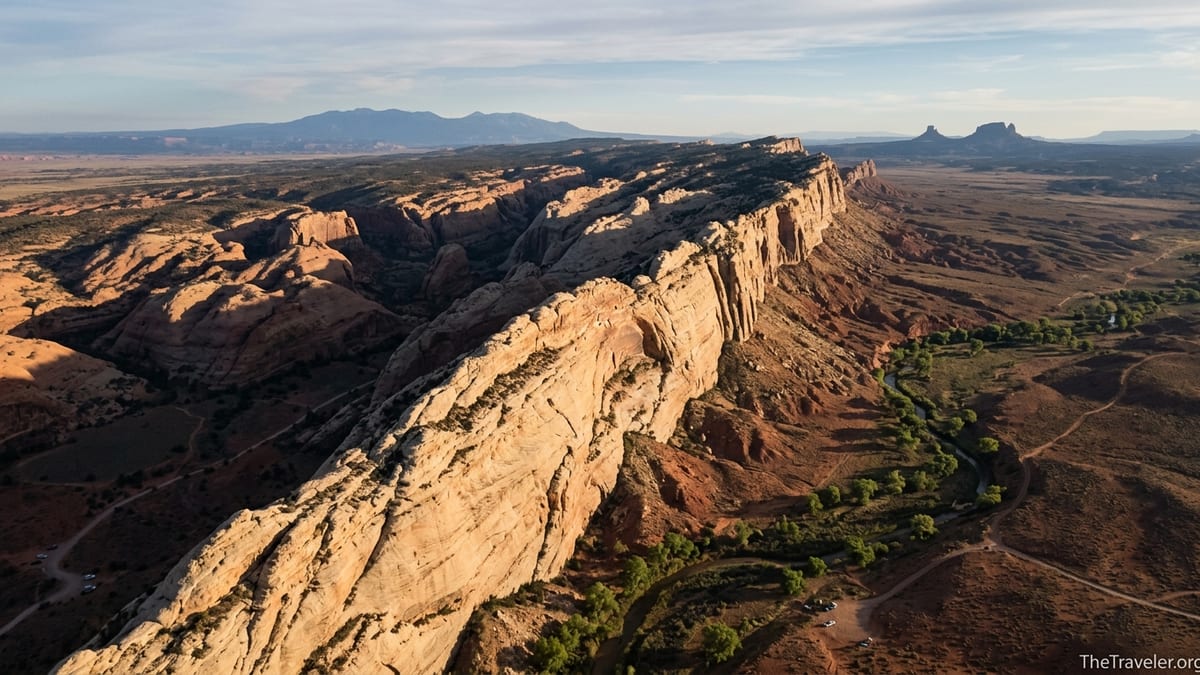
Seen from the air, Comb Ridge looks like a giant stone wave frozen mid-crest, slicing across the desert for dozens of miles. On the ground, this serrated wall of sandstone on the edge of Bears Ears National Monument offers something different from Utah’s headline parks: fewer crowds, a sense of real discovery, and quiet canyons filled with traces of thousands of years of human history. For many travelers, that combination makes Comb Ridge not just worth visiting, but unforgettable.
Get the latest updates straight to your inbox!
What And Where Is Comb Ridge?
Comb Ridge is a long, north south trending sandstone ridge in southeast Utah, just west of the small town of Bluff and south of Blanding. Geologists call it a monocline, a huge crease in the Earth’s crust that lifts rock layers on one side and leaves them relatively flat on the other. In practical travel terms, it is an 80 mile long stone backbone that defines the eastern edge of Bears Ears National Monument and frames some of the most atmospheric desert driving in the Southwest.
Highway 95, the Trail of the Ancients National Scenic Byway, actually cuts straight through Comb Ridge about 14 miles west of Blanding. Drivers heading between Blanding and Hanksville feel the pavement climb, kink and then drop again as the road threads a gap in the wall, with cliffs of Navajo Sandstone towering close on both sides. To the south, U.S. 163 between Bluff and Monument Valley runs along the San Juan River with sweeping side views back to the ridge, especially near the town of Bluff where the river curves beneath the stone escarpment.
Unlike a national park with a single gate and visitor center, Comb Ridge is more of a landscape than a formal attraction. You explore it through a network of dirt roads, short hiking trails and unmarked canyon routes, often starting from Butler Wash Road on the east side of the ridge or Comb Wash Road on the west. That low key, choose your own adventure character is a big part of its appeal, especially for travelers who like to get a little bit off the grid without needing full-on expedition skills.
The surrounding hubs are small but practical. Bluff, about a 10 to 20 minute drive from many eastern trailheads, has a handful of inns, cafes and outfitters. Blanding, about 30 minutes to the north, offers more groceries, gas and basic motels. Most travelers use one of these as a base and treat Comb Ridge as a day trip or a series of day outings within a wider Four Corners itinerary.
Why Comb Ridge Feels Different From Utah’s Big Parks
Travelers who already know Arches, Canyonlands and Zion often describe Comb Ridge as feeling wilder and more personal. There are no shuttle buses, food courts or long lines at entrance stations here. On a spring weekday, you might find only a few cars at a popular trailhead like Butler Wash Ruins, and you may never see another party on lesser known side canyons. That thinner crowd density changes the whole mood: you hear wind in the cottonwoods and the scrape of your boots on sandstone more than you hear voices.
The ridge also offers a rare blend of high impact scenery and low effort access. With a standard rental car, you can drive Highway 95 through the heart of Comb Ridge and get big western movie vistas without leaving the pavement. Turn onto the graded Butler Wash Road from U.S. 163 near Bluff or from Highway 95 and you quickly find trail pullouts leading to rock art panels, cliff dwellings and hidden alcoves. For many visitors, a half day of this kind of light exploration feels more rewarding than elbowing through the crowds at a single Instagram-famous arch.
Another reason travelers fall for Comb Ridge is the way it connects geology and deep time human history. The ridge forms the eastern boundary of Cedar Mesa and the southern part of Bears Ears National Monument, one of the most archaeologically rich areas in the United States. Short hikes lead to Ancestral Puebloan cliff dwellings, granaries, pottery sherds and petroglyph panels. When you stand beneath the sweeping roof of a sandstone alcove looking at 700 year old handprints, with the white crest of the ridge on the skyline, it is hard not to feel like you have stepped into a living outdoor museum.
Finally, there is the atmosphere of small town desert Utah itself. Staying at an independent lodge in Bluff, grabbing breakfast burritos from a local café, and then driving out under a huge blue sky to wander canyon rims feels very different from visiting a heavily touristed gateway town. For travelers who enjoy slow travel and place-based experiences, Comb Ridge offers exactly that kind of immersion.
Highlights Travelers Love Most
Most first time visitors start on the east side of the ridge along Butler Wash Road, a maintained dirt road that parallels Comb Ridge between U.S. 163 near Bluff and Highway 95. One of the most accessible stops is Butler Wash Ruins, marked by a signed parking area off Highway 95. From here, a family friendly trail of roughly one mile round trip crosses slickrock and sandy patches to an overlook of a large Ancestral Puebloan cliff dwelling tucked into a dramatic alcove. The path is easy to follow and includes a couple of short rock stair sections, making it a good introduction for kids or cautious hikers.
A bit farther south along Butler Wash Road, more primitive pullouts lead to lesser known sites like Monarch Cave, a beautiful ruin at the back of a high alcove, and Split Level Ruin, known for its multi tiered construction and rock art. These routes are usually a few miles round trip, with mostly gentle grades but some scrambling. Travelers who have done similar hikes in nearby Bears Ears canyons often describe them as moderate: not technically difficult, but remote enough that you need to be self reliant with water, navigation and basic desert travel sense.
Rock art enthusiasts talk about the Procession Panel, one of the region’s most striking petroglyph panels, as a highlight of Comb Ridge. Reached by a longer hike across open slickrock from Butler Wash, this panel depicts rows of small human figures and animals etched into a cliff face, possibly representing ceremonial processions or clan migrations. The hike itself is part of the experience, traversing tilted sandstone sheets with big views out toward Cedar Mesa and the Abajo Mountains.
On the west side, Comb Wash Road runs along the base of the cliffs and can be a scenic drive in its own right during dry weather. Full size cottonwood trees and occasional pools of water make this side feel a little greener, especially in spring. Some travelers combine a drive up Comb Wash with a picnic beneath the ridge and then return to Bluff via U.S. 163 along the San Juan River, catching late afternoon light on both the river and the stone spine of Comb Ridge.
Planning Your Visit: Access, Season And Difficulty
From a logistics point of view, Comb Ridge is relatively straightforward for an independent traveler, as long as you respect the desert environment. The easiest gateway is Bluff, which sits on U.S. 191 and U.S. 163, roughly 45 minutes south of Blanding and about 1 hour 45 minutes from Monument Valley. From Bluff, it is about a 10 to 20 minute drive to the southern reaches of Butler Wash Road or to the scenic pullouts along U.S. 163 with views of the ridge and the San Juan River.
Butler Wash Road and Comb Wash Road are generally passable in dry conditions for standard clearance vehicles with cautious driving, but rain and snow can quickly turn segments into deep mud. Rental companies in Utah frequently prohibit taking cars on unpaved roads during wet weather, so always check your agreement, study current conditions from local BLM or monument information, and build flexibility into your itinerary. Many travelers choose to use a high clearance SUV, even if four wheel drive is not strictly required, simply for peace of mind on rutted or rocky sections.
The best seasons are typically late March through May and late September through early November, when daytime highs are warm but not extreme and nights are cool. Summer heat routinely climbs well above 90 degrees Fahrenheit in the canyons, and shade can be scarce on some slickrock routes. In practice, many summer visitors limit themselves to early morning hikes such as Butler Wash Ruins, then retreat to the river in Bluff or drive shaded sections of U.S. 191 and U.S. 163 during the hottest hours.
In terms of hiking difficulty, Comb Ridge offers a wide spectrum. At the easy end are short, signed trails to overlooks with minimal route finding. In the middle are off trail alcove routes that require following cairns across slickrock, minor scrambling, and occasional streambed crossings. At the adventurous end, some experienced hikers traverse long sections of the ridge crest or link multiple canyons in a day, covering 10 to 15 miles or more. If your comfort zone is moderate, you can build a satisfying 2 to 3 day visit around a few 2 to 6 mile outings and still feel that you have sampled the essence of the place.
Culture, Respect And Responsible Travel
Comb Ridge lies within Bears Ears National Monument, an area that Indigenous nations including the Navajo Nation, Hopi Tribe, Zuni Tribe and Ute Mountain Ute Tribe regard as a living cultural landscape. The canyons and mesas hold the homes, kivas, burial sites and ceremonial places of their ancestors. That means visiting Comb Ridge is not just about outdoor adventure; it is an encounter with places that remain spiritually important to living communities.
In practical terms, responsible travel here starts with staying on durable surfaces and established paths wherever possible, particularly near archaeological sites. At cliff dwellings and rock art panels, travelers are urged to never enter rooms, sit on walls, touch petroglyphs or pictographs, or pick up artifacts such as pottery sherds and corncobs. Many ruins are more fragile than they appear; the weight of a few repeated visitors can cause a 700 year old wall to collapse, and skin oils can permanently damage rock art.
Because the region is actively managed by the Bureau of Land Management and U.S. Forest Service in consultation with tribal nations, regulations evolve. Some areas require day use permits or limit commercial guiding, especially where visitation has spiked. A common pattern is that easier access routes near highways see the most pressure, while more remote canyons stay relatively quiet. Before your trip, it is wise to check the latest Bears Ears National Monument visitor information, review current fire restrictions, and read up on cultural site etiquette so you are not relying on sparse trailhead signage.
Travelers can also support local communities by patronizing Native owned businesses in the broader Four Corners area and by joining guided experiences that center tribal perspectives on the land. While guided tours specifically at Comb Ridge are more limited than in places like Monument Valley, some regional outfitters collaborate with Indigenous guides for cultural tours, storytelling evenings or art events in nearby towns. Even a simple decision like buying groceries or crafts in Bluff or Blanding instead of stocking up far away keeps more of your travel spending circulating close to the landscape you are enjoying.
Is Comb Ridge Worth It For You? Matching The Ridge To Your Travel Style
Comb Ridge is not for everyone. Travelers who prefer well signed loops, visitor centers with exhibits, and clear checklists of “must see” sights may feel frustrated here. There is no single postcard spot that sums up the ridge, and many of the very best experiences require reading topographic maps, following subtle cairn lines, and being happy with a bit of uncertainty about exactly where the trail will lead.
But if you thrive on semi wild exploration, Comb Ridge can be a standout part of a Southwest trip. Road trippers driving between Moab and Monument Valley, for example, often plan a one night stop in Bluff and devote an afternoon and morning to a trio of short hikes: Butler Wash Ruins for an overview, Monarch Cave or Split Level for a more intimate ruin, and a sunset drive along U.S. 163 to catch side light on the ridge and San Juan River. Photographers may build their visit around golden hour light, scouting compositions where the white caps of Navajo Sandstone catch the low sun while cottonwoods in the washes glow green or gold depending on the season.
Outdoor enthusiasts with more time might anchor a four or five day Bears Ears itinerary around Comb Ridge, pairing it with canyon hikes on Cedar Mesa, a day trip to Natural Bridges National Monument, and perhaps a float trip on the San Juan River from Bluff or Mexican Hat. In that context, Comb Ridge becomes both a scenic backdrop and a hands on classroom in desert geology and archaeology. Travelers often say that, looking back, it was the quieter days here between the more famous parks that they remember most vividly.
If you are traveling with children or less experienced hikers, Comb Ridge still works, as long as you choose routes conservatively. Many families report that the combination of short hikes, ruined cliff “villages” visible from safe overlooks, and the simple novelty of driving sandy roads engages kids without overtaxing them. As always in canyon country, sun protection, plenty of water and realistic expectations about pace are the keys to keeping everyone comfortable.
The Takeaway
Comb Ridge is worth visiting if you are drawn to big landscapes, quiet canyons and places where the line between natural wonder and cultural history is almost impossible to separate. It rewards travelers who are willing to leave the main highway, who understand that the best viewpoints are often unmarked pullouts, and who find meaning not only in grand vistas but also in small details like a handprint on sandstone or the pattern of desert varnish on a cliff.
What makes this ridge unique is not only its striking geology, a stone wave visible from space, but the way it anchors an entire region of story filled canyons within Bears Ears National Monument. Whether you give it a focused day or weave it into a longer Four Corners journey, Comb Ridge has a way of lingering in memory long after the dust has washed off your boots. For many travelers, that lasting impression is the clearest answer to the question of whether it is worth the detour.
FAQ
Q1. Where exactly is Comb Ridge, and how do I get there?
Comb Ridge sits in southeast Utah, west of Bluff and south of Blanding, on the eastern edge of Bears Ears National Monument. The most common access points are along Highway 95, which crosses the ridge about 14 miles west of Blanding, and via Butler Wash Road, a graded dirt road reached from U.S. 163 just west of Bluff or from Highway 95.
Q2. Do I need a four wheel drive vehicle to visit Comb Ridge?
You can see Comb Ridge and reach some trailheads using a standard passenger car by staying on paved highways and carefully driven graded roads in dry conditions. However, a high clearance vehicle is strongly recommended if you plan to explore farther along Butler Wash Road or Comb Wash Road, and all unpaved access becomes risky or impassable after heavy rain or snow.
Q3. Are permits required to hike around Comb Ridge?
Some areas in and around Comb Ridge, particularly within Bears Ears National Monument and on nearby Cedar Mesa, use permit systems for day hiking or overnight trips. Requirements can change, so travelers should check the latest information from local land management agencies or monument visitor resources before arriving and be prepared to self register or purchase low cost permits where needed.
Q4. What are the best months to visit Comb Ridge?
Most travelers find late March through May and late September through early November to be the most comfortable times, with warm days and cool nights. Summer can be extremely hot on exposed slickrock, while winter may bring snow or icy patches on roads and trails. Shoulder seasons also tend to balance manageable temperatures with lighter visitation.
Q5. Is Comb Ridge suitable for beginners or families with children?
Yes, if you choose your routes carefully. Short, signed hikes such as the trail to the Butler Wash Ruins overlook are suitable for many families and newer hikers, offering clear paths and rewarding views. More remote ruins and ridge routes require stronger navigation skills, so families often combine an easy outing with scenic driving rather than attempting the most challenging terrain.
Q6. Can I camp near Comb Ridge?
Dispersed camping is commonly practiced on public lands in the greater Comb Ridge and Bears Ears region, but rules vary by corridor and are updated periodically. In general, travelers are encouraged to use existing campsites on durable surfaces, pack out all waste, avoid camping directly under cliffs or near archaeological sites, and respect fire restrictions. Those who prefer amenities can stay at campgrounds or lodging in Bluff, Blanding or along major highways.
Q7. How much time should I plan to experience Comb Ridge?
If you only have a half day, you can still drive Highway 95 through the ridge, stop at a couple of viewpoints and walk a short trail such as Butler Wash Ruins. With a full day, you can add one or two longer hikes to alcove ruins or rock art panels. Many travelers who are particularly interested in archaeology or photography allow two or three days and pair Comb Ridge with nearby destinations like Cedar Mesa or Natural Bridges National Monument.
Q8. What should I bring for a day of hiking at Comb Ridge?
At a minimum, carry plenty of water, sun protection, sturdy shoes with good grip on rock, a detailed map or GPS with offline data, and extra layers for changing temperatures. Because cell service is patchy, it is also wise to tell someone your planned route, carry a small first aid kit, and bring snacks or lunch so you are not rushed by hunger in remote terrain.
Q9. Are there guided tours available at Comb Ridge?
Guided trips focused specifically on Comb Ridge are less common than in some nearby national parks, but regional outfitters sometimes include its canyons and viewpoints within broader Bears Ears or Four Corners itineraries. In addition, some cultural tours and educational programs based in local towns highlight the history and significance of the area, which can enrich your self guided explorations.
Q10. How does Comb Ridge fit into a larger Southwest road trip?
Comb Ridge lies conveniently between major destinations such as Moab, Monument Valley and Mesa Verde National Park, making it an ideal “between parks” stop. Many road trippers spend one or two nights in Bluff or Blanding, using a day to explore Comb Ridge and nearby Bears Ears sites, then continue toward Page, the Grand Canyon or Durango, turning a simple transit day into a highlight of their journey.