


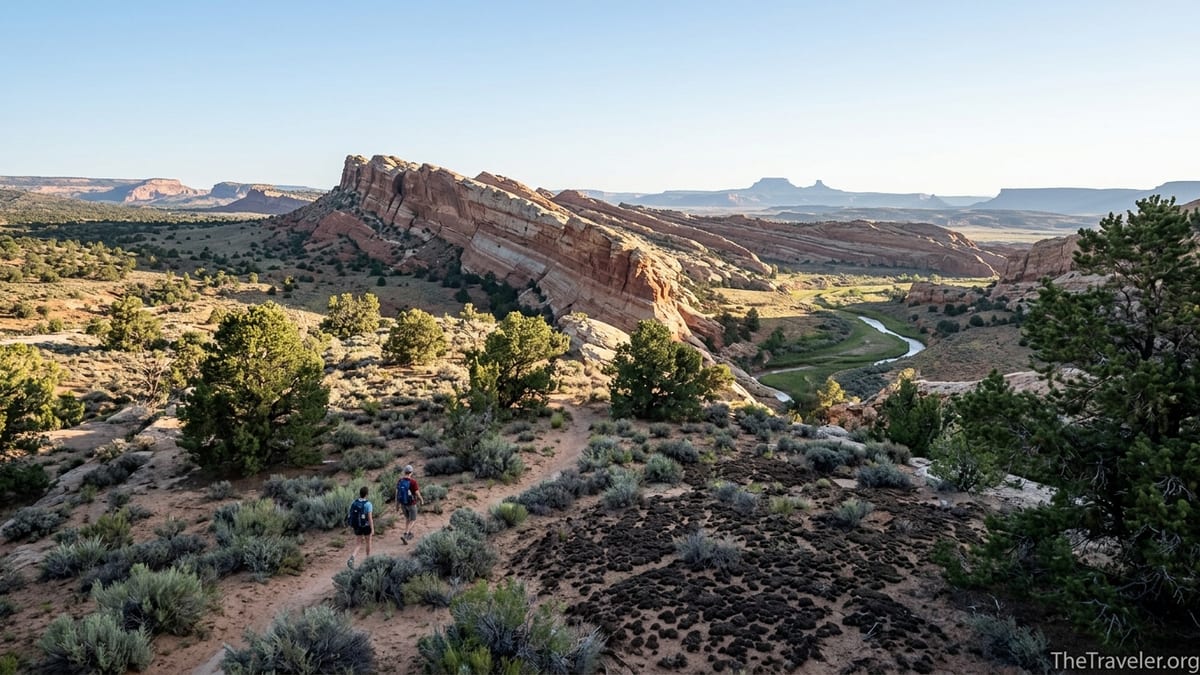
Comb Ridge rises out of the desert in a dramatic sandstone fin that runs for nearly 80 miles across southeastern Utah. Straddling Bears Ears National Monument and the surrounding public lands, this tilted monocline holds thousands of years of human history in its canyons and alcoves. From short interpretive walks to all-day backcountry adventures, the area around Comb Ridge, Butler Wash, and nearby Mule Canyon offers some of the most rewarding combinations of hiking, scenery, and archaeology in the American Southwest for travelers willing to explore with care and respect.
Get the latest updates straight to your inbox!
Understanding Comb Ridge and the Bears Ears Landscape
Comb Ridge is a striking geological fold that runs roughly north to south between the town of Blanding and the San Juan River near Bluff in southeastern Utah. Seen from the air or from U.S. Highway 163, it appears as a continuous white and red sandstone “comb” rising above the desert. The eastern side drains into Butler Wash, a shallow, cottonwood-lined drainage, while the western side falls toward Comb Wash and Cedar Mesa. Much of this landscape is now within or directly adjacent to Bears Ears National Monument, a region recognized for its outstanding cultural and natural resources.
The cultural density here is extraordinary. Along the drainages and side canyons of Butler Wash, Mule Canyon, and other tributaries, visitors encounter cliff dwellings, granaries, rock art panels, and ancient agricultural remnants created by Ancestral Puebloan peoples over the course of many centuries. Official sites such as Butler Wash Ruins and Mule Canyon Ruins have developed parking areas and interpretive signs, while thousands of other sites sit in more remote locations along unpaved roads and hiking routes. This combination of easy-access and backcountry options makes Comb Ridge ideal for both first-time visitors and experienced desert hikers.
Despite the beauty and accessibility, this remains a lightly developed backcountry environment. Travel typically involves a mix of paved highways, graded dirt roads like Butler Wash Road and Comb Wash Road, and sometimes rougher two-track spurs that may require high-clearance or 4x4 vehicles, particularly after rain. Because the same routes are used by local ranchers, tribal members, and land managers, visitors should always drive cautiously, carry extra water and fuel, and check recent conditions with the Bureau of Land Management field offices in Blanding or Monticello before heading onto back roads.
Equally important, visitors should understand that many communities, including Navajo, Hopi, Ute, and Zuni peoples, consider Comb Ridge and the Bears Ears region to be a living cultural landscape, not simply a playground or photo destination. Treating the area with humility and following local guidance about site etiquette, seasonal closures, and fire restrictions is an essential part of any responsible trip here.
Classic Archaeology-Focused Hikes at Butler Wash and Mule Canyon
If you are short on time or new to desert hiking, Butler Wash Ruins and Mule Canyon Ruins provide excellent introductions to the archaeology of Comb Ridge without committing to a long or committing trek. The Butler Wash Interpretive Site, about 13 to 15 miles west of Blanding along Utah Highway 95, is signed from the highway and features a gravel parking lot and vault toilets. From the trailhead, a well-marked path winds roughly half a mile across slickrock and sandy drainages to an overlook above a broad alcove filled with masonry walls, storage rooms, and four kivas dating to roughly the 1200s.
This hike is short, usually under an hour round trip, but rewards patient observation. From the overlook, you can spot original plaster, small windows, and built-up terraces where families once lived and stored crops. Binoculars help you see the details without leaving the designated viewing area. Because this is a stabilized site managed by the Bureau of Land Management, interpretive signs explain some of the architecture and history, making it a good choice for families and first-time Southwest visitors who want context before venturing deeper into the backcountry.
Farther west along Highway 95, the Mule Canyon Ruins and Kiva site offers an easy stop with paved parking, restrooms, and a short path around exposed stone walls. The partially reconstructed kiva, complete with a roof and ladder, gives a physical sense of the ceremonial spaces that once existed in the surrounding canyons. Many travelers combine a quick visit here with a longer day hike to House on Fire in nearby Mule Canyon or with an afternoon drive across Cedar Mesa, making it a convenient anchor stop on an otherwise full day of exploring.
Both sites work well as stand-alone excursions for travelers staying in Blanding or Bluff who have only a morning or afternoon to spare. They also function as orientation points for longer stays, helping you develop a sense of how cliff dwellings, granaries, and field houses fit into the broader geography of Comb Ridge and Cedar Mesa before you set out on more rugged routes along Butler Wash Road or into side canyons.
Backcountry Routes Along Butler Wash and Comb Ridge
Beyond the official interpretive sites, much of the appeal of Comb Ridge lies in exploring the less-developed trailheads along Butler Wash Road, a north–south dirt road that parallels the eastern base of the ridge between Highway 95 and Highway 163. This route, roughly 20 miles long, is often drivable in dry weather by high-clearance vehicles, but heavy rain can quickly turn its clay-rich surface into slick mud that strands even 4x4 trucks. In practice, many visitors time their trips for spring and fall, when temperatures are reasonable and afternoon thunderstorms are less intense than in mid-summer.
Numerous unsigned or minimally signed parking pullouts along Butler Wash Road lead to side canyons that penetrate the eastern face of Comb Ridge. Popular objectives include Monarch Cave, Ballroom Cave, and several unnamed alcoves containing cliff dwellings and rock art. For example, the hike to Monarch Cave from a pullout north of Bluff follows a sandy wash and then climbs into a large alcove that holds a cluster of masonry rooms, a pool, and scattered pottery fragments. The route feels adventurous but is still manageable for fit hikers who are comfortable with occasional route finding and light scrambling.
On the western side of Comb Ridge, Comb Wash Road gives access to lower Mule Canyon, Arch Canyon, and a series of side canyons draining off Cedar Mesa toward the San Juan River. Here, longer day hikes follow sandy washes shaded by cottonwoods into canyons where cliff dwellings perch on ledges high above the streamcourse. While some routes, like lower Mule Canyon, have become well known through guidebooks and photography, others remain more obscure and may require topographic maps or a GPS app to navigate confidently. Because evidence of past human use is so widespread, responsible hikers stay on durable surfaces, avoid climbing into fragile alcoves unless there is a clear, established path, and photograph artifacts without moving or touching them.
Travelers who enjoy longer, point-to-point challenges sometimes tackle ridge-top routes along Comb Ridge itself, starting from a highway crossing such as Highway 95 and walking south along the spine toward the next vehicle access point. These traverses demand strong navigation skills, ample water, and comfort with exposure, but the reward is a sweeping, 360-degree view of Bears Ears, Cedar Mesa, Monument Valley, and the snow-tipped Abajo and La Sal Mountains on the horizon. For most visitors, though, a series of shorter out-and-back hikes from Butler Wash or Comb Wash provides more than enough variety over several days.
Guided Tours and Cultural Experiences Around Comb Ridge
While many hikers explore Comb Ridge independently, guided tours are an excellent option for travelers who want deeper archaeological insight, wish to minimize navigation stress, or prefer not to drive rough dirt roads on their own. Outfitting companies based in Bluff, Blanding, and nearby Moab typically run small-group or private trips into the Bears Ears region, including Butler Wash, Comb Ridge, and Cedar Mesa. These tours often combine vehicle-based sightseeing on Highway 95 with short hikes to sites such as Butler Wash Ruins, House on Fire, or Monarch Cave.
Typical half-day hiking tours from Bluff might cost in the ballpark of 150 to 200 dollars per person, with private full-day itineraries running higher depending on group size and customization. Prices can shift seasonally and may include extras such as picnic lunches, transport from your lodging, and use of trekking poles. Travelers who value flexibility often book a private guide for one full day early in their visit, using that time both to see a few highlight sites and to learn navigation tips, desert hiking strategies, and site etiquette they can apply on self-guided days.
Some outfitters advertise “scenic and cultural” experiences that emphasize storytelling and Indigenous perspectives on the Bears Ears landscape. While not all guides are tribal members, a growing number of tours in the region aim to foreground Native voices, oral histories, and contemporary connections to Comb Ridge. When researching options, look at company descriptions for references to collaboration with tribal communities, training in archaeology-friendly practices, and group size limits. It is worth calling or emailing in advance to ask how a tour handles sensitive sites, whether they avoid posting specific location details publicly, and how they adapt itineraries in response to weather or cultural closures.
Travelers less interested in hiking but still curious about archaeology can arrange vehicle-based tours that link paved viewpoints, short walks, and museum visits. For instance, a day might start in Blanding at a local museum with Ancestral Puebloan artifacts and then move on to Mule Canyon Ruins, Butler Wash Ruins, and overlooks along Highway 95 and Highway 163 for views of Comb Ridge and the San Juan River. Such itineraries are well suited to multi-generational families or visitors with limited mobility who still wish to experience the essence of the region.
Archaeological Ethics, Permits, and Safety Considerations
Comb Ridge and Butler Wash contain one of the highest concentrations of archaeological sites in the United States, which makes ethical travel practices especially critical. Visitors should follow the simple principle of “visit with respect,” meaning they do everything possible to leave sites exactly as they were found so that future visitors and researchers can learn from them. This includes staying on existing paths where they exist, avoiding climbing into fragile alcoves or rooms, and never entering kivas or ceremonial spaces unless a sign explicitly allows it, as at the reconstructed kiva at Mule Canyon Ruins.
Artifacts such as pottery sherds, stone tools, corncobs, and beads should be left where they lie. Photographing them is acceptable, but stacking, arranging, or moving items for a better image damages the record archaeologists rely on. Similarly, rock art panels along Butler Wash and other canyons are easily harmed by touching, chalking, or tracing; even the oils from a single handprint can hasten the breakdown of pigment on sandstone. Travelers with children can turn artifact spotting into a “treasure you do not touch” game, emphasizing that the best souvenir is a memory or a photo, not a physical object.
Access and permit rules in and around Bears Ears can shift as land managers respond to increased visitation and evolving monument boundaries. Before a trip, it is wise to check with the BLM field offices or the official Bears Ears information portals for current regulations. Some areas on Cedar Mesa require day-use permits or limit group sizes, and overnight backpacking may involve additional fees or quota systems to reduce crowding and protect resources. Even where no formal permit is required, small groups of fewer than eight people have a lighter footprint and make it easier to share narrow canyons and delicate sites respectfully.
From a safety perspective, the biggest hazards in Comb Ridge country are heat, flash flooding, and getting lost. Summer temperatures can easily climb well above 90 degrees Fahrenheit, making early morning and late afternoon starts far more comfortable and safer than midday outings. Hikers should carry significantly more water than they think they will need, as seeps and pools are unreliable and often unsuitable for drinking. During the summer monsoon (typically July through early September), localized thunderstorms can turn dry washes into dangerous torrents in minutes, even if the storm is miles away. Checking the day’s forecast and avoiding narrow slot-like sections of canyons when storms are possible is non-negotiable.
Planning Your Base: When to Go and Where to Stay
Most travelers use either Bluff or Blanding as their base for exploring Comb Ridge. Bluff, a small community on the San Juan River, sits closest to the southern end of the ridge and Butler Wash Road’s southern access point off Highway 163. It offers a selection of small inns, bed-and-breakfasts, and modest motels, along with a few cafes and outfitters. The atmosphere is quiet and low-key, with dark night skies and quick access to sunrise and sunset views along the river and nearby overlooks.
Blanding, about 40 minutes north of Bluff along Highway 191, is larger and offers more lodging and dining choices, as well as fuel, groceries, and an excellent local museum that helps contextualize the archaeology of Bears Ears and Cedar Mesa. For visitors planning longer trips that include day excursions to Natural Bridges National Monument, Hovenweep National Monument, or Canyonlands National Park’s Needles District, Blanding can serve as a more centralized base. Many travelers split their time, spending a few nights in each town to minimize daily driving for specific hikes.
The best seasons for hiking and archaeological touring around Comb Ridge are generally March through early June and late September through October, when daytime highs are comfortable, nights are cool, and road conditions are typically more stable. Winter visits can be rewarding under clear skies, but snow, ice, and short daylight hours can complicate travel on dirt roads and across shaded slickrock. Summer brings intense sun and monsoon storms, which can be managed with very early starts, careful weather monitoring, and conservative route choices, but many visitors simply avoid July and August for serious hiking.
For travelers seeking a more immersive experience, dispersed camping on public land along Comb Wash Road or on appropriate side roads remains possible in many areas, though it is essential to follow current BLM guidelines on fire use, human waste disposal, and camp placement. Using existing campsites, packing out all trash, and keeping vehicles on established tracks are crucial for preserving biological soil crusts and plant life. As visitation to Bears Ears continues to grow, land managers may refine camping rules, so checking for updated guidance before a trip is increasingly important.
The Takeaway
Comb Ridge offers an unusually rich blend of scenic hiking, accessible archaeology, and deep cultural significance within a compact corner of southeastern Utah. Whether you are walking the short trail to Butler Wash Ruins, peering down into a reconstructed kiva at Mule Canyon, or following a sandy wash toward a remote cliff dwelling, the ridge and its canyons invite a slower, more attentive kind of travel. It is a place where every bend in the wash or new alcove on the skyline hints at the presence of earlier generations who farmed, traveled, and performed ceremonies here long before modern roads arrived.
To make the most of a visit, approach the area as both a hiker and a guest. Plan your routes carefully, using recent information on road conditions and access; carry ample water and sun protection; and consider hiring a local guide for at least one day to deepen your understanding of the region’s human stories. At the same time, walk gently, keep a respectful distance from sites, and leave artifacts undisturbed so that this intricate cultural landscape can endure. Done thoughtfully, exploring Comb Ridge, Butler Wash, and Mule Canyon can become one of the most memorable experiences of a Southwest journey, offering not just beautiful photographs but a lasting sense of connection to place.
FAQ
Q1. Do I need a permit to hike around Comb Ridge and Butler Wash?
In many of the popular roadside areas such as Butler Wash Ruins and Mule Canyon Ruins, day hiking does not currently require a permit, but some sections of Cedar Mesa and certain backcountry routes nearby may have day-use or overnight permit systems that change over time. Always check with the local Bureau of Land Management office or official Bears Ears information sources before your trip for the most up-to-date rules.
Q2. What type of vehicle do I need for Butler Wash Road and Comb Wash Road?
In dry conditions, high-clearance vehicles are strongly recommended for both Butler Wash Road and Comb Wash Road, as they are long dirt routes with sandy sections, embedded rocks, and occasional wash crossings. After rain, the clay-rich surface can become slick and difficult even for 4x4 trucks, so visitors in standard passenger cars are better off sticking to paved highways and guided tours unless they receive clear, current advice that conditions are unusually good.
Q3. How much time should I plan for a first visit to Comb Ridge?
If you only have one day, you can comfortably visit Butler Wash Ruins and Mule Canyon Ruins and perhaps add a short hike into a side canyon. For a more complete experience that includes several different archaeological sites, a mix of guided and self-guided hiking, and time to explore both Bluff and Blanding, plan at least three full days in the area, with extra days if you want to include Natural Bridges or Cedar Mesa.
Q4. Are guided tours worth the cost for Comb Ridge?
For many travelers, especially those unfamiliar with desert navigation or archaeology, guided tours provide significant value by handling logistics, driving challenging roads, and explaining the cultural and historical context of the sites. While prices for half-day and full-day tours can feel substantial, the insight and safety margin they offer, along with reduced wear on your own vehicle, often make them worthwhile, particularly on a first visit.
Q5. Can children safely hike to the archaeological sites?
Yes, many of the shorter hikes such as Butler Wash Ruins and Mule Canyon Ruins are suitable for active children with supervision, provided they are kept away from cliff edges and are taught not to climb on masonry or touch rock art. Longer, rougher routes into side canyons may be better suited to older kids or teenagers who are used to desert conditions and can carry their own water and sun protection.
Q6. What is the best time of day to photograph sites like House on Fire or Monarch Cave?
Light in canyon environments changes quickly, and the most dramatic photographs usually come in the early morning or late afternoon when low-angle sunlight reflects off opposite walls to create soft, warm tones. Many photographers aim for mid-morning at House on Fire to capture the glowing effect on the alcove ceiling, while Monarch Cave can be more forgiving with softer light throughout much of the day. Be prepared to wait patiently and avoid using flash on rock art.
Q7. Is it legal or appropriate to enter cliff dwellings and kivas?
In almost all backcountry locations around Comb Ridge, visitors should not enter rooms, kivas, or fragile alcoves unless there is clear signage indicating that access is allowed. The one common exception is the reconstructed kiva at Mule Canyon Ruins, which is designed for visitors to descend via a ladder. As a rule of thumb, if you are unsure whether entry is appropriate, stay outside, observe from a distance, and prioritize preservation over close-up access.
Q8. How can I respect Native perspectives when visiting Bears Ears and Comb Ridge?
Respect begins with recognizing that this is an active cultural landscape for several Native nations, not just a scenic backdrop. Visitors can show respect by learning basic history before arriving, following site etiquette, staying on existing paths, avoiding geotagging sensitive locations on social media, and supporting local businesses and guides, particularly those owned or staffed by tribal members. Listening to Indigenous voices about how they would like visitors to behave is as important as any hiking guideline.
Q9. Are there services or water sources along Butler Wash Road?
There are no developed services such as fuel, stores, or potable water along Butler Wash Road or Comb Wash Road. Travelers should arrive with a full tank of gas, extra drinking water, and sufficient food and emergency supplies for the day, as even minor vehicle issues or sudden storms can delay travel. Any natural pools or seeps encountered in side canyons should be treated as unreliable for drinking and left for wildlife.
Q10. Can I camp near archaeological sites in the Comb Ridge area?
Dispersed camping is allowed in many parts of the surrounding public lands, but campers must keep a respectful distance from archaeological sites, avoiding alcoves, ruin-bearing ledges, and rock art panels. The best practice is to use existing, previously disturbed campsites on durable surfaces, pack out all waste, follow any current fire restrictions, and move camp if you discover previously unnoticed cultural material nearby. Checking for any new camping regulations before your trip helps ensure you are in compliance with evolving management plans.