


Airport lounges used to be the domain of frequent flyers in first or business class. Today, independent networks like Escape Lounge promise a quieter space, better food, and strong Wi-Fi for almost any traveler willing to pay or hold the right credit card. With Escape Lounges popping up in more US airports and joining programs like Priority Pass, many travelers are asking a simple question: is Escape Lounge a legit way to get reliable, good-value airport lounge access, or just clever branding on top of an average waiting room?
Get the latest updates straight to your inbox!
What Is Escape Lounge and Who Operates It?
Escape Lounge is a network of independent airport lounges that operates primarily in the United States and the United Kingdom. It is part of the Global Lounge Network under the Collinson Group umbrella, the same company behind Priority Pass, so it sits firmly within the established airport hospitality industry rather than being a fringe startup concept. In several airports, Escape operates co-branded “Escape Lounge – The Centurion Studio Partner” locations in partnership with American Express, which is another indicator that mainstream financial brands consider the product credible.
In practical terms, Escape Lounges are not tied to a single airline. You might find an Escape Lounge in Chicago O’Hare’s Terminal 3, in Phoenix Sky Harbor’s Terminal 3, at Portland International, or at mid-size airports such as Cincinnati/Northern Kentucky and Reno–Tahoe. These lounges are designed to serve travelers from any airline or cabin class, filling gaps where airline-branded clubs like United Club or Delta Sky Club are missing or overcrowded.
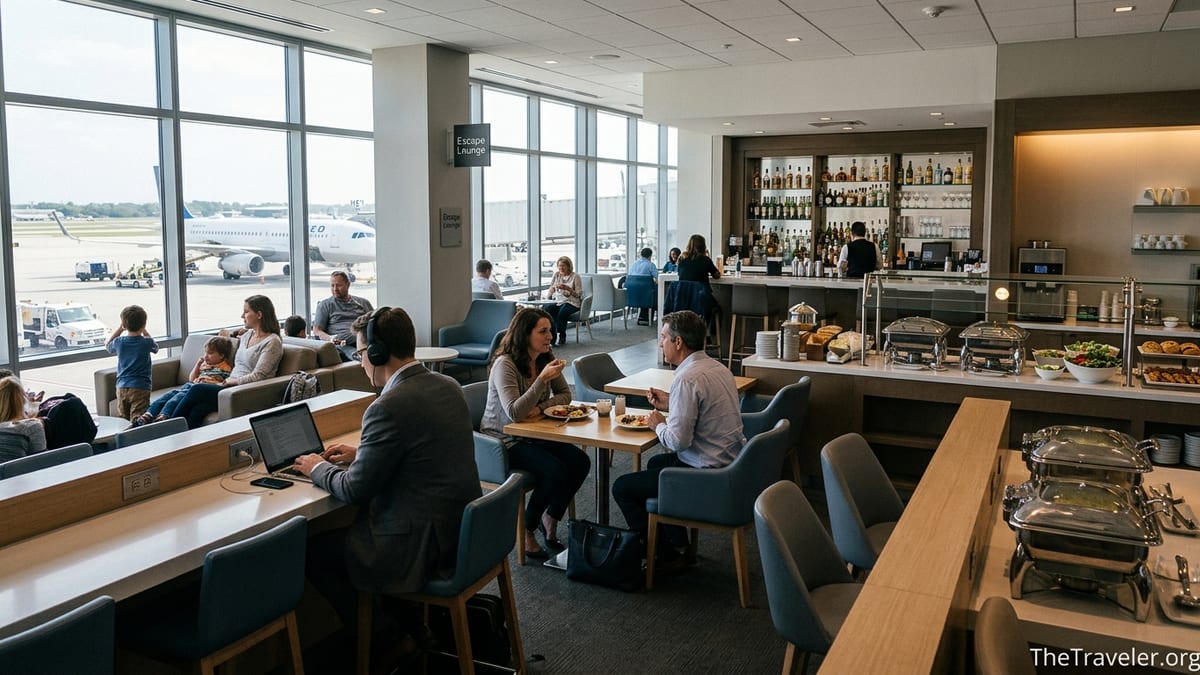
Because Escape is independent, the experience is more standardized across locations than many contract lounges run directly by small local operators. Most Escape Lounges emphasize similar touchpoints: cooked-to-order or buffet-style hot food, complimentary alcoholic and soft drinks, barista-style coffee machines, plenty of outlets, and quieter seating zones. That consistency, coupled with backing from established travel and financial brands, is a strong signal that Escape Lounge is a legitimate, professional operation rather than a pop-up experiment.
Travelers can verify individual locations, hours, and access rules on the Escape Lounge site or through major lounge programs like Priority Pass. The brand has been expanding instead of shrinking, with new and relocated lounges announced in airports like Cincinnati/Northern Kentucky in recent years, which again suggests sustained demand and stable investment rather than a short-lived trend.
How You Can Access Escape Lounge
Escape Lounges are intentionally flexible about access, which is one reason they have become central to the US lounge ecosystem. The most straightforward method is to pre-book or walk up and pay a one-time entry fee. Pricing can vary slightly by airport and time, but in many US locations day passes typically cost in the ballpark of 40 to 50 dollars per adult if you book ahead, with walk-up pricing sometimes a bit higher. This is comparable to casual access pricing at airline clubs like United Club or American Airlines Admirals Club when purchased at the door.
For many frequent travelers, the smarter route is to use an eligible credit card. The Platinum Card from American Express and the Business Platinum Card from American Express generally provide complimentary access for the cardholder at Escape Lounges in the United States through Amex’s Global Lounge Collection. In practice, that means that if you hold one of these premium cards, you can usually walk into an Escape Lounge in places like Minneapolis–St. Paul (Terminal 1) or Oakland without paying an extra fee, provided the lounge is not over capacity.
Since mid-2024, most US Escape Lounges have also joined the Priority Pass network. That is a major shift. Previously, only the Syracuse, New York lounge participated; now, an expanded set of US locations, plus the existing UK lounges, accept Priority Pass. This matters because Priority Pass memberships are bundled with popular cards like Chase Sapphire Reserve, Capital One Venture X, and Hilton Honors Aspire. If you hold one of these cards, you can often enter Escape Lounges using one of your Priority Pass visits, turning what used to be a niche network into a mainstream option for many US travelers.
Finally, some travelers access Escape Lounges through airline arrangements. In a few airports, airlines may contract with Escape to host premium-cabin passengers or elites when they lack their own lounge in a given terminal. The specifics change by airport and airline, so travelers should always double-check with their carrier, but the key point is that Escape Lounges function as legitimate partner facilities within the commercial airline ecosystem, not as an off-brand side option.
What You Actually Get Inside an Escape Lounge
The core test of whether Escape Lounge is legit is what happens after you walk through the door. Across airports, travelers consistently report an experience that is a clear step up from the public concourse, though not always at the standard of a top-tier flagship lounge. The typical Escape Lounge layout offers a mix of dining tables, lounge chairs, and high-top workstations, with plentiful power outlets and fast Wi-Fi that can handle streaming and remote work. Large windows at many locations provide natural light and runway views, such as at Portland and Phoenix.
Food is one of the stronger points. Rather than offering only packaged snacks and a few cold items, most Escape Lounges provide a rotating buffet of hot and cold dishes. In some locations, menus are designed with local partners. For example, the Cincinnati/Northern Kentucky lounge has highlighted locally inspired dishes to reflect the region, while the Minneapolis lounge has historically leaned into Midwestern comfort food with items like breakfast skillets or hearty soups. Travelers in Phoenix have reported solid options for early departures, including scrambled eggs, breakfast potatoes, pastries, yogurt, and fresh fruit, plus vegetarian and gluten-free choices.
Beverages are generally generous for a day-pass or credit-card-access lounge. Self-serve soda fountains, coffee machines, and tea are standard, while most locations feature a staffed bar offering house wines, beers, and basic mixed drinks at no extra cost. Premium spirits or cocktails, where available, may incur a surcharge, which is typical across independent and airline lounges alike. This setup means that a traveler paying roughly 45 dollars for a two- or three-hour stay can realistically have a hot meal, a glass of wine or beer, dessert, and a couple of coffees, often recouping much of the cost compared with terminal prices.
Amenities beyond food, drinks, and Wi-Fi vary by location but usually include clean restrooms, quiet corners for phone calls, and a modest selection of reading material. Unlike some large airline lounge flagships, Escape Lounges generally do not offer full showers or nap rooms, especially in US domestic terminals, so they are best thought of as high-quality spaces for short layovers and work sessions rather than full-service transit hubs for long-haul connections.
Real-World Examples: Where Escape Lounge Shines and Where It Falls Short
One of the strongest real-world examples of Escape Lounge’s value is at Chicago O’Hare’s Terminal 3. For travelers flying American Airlines or low-cost carriers out of that terminal, the Escape Lounge provides a Priority Pass and Amex Platinum–friendly option with a hot buffet, full-service bar, and workstations. Travel guides describing O’Hare’s lounge scene routinely note that Escape is the only full-service Priority Pass lounge accessible from the connected Terminals 1, 2, and 3 on the secure side, which makes it particularly useful for frequent domestic flyers who prefer Chase Sapphire Reserve or Venture X over airline-specific credit cards.
Phoenix Sky Harbor is another instructive case. In Terminal 3, the Escape Lounge sits alongside the Chase Sapphire Lounge by The Club. Travelers using Priority Pass through a Chase Sapphire Reserve may find the Chase-branded lounge at capacity with a long wait list. In those situations, the Escape Lounge becomes a reliable fallback: still accessible with the same Priority Pass membership, still offering complimentary food and drinks, and often with a shorter wait. Over the course of a year, that reliability can matter more to a frequent traveler than marginal differences in decor.
On the downside, expansion into Priority Pass has brought some crowding to certain locations. Regular visitors to Minneapolis–St. Paul, for example, have described the Escape Lounge as more crowded in peak morning and early evening hours since joining broader membership networks. In smaller airports such as Hartford or Reno, lounges have occasionally operated from temporary or compact spaces during renovations, which can limit seating and reduce the sense of calm that travelers are seeking.
Another limitation is the lack of universal participation across the network. While most US Escape Lounges now accept Priority Pass, a few outliers and newly opened locations may restrict access to American Express cardholders or direct-pay guests. That means a traveler who routinely uses Escape via Priority Pass in one city might be surprised to find a different access rule in another. This inconsistency does not make Escape illegitimate, but it does mean you cannot assume your membership will automatically work at every location without checking the latest details.
Pricing and Value Compared With Other Lounge Options
Whether Escape Lounge is “worth it” comes down to what you would otherwise spend in the terminal and how often you travel. In many US airports, a basic sit-down meal with a drink can easily reach 30 to 40 dollars per person after tax and tip. Add a coffee and perhaps a snack before boarding, and you are close to the cost of a typical Escape Lounge day pass. If you are facing a three-hour layover or arriving early for a busy travel day, the math can favor lounge access, particularly for solo travelers or couples who value quiet and workspace.
Compared with airline-branded lounges, Escape pricing is generally similar when purchased as a one-off visit. United Club and Delta Sky Club often charge comparable fees for single-entry passes when available, though some have pulled back on day-pass sales due to crowding. Where Escape gains an edge is in card-based access. If you already hold an Amex Platinum, Chase Sapphire Reserve, Capital One Venture X, or similar premium card for other reasons, Escape Lounges can become essentially “free” perks each time you travel, beyond any guest fees.
Escape’s legitimacy as a value proposition becomes most obvious in airports where airline lounge access is limited. At mid-size hubs like Cincinnati/Northern Kentucky or Columbus, Escape Lounges can be the only modern, full-service spaces available to Priority Pass or Amex Platinum holders. In those settings, the alternative may be a crowded bar with few outlets and limited seating. If you regularly travel through such airports for business or family visits, access to an Escape Lounge can meaningfully reduce travel stress and improve productivity.
That said, not every traveler needs lounge access on every trip. For very short hops where you arrive at the airport close to departure, paying a day-pass fee just to grab a quick drink does not make sense. In busy leisure terminals, families may prefer the open concourse if children want to explore or if you are already planning to eat at a specific restaurant. Escape Lounges are most effective when you have at least 90 minutes to relax, work, or have a full meal before boarding.
How Escape Lounge Fits Into the Broader Lounge Ecosystem
To decide if Escape Lounge is legit, it helps to see where it sits within the wider lounge ecosystem. Programs like Priority Pass and credit-card networks have grown into massive global access systems with thousands of lounges and experiences across hundreds of airports. Escape Lounges are a regional piece of that puzzle, servicing mostly US and UK airports with a consistent, mid-to-upper-tier product that complements airline-specific clubs and new bank-branded lounges.
For example, a traveler with a Chase Sapphire Reserve and an Amex Platinum might build an airport strategy like this: use an Escape Lounge where there is no Centurion Lounge or where the Centurion is overcrowded; switch to a Chase Sapphire Lounge where available and queues are reasonable; use airline clubs only when flying that carrier in a compatible terminal. In this layered approach, Escape Lounges function as a dependable baseline. They may not always be the flashiest option, but they raise the minimum quality level of your trip.
This role is especially important in domestic terminals that historically lacked high-end lounges. In Portland, the Escape Lounge has been recognized in Priority Pass awards as one of the top global lounges, a sign that mid-size airports can now host facilities that compete with big-hub offerings. Travelers at secondary hubs like Reno or Hartford consistently describe Escape Lounges as substantially better than waiting at the gate, and often better than some older airline-branded clubs in larger hubs.
Importantly, Escape Lounges also help normalize the idea that lounges are not just for business-class passengers. Because access can be purchased directly and tied to mainstream credit cards, even an occasional leisure traveler flying economy can enjoy a quiet meal before a long flight. That democratization is part of a broader industry trend, and Escape is one of the key brands enabling it in North America.
Tips for Getting the Most Out of Escape Lounge Access
Travelers who approach Escape Lounge strategically get more value than those who treat it as an impulse purchase. First, timing matters. Most Escape Lounges limit visits to around three hours, and peak congestion tends to occur in early mornings and late afternoons, when banks of departures cluster. If your schedule is flexible, arriving just after the early-morning rush or during mid-day lulls can mean a quieter space, better seating choices, and faster bar service.
Second, know which access method you will use before you arrive. If you rely on a Priority Pass or Amex Platinum benefit, make sure your membership is active and that the specific airport location participates under your program, since a few sites may differ. If you plan to buy a day pass, pre-booking online can lock in a slightly lower rate and guarantee space at busier lounges, which is important during holiday peaks or large convention weeks.
Third, plan your time inside the lounge. Many Escape Lounges rotate menus by daypart, with stronger hot food offerings at breakfast and dinner times, and lighter fare during mid-day. If you are connecting through Phoenix or Minneapolis in the morning, for example, you might plan to have a full breakfast and coffee in the lounge and skip buying food in the terminal entirely. In the evening, you might use the lounge for a glass of wine, a hot entree, and a quiet hour of email before boarding a late flight.
Finally, manage expectations. Escape Lounges are not five-star hotel clubs. They are comfortable, well-run airport spaces that usually provide good value in food, drink, and comfort for the time you spend. You may encounter occasional crowding, especially after the expansion into Priority Pass, and some locations will feel more upscale than others. Going in with a realistic picture of what they offer will help you appreciate the benefits without being frustrated if a given lounge is busier or smaller than you imagined.
The Takeaway
Taken as a whole, Escape Lounge is a legitimate and increasingly important player in the airport lounge world. It is backed by established travel-industry companies, trusted by major financial brands like American Express, and integrated into mainstream access programs such as Priority Pass. Across a growing list of US and UK airports, Escape Lounges deliver a reliably better environment than the main terminal, with solid food, complimentary drinks, decent workspaces, and friendly staff.
That does not mean Escape is perfect. Network coverage is still limited compared with global airline alliances, crowding can appear at peak times, and amenities like showers are rare in US domestic locations. Travelers also need to stay alert to differing access rules by airport, especially if they rely on a specific credit card or membership.
For many travelers, however, Escape Lounges strike a sweet spot. If you already hold an eligible premium credit card, access is often effectively free and can dramatically improve the experience of flying out of mid-size or crowded airports. Even for those paying a one-off fee, the combination of a proper meal, drinks, Wi-Fi, and a calmer space can easily justify the cost on longer travel days. On balance, Escape Lounge is not just legit; it is one of the most practical and approachable ways for everyday travelers to upgrade their time at the airport.
FAQ
Q1: Is Escape Lounge a real, reputable lounge network or just a pop-up concept?
Escape Lounge is a well-established, professionally run network of airport lounges with locations across the United States and the United Kingdom, backed by major travel and financial industry partners. It operates under the same corporate family as Priority Pass and collaborates with American Express on co-branded “Centurion Studio Partner” lounges, which gives it credibility beyond a short-term or experimental operation.
Q2: How much does it cost to access an Escape Lounge without a membership?
Prices vary by airport, but many Escape Lounges charge in the region of 40 to 50 dollars per adult when you pre-book, with walk-up prices sometimes slightly higher. Children often receive discounted rates or free entry below a certain age, such as under three, though exact policies differ by location. The fee typically covers up to about three hours of access with complimentary food, non-alcoholic drinks, and a selection of alcoholic beverages.
Q3: Which credit cards provide free or discounted access to Escape Lounges?
In the United States, The Platinum Card from American Express and the Business Platinum Card from American Express commonly offer complimentary Escape Lounge access for the cardholder through Amex’s Global Lounge Collection. Many Escape Lounges also participate in the Priority Pass network, which is bundled with cards like Chase Sapphire Reserve, Capital One Venture X, and some premium Hilton and Marriott cards. Exact guest policies and access rules can differ by card and by lounge, so it is wise to confirm details before you travel.
Q4: Are Escape Lounges better than typical airline lounges?
The answer depends on the specific airport and airline. In some locations, travelers report that Escape Lounges offer fresher food and a calmer environment than older airline clubs, especially in terminals that do not have a flagship lounge. In major hubs with top-tier airline lounges featuring showers, dedicated dining rooms, or quiet suites, Escape Lounges may feel more modest. Overall, they tend to sit in the middle to upper range of lounge quality: significantly better than the gate area, competitive with many airline clubs, but not always at the level of the most luxurious lounges in the world.
Q5: Do Escape Lounges accept Priority Pass at every location?
Most, but not all, US Escape Lounges now participate in the Priority Pass network, and the UK locations have long been included. However, there are exceptions, especially at newly opened or co-branded lounges that may restrict access to American Express cardholders or direct-pay guests. Because participation can change over time, travelers should always check the current details in the Priority Pass app or on the Escape Lounge site before counting on access with a specific membership.
Q6: What kind of food and drinks can I expect in an Escape Lounge?
Escape Lounges typically offer a buffet of hot and cold dishes that change by time of day, such as eggs, breakfast potatoes, pastries, salads, soups, sandwiches, and a few hot entrees. Many locations incorporate regional flavors or local partners in their menus. Soft drinks, coffee, tea, and a selection of house wines and beers are generally complimentary, while premium spirits and cocktails may be available at an extra cost. The quality is usually closer to a good hotel breakfast or casual restaurant than to basic terminal grab-and-go snacks.
Q7: How long can I stay in an Escape Lounge?
Most Escape Lounges limit visits to around three hours prior to your scheduled departure time, though precise rules may differ slightly by airport and by access method. For example, some Priority Pass entries or Amex benefits specify a maximum stay of three hours. This policy is meant to keep lounges from becoming overcrowded and to ensure a reasonable level of comfort for all guests, so it is best to time your arrival accordingly.
Q8: Are children allowed in Escape Lounges, and is it worth it for families?
Children are generally welcome in Escape Lounges, and kids below a certain age, often under three, may enter free when accompanied by a paying adult or eligible cardholder. For families facing a long layover or traveling through airports with limited dining options, the lounge can provide a safer, more comfortable space for children to eat and unwind. However, parents should weigh the cost of multiple day passes against their children’s patience and the length of time they will actually spend inside.
Q9: Do Escape Lounges have showers or sleep facilities?
Most Escape Lounges in the United States do not offer full shower suites or dedicated sleeping rooms, especially in domestic terminals focused on short-haul traffic. Seating is designed for relaxation and work rather than overnight rest, and while some chairs may recline slightly, they are not intended as beds. Travelers on long-haul journeys who need to shower or nap may be better served by specific airline lounges or third-party facilities that advertise those amenities.
Q10: How can I tell if an Escape Lounge is worth visiting at a particular airport?
The best approach is to compare your alternatives. If the terminal is crowded, restaurant prices are high, and you have at least 90 minutes before boarding, an Escape Lounge visit can almost always improve your experience, especially if access is included with a credit card. In airports with multiple lounges, you might look at recent traveler reviews, typical crowding patterns, and specific amenities, such as runway views or locally inspired food, to decide whether Escape offers better value than airline or bank-branded lounges nearby.