


Airport lounges used to feel like secret clubs reserved for first class passengers and frequent flyers. Escape Lounges changed that idea by promising a pay-per-use space that anyone can book, plus special access for select credit cards. But between day-pass prices, Amex Platinum perks, Priority Pass quirks, and sold-out time slots, it can be hard to understand what you are actually getting. This guide breaks down what Escape Lounges really are, how the booking process works in practice, and how to decide if they are worth it for your next trip.
Get the latest updates straight to your inbox!
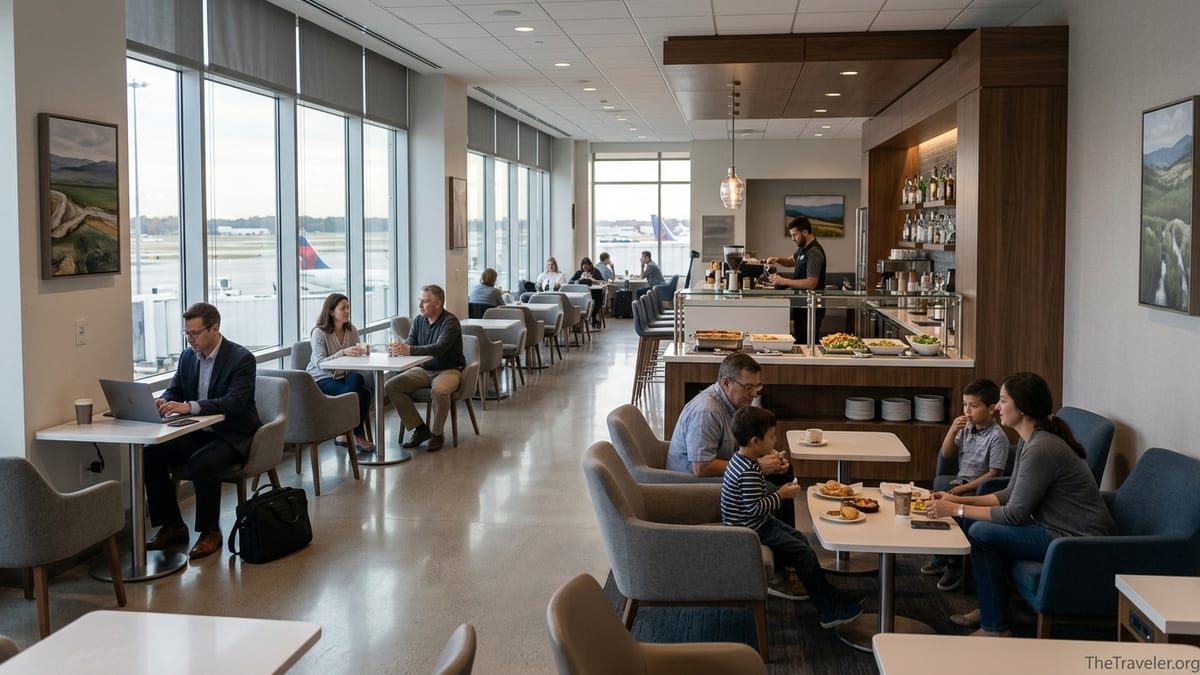
What Exactly Is an Escape Lounge Today?
Escape Lounge is a network of common-use airport lounges originally created by Manchester Airports Group in the UK and now expanded across the United States and parts of Europe. Unlike airline-branded lounges that are usually tied to one carrier, Escape Lounges are designed to be airline-neutral. You can use them whether you are flying Delta, Southwest, Ryanair, or a low-cost carrier, as long as you have a valid boarding pass for that day.
In practical terms, an Escape Lounge typically offers comfortable seating, work tables with power outlets, a buffet-style food selection, a staffed bar or self-serve drinks station, Wi-Fi, and a quieter environment than the main terminal. For example, at the Escape Lounge at Minneapolis–Saint Paul (MSP), travelers commonly find hot breakfast items like scrambled eggs and breakfast potatoes in the morning, plus salads, soups, and small plates later in the day, along with a full bar and barista-style coffee service.
The brand promotes a “locally inspired” feel. At some U.S. locations you will see regional dishes and local craft beers on tap. In the UK, such as at Manchester or Edinburgh, menus often include familiar British comfort food alongside standard lounge options. The quality is not identical everywhere, but the baseline promise is a more premium environment than sitting at a crowded gate or fast-food outlet.
Because Escape Lounges are positioned as common-use spaces, the business model blends several revenue streams: pre-booked day passes sold on its website or via airport partners, walk-up access paid at the door, and complimentary or discounted entry through financial partners such as American Express, Priority Pass, and other lounge programs. Understanding which category you fall into is the first step to navigating the booking process without confusion.
How Much Does Escape Lounge Access Really Cost?
For most travelers without a premium credit card, the starting point is the cash price. In the United States, Escape Lounges currently advertise advance online pricing from roughly 32 US dollars per person when you pre-book on their site. Same-day walk-up rates at the lounge door are usually higher, often in the mid-40 dollar range or more, depending on the airport and time of day, and can be higher again at certain European locations where prices are in pounds or euros.
To make this concrete, imagine you are flying from Reno–Tahoe International Airport (RNO) on a weekday afternoon. If you pre-book online a week before travel, you might see a price around the low 30 dollar mark per adult for a three-hour stay before departure. If you wait to decide until you arrive and the lounge has space for walk-ins, the price at the door could be closer to 45 dollars. For a family of four, that difference is significant: roughly 128 dollars if booked ahead versus around 180 dollars if you roll the dice on walk-up access.
In the UK, the pricing structure is similar but in local currency. At Manchester or Edinburgh, pre-booked adult access often starts in the low-30 pound range, with child discounts sometimes available. Some airports run promotions through parking and lounge bundles, where you book your airport parking plus lounge access together at a lower combined price than if you bought each separately.
The value equation depends on how you travel. If you are facing a three-hour layover at a busy airport like Phoenix or Newark and would likely buy two drinks and a meal anyway, a 32 dollar lounge visit that includes food, coffee, and standard alcoholic drinks can easily beat terminal prices. On the other hand, if you tend to arrive at the airport with only 60 to 90 minutes before boarding and rarely eat or drink there, the cash price for a lounge visit may be harder to justify.
Booking Online vs Walk-up: How the Process Actually Works
The booking process for Escape Lounges is more structured than many travelers expect. On the official site, you typically choose your country, then your airport, then your date, and finally a time slot that reflects your planned arrival time at the lounge. The standard rule is that you may enter up to three hours before your scheduled departure. So if your flight leaves at 5:00 pm, you can usually book a time such as 2:00 pm entry, which locks in your three-hour window.
When you complete the booking, you pay upfront for all guests and receive a confirmation via email with a booking reference or QR code. At the airport, you present that confirmation plus your same-day boarding pass and identification. The name on the booking should match the lead traveler, but additional guests typically do not need to be named individually as long as the head count matches what you paid for.
Walk-up access is possible at most Escape Lounge locations, but it is not guaranteed. If the lounge is at or near capacity, staff may start a waiting list or turn away day-pass customers while still admitting eligible premium cardholders when space becomes available. At some busy U.S. locations that also serve as American Express Centurion Studio Partner lounges, front desk staff may prioritize Amex Platinum and Centurion cardmembers over cash walk-ins when the space is constrained.
A common real-world scenario: a traveler at Phoenix Sky Harbor, Terminal 3, arrives on a Friday afternoon without a booking and asks to buy a day pass. If the lounge is full of Amex Platinum users and Priority Pass members, staff may quote a wait time of 30–60 minutes or politely decline walk-up sales. Someone who pre-booked the same time slot a week earlier, however, will generally be admitted promptly because their spot is reserved, subject to normal access rules such as valid boarding pass and ID.
Credit Cards, Priority Pass and “Free” Access Explained
Much of the confusion around Escape Lounges comes from the web of credit card and membership partners. In the United States, many Escape Lounges operate as part of the American Express Global Lounge Collection. Eligible American Express Platinum, Business Platinum, Corporate Platinum, and Centurion cardmembers receive complimentary entry for themselves and up to two guests per visit at participating U.S. locations, subject to capacity and normal requirements like a same-day boarding pass.
The same U.S. lounges may also partner with Priority Pass or DragonPass, meaning members of those programs can enter using their digital or physical membership card instead of paying cash. However, not every Escape Lounge participates in every program, and participation can differ by terminal even within a single airport. For example, one terminal’s Escape Lounge might accept Priority Pass while the other terminal’s lounge under the same brand does not, leading to understandable frustration for travelers who assume the rules are identical everywhere.
Real travelers often discover this the hard way. Someone with a Priority Pass membership might plan to visit an Escape Lounge at a smaller airport like Palm Beach (PBI) or Reno (RNO) only to learn at the desk that their specific lounge has not yet joined the Priority Pass network. Conversely, another traveler departing from a larger airport like Minneapolis or Sacramento could have several options: pay cash, tap an Amex Platinum card for free entry, or scan a Priority Pass membership, all at the same front desk. Staff will usually ask which access method you want to use, especially if some methods come with guest fees and others do not.
It is also important to distinguish between different types of American Express cards. The Platinum and Centurion series typically provide complimentary Escape Lounge access when issued in eligible markets, but not all Amex-branded cards do. An Amex cash-back card or a basic green or blue card, for instance, usually does not include Escape Lounge access. Travelers sometimes show up with the wrong expectation, only to be offered a paid day pass instead of free entry.
Step-by-Step: How to Book Escape Lounge Access Smoothly
In practice, the easiest way to avoid surprises is to treat Escape Lounge planning as a small project before your trip, just like booking parking or checking terminal maps. The first step is to confirm that your departure airport actually has an Escape Lounge and which terminal it sits in. For example, Phoenix has an Escape Lounge in Terminal 3, while other airports like Kansas City recently added locations as part of new-terminal openings. If your airline often uses a different terminal without a lounge, you may need to clear security in the lounge terminal first, visit the lounge, then walk or ride back to your actual departure gate if that is permitted at your airport.
Once you confirm the lounge exists where you need it, decide how you plan to access it. If you hold an Amex Platinum card, your most straightforward path is simply to show that card, plus your same-day boarding pass and ID, at the front desk. If your access depends on Priority Pass, double-check the specific lounge’s current status in your Priority Pass app or on the Escape Lounge website, since participation lists are updated over time and may not match older blog posts or online comments.
If you expect the airport to be busy or you are traveling at peak times, pre-booking a paid visit can be wise even if you have a premium card, especially if you are traveling with more guests than your card includes for free. For instance, a Platinum cardholder traveling with three companions to Sacramento might be able to bring two guests free, then pre-book and prepay one extra day pass for the fourth person. That way, you avoid negotiating guest fees at the desk and reduce the risk that the lounge sells out of additional capacity.
Always align your booking with your actual flight time. Because Escape Lounges generally cap visits at three hours before departure, booking a 9:00 am entry for a 4:00 pm flight will not work. If your flight changes after booking, some lounges allow you to adjust your time slot online or by contacting customer service, while others may handle changes case by case at the desk. It is safer to book closer to the time your airline typically starts boarding and give yourself a realistic buffer for security and walking time at the airport.
Common Problems, Fine Print and How to Avoid Them
Even travelers who understand the basics of Escape Lounges sometimes run into issues caused by fine print or operational limits. The most common headache is capacity control. During busy travel periods such as school vacations, holiday weekends, and Monday mornings at business-heavy airports, Escape Lounges can fill to the point where staff begin a waitlist or temporarily stop accepting some access methods. Casual reports from travelers suggest that at times, Amex Platinum or Centurion members may be prioritized over basic Priority Pass or cash walk-ups, though each location sets its own procedures.
Another recurring problem is confusion about memberships. Many Amex Platinum cardholders think their card automatically acts as a universal lounge pass. In reality, American Express often requires you to opt in separately for certain benefits, such as Priority Pass Select, while Escape Lounge access is processed directly by scanning your Platinum card at the front desk. Travelers who never completed their Priority Pass enrollment may arrive at a Priority Pass-partner Escape Lounge expecting to scan a digital card in a third-party app, only to find that nothing is set up. The result is either paying cash on the spot or skipping the lounge altogether.
Timing is another source of friction. If you arrive more than three hours before departure, staff may ask you to wait until your three-hour window opens, especially at smaller lounges with limited seating. Similarly, if your departing flight is significantly delayed, you may not be allowed to remain in the lounge indefinitely. Policies vary, but after several hours of rolling delays, many lounges will ask guests to leave once they have exceeded a reasonable stay, particularly when other travelers are waiting for a seat.
Finally, food and drink expectations can be a sticking point. Escape Lounges market fresh, locally inspired menus, but offerings are still buffet-style and designed for volume. A traveler who books primarily for a sit-down restaurant experience could be disappointed if they expect multi-course dining. On the other hand, someone looking for a calm space, decent hot food, and complimentary beer or wine will often feel they received solid value, especially when comparing the lounge’s buffet and drinks to buying a full meal and cocktails at an airport restaurant.
Real-World Use Cases: When Escape Lounge Makes Sense
There are particular travel scenarios where Escape Lounges shine. A common example is an early morning departure from a mid-sized U.S. airport like Sacramento, Reno, or Greenville–Spartanburg, where restaurant options may be limited before 7:00 am. Pre-booking Escape Lounge access for a 5:00 or 6:00 am entry lets you clear security, settle into a quiet space, have coffee and a full breakfast, and start working or relaxing while other passengers queue for the only open cafe in the terminal.
Another strong use case is a long layover due to airline schedule changes. If your original 90-minute layover in Minneapolis turns into four hours on a winter day, paying around 32 dollars for lounge access can feel like a small price for a comfortable seat, Wi-Fi, and snacks compared with wandering the terminal. Travelers with Amex Platinum cards, who do not pay an extra fee to enter, can treat Escape Lounges as an automatic default in such situations, heading straight there as soon as they clear security.
Families also find Escape Lounges useful when traveling with children. The ability to sit around a table, charge multiple devices, and access snacks and drinks without repeated purchases at terminal vendors adds up quickly. For a family of four without premium cards, a pre-booked total of roughly 120 to 150 dollars may still be more economical than buying separate restaurant meals, drinks, and entertainment for several hours at a busy gate, particularly during delays.
On the flip side, Escape Lounges are less compelling when you are connecting on a tight schedule or flying from a low-cost carrier terminal with its own efficient food court and plenty of seating. If you will only realistically use the lounge for 45 minutes, you might prefer to grab a quick coffee and head straight to your gate, reserving lounge visits for longer or more stressful journeys.
The Takeaway
The truth about Escape Lounges is that they are neither a magical first class sanctuary nor a marketing gimmick. They are a practical, mid-range airport lounge option that makes premium-feeling space available to ordinary travelers, especially those flying economy on domestic or short-haul routes. At their best, they offer a quieter, more comfortable environment with reliable Wi-Fi, hot food, and complimentary drinks at a price that can compete well with what you would otherwise spend in the terminal.
The keys to getting value are preparation and realistic expectations. Confirm that your airport and terminal have an Escape Lounge, verify whether your access comes from an Amex Platinum or similar card, Priority Pass, or simple day-pass purchase, and book a time that matches your actual departure window. Do not assume that what worked for a friend at one airport will work the same way at another, and stay alert to capacity controls during peak periods.
For frequent travelers with eligible credit cards, treating Escape Lounges as part of a broader lounge strategy across multiple airports can substantially improve the experience of routine trips. For occasional travelers paying cash, a carefully chosen pre-booked visit on a longer or more stressful travel day can turn an otherwise tedious wait into a manageable and even enjoyable part of the journey.
FAQ
Q1. Do I need a first or business class ticket to use an Escape Lounge?
Not usually. Escape Lounges are designed as common-use spaces, so in most cases you can enter regardless of airline or cabin class as long as you have a same-day boarding pass and either pay the day-pass fee or qualify through an eligible card or membership.
Q2. How far in advance should I book Escape Lounge access?
For busy travel days or popular airports, booking at least a week or two ahead is sensible, especially for morning departures. Some travelers book as soon as they finalize flights, while others wait until a few days before. Same-day booking is sometimes available online, but capacity can be limited.
Q3. How long can I stay in an Escape Lounge?
Most Escape Lounges allow access starting up to three hours before your scheduled departure time. If your flight is delayed, staff may permit you to stay longer within reason, but very long delays can lead to stay limits so that new guests can be accommodated.
Q4. What is included in the Escape Lounge day-pass price?
Typical inclusions are buffet-style hot and cold food, non-alcoholic drinks like coffee, tea and soft drinks, and a selection of alcoholic beverages such as beer, wine and basic spirits, plus Wi-Fi and seating. Premium items, such as certain cocktails or higher-end wines, may be extra at some locations.
Q5. Can I bring guests with my American Express Platinum card?
At most participating U.S. Escape Lounge locations, eligible American Express Platinum and Centurion cardholders can bring up to two guests at no additional charge, subject to capacity. Additional guests beyond that limit may need to pay the standard day-pass rate.
Q6. Does every Escape Lounge accept Priority Pass?
No. Some Escape Lounges partner with Priority Pass while others do not, and partnerships can vary by airport and terminal. Always check the latest information in your Priority Pass app or on the lounge’s information page before assuming your membership will be accepted.
Q7. What happens if I arrive at the lounge earlier than three hours before my flight?
If you show up too early, staff may ask you to return closer to your eligible entry time, particularly when the lounge is busy. In quieter periods they may be flexible, but you should not count on being admitted more than three hours before departure.
Q8. Can I change or cancel an Escape Lounge booking?
Change and cancellation rules depend on the specific booking terms shown at purchase. Many advance bookings allow changes up to a certain time before arrival, often for a fee or within a flexible window, while heavily discounted or promotional rates may be non-refundable.
Q9. Is Escape Lounge access worth it for a short layover?
If you will be in the lounge for less than an hour and would not otherwise buy a meal or drinks, it may not be good value. For stays closer to two or three hours, especially when airport restaurants are crowded or expensive, the cost can be easier to justify.
Q10. Do children pay the same Escape Lounge price as adults?
Policies vary by location. Some Escape Lounges offer reduced rates for children, while others charge a flat per-person fee. When booking online, check the pricing breakdown for adults and children before confirming your reservation.