


Airport lounges used to be a rarefied perk for business travelers. Today, travelers with the right card or day pass can swap crowded gate areas for quieter spaces with food, drinks and Wi-Fi. Two options often confused with each other are Escape Lounges and Priority Pass. One is a specific lounge brand, the other a global membership program. Understanding the difference is key to choosing the option that actually improves your time at the airport instead of just adding another fee.
Get the latest updates straight to your inbox!
Escape Lounge vs Priority Pass: What Each One Really Is
Escape Lounges are a chain of independent airport lounges. In the United States they are branded as “Escape Lounges – The Centurion Studio Partner” because of a partnership with American Express, while in the UK and a few other markets they operate simply as Escape. You will find them at airports such as Sacramento (SMF), Fort Lauderdale (FLL), Minneapolis (MSP), Palm Beach (PBI), Kansas City (MCI), Tulsa (TUL) and several others, plus a strong presence at Manchester Airport in the UK. At most of these locations anyone with a same-day boarding pass can enter if they pay a day pass fee or hold an eligible credit card.
Priority Pass is not a lounge brand. It is a membership program that gives access to more than one thousand third-party lounges around the world, plus a growing mix of airport restaurants and minute suites. Instead of running lounges itself, Priority Pass pays independent lounges and airport partners when members visit. You might use your Priority Pass card to enter an Escape Lounge in Sacramento, a third-party lounge in Lisbon, a Turkish Lounge in Bangkok, and a sleepy contract lounge in Cleveland, all under one membership.
This difference matters. Picking “Escape vs Priority Pass” is not exactly an apples-to-apples choice. Escape is like choosing a specific hotel chain for certain cities. Priority Pass is like joining a hotel program that gives you a discount at many unrelated properties worldwide. The best option depends on whether you care more about depth at a few airports or breadth across your whole travel map.
In practical terms, many travelers will encounter Escape Lounges first when they see the signage walking through airports like FLL or MSP, then discover that their Priority Pass membership or American Express Platinum card opens the door. That overlap can make it confusing, but you are still using two different products: an Escape Lounge location, accessed via a Priority Pass or card benefit.
Where You Can Use Each Service in 2026
Escape Lounges have a small but growing footprint. In the United States, the Escape website currently lists locations at airports including Sacramento, Minneapolis, Oakland, Fort Lauderdale, Palm Beach, Reno-Tahoe, Syracuse, Hartford–Bradley, Kansas City, Tulsa and San Juan, with more openings being announced periodically such as a recent lounge in Kansas City and new space in San Juan. Several UK airports, especially Manchester, also feature multiple Escape-branded lounges, and there is expansion into select Australian locations as well.
For US-based travelers, this means Escape will feel very familiar if you often fly through specific mid-size hubs. A Minnesota-based traveler who frequently uses MSP might rely heavily on the Escape Lounge there, while a Florida traveler may see Escape in Fort Lauderdale every month. However, if your home airport is a large coastal hub like Los Angeles, Atlanta or Dallas–Fort Worth, you may never see an Escape Lounge at all, because those airports already have a mix of airline clubs and premium issuer lounges instead.
Priority Pass, by contrast, is about worldwide coverage. The program now advertises access to roughly 1,800 lounges and airport experiences in more than 700 airports across over 140 countries, from major hubs such as London Heathrow and Singapore Changi to smaller regional airports that have only one contract lounge. A New York traveler connecting in Paris, Doha and Nairobi can often use Priority Pass at all three stops, even though none of the lounges share a common brand name.
The key crossover is that many, but not all, US Escape Lounges now accept Priority Pass members. Escape’s own access page notes that Priority Pass members can access 11 of its US lounges, with availability varying by location. For example, the Escape Lounge at Palm Beach may welcome Priority Pass visitors subject to capacity, while a newly opened lounge in another city might initially focus only on American Express and day pass guests. Travelers cannot assume every Escape location is in the Priority Pass network; it is essential to check each lounge’s listing in the Priority Pass app before banking on entry.
How Much You Will Actually Pay
For Escape Lounges, the pricing is straightforward if you are not coming in with a premium card. The US Escape website cites advance-booked day passes starting from about 32 to 45 dollars per person, depending on the airport and time of day. Recent examples include pre-book pricing around 45 dollars at Palm Beach and similar amounts at Kansas City. Walk-up prices at the door tend to be higher, and at busier UK locations such as Manchester, publicly available walk-up rates have been closer to 55 pounds, with online bookings a little cheaper. Access is generally for up to three hours before departure.
If you hold an American Express Platinum, Business Platinum or Centurion card, Escape Lounges are included as part of the Amex Global Lounge Collection. These cardholders typically receive complimentary entry plus up to two guests at most US Escape locations, with additional guests charged a per-visit fee. Delta SkyMiles Reserve cardholders can also access Escape when flying on a same-day Delta flight, though guest access rules can be stricter there. In these situations, the marginal cost of using Escape is effectively zero if you already pay the card’s annual fee.
Priority Pass, when purchased directly, charges an annual membership fee plus per-visit fees on most tiers. Public pricing as of spring 2026 clusters around three levels: an entry-level plan near 99 dollars per year where every lounge visit costs about 35 dollars, a mid-tier plan above 300 dollars per year with a set number of free visits before per-visit fees apply, and a top tier in the high 400-dollar range that includes unlimited member visits but still charges roughly 35 dollars per guest. Exact numbers change periodically, but these figures give a realistic ballpark for what most travelers are seeing on the Priority Pass website.
However, very few US frequent travelers buy Priority Pass direct. Instead, they receive a “Priority Pass Select” membership bundled with a premium credit card such as the American Express Platinum, Capital One Venture X or many top-tier Chase and Citi cards. The card sets the rules: some allow unlimited free visits with two free guests, others offer only a certain number of complimentary visits or charge a guest fee of around 35 dollars per person. Because the credit card annual fee effectively covers the lounge benefit, your calculation becomes whether you will use Priority Pass enough to justify the card fee, not whether to pay a standalone Priority Pass subscription.
What the Experience Is Like on the Ground
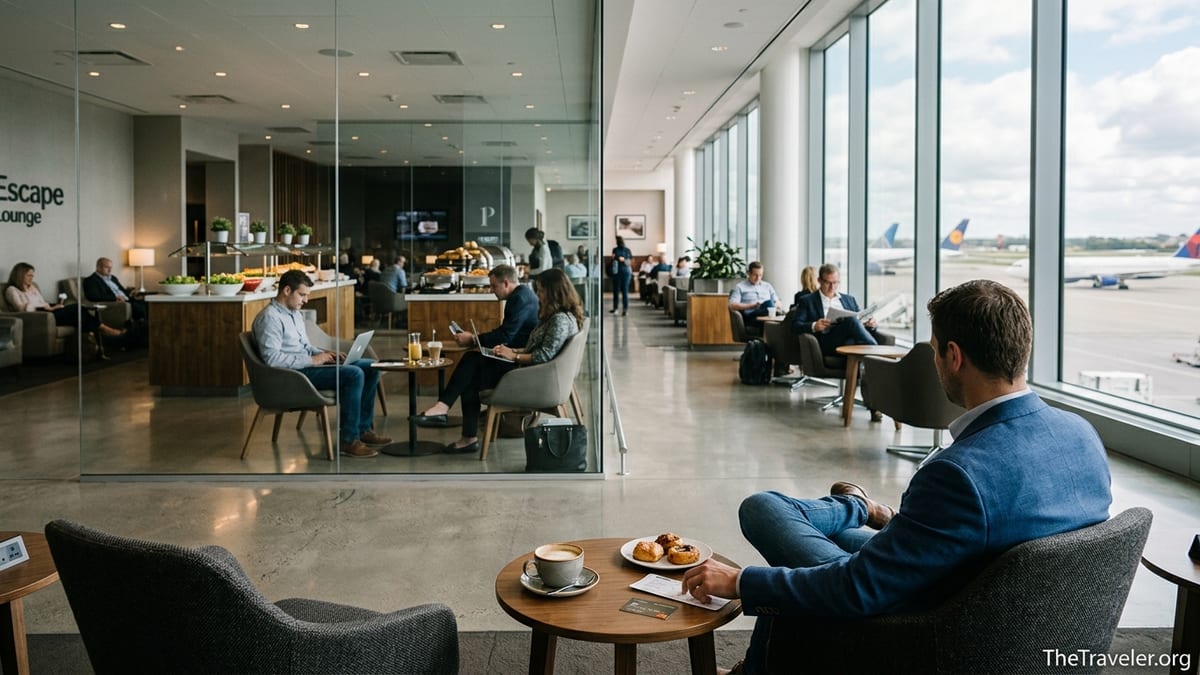
A typical Escape Lounge aims for a consistent in-lounge experience. Step into the Escape Lounge at Sacramento or Fort Lauderdale and you will usually find a staffed check-in desk, a buffet with hot dishes like scrambled eggs or pasta depending on time of day, salads and snacks, a self-serve or staffed bar with complimentary wine, beer and basic spirits, barista-style coffee, and plenty of power outlets. Many locations feature runway views and a design palette that feels closer to an upscale hotel lobby than a generic waiting room. Ample natural light and a quieter environment than the main concourse are part of the promise.
Because Escape operates as a single brand, the quality is generally predictable. Travelers who visit multiple locations often describe the lounges as a notch above the more basic contract lounges in the Priority Pass network in the US, with better food and more pleasant decor, though still below the top-tier experience of a flagship American Express Centurion Lounge. For a traveler killing a two-hour layover in Kansas City or Palm Beach, having a cooked-to-order omelet station or a staffed bar can feel like a significant upgrade over hunting for an open seat at the gate.
Priority Pass experiences are much more varied. In a large international hub, the Priority Pass listing might include a full-service contract lounge with hot meals and showers, an airline-branded business class lounge during off-peak hours, several “refresh” pods, and even a sit-down restaurant where members receive a dining credit. In contrast, at a smaller US airport the only Priority Pass option may be a very basic lounge with limited snacks and soft drinks, or nothing more than a quiet room with coffee and Wi-Fi.
This variability becomes real the moment you walk in. A traveler using Priority Pass in Singapore may enjoy a multi-room lounge with noodle stations, nap chairs and showers. The same traveler connecting in a smaller US airport could find the Priority Pass lounge crowded, with minimal food and a waitlist at the door, leading them to seek out an Escape Lounge instead if available. In other words, Priority Pass sometimes delivers an Escape-level experience and sometimes something much more modest, depending entirely on which partner is operating the lounge you visit.
Capacity, Access Rules and Fine Print
Capacity management is increasingly important at both Escape Lounges and Priority Pass partner lounges, and this is where the details start to matter. Escape openly states that “turn up” access with Priority Pass or other membership cards is always subject to availability on the day of travel, and that only pre-booked day passes truly guarantee entry. That means a traveler relying solely on their Priority Pass card for Escape access at a busy time in Minneapolis or Palm Beach may find themselves turned away if the lounge is already full of day pass and American Express guests.
American Express Platinum and Centurion members get an edge at Escape Lounges, since Escape’s partnership with Amex designates these lounges as part of the Global Lounge Collection. In practice, that often means Amex members are the core customer base, with Priority Pass, DragonPass and other programs layered on top. When a lounge reaches capacity, front desk agents may prioritize Amex cardholders and pre-booked guests over walk-up Priority Pass members. A business traveler using an Amex Platinum might notice that they are admitted reliably at 7 a.m. on a Monday, while a Priority Pass member arriving at the same time without a reservation is told to come back in 30 minutes.
Priority Pass itself imposes some usage rules that can affect value. Members must usually present their digital or physical card plus a same-day boarding pass. Each guest counts as a separate visit for billing purposes, and the standard per-guest fee of roughly 35 dollars often applies once you exceed any complimentary guests your card allows. Some high-end issuer lounges that participate in Priority Pass, such as Chase-backed lounges in the US, have set their own higher guest fees for Priority Pass visitors compared with their standard entry fee for non-members. These nuances appear in the details for each lounge and surprise travelers who only skim the headline “Priority Pass accepted here.”
Both Escape and Priority Pass also enforce a typical three-hour pre-departure access window at most locations, which matters if you like to arrive at the airport extremely early. A traveler who turns up five hours before a long-haul flight out of a European hub might be told to return closer to departure time even if the lounge is half-empty. Some lounges relax this policy during irregular operations or long layovers, but it is unwise to assume extended access unless staff specifically confirm it.
Which Travelers Should Choose Escape, Priority Pass, or Both
Escape Lounges make the most sense for travelers whose patterns match Escape’s footprint and who value a consistent, mid-tier experience. A Minneapolis-based consultant who flies to the coasts through MSP every week, for example, may be perfectly happy buying 40 to 45 dollar Escape day passes on heavy travel months, skipping a global Priority Pass membership entirely. If they already carry an American Express Platinum card for other reasons, Escape effectively becomes “free” each time they fly through participating airports, making it an easy, high-value benefit.
For leisure travelers who fly only a few times a year, occasional Escape day passes can be simpler and cheaper than a full Priority Pass subscription. A family flying from Kansas City to Orlando once a year might pre-book the Escape Lounge at MCI for about 40 to 45 dollars per adult, enjoy a proper breakfast and drinks, and feel they have upgraded the start of their vacation. Trying to justify a roughly 100 dollar annual Priority Pass membership plus per-visit fees for just one or two trips per year would be more difficult.
Priority Pass shines for travelers who regularly cross borders or use diverse airports. An entrepreneur based in New York who makes quarterly trips to Europe and Asia, plus domestic hops to secondary US cities, can extract enormous value from a card like the Capital One Venture X or American Express Platinum that includes Priority Pass. On a single two-week business trip, they might use Priority Pass in New York, Frankfurt, Istanbul and Singapore, collecting several hundred dollars’ worth of lounge access that would have been impossible to replicate with Escape alone.
Many frequent travelers effectively choose “both” without thinking about it, because the same premium credit card that gives them Escape access also includes Priority Pass Select. In this setup, Escape is the known quantity they rely on at certain US airports, while Priority Pass fills in the gaps everywhere else. On a domestic trip from Sacramento to New York via Minneapolis, they may use Escape at SMF and MSP. On their next international trip from JFK to Lisbon, they might rely on a Priority Pass partner lounge and an airport restaurant credit instead.
Real-World Scenarios to Help You Decide
Consider three concrete traveler profiles. First, a Florida-based retiree who flies seasonally between Fort Lauderdale and the Midwest to visit family. They typically use FLL, MSP and perhaps Kansas City. In their case, focusing on Escape Lounges makes sense. Pre-booked passes or an American Express Platinum card delivering complimentary Escape access offer a reliable oasis in the specific airports they use, without paying extra for global coverage they rarely need.
Second, a remote worker who has embraced “work from anywhere” and spends months at a time abroad. They may string together itineraries that include New York, London, Lisbon, Dubai, Bangkok and Tokyo. Here, Priority Pass is the clear winner. Escape Lounges simply do not exist in most of these airports, while Priority Pass covers a wide range of contract lounges and in-terminal restaurants. Picking a credit card that bundles Priority Pass with other travel perks, such as travel insurance and statement credits, can turn lounge access into just one part of a broader travel toolkit.
Third, a mid-career consultant based in Chicago who flies a mix of domestic and international routes and already holds an American Express Platinum card for its points and airline benefits. This traveler effectively has both Escape and Priority Pass at no extra marginal cost. Their best move is not to choose one over the other, but to learn which option is stronger at each airport they visit. At Sacramento, they may head straight to the Escape Lounge. At Heathrow, they will check the Priority Pass app and pick the best-rated contract lounge in their terminal. At Dallas–Fort Worth, they may skip both and use an American Express Centurion Lounge instead.
In all three cases, the “right” answer stems from travel patterns rather than abstract program features. Mapping your last 12 months of flights, or your likely route map for the coming year, is often more useful than comparing membership brochures. If Escape appears several times on that map and you value a consistent product, lean toward Escape. If your dots span continents, Priority Pass almost always comes out ahead.
The Takeaway
Escape Lounges and Priority Pass are complementary rather than direct competitors. Escape is a small but thoughtfully run lounge brand, currently strongest in the United States and the UK, offering a consistent experience with decent food, drinks and work-friendly spaces. Priority Pass is a global access program that opens the door to an enormous variety of lounges and airport experiences, from excellent to merely adequate, spread across hundreds of airports worldwide.
If you mainly use the specific US and UK airports where Escape operates, and you do not travel internationally very often, paying for Escape day passes or carrying a card that includes Escape access may be the more straightforward and cost-effective choice. If your travels regularly take you overseas or through diverse hubs, a card with Priority Pass Select will usually deliver more value, especially when you add up visits across a full year.
For many frequent travelers holding premium credit cards, the smartest strategy is to stop thinking of Escape versus Priority Pass as an either-or decision. Instead, treat Escape as one of the better lounge options you may encounter inside the wider world that Priority Pass and card networks open up. Learn which Escape locations accept Priority Pass, which airports offer better non-Escape lounges, and where pre-booking is wise. With that knowledge, you can choose the quieter corner of the airport that best fits each trip, rather than committing blindly to one logo.
FAQ
Q1. Is Escape Lounge a type of Priority Pass lounge?
Not exactly. Escape is its own lounge brand. Some Escape Lounges participate in the Priority Pass network, so you can use your Priority Pass membership to enter those specific locations, but Escape is not owned or run by Priority Pass.
Q2. Which is cheaper: buying Escape day passes or a Priority Pass membership?
For a few trips per year, Escape day passes that cost roughly 32 to 45 dollars when pre-booked are usually cheaper. If you use lounges frequently in many different airports, a premium credit card that includes Priority Pass can offer better value over a full year, even though the card’s annual fee is higher.
Q3. Can I guarantee entry to an Escape Lounge with Priority Pass?
No. Priority Pass access at Escape Lounges is typically on a space-available basis. Only pre-booked day passes directly with Escape truly guarantee entry at a specific time. At busy periods, walk-up Priority Pass members can be waitlisted or turned away.
Q4. Does Priority Pass get me into every Escape Lounge worldwide?
No. Escape’s own information notes that Priority Pass is accepted at a subset of its US lounges, and participation can vary by airport. You should always check the specific lounge listing in the Priority Pass app to confirm whether your membership is valid at that location before you travel.
Q5. If I have an American Express Platinum card, do I still need Priority Pass?
It depends on your routes. The Amex Platinum includes Escape Lounge access at participating locations and also provides a Priority Pass Select membership. If you only fly through airports with Amex and Escape lounges, you may rarely use Priority Pass. If you travel internationally, Priority Pass remains valuable for lounges where Amex and Escape do not operate.
Q6. How long can I stay in an Escape Lounge compared with a Priority Pass lounge?
Most Escape Lounges allow stays of up to about three hours before departure, which is similar to the common three-hour rule at many Priority Pass partner lounges. Some lounges may extend this during long layovers, but you should not assume unlimited stays unless staff confirm it.
Q7. Are food and drinks free in Escape Lounges and Priority Pass lounges?
Yes, in most cases. Escape Lounges usually include buffet-style food, snacks and a selection of complimentary alcoholic and nonalcoholic drinks. Most Priority Pass partner lounges offer similar inclusions, though the quality and variety can range from basic snacks to full hot meals, depending on the lounge.
Q8. Do Escape Lounges or Priority Pass lounges have dress codes?
Both generally require “smart casual” standards. That typically means no offensive clothing, bare feet or heavily soiled garments. Airlines and lounge operators focus more on behavior than on strict fashion rules, so as long as you are neat and respectful, standard travel clothes are normally fine.
Q9. Can my family come into an Escape Lounge or Priority Pass lounge with me?
Yes, but guest rules differ. Escape sells individual day passes for each adult and sometimes discounts for children, while certain credit cards let you bring a limited number of guests for free. Priority Pass typically treats each guest as a separate visit, with a common guest fee around 35 dollars unless your card benefit includes free guests.
Q10. If I mostly travel within the United States, which should I pick?
If your regular airports include several with Escape Lounges, focusing on Escape access via day passes or an American Express card can be very practical. If your US travel takes you through many different hubs that do not have Escape, a card with Priority Pass will likely expose you to more lounges overall, even if the quality varies more from place to place.