


Ponte Vecchio is the postcard bridge of Florence, a medieval span over the Arno lined with tiny gold shops and thick with camera phones. Many visitors arrive in 2026 wondering the same thing: is it still worth squeezing onto such a crowded landmark, or has overtourism turned it into a box to tick and quickly escape? The answer depends a lot on when you go, what you expect, and how you like to travel.
Get the latest updates straight to your inbox!
What Ponte Vecchio Actually Is, Beyond the Postcards
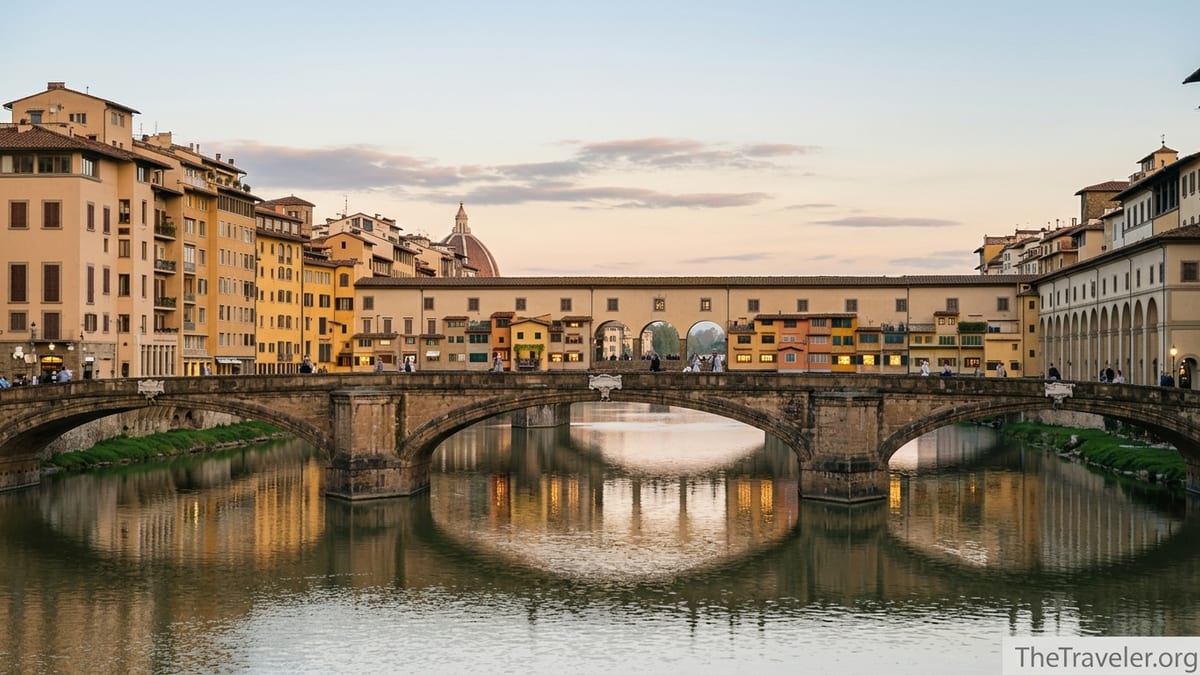
First-time visitors are often surprised that Ponte Vecchio is not a wide, open viewpoint but a narrow medieval bridge, just over 30 meters across at its widest point, with small shops forming almost a solid wall on both sides. You actually walk through what feels like a lane of jewelry boutiques rather than over a typical river bridge. Only occasional gaps between the shops let you peer out over the Arno to the other bridges and terracotta roofs of Florence.
The current structure dates back to the 14th century and survived the Second World War largely intact, which already makes it unusual among European river bridges. It has carried everything from butchers and tanners to today’s goldsmiths, who have been officially based here since the late 1500s when the Medici rulers pushed out the meat sellers to clean up the area. That long commercial history is why the bridge feels like a living market rather than a static monument.
The look of Ponte Vecchio is defined by its so-called sportelli, the wooden shop fronts that fold out in the morning like small treasure chests and close again at night, turning the bridge into a continuous line of timber boxes perched above the river. Many of the shops are still family businesses that have been operating for generations and quietly doing business behind the glass while the crowds swirl past.
Today the bridge has become a kind of open-air corridor between the historic center and the Oltrarno neighborhood, which means locals, hotel porters, guided groups and solo tourists all funnel across the same narrow space. That mix is part of its energy, but it also explains why it can feel so congested in peak season.
How Crowded Is Ponte Vecchio in 2026?
Florence has been repeatedly cited in recent years as one of Europe’s most pressured historic centers, with more visitors than residents in the core districts on many days. Local media and tourism studies note that Florence, with a resident population of roughly 360,000, receives several million visitors a year, and iconic spots like Ponte Vecchio absorb a large share of that foot traffic. In 2025 a Florence news outlet even used images of gridlocked pedestrians on Ponte Vecchio to illustrate stories about overcrowding in the city center.
Practically, this means that on a typical spring or autumn afternoon between roughly 11:00 and 17:00, the bridge can feel like a slow-moving queue. In June and July, you may find yourself shuffling shoulder to shoulder from one end to the other, with street musicians trying to be heard above the murmur and group leaders raising colored flags. Trip review sites in 2026 contain hundreds of comments mentioning the crowds, with many users recommending an early-morning or late-evening visit specifically to avoid the crush.
However, the experience is not uniformly unpleasant. If you cross at 7:30 on a weekday morning in May, for example, you might see delivery carts trundling to open shops, a few joggers using the bridge as part of their river route, and photographers quietly setting up tripods. On a cool November evening around 21:00, the atmosphere can be almost serene, with shop shutters closed and the bridge lit softly from both sides. The same place that feels like a tourist bottleneck at midday can feel atmospheric and almost local at the margins of the day.
The key takeaway for planning is that crowds on Ponte Vecchio are highly time-dependent rather than constant. If your image of the bridge involves quiet reflection, you will almost certainly be disappointed at 3 p.m. in July. If you are willing to shift your visit by a few hours, the experience can be surprisingly different without changing anything else about your itinerary.
Is It Worth Visiting If You Are Not Shopping for Gold?
Many travelers wonder if Ponte Vecchio has any value beyond luxury shopping, especially if they are on a tight budget or simply not interested in jewelry. In 2026, typical prices for small 18-karat gold pieces on the bridge start around 100 to 150 euros for simple earrings or a slender ring and can easily reach several thousand euros for diamond pieces or intricate designs, according to current shopping guides for Florence. That puts most purchases firmly in the “special occasion” category rather than a casual souvenir.
If you know you will not be buying gold, it is still worth crossing the bridge at least once for the setting. The real reward is not the shop windows, it is the views just off the bridge. For example, one of the best vantage points is a short walk away on the neighboring Ponte Santa Trinita, where you can look back at Ponte Vecchio’s jumble of pastel houses, small arches and reflections in the Arno at sunset. Many photographers skip buying anything on Ponte Vecchio itself and instead spend their time wandering the riverbanks before or after a quick pass through the crowds.
Another way to get value without shopping is to treat Ponte Vecchio as a link between two different Florences. On the north side you have high-traffic areas around Piazza della Signoria and the Uffizi galleries. On the south, in the Oltrarno, you can quickly reach quieter artisan streets such as Via Romana or the squares around Santo Spirito. A traveler who crosses the bridge once at 08:00 on the way to coffee in the Oltrarno, then again at 22:00 walking back after dinner, will have a much richer sense of the city than someone who stands in the middle of the bridge at noon and leaves frustrated.
That said, if you have only a few hours in Florence and dislike crowds intensely, you will see similar or better river views from other bridges with less compression. In that narrow sense, Ponte Vecchio can be “skipped” without fundamentally changing your understanding of Florence’s layout, as long as you compensate by walking along the Arno or crossing via one of the nearby bridges.
Strategies to Avoid the Worst of the Crowds
The simplest way to enjoy Ponte Vecchio is to treat it like a popular restaurant: do not turn up at peak hour and expect a relaxed experience. Recent visitor reports and local advice consistently point to early morning and late evening as the best times, particularly from March through October. For example, crossing just after sunrise in late April means cool air over the Arno, very soft light on the pastel buildings and mostly locals walking to work. In December, a late-evening stroll when the Christmas lights are on the bridge can feel festive but not overwhelming, especially on weekdays.
Time of year also matters. Summer holidays in Europe and North America, roughly from late June to late August, bring the heaviest crowds. If you are traveling in shoulder seasons such as March or late October, you can still encounter busy afternoons if a cruise excursion or multiple tour groups arrive together, but the overall volume tends to be more manageable. January and February are generally the quietest months, and a chilly but bright winter day can give you almost unobstructed space on the bridge by mid-morning.
Another tactic is to approach Ponte Vecchio as part of a walking route rather than a standalone destination. A realistic example: after visiting the Uffizi, you might exit toward the river, walk across the bridge once, continue straight into the Oltrarno for a sandwich at a neighborhood bakery, then return via Ponte Santa Trinita. This loop gives you four distinct views of the Arno and two crossings without spending more than a few minutes in the densest section of Ponte Vecchio itself.
If you do arrive at a crowded time, move steadily rather than stopping at the first gap you see. There are a few slightly wider breaks in the wall of shops where the Vasari Corridor passes above you; these pockets often have just enough extra room to step aside and enjoy the river views without blocking everyone behind you. With a bit of patience, you can still find a spot to take photos, even when the main stream of pedestrians feels heavy.
What It Is Like to Shop for Jewelry on the Bridge
For travelers specifically interested in gold, Ponte Vecchio can be both an exciting and intimidating place. Most shops sell 18-karat Italian gold, often marked with the 750 hallmark on the piece, and display designs ranging from classic rope chains and signet rings to modern geometric styles. Current Florence shopping guides indicate that entry-level pieces here start around 100 euros, but it is more common to see budgets in the range of 500 to 2,000 euros for a memorable ring, bracelet or necklace from these boutiques.
In practice, the experience varies widely depending on your preparation. A traveler who checks the international gold price before arriving, compares prices at a couple of non-touristy jewelers elsewhere in Florence and sets a firm budget is more likely to feel satisfied. For instance, you might look at a simple 18-karat gold band priced at 450 euros on Ponte Vecchio and then confirm that a similar-quality ring a few streets away costs 350 euros. You may decide that paying a premium for the bridge location and the specific workshop is worth it, or you may walk back across the river and buy off the main tourist route.
Many recent visitors report that some shops are happy to explain the hallmark system, weight and craftsmanship details, while others focus on quick sales. If you feel pressured, it is acceptable to thank the staff and leave; there are over 40 jewelry boutiques along the bridge and in the immediate surroundings, which gives you options. Look for places that clearly display hallmarks and are willing to write detailed receipts, including the carat and weight; this is standard practice among serious Florentine goldsmiths.
It is also important to understand what Ponte Vecchio is not: it is rarely the cheapest place in the city to buy gold. Locals and frequent visitors often recommend exploring jewelry districts near Santa Croce or smaller artisan workshops in the Oltrarno for better value. An example shared by travelers in recent years involves someone paying more than 150 euros for a pair of silver earrings on the bridge, only to find similar designs around half the price in a side street shop elsewhere in Florence the next day. Ponte Vecchio pricing often includes a strong location premium.
Alternatives and Complements to the Classic Bridge Experience
If you decide that the mid-day crush on Ponte Vecchio is not for you, or you want to see more nuanced sides of the city, there are easy alternatives nearby. The most obvious is to walk a few minutes downstream to Ponte Santa Trinita, which offers arguably the best overall view of Ponte Vecchio itself, framed by the Arno and the hills beyond. Many photographers set up here around sunset, when the light hits the western face of Ponte Vecchio and its small houses seem to float above the water. You get the postcard image without the crowd density.
Just beyond the south end of the bridge, the Oltrarno district opens into a network of streets that still have a strong local feel, especially away from the main route to Palazzo Pitti. A traveler who spends an hour browsing tiny artisan workshops around Piazza Santo Spirito or Via Maggio, perhaps stopping for a coffee that costs under 2 euros at a neighborhood bar, will often report a much more relaxed and authentic experience than lingering in the jewelry arcades on the bridge itself.
You can also approach Ponte Vecchio from a different angle by seeing it from above. Guided routes that use the elevated Vasari Corridor, when available, let small groups walk over the tops of the bridge shops, offering a rare perspective on the structure without immersing you in the crowd below. Similarly, heading up to Piazzale Michelangelo or the church of San Miniato al Monte gives panoramic views over the entire city, including the soft curve of the Arno and the small shape of Ponte Vecchio in context.
For travelers concerned about overtourism, consciously spreading your time among lesser-known bridges and neighborhoods can help. Spend 15 minutes crossing Ponte Vecchio once, then an hour wandering along the riverbank paths or in residential streets where everyday life continues at its own pace. You still see the icon, but you support businesses and corners of Florence that are not at the breaking point.
The Takeaway
So is Ponte Vecchio worth visiting, or has it become too crowded to enjoy? The honest answer is that it can be both, sometimes within the same day. If you arrive expecting a quiet, romantic stroll at the heart of Florence at 2 p.m. in July, you will likely be frustrated by the slow-moving queues, group tours and tightly packed shop windows. In that scenario, the bridge may feel more like an obligation than a pleasure.
However, with modest adjustments, Ponte Vecchio can still offer real magic. An early-morning crossing with the sound of shop shutters opening, a winter evening walk when the reflections of the lamps ripple in the Arno, or a quick pass on your way to explore the artisan streets of the Oltrarno can all be memorable. Even travelers who vow not to buy a single piece of jewelry often appreciate at least one look at the bridge from Ponte Santa Trinita or the riverbanks at golden hour.
If you are building a realistic Florence itinerary, consider Ponte Vecchio as a short, targeted experience rather than a centerpiece. Plan to cross once or twice at off-peak hours, enjoy the views, perhaps step into one or two carefully chosen shops if you are in the market for gold, and then move on to the wider city. Approached that way, it remains a worthwhile and evocative part of Florence rather than a stressful obstacle.
In the end, Ponte Vecchio is less about ticking a box and more about how you choose to interact with it. With awareness of its limits and some thoughtful timing, you can still find the charm that has drawn travelers to this “old bridge” for centuries.
FAQ
Q1. Is Ponte Vecchio actually worth visiting if I only have one day in Florence?
If you have just one day, it is still worth a brief visit, provided you treat it as a quick crossing and photo stop rather than a long activity. Plan to walk across in the early morning or late evening, then focus your limited time on major sites like the Duomo, the Uffizi or simply wandering the historic streets.
Q2. When is the best time of day to visit Ponte Vecchio to avoid crowds?
The quietest windows are typically shortly after sunrise and later in the evening after dinner, especially on weekdays. Visiting around 07:30 to 09:00 or after about 21:00 often means cooler temperatures, softer light and far fewer tour groups than the midday peak.
Q3. Is it safe and sensible to buy gold jewelry on Ponte Vecchio?
Yes, many reputable goldsmiths operate on the bridge, and most sell 18-karat Italian gold marked with a 750 hallmark. However, prices include a premium for the location, so it is wise to check the gold price, compare with a jeweler off the bridge and set a clear budget before you start shopping.
Q4. How expensive is the jewelry on Ponte Vecchio compared with elsewhere in Florence?
Current guides and traveler reports indicate that simple pieces start around 100 to 150 euros and can rise to several thousand for elaborate designs, which is usually higher than similar items in less touristy neighborhoods. You are paying partly for the bridge address and history, so value-conscious buyers often compare prices in side street shops before deciding.
Q5. Can I enjoy Ponte Vecchio without buying anything?
Absolutely. Many visitors cross only for the atmosphere and the river views. You can window-shop, pause briefly at the viewpoints between shops, then continue into the Oltrarno or to another bridge like Ponte Santa Trinita for a wider, less crowded perspective on the city and the Arno.
Q6. Are there better bridges or viewpoints in Florence if I want photos of Ponte Vecchio itself?
For photos of the bridge, nearby Ponte Santa Trinita is often considered the best spot, especially at sunset. You can also capture striking views from the riverbanks or from higher overlooks like Piazzale Michelangelo, where Ponte Vecchio appears as part of the wider cityscape rather than the main subject.
Q7. Is Ponte Vecchio accessible for travelers with mobility issues?
The bridge is flat and step-free, but at busy times the dense crowds can make movement slow and tiring for anyone using a wheelchair, cane or stroller. Visiting during quieter early-morning or late-evening periods, and approaching from the flatter riverfront side streets, usually offers a more comfortable and accessible experience.
Q8. Does Ponte Vecchio feel touristy, or do locals still use it?
It definitely feels touristy during the day, with many visitors, tour groups and souvenir shoppers. That said, Florentines still cross it as a practical route between the historic center and the Oltrarno, especially early in the morning and later at night, when you will likely notice more locals than tour groups.
Q9. How much time should I plan to spend on Ponte Vecchio?
Most travelers find that 15 to 30 minutes is enough for a relaxed crossing, quick photos and perhaps a look into one or two shop windows. If you intend to seriously shop for jewelry, you may want to allow an hour or more to compare designs and prices in several boutiques without feeling rushed.
Q10. Are there any signs of overtourism policies affecting visits to Ponte Vecchio?
Florence’s authorities have been discussing and implementing broader measures to manage tourism in the historic center, but as of 2026 there are no routine ticket barriers or time slots for simply walking across Ponte Vecchio. Instead, the main effect visitors notice is general crowding at peak hours, which you can largely avoid by choosing off-peak times and dispersing your sightseeing across less-busy neighborhoods.