


Set on the curve between Antibes old town and the start of Cap d’Antibes, Plage du Ponteil is easy to overlook on a quick scan of the map. Yet for many locals, this long ribbon of pale sand is the beach they return to week after week, even with postcard‑pretty options like Plage de la Gravette and Plage de la Salis close by. What makes this stretch of shoreline quietly special, and how does it really compare with the other beaches around Antibes?
Get the latest updates straight to your inbox!
A Long, Gently Shelving Bay Instead of a Tight Urban Cove
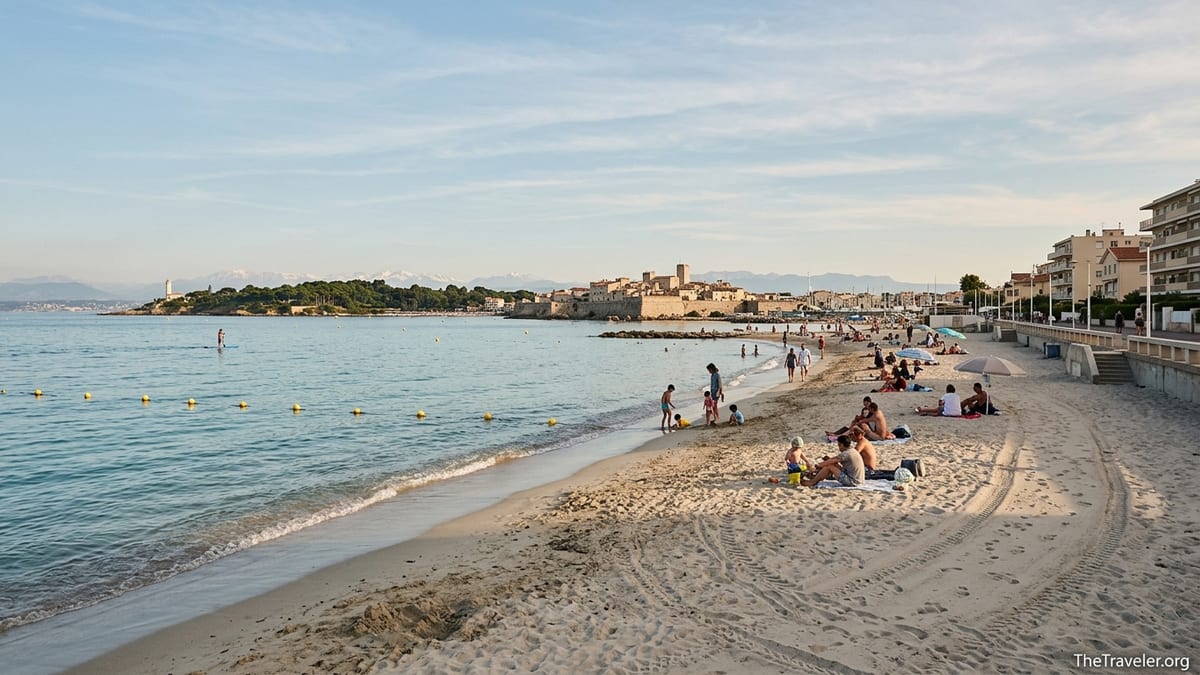
One of the first things that sets Plage du Ponteil apart is its shape and scale. Where Plage de la Gravette is a compact horseshoe tucked under the old ramparts, Ponteil runs in a long, almost straight line along Boulevard James Wyllie, with a wide band of pale sand edging a shallow, sheltered bay. Standing near the western end, you can see all the way along the curve toward Plage de la Salis, which begins just a few minutes’ walk farther south.
This matters when you are choosing where to swim. Gravette’s enclosed cove can feel crowded by mid‑morning in July and August, and the small car park by Port Vauban fills up quickly. At Ponteil you have more physical breathing space, even in high season. The water deepens very gradually, which suits hesitant swimmers and anyone supervising children or older relatives who prefer to stand a long way out and still feel the sand underfoot.
Compared with Plage de la Salis, which is slightly longer again and opens more directly to the bay, Ponteil feels more like a classic town beach. Salis begins to transition you into Cap d’Antibes, with a sense that you are leaving town behind. Ponteil, by contrast, still has the city at its back: apartment blocks, a sailing club, a simple promenade. It feels connected to everyday Antibes rather than a deliberate excursion into the Cap.
For many visitors, this combination of urban convenience and a spacious, gently shelving bay is exactly the point. You can step off the bus from Nice or Cannes, walk fifteen minutes from Antibes station, and be ankle‑deep in calm water without having to scramble over pebbles or rocks, as you would on parts of the Cap d’Antibes coastline.
A Predominantly Local Beach With a Subtle Tourist Presence
Another difference you will notice at Plage du Ponteil is who actually uses it. Gravette, framed by ramparts and only a short stroll from the Picasso Museum and the Provençal market, draws a constant flow of day‑trippers. You are as likely to hear English, Italian or German as French. Salis, on the other side, is on the route toward some of the famous Cap d’Antibes villas and attracts hotel guests who have read about its soft sand and mountain views in guidebooks.
Ponteil certainly sees international visitors in summer, but its core audience is local. Residents of the surrounding streets, families from slightly farther inland, teenagers from Antibes who meet there after school in June, and people who come down on their lunch break to eat a sandwich on the wall above the sand. If you arrive around 8.30 on a weekday morning, you will often find joggers cooling down in the sea and retirees doing gentle laps close to shore.
This creates a subtly different atmosphere from some of the other beaches. Services are there, but low‑key. You will not find rows of brand‑name beach clubs and white‑linen restaurants on the sand as you do in Juan‑les‑Pins. Instead, you are likely to see cool boxes, folding chairs and battered parasols that have clearly survived many summers. In practical terms, it means you can spend almost nothing beyond a takeaway coffee from a nearby kiosk if you choose, yet you are never far from a bakery or café on the streets behind.
For travelers who enjoy people‑watching and want a sense of how Antibes residents actually use their coastline, Ponteil offers a more authentic snapshot than the heavily photographed Gravette or the higher‑priced private stretches farther west toward Juan‑les‑Pins.
Calm Conditions and a Sense of Shelter in Most Weather
On paper, both Plage de la Gravette and Plage du Ponteil are described as sheltered, family‑friendly beaches, and both usually enjoy calm, clear water in settled weather. In practice, though, the way Ponteil sits inside the Baie des Anges gives it a distinct character. With its long, shallow shelf and partial protection from the Cap d’Antibes headland, waves here are usually small, even when the mistral or other winds roughen up the open coast.
Regular water quality monitoring along the Antibes shoreline classifies Ponteil as suitable for bathing in normal conditions, and local authorities deploy lifeguards here in the main summer period, like at Gravette and Salis. For most travelers, the more tangible difference is what it feels like to enter the water. At Ponteil you can walk out over mostly sandy seabed, with scattered patches of grit and occasional stones, rather than stepping straight into deeper water or onto rock ledges, as you might at some of the Cap’s smaller coves.
There are exceptions. Strong easterly storms can eat away at the ends of the beach and churn up seagrass, which local reports note as a recurring issue. After such weather, the municipality often reshapes the sand and clears debris before or during the season. Visitors arriving in early spring, before this work is fully complete, may find a steeper step at the waterline on some sections. By early summer, however, Ponteil usually regains its classic flat, easy entry, which many parents and less confident swimmers value over the steeper drop‑off at deeper bays.
If you are planning to swim lengths for exercise, Ponteil’s long, straight shoreline is an asset. Strong swimmers can follow the line of the buoys parallel to the sand for several hundred metres without having to turn in a tight cove. In the early morning, when the sea is usually glassy and there are few boats moving in the bay, this can feel like a natural open‑air lap pool in a way that the smaller Gravette cannot match.
Public Facilities Without the Price Tag of Beach Clubs
One of the practical advantages of Plage du Ponteil, particularly compared with the beaches of Juan‑les‑Pins and some parts of Cap d’Antibes, is that it is entirely public. There are no private zones where access is restricted to those renting loungers, no entry fees, and no pressure to spend in order to justify your spot on the sand. For budget‑conscious travelers or families who prefer the flexibility of bringing their own picnic, this can make a noticeable difference to daily costs.
Facilities are basic but useful. Seasonal lifeguard posts, public showers and nearby toilets typically operate during the main summer period, similar to those at Gravette and Salis. Simple snack kiosks and casual restaurants are dotted along Boulevard James Wyllie and the parallel streets, where you can pick up a coffee, cold drink or takeaway panini for just a few euros. Many visitors stop at a supermarket or boulangerie in town, then walk down carrying water, fruit and sandwiches to eat on the beach.
By contrast, if you spend a day at a private beach club in nearby Juan‑les‑Pins, you are likely to pay a daily rate for a sunbed and umbrella that can easily reach several tens of euros per person in high season, on top of food and drink. Even some semi‑private areas on Cap d’Antibes, attached to hotels or restaurants, work on a similar model. For a couple or a family staying a week, choosing Ponteil and other public beaches can free up a substantial portion of the holiday budget for day trips, museum visits or dinners in the old town instead.
The lack of formal clubs also contributes to a different soundscape. Instead of amplified music drifting from bar speakers, you are more likely to hear children playing, the thud of a volleyball or the splash of paddleboards being launched from the shore. For those who prefer a quieter, less curated beach day while still enjoying essential services, Ponteil strikes a comfortable balance.
Easy, Mostly Level Access From Town Compared With Other Beaches
Location is another area where Plage du Ponteil distinguishes itself. From Antibes railway station, it is roughly a 20‑minute walk through the old town and along the seafront, or a short local bus ride followed by a few minutes on foot. Once you are in the area, the promenade running behind the beach is mostly flat, which is an advantage for travelers with strollers or anyone who prefers to avoid steep climbs.
Plage de la Gravette, right under the ramparts, is slightly closer to the historic centre and is the easiest beach to reach if you have only an hour or two between visits to the market and the Picasso Museum. However, reaching it generally involves a short walk down from the old town walls or across from Port Vauban. For wheelchairs, strollers and travellers carrying heavier beach gear, the level approach to Ponteil can feel more straightforward, especially if you are staying in accommodation to the south of the centre.
Parking also plays a role in the overall experience. Around Ponteil there is limited on‑street parking, which fills quickly on peak summer days, but some drivers find it easier to locate a space in the surrounding residential streets than near the port and Gravette, where competition can be intense and traffic heavier. Salis has its own clusters of spaces and a slightly more “end of the road” feeling as the town gives way to Cap d’Antibes; Ponteil sits between the two, slightly closer to the daily rhythm of Antibes.
For those combining beach time with sightseeing, Ponteil’s position can be ideal. You might spend the morning at the Picasso Museum, walk down past the harbour and Gravette, follow the seafront around to Ponteil for a long afternoon swim, then continue on foot toward Salis and the start of the coastal path around Cap d’Antibes, returning to town by bus in the early evening.
Views That Look Back to Old Antibes Rather Than Out to the Open Sea
Stand at the water’s edge at Plage du Ponteil and look up, and you are reminded that you are still within sight of one of the Riviera’s most characterful towns. To your right, the outlines of Antibes’ old ramparts rise beyond Plage de la Gravette and Port Vauban. On clear days, the Alps form a hazy blue backdrop beyond the bay. To your left, the palm‑fringed curve of Salis leads your eye toward the pine‑covered slopes of Cap d’Antibes.
This perspective is subtly different from the more enclosed feel of Gravette, where the high walls and narrow entrance frame your view mostly toward the harbour and the sky, or from Salis, where your gaze is drawn out toward the open Mediterranean and the distant Esterel hills. At Ponteil, you are always aware of the town behind you and the layered coastline ahead, which makes it a particularly good spot for golden‑hour photography.
In the evening, locals often gather on the seawall behind the beach with takeaway pizzas or paper cones of frites, watching the light fade over the bay. The absence of large concrete jetties or tall hotel towers directly on the sand means your view remains relatively uncluttered, especially compared with certain built‑up stretches of Juan‑les‑Pins or Cannes. The mix of sailing dinghies from the nearby club, anchored pleasure boats out in the bay, and the occasional paddleboarder passing close to shore adds movement without overwhelming the scene.
If you are visiting outside peak summer, such as in late September or early October, Ponteil’s orientation can also matter. The beach faces broadly north‑northwest over the Baie des Anges, so it tends to hold soft, indirect light for much of the afternoon. Sunbathers who like milder warmth often appreciate this in shoulder seasons, when the midday sun is strong but the air can still carry a hint of cool from the mountains.
How Plage du Ponteil Compares With Other Antibes Beaches
Seen in context, Plage du Ponteil is one link in a chain of very different beaches around Antibes. Gravette, at the foot of the old town, is compact and photogenic, with shallow water and easy access to the market and museums. It is the place families often choose for a quick dip between sightseeing stops, but its small size means towels end up almost touching in high summer.
Plage de la Salis, extending from the far end of Ponteil toward Cap d’Antibes, is longer and sometimes a fraction less busy, especially if you walk a little farther from the main access points. Its sand is soft and pale, and the views of the Cap and the Alps are some of the most celebrated on this stretch of coast. It also has a beach area adapted for visitors with reduced mobility during the season, with staff and equipment to help people enter the water more easily.
Beyond Salis, the peninsula of Cap d’Antibes offers smaller, more intimate beaches such as Plage de la Garoupe and Plage des Ondes. These coves can feel almost theatrical, with pines leaning over the water and, in some cases, private clubs or restaurants edging the sand. They are memorable destinations for a special lunch or a day with hired loungers, but they are less convenient for a spontaneous hour of swimming, especially if you are staying in central Antibes and relying on public transport.
In this spectrum, Ponteil stands out as the everyday beach that quietly does many things well. It offers more space and a more “local” atmosphere than Gravette, easier access and more modest prices than the private stretches of Juan‑les‑Pins, and a stronger sense of connection to town life than the Cap’s more secluded bays. For travellers who want to blend into the rhythm of Antibes rather than chase the most famous Instagram shot, that balance can be exactly what they are looking for.
The Takeaway
Plage du Ponteil is not the most dramatically beautiful beach on the French Riviera, and it is not trying to be. Its charm lies in the way it weaves seaside time into the fabric of everyday Antibes: a long, shallow bay you can wander down to without planning, a place where children learn to swim, where office workers eat lunch on the wall above the sand, and where visitors can spend long afternoons without watching the clock on a rented sunbed.
Compared with other beaches near Antibes, Ponteil offers a distinctive mix of generous space, calm water, local character and practical, low‑cost convenience. It sits within easy reach of the old town yet feels far enough away from the densest crowds to allow a slower, more relaxed day by the sea. For many travellers, especially those staying several days or visiting with family, that makes Plage du Ponteil less a back‑up option and more the quiet heart of their time by the Mediterranean.
FAQ
Q1: Is Plage du Ponteil sandy or pebbly?
Plage du Ponteil is predominantly sandy, with a mix of fine sand and some coarse grains. You may encounter occasional small stones underfoot, but most visitors find it more comfortable than the pebble beaches in nearby Nice.
Q2: How does Plage du Ponteil compare to Plage de la Gravette for families?
Both beaches are suitable for families, but Gravette is a smaller, enclosed cove that can feel crowded quickly. Ponteil offers a longer stretch of sand, more room to spread out and a very gentle slope into the water, which many parents appreciate when supervising children.
Q3: Are there lifeguards at Plage du Ponteil?
In the main summer season, local authorities usually staff Plage du Ponteil with lifeguards during set hours, similar to other major Antibes beaches. Outside these periods, swimming is at your own risk, so it is wise to check local notices on the beach for current information.
Q4: Can I rent sunbeds and umbrellas on Plage du Ponteil?
Plage du Ponteil is primarily a public beach without the long rows of private beach clubs found in Juan‑les‑Pins or central Cannes. In high season you may find limited rental options for basic loungers and umbrellas nearby, but most people bring their own towels, mats or compact beach chairs.
Q5: Is Plage du Ponteil accessible by public transport?
Yes. From Antibes railway station you can walk to Plage du Ponteil in around 20 minutes via the old town and seafront, or use local buses that stop within a short walk of the beach. The route from the nearest stops is mostly level, which helps if you have a stroller or are carrying beach gear.
Q6: What are the parking options near Plage du Ponteil?
There is limited on‑street parking in the streets behind Plage du Ponteil, which can fill quickly in July and August. Some visitors prefer to park slightly farther from the water and walk down, or to leave the car in larger car parks closer to the town centre and reach the beach on foot.
Q7: Are there showers and toilets at Plage du Ponteil?
During the main bathing season, Plage du Ponteil usually has public showers and nearby toilet facilities, similar to other major beaches in Antibes. Availability outside high season can vary, so if you are visiting in spring or autumn it is worth being prepared for more limited services.
Q8: Is the water at Plage du Ponteil usually calm?
Most days, the water at Plage du Ponteil is relatively calm, thanks to its position inside the bay and the gradual slope of the seabed. On days with strong easterly winds or after storms, waves and currents can be stronger and the beach profile may be steeper at the waterline.
Q9: Are there places to eat near Plage du Ponteil?
Yes. While there are no large, high‑end beach clubs on the sand itself, you will find casual cafés, snack kiosks and restaurants along Boulevard James Wyllie and on nearby streets. Many visitors buy sandwiches, salads or pastries in town and bring them down for a simple picnic on the beach.
Q10: Is Plage du Ponteil a good base for exploring other Antibes beaches?
Plage du Ponteil works well as a starting point. You can walk north along the seafront toward Plage de la Gravette and the old town, or south toward Plage de la Salis and the coastal path around Cap d’Antibes. This makes it easy to combine different beach experiences in a single day without needing a car.