


La Rambla is one of Europe’s most famous streets and one of its most divisive. For some travelers, a stroll under its plane trees is a non‑negotiable Barcelona rite of passage. For many locals, it has long symbolized everything that has gone wrong with mass tourism: crowds, pickpockets, soaring rents and souvenir shops where neighborhood groceries used to be. As Barcelona overhauls the boulevard and rethinks its tourism model, the question feels sharper than ever: is La Rambla still worth visiting, or has it simply become too touristy?
Get the latest updates straight to your inbox!
What La Rambla Actually Is Today
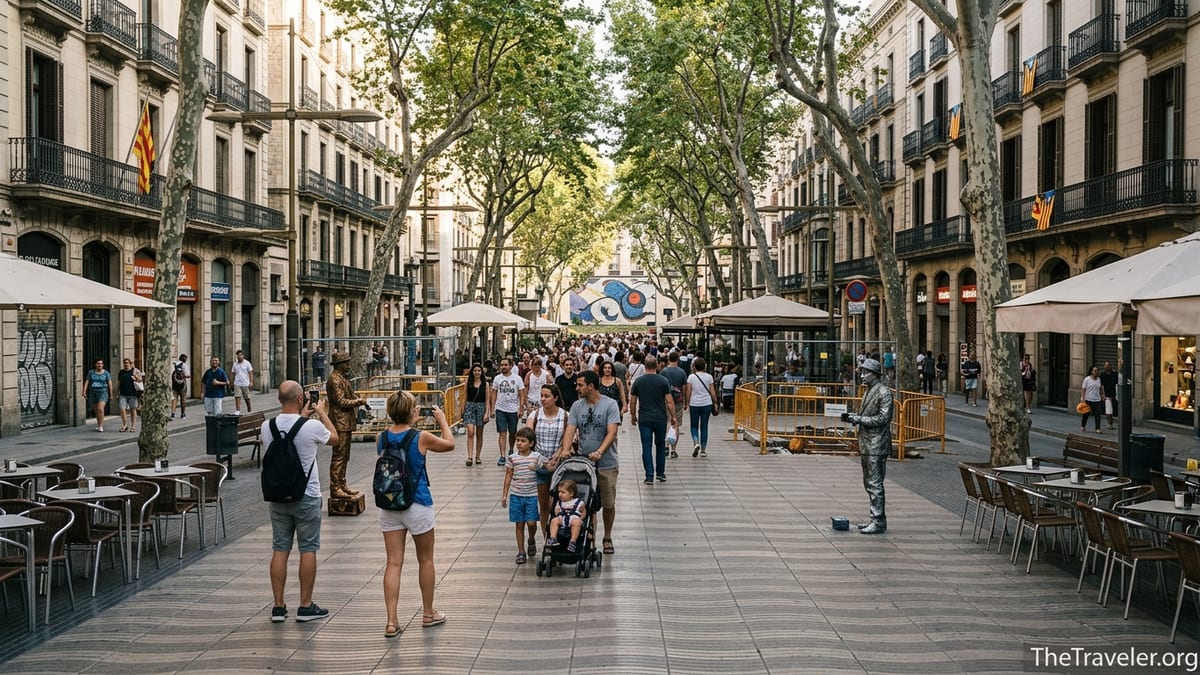
La Rambla is not just “a street with tourists.” It is a 1.2‑kilometer tree‑lined boulevard running from Plaça de Catalunya, Barcelona’s central square, down to the Christopher Columbus monument by the old port. A wide pedestrian promenade occupies the middle, flanked by narrow traffic lanes on either side. Underneath runs Metro line L3, with stations like Liceu and Drassanes making it one of the city’s most accessible arteries.
On a typical afternoon you will see cruise‑ship passengers shuffling in groups behind guides with colored umbrellas, families pushing strollers, street performers painted in metallic body paint, hen parties and solo travelers pulling wheelie bags to nearby hotels. Cafés advertise espresso and fresh‑squeezed orange juice at small sidewalk counters; souvenir kiosks sell FC Barcelona scarves, flamenco fridge magnets and straw hats. You will hear English, French, Italian and German as often as Catalan or Spanish.
The atmosphere changes along its length. Near Plaça de Catalunya, flagship retail stores and large hotels dominate side streets. Around the Liceu opera house and the famous La Boqueria market, the crowds thicken and restaurant hosts compete aggressively for customers. Farther down towards Drassanes, there is more open sky, a view of the port and, in the evenings, a heavier nightlife presence.
This mix of central location, transit access and constant footfall is precisely why La Rambla became what it is today: an almost unavoidable crossroads for visitors and a place from which many residents quietly retreated.
The “Too Touristy” Problem: Crowds, Prices and Pickpockets
If you ask long‑time Barcelonians whether they go to La Rambla for fun, many will say they avoid it unless absolutely necessary. Over the last decade, rising visitor numbers and short‑term rentals have pushed the area toward a tourism‑first economy. That shift shows up in several very tangible ways for travelers.
The first is simple congestion. In high season and on weekends, particularly when cruise ships dock or there is a festival in town, the pedestrian strip can feel like a moving carpet of people. It can take 20 to 30 minutes to walk the kilometer between Plaça de Catalunya and the port because you are frequently forced to slow to the pace of the densest groups. If you are sensitive to crowds, this alone may make the stroll more stressful than enjoyable.
The second is pricing. A coffee on one of the marquee terrace cafés directly on La Rambla can easily cost double what you would pay two or three blocks inland. It is not unusual to see menus listing a basic café con leche for 3 to 4 euros and a simple sangria for 8 to 10 euros, with a bowl of patatas bravas reaching 9 to 12 euros. At a neighborhood bar in the nearby Raval or Gòtic backstreets, you might pay closer to 1.50 to 2 euros for the same coffee and find lunch menus of the day in the 13 to 18 euro bracket rather than tourist‑priced main courses.
The third and most discussed issue is petty crime. Local statistics and traveler reports consistently highlight La Rambla as a hotspot for pickpocketing, especially around the Boqueria entrance, at Metro stairways and on crowded corners near Plaça de Catalunya. Typical real‑world scenarios involve someone bumping you “by accident” while an accomplice lifts your phone from a back pocket, or a friendly stranger offering a hug, petition or bracelet while their partner’s hands move toward your bag. Travelers frequently share stories of realizing a phone or wallet is gone only after stepping away from a street show or leaving a terrace table.
How Locals and the City Are Trying to Reclaim La Rambla
What makes La Rambla particularly interesting right now is that Barcelona is not simply accepting its fate as a permanent tourist funnel. In recent years, the city council has launched an ambitious, long‑term redevelopment project to transform the promenade by roughly 2027. Official plans emphasize turning La Rambla from a tourist “attraction” into a civic corridor focused on culture, greenery and public life rather than purely consumption.
The works, which began in sections and will roll out along the full length from the Columbus monument up to Plaça de Catalunya, include widening and leveling sidewalks, reducing car lanes, planting more trees and reconfiguring crossings to make it easier to wander between the Gòtic and Raval neighborhoods. Existing cultural anchors like the Gran Teatre del Liceu, the Centre d’Arts Santa Mònica and nearby museums are meant to play a bigger role, with more outdoor performances, book fairs and small cultural events programmed directly on the promenade.
In 2024 the city also convened an advisory council dedicated specifically to La Rambla’s future. Its members, including business owners, cultural figures and urban planners, have argued publicly that the street’s survival depends on drawing residents back through culture, not just painting new lines on the pavement. Their recommendations include encouraging independent bookstores and creative studios instead of yet another souvenir shop, and even converting some overbuilt hotel or office space back into housing to rebalance the resident population along the boulevard.
For travelers, this matters because it suggests La Rambla of the late 2020s may look and feel different from the pre‑pandemic peak. Even today you might stumble upon a bookstall fair during Sant Jordi celebrations, a classical music open rehearsal outside the Liceu or a temporary art installation occupying an entire section of the central promenade. The street is in flux, which can mean construction barriers and noise but also a chance to see a famous place mid‑transformation.
When La Rambla Is Worth Your Time
Despite all its issues, there are strong reasons many travelers still choose to visit La Rambla, especially on a first trip to Barcelona. One is simple orientation. Because it connects Plaça de Catalunya to the waterfront and slices between two historic quarters, walking it once gives you a physical sense of how the old city fits together. From the promenade you can duck into the medieval lanes of the Barri Gòtic to visit Barcelona Cathedral, or cross west into El Raval for contemporary culture at the MACBA museum and more local bars.
Another is architectural and historic context. Several significant buildings and spaces line or branch off the boulevard. The Liceu opera house, with its richly restored interior, still hosts world‑class performances. The mosaic by Joan Miró, often trampled underfoot near the Liceu Metro entrance, provides a subtle link to Barcelona’s modernist and surrealist heritage if you pause long enough to notice it. At the lower end, the Columbus Monument and its surrounding square frame the transition from medieval city to maritime port.
La Rambla can also be enjoyable at carefully chosen times. Early morning, between roughly 7:30 and 9:00, the street feels almost like a different place. Market workers roll up shutters, delivery vans unload bread and produce, and office‑bound locals cut through briskly. Terraces are quiet, performers are just setting up, and the usual tide of tour groups has not yet arrived. An inexpensive espresso at a standing‑room bar during this hour will feel far more “real” than a midday paella special under a misting fan.
Finally, some visitors simply want to see the places they have read about, even if only briefly. Much as first‑time travelers to Paris still walk along the Champs‑Élysées fully aware it is not where Parisians shop, many people feel that skipping La Rambla entirely would leave their mental map of Barcelona incomplete. If you go in with your eyes open and keep your expectations calibrated, a single, strategic pass can satisfy that curiosity without dominating your itinerary.
When You Might Skip It and What to Do Instead
If your tolerance for crowded, commercialized spaces is low, or if you only have a short time in Barcelona, it is perfectly reasonable to give La Rambla a miss. You will not lose access to any unique landmark that cannot be approached from another street, and you may find better versions of what you are seeking elsewhere.
For example, if what you want is a lively local promenade with outdoor cafés and street life, consider Passeig de Sant Joan or Rambla del Poblenou. These wide boulevards have bike lanes, trees and playgrounds, but their terraces are still largely used by residents, with more Catalan than English on the menus. Prices are usually lower, and petty crime feels less concentrated. Even closer to the center, the broad pedestrian section of Passeig de Gràcia around Casa Batlló provides elegant architecture, designer shopping and people‑watching without La Rambla’s particular intensity.
If you are mainly interested in food, walking five minutes off La Rambla opens up far better options. The Boqueria market itself is famous but heavily geared toward visitors, with photo‑ready fruit cups and juice stands at tourist prices. Many locals now prefer markets like Santa Caterina near the Born district, with its undulating tiled roof, or Sant Antoni, whose vendors mix everyday shopping baskets with tapas counters frequented by residents. In the evenings, streets like Carrer Parlament in Sant Antoni or parts of Gràcia offer bar‑hopping and tapas with a distinctly local feel.
Travelers who prioritize safety and calm, including many solo visitors and families with young children, may also find more peace of mind on alternative walking routes. A stroll along the seafront boardwalk from Barceloneta toward the Olympic Port or Poblenou, or an uphill wander through the Eixample grid with its modernist façades, can be just as memorable without the same concentration of touts and opportunistic thieves.
How to Visit La Rambla Smartly and Safely
If you do decide La Rambla deserves a spot on your itinerary, a few practical choices can significantly improve the experience. Timing is crucial. Early morning or late afternoon outside peak summer months tends to be more relaxed, with softer light and cooler temperatures. Midday in July and August, when temperatures climb and cruise excursions hit at once, is when discomfort and risk both increase.
Treat the boulevard as a visual walk rather than a place to linger with valuables on display. Keep your bag zipped and in front of you, carry phones and wallets in front pockets or a money belt, and avoid placing them on café tables or dangling them from back pockets. If someone approaches you unusually close with an unsolicited offer, petition or friendly gesture, assume distraction may be part of their strategy and politely but firmly move away.
Where you sit and spend also matters. Many of the most aggressively priced and least satisfying meals lie directly on the central strip. If you want to rest your feet, consider stepping one or two streets to either side into the Gòtic or Raval, where you can often find smaller bars serving a simple café con leche for around 2 euros or a local vermut and olives at more typical city prices. This approach lets you use La Rambla as a scenic spine while still supporting more diverse local businesses slightly off the main drag.
Finally, manage your own expectations and pace. Aim to walk the length once, perhaps detouring briefly into La Boqueria to look rather than sit for a full meal, and then move on. Combine the stroll with a specific cultural stop, such as a daytime tour of the Liceu or an exhibition at a nearby arts center, to give the outing more substance than just weaving through crowds.
Balancing Overtourism Concerns With Traveler Curiosity
In recent years, Barcelona has seen visible protests against overtourism, including demonstrations that passed near central areas like La Rambla. These reflect deep local frustrations over housing costs, noise, crowding and a sense that parts of the city have been turned into a backdrop for other people’s holidays at the expense of everyday life. For visitors, this context raises a fair ethical question: by walking La Rambla, are you contributing to a problem?
In reality, the issue is not a single street but how tourism is managed city‑wide. La Rambla is already part of the visitor circuit; avoiding it personally will not change the overall flow. What you can control is your behavior and spending pattern. Choosing locally owned cafés or shops on the side streets instead of only the largest chains, respecting noise at night, using public transport instead of unlicensed taxis and not blocking narrow alleys with large groups are small but meaningful ways to reduce your footprint.
Some locals also point out that many travelers genuinely seek more authentic, less crowded spaces but arrive without good information or feel overwhelmed by choice. By diversifying your itinerary beyond the classic postcard spots and being mindful of where you stay and dine, you help distribute the pressure more evenly. Visiting La Rambla briefly and then spending the bulk of your time and budget in neighborhoods where residents still dominate the pavements can be a reasonable middle ground.
Ultimately, whether La Rambla feels “too touristy” is partly a matter of personal threshold. A traveler used to the bustle of Times Square or Rome’s Via del Corso may find it energetic but manageable, while someone who prefers quiet medieval backstreets or small coastal villages might consider it an ordeal. Knowing the context and going in prepared allows you to decide for yourself rather than be surprised on the spot.
The Takeaway
La Rambla today is many things at once: a historic promenade, a work‑in‑progress urban project, a magnet for tourist crowds and petty thieves, and a symbol of Barcelona’s struggle to balance its global appeal with local quality of life. It is unquestionably touristy. Yet it also remains physically and historically central to the city, with cultural institutions and everyday connections that go beyond souvenir stands.
For most first‑time visitors, La Rambla is worth seeing once, briefly and on your own terms. Walk it in the cool of the morning or late afternoon, keep your valuables secure, and treat it as a scenic corridor linking more rewarding stops rather than the main attraction. If you already know you dislike crowded high‑street environments or have limited time, you will miss little by prioritizing alternative promenades, markets and neighborhoods that better reflect how Barcelonians live today.
In the coming years, as redevelopment projects finish and cultural programming takes root, La Rambla may evolve into something closer to the layered, locally loved boulevard it once was. Until then, it is best approached with clear expectations: not as the essence of Barcelona, but as one chapter in a much richer urban story you can explore far beyond its tree‑lined central strip.
FAQ
Q1. Is La Rambla safe to visit during the day?
La Rambla is generally safe during daylight hours if you stay alert, keep bags zipped and in front of you, and avoid displaying phones or wallets carelessly.
Q2. What is the best time of day to walk La Rambla?
Early morning between about 7:30 and 9:00 or late afternoon outside peak summer tends to be more pleasant, with fewer crowds and softer light.
Q3. Are restaurants on La Rambla really more expensive?
Yes, terrace cafés directly on the boulevard often charge significantly higher prices than bars and eateries just a few streets away in the Gòtic or Raval.
Q4. Is La Rambla suitable for families with children?
It can be, but go at quieter times, keep children close in crowds, and consider limiting your visit to a short walk rather than a long stop with strollers and bags.
Q5. How long does it take to walk the full length of La Rambla?
Without heavy crowds the 1.2‑kilometer stretch takes about 15 minutes, but in peak season it can easily stretch to 25 or 30 minutes.
Q6. Are there still local businesses on or near La Rambla?
Yes, although tourism dominates, there are still traditional cafés, small shops and cultural venues, especially on the side streets leading into Gòtic and Raval.
Q7. Should I visit La Boqueria market while I am on La Rambla?
It is worth a quick look for its colors and energy, but for less touristy shopping and eating, markets like Santa Caterina or Sant Antoni are often better choices.
Q8. What is the dress code or etiquette for visiting La Rambla?
Casual clothing is fine; the key is practical shoes, secure bags and respectful behavior toward residents, avoiding loud groups or blocking narrow side streets.
Q9. Can I skip La Rambla and still see Barcelona’s highlights?
Absolutely. You can reach major sights like the Gothic Quarter, the cathedral and the waterfront via other streets without setting foot on the main promenade.
Q10. Will La Rambla change in the next few years?
Yes, ongoing city projects aim to reduce car traffic, add greenery and boost cultural activities, so the street is likely to feel gradually less like a pure tourist funnel.