


Malta is often sold as a classic summer escape, all golden bays and Blue Lagoon boat trips. Yet from November to March, the islands quietly shift into a different destination: greener, cooler, cheaper and far less crowded. For value focused travelers who care more about historic streets than sun loungers, winter can be the smartest time to visit. The key question is not just whether Malta is pleasant in winter, but whether it offers good value for the money once you factor in weather, sightseeing, hotels and transport.
Get the latest updates straight to your inbox!
What Winter in Malta Really Feels Like
Malta’s winter is mild by northern European or North American standards. Long term climate data for Valletta and central Malta shows average daytime highs in January around 15 to 16 degrees Celsius and night time lows close to 10 degrees. There is still a real winter season, with wind, showers and cool evenings, but snow and frost are essentially unknown. On many days you will walk around comfortably in a light jacket or sweater rather than a heavy coat.
December, January and February bring more cloud and rain than other months, but daylight hours remain noticeably longer than in cities such as London or Berlin. A typical January day might start around 10 degrees, climb to the mid teens by afternoon, then cool quickly after sunset when humidity and wind can make it feel colder than the thermometer suggests. Travelers who are happy with “spring like” weather rather than beach conditions often find this ideal for exploring.
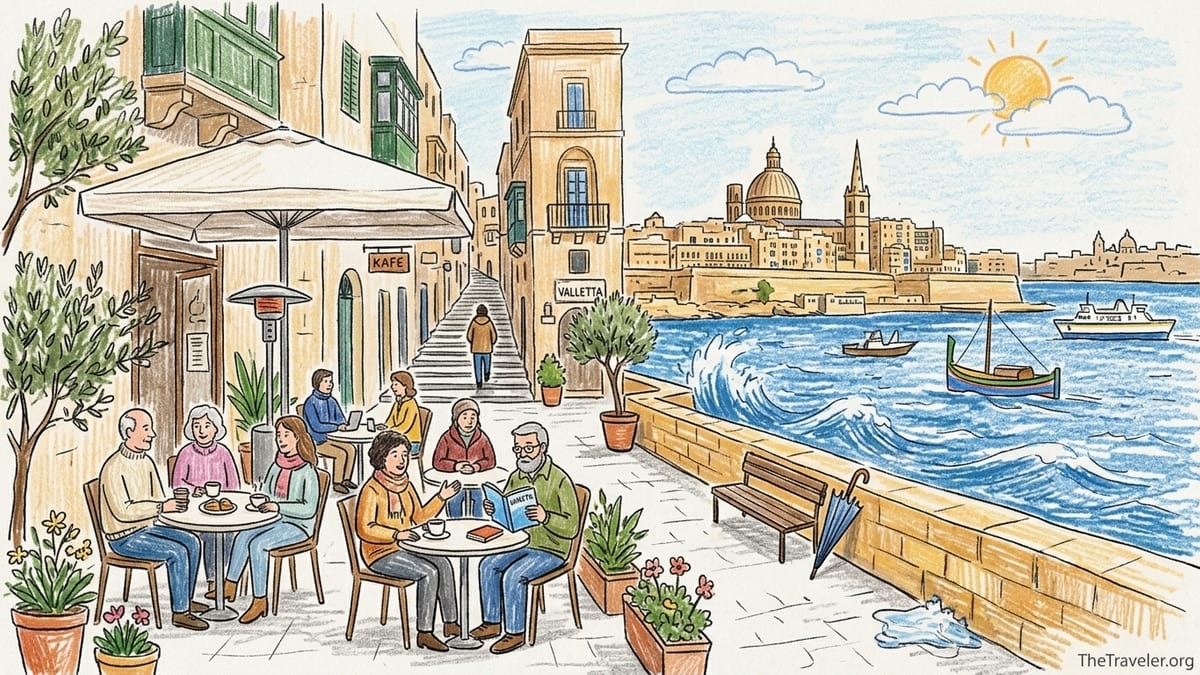
There are still occasional warm spells. Local climate records note that even in mid winter some afternoons reach 18 to 20 degrees, and you will see people sitting outdoors in sheltered harborside cafés in Valletta or Sliema. On the other hand, storms can roll in off the Mediterranean for a day or two at a time, closing boat trips and making coastal walks unpleasant. Planning a flexible itinerary, with indoor options such as museums and churches, is essential.
One surprise for many visitors is that Maltese houses are often built for summer, with thick stone walls but limited insulation or central heating. A basic hotel room may feel chilly on damp days. If you feel the cold, it is worth paying a little more for accommodation that mentions efficient heating or modern climate control, especially for stays in older townhouses or traditional guesthouses.
Does Malta in Winter Offer Good Value?
From a cost perspective, winter is the most budget friendly season for Malta outside the Christmas and New Year holidays. Tourism authorities and local travel planners generally define the off season as November to March, excluding festive peaks and specific event weekends. Flight schedules thin out from smaller regional airports, but major hubs across Europe continue to serve Malta International Airport, often with attractive off season fares.
Flight prices vary widely by departure city, but it is not unusual to see return fares from major European hubs dipping under 150 euros in January or February on low cost carriers if booked in advance, especially midweek. In contrast, the same routes can be significantly higher in July and August. For long haul travelers connecting via Europe, winter fares from North America to European hubs are often lower outside the Christmas period, which can make a winter Malta stopover comparatively good value.
On the ground, accommodation is where the clearest savings appear. Hotel booking data commonly shows three and four star properties in areas such as Sliema, St Julian’s and the outskirts of Valletta pricing standard double rooms in winter from roughly 60 to 90 euros per night, depending on exact dates, quality and how far ahead you book. In peak summer those same rooms can easily push past 150 euros, especially with sea views. Boutique guesthouses within Valletta’s walls may run from around 90 to 140 euros in winter instead of much higher summer rates, reflecting the premium location but still offering a discount compared with August.
Daily spending is also easier on the wallet in the cooler months. Seaside kiosks and seasonal lidos may be closed, but many restaurants run set lunch menus or off season promotions. A sit down plate of homemade ravioli or rabbit at a mid range restaurant in Rabat, including a non alcoholic drink, often comes to around 18 to 25 euros per person. In more touristic waterfront areas, prices are higher but still modest by Western European capital standards. For travelers comfortable using buses and staying in mid range accommodation, a realistic winter daily budget excluding flights can often be kept in the 70 to 120 euro range per person, depending on how often you dine in higher end places or book guided tours.
Winter Weather and How It Shapes Your Trip
Malta’s winter climate shapes what you can comfortably do each day. The sea temperature drops to the mid teens Celsius in January and February, too cold for most casual swimmers, and strong winds or rough seas are common. Long term climate tables show that December and January are among the wettest months, with around ten to fifteen days of measurable rainfall on average. That does not translate to constant drizzle, but rather to periodic downpours and some grey days between brighter spells.
Sunshine hours remain respectable for winter. Historical figures suggest an average of roughly five to six hours of bright sunshine per day across December to February. Practically speaking, that means many mornings or afternoons will still feel pleasantly bright, even if a passing shower interrupts your walk along the Sliema seafront or the Upper Barrakka Gardens. Packing a compact umbrella and a light waterproof jacket is far more useful than filling your suitcase with beachwear you may not use.
Wind is an under appreciated factor. Strong north easterlies can whip up large waves along exposed coasts, occasionally leading to dramatic scenes at places like the Sliema promenade or Marsascala’s harbor walls. Ferries to Gozo or small boat trips to the Blue Grotto and Comino are sometimes cancelled or rescheduled for safety, which can disrupt tight itineraries. If boat excursions are important to you, try to plan them earlier in your stay so you have spare days to reshuffle if the weather deteriorates.
For many, the trade off is positive. Without intense summer heat, walking the stepped streets of Valletta, exploring the fortified city of Mdina or hiking the Dingli Cliffs becomes far more comfortable. Families with young children and older travelers often report that they can spend full days sightseeing without the midday shutdown that July and August practically force. The result is a slower, more immersive visit, provided you accept that you will likely not be swimming or sunbathing much.
Sightseeing in the Off Season: What Stays Open
Malta’s major cultural and historical attractions operate year round, which is one reason the islands remain attractive in winter. The fortified capital Valletta, the medieval hilltop city of Mdina and its neighbor Rabat, and the Three Cities across the Grand Harbour are all working towns as well as tourist draws. Their streets, churches, small museums and cafés do not close when the last charter flight of summer departs. You can walk into St John’s Co Cathedral on a cool January morning, admire Caravaggio’s paintings without elbow to elbow crowds, then sit down for coffee in a quiet side street that in August would be shoulder to shoulder.
Key prehistoric sites, including the Ħaġar Qim and Mnajdra temple complexes in the south of the island, also open through winter, although their exact hours can vary slightly with the season. Visitor centers are enclosed, but the stones themselves stand in exposed locations above the sea, so you will want a windproof layer. In winter, it is entirely possible to find yourself with only a handful of other visitors at World Heritage listed sites that can feel busy in peak months, creating a very different sense of atmosphere.
On Gozo, the Citadel above Victoria, the basilicas at Ta’ Pinu and Xewkija, and coastal spots such as Xlendi and Marsalforn remain accessible throughout the year, but some smaller seaside restaurants may operate on reduced hours or close for renovations in January and February. Travelers doing a winter day trip to Gozo often focus on the Citadel, the inland countryside and one or two villages rather than chasing beach time. A rental car or well planned bus routes make it easy to move between sights even with early winter sunsets.
Boat based attractions are where winter’s limitations show most. Many operators still offer harbor cruises around Valletta’s Grand Harbour and Marsamxett Harbour during calmer spells, but departures can be reduced and same day cancellations more frequent. Day trips to Comino’s Blue Lagoon run on a much smaller scale, if at all, and the experience shifts from swimming and snorkelling to short hikes and coastal viewpoints in brisk wind. If your vision of Malta is mostly about turquoise swims, winter will not deliver that consistently. If your interest leans toward stone alleyways, fortifications and quiet churches, winter offers excellent value.
What You Will Pay for Hotels and Food in Winter
Lodging costs are central to Malta’s winter value proposition. In Sliema and St Julian’s, which have the largest concentration of hotels, winter rates for standard double rooms in reputable three star properties typically start somewhere around 60 to 80 euros per night, with breakfast sometimes included. Four star hotels with indoor pools or spa facilities might quote winter rates in the region of 80 to 130 euros, still substantially lower than mid summer when demand peaks and prices rise accordingly.
Valletta itself tends to be more expensive, but winter narrows the gap. Boutique hotels housed in 16th century townhouses might charge from about 100 to 160 euros per night in January, depending on the room size and view, whereas in June or July similar rooms often climb far higher. Across the harbor in the Three Cities, you may find character guesthouses with harbor views in the 80 to 120 euro range, trading centrality for a quieter, more residential feel that suits winter stays.
Self catering apartments are another good winter value, particularly for longer visits. Platforms listing rentals in central Malta show one bedroom apartments in areas such as Gzira, Msida or inland towns like Mosta and Rabat from roughly 45 to 70 euros per night in deep winter when booked for a week or more. Travelers staying a month or longer sometimes negotiate lower rates directly with owners, making Malta a practical mid range winter base for remote workers who are happy with cooler temperatures.
Food prices remain relatively stable year round, but your experience of dining shifts in winter. In resort zones such as Bugibba or Qawra, some seafront venues close or move to reduced hours, while year round restaurants and local bars continue to serve. In Valletta, Mdina and most residential towns, bakeries and small family run places keep operating, selling pastizzi and ftira sandwiches for just a few euros each. A coffee and pastry breakfast in a local café may cost under five euros, while a glass of local wine in a neighborhood bar can be pleasantly inexpensive compared with many Western capitals.
Getting Around: Buses, Taxis and Winter Logistics
Public buses are the backbone of Malta’s transport system and run all year. The government introduced free bus travel for residents with a personalized Tallinja card in 2022, which does not apply to most visitors but shapes how the system operates. Tourists without such a card generally pay a seasonal fixed fare for single journeys on day services when buying from drivers or tapping a contactless bank card. Recent fare announcements for the 2025 to 2026 winter period set this standard single fare at 2 euros, valid for two hours of travel with transfers on day routes when using cash or contactless payment.
For short term visitors, Malta Public Transport also offers Explore cards that provide unlimited travel for a set number of days. An adult Explore 7 Day card has recently been priced at 25 euros, giving one week of bus travel on day and night routes except certain direct services. These cards are widely sold at the airport arrivals hall ticket kiosk and in sales outlets in places such as Valletta, Sliema and Bugibba. A traveler planning to use buses multiple times per day to explore the island in winter often finds the Explore card more convenient than carrying exact change and paying single fares.
Buses cover all towns and most major sights, though journey times can be slow at rush hours and routes sometimes detour through residential areas. In winter, there is generally enough capacity, but service frequency may be lower on some routes compared with high season schedules. The main bus interchange in Valletta is the hub; from there, routes fan out to Mdina and Rabat, Marsaxlokk, Mellieħa and Cirkewwa for the Gozo ferry. Schedules vary, so using the official transport app or checking departure boards is important, especially in bad weather when congestion can cause delays.
For evenings or early mornings when bus services are less convenient, app based ride services and white taxis are widely available in urban areas. A ride from Valletta to St Julian’s in winter might typically fall somewhere in the 12 to 20 euro range depending on demand and company, with longer cross island trips costing more but still manageable when split between two or three people. For day trips that combine scattered rural sights, such as Dingli Cliffs, Blue Grotto viewpoints and small villages, many visitors either rent a car for 30 to 50 euros per day in low season or book organized tours, which can run from around 25 to 60 euros per person depending on inclusions.
Who Will Enjoy Malta in Winter (And Who Will Not)
Malta in winter suits certain kinds of travelers particularly well. History enthusiasts who want to dig into the islands’ layered past, from prehistoric temples to the Knights of St John and World War II, may find winter the ideal season. Off peak crowds make it easier to linger over details in museums and churches, and the softer light and changeable skies can make photography more atmospheric. Walkers and casual hikers who prefer 14 degree air temperatures to 32 degree heat also tend to appreciate winter’s conditions, especially on routes along the Dingli Cliffs, around Gozo’s rural interior or through the countryside between villages.
Budget conscious city trippers who like a compact capital full of character, good coffee, and the chance to see local life without the crush of mass tourism should consider basing themselves in Valletta, Floriana or the Three Cities. From there, buses or short taxi rides will connect them to most of the island, and evenings can be spent in wine bars and small restaurants that feel like neighborhood hangouts rather than resort venues. Winter is also attractive for remote workers who want a change of scene for a few weeks, since apartment rates are comparatively low and long term rentals often include decent internet connections as standard.
By contrast, travelers whose top priority is swimming in warm seas and sunbathing every day are likely to be disappointed. While occasional winter days are warm enough for hardy swimmers, sea temperatures and wind mean regular beach days cannot be expected. Families hoping to tire out younger children with hours in the water may find the islands’ small size and limited indoor attractions a constraint in bad weather. Nightlife seekers who want open air clubs, beach parties and a classic resort buzz will find the bar scene in St Julian’s and Paceville much quieter than in July or August, even though local nightlife does continue at a more low key level.
If you are particularly sensitive to cold, the combination of humid air and buildings without central heating might also be a drawback. While daytime highs look mild on paper, damp interiors can feel chilly in January storms. Packing layers, including a warm sweater and socks for evenings in your room, will help, but travelers craving a mid winter destination where they can comfortably sit outdoors late into the night without a jacket might be better off further south or in a different climate zone entirely.
Is Malta Worth It in Winter? A Value Verdict
Taking weather, costs, transport and sightseeing together, Malta in winter emerges as a solid value oriented destination for travelers whose expectations match the season. Airfares from Europe and hotel rates across the islands are generally at their lowest outside Christmas and specific events, and public bus travel is affordable, especially with multi day passes. Food and drink prices are moderate, and the absence of high season markups on everything from boat tours to basic souvenirs helps keep daily spending predictable.
The trade off is simple but non negotiable. You exchange reliable beach weather and full scale resort life for cooler temperatures, more uncertain skies and a quieter social scene. In return, you gain open space at UNESCO listed temples, uncrowded medieval streets in Mdina and Valletta, and locals who have more time to talk when not overwhelmed by summer crowds. For many culturally inclined travelers, that is a favorable bargain, especially when they see their final trip costs compared with a high season visit.
The key to a satisfying winter trip is honest self assessment. If the idea of a windswept walk along Dingli Cliffs followed by a plate of hot fish soup in Marsaxlokk sounds appealing, Malta in January or February will likely feel rewarding and pleasantly affordable. If your mental image of Malta is inseparable from sun loungers and turquoise coves, you may want to shift your dates to late spring or early autumn instead, when sea temperatures rise and boat services run at full strength while prices remain lower than in high summer.
For travelers prepared for a Mediterranean winter, Malta offers distinctive landscapes, dense history and a manageable price tag. It may not deliver a tropical escape, but it provides an engaging, often under appreciated off season experience that can feel like a different country compared with its sun baked summer self.