


For most visitors, Oslo Central Station, known locally as Oslo S, is the first real taste of Norway beyond the airport arrivals hall. It is where high-speed airport trains glide in alongside regional services to Bergen and Trondheim, and where jet-lagged travelers try to decode ticket machines, platforms and tram stops in a new language. Is it actually easy to use, or does it feel like a maze when you are hauling luggage and watching the clock? Drawing on recent traveler reports and up-to-date information, this guide looks at how Oslo S really works in practice: how clear the signs are, how crowded it gets, and what people say about their experience of moving through Norway’s busiest station.
Get the latest updates straight to your inbox!
First Impressions: Arriving at Oslo S from the Airport
For many international visitors, the first encounter with Oslo Central Station is stepping off the airport express train or Vy regional service from Oslo Gardermoen Airport. The journey typically takes around 19 to 22 minutes on the Flytoget Airport Express and roughly 22 to 25 minutes on the cheaper Vy trains, so you go from aircraft cabin to city-centre platforms surprisingly fast. That short ride means the real test of how easy it is to arrive in Oslo is not the train itself, but what happens once the doors open at Oslo S.
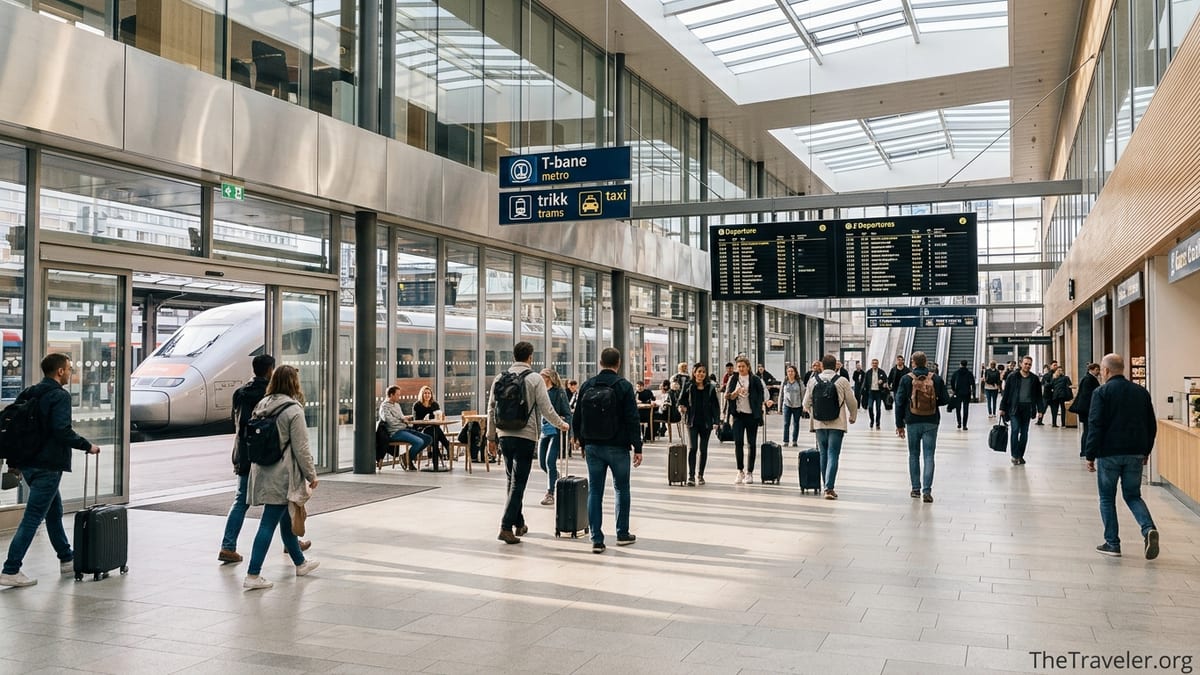
Travelers arriving with luggage usually disembark onto wide, level platforms with elevators and escalators up to the main concourse. Recent visitor reports describe the station as modern and bright, with high ceilings and a lot of glass, so the transition from the airport’s polished interior to Oslo S feels consistent rather than jarring. Digital departure boards are placed at the end of platforms and in the main hall, which helps people immediately see onward connections to places like Bergen, Trondheim or local commuter lines.
One detail that often reassures first-time visitors is that Flytoget and the Vy airport trains both use clear English-language announcements. As the train pulls into Oslo S, a recorded message explains that you are at the city’s main station and gives information about where to find taxis, buses and the metro. For a traveler landing in Norway late in the evening and perhaps anxious about making a hotel check-in or night train, that clear handover from train to station is a strong point in Oslo S’s favour.
Criticisms do surface. Some visitors who arrive during the peak commuter rush or on winter afternoons mention that the station can feel crowded and slightly chaotic at the exits near the bus terminal and tram stops. Others note that if you are expecting the train to continue one more stop to Nationaltheatret, you need to double-check the screens, because some airport express departures now terminate at Oslo S only. In general, though, the consensus is that physically arriving at the station is straightforward, and confusion starts only when you are trying to choose the right way out.
Layout and Signage: Finding Your Way Around
The overall layout of Oslo Central Station is fairly simple once you have seen it, but first-time visitors often describe a short moment of disorientation while they get their bearings. The station is made up of long rows of platforms at ground level, a main concourse running parallel to them, and several exits that lead to different parts of the city centre, including the bus terminal, the metro hub at Jernbanetorget and the historic Østbanehallen food and shopping hall.
Signage is one of the key reasons many travelers report that Oslo S is ultimately easy to use. Direction signs are typically in Norwegian and English, using clear icons to mark the “T-bane” (metro), trams, buses, taxis and city streets. Overhead boards show live departures with platform numbers, and ticket machines are clustered in logical places near entries and exits rather than being hidden in side corridors. People arriving from the airport usually find that walking from the platform to the main concourse takes only a couple of minutes, with signs to “City center / Sentrum” and “Jernbanetorget” making it clear where to go for onward urban transport.
However, several recent trip reports and forum posts mention that it can be confusing the first time you try to move between the station and the adjacent Oslo Bus Terminal. The route involves heading towards the end of the platforms, exiting through the main doors and then crossing a plaza and enclosed walkway. It is not difficult, but if you are carrying ski bags in January or arriving with children late at night, that small extra navigation step can feel like a puzzle. Locals often advise giving yourself at least 10 to 15 minutes for a tight bus connection until you are familiar with the walk.
Inside the station building, the refurbished Østbanehallen wing is one of the most intuitive areas: it is essentially a curved arcade filled with cafes, restaurants and small boutiques. Many travelers naturally drift through this area on their way to hotels like the popular chains that line the streets outside. The downside is that if you are only following the smell of coffee, it is easy to walk further than you need and overshoot the exits to the metro or tram stops. The best strategy is to pause for one minute in the central concourse, locate the big departure and information boards, and orient yourself using the clearly marked “T-bane” and “Trikk” (tram) signs before you start walking with your luggage.
Tickets, Apps and Machines: How Easy Is It to Pay?
When travelers talk about whether Oslo Central Station is easy to use, ticketing is often where the station performs surprisingly well. Both the Flytoget airport express and the national operator Vy sell tickets via user-friendly English-language apps, and most visitors now download one or both before landing. The apps allow you to buy airport train tickets or long-distance journeys from Oslo S using international bank cards or Apple and Google Pay, and to show a digital ticket on your phone rather than printing anything.
For people who prefer not to rely on mobile data, Oslo S also has a network of ticket machines and staffed counters. Recent guides highlight that the same machines can sell both Flytoget and Vy tickets, which can be confusing if you do not realise there are two different services to the airport at very different price points. As a rule of thumb, Flytoget is the faster, premium train with prices in the mid-200 NOK range for a one-way trip to the airport, while Vy’s regional and local trains cost roughly half that but are a few minutes slower. Staff at the information desks and ticket counters are generally reported as helpful and fluent in English, and they will often ask whether price or speed is more important before recommending a ticket.
Within the city, the Ruter public transport system covers metro, trams and buses, and many travelers top up a Ruter ticket or pass as soon as they arrive at Oslo S. You can do this via the Ruter app or at designated machines on or near the concourse. Long-stay visitors often mention buying a 24-hour or 7-day pass that is valid across the city zones, then using Vy or Flytoget separately for the airport leg. The machines and the app are both available in English and take major international cards, which lowers the barrier for visitors who are unfamiliar with Norwegian currency or do not want to withdraw cash immediately.
The main ticketing challenges arise when people are rushing. For example, a traveler arriving by bus at the central terminal with only a few minutes to catch a Bergen-bound train might find the cluster of different machines in the hall intimidating. That is where planning helps: most experienced visitors advise buying or at least researching your long-distance tickets before you arrive at the station, and then using Oslo S mainly as a place to move between platforms rather than as a last-minute ticket office.
Accessibility, Luggage and Traveling With Kids
From an accessibility perspective, Oslo Central Station scores relatively well in traveler accounts. The platforms used for airport trains and most intercity services have level access to the trains or small gaps that staff can assist with, and there are elevators as well as escalators between the platform level and concourse. Visitors using wheelchairs or pushing strollers often mention that they can move across the station without needing to tackle long flights of stairs, although lifts can be busy at peak times.
The presence of wide doors, step-free routes and clearly marked elevators is particularly helpful for families arriving with bulky luggage. For example, a family flying in for a ski holiday might have two large suitcases and ski bags; they can roll everything straight from the Flytoget or Vy airport train onto the concourse, then use elevators to reach the street level for a short walk to nearby hotels opposite the station. Several central hotels deliberately advertise their location as “across from Oslo S” for this reason, making the arrival relatively painless even in winter.
Inside the station and its immediate surroundings, travelers can find essentials like supermarkets, convenience stores, a pharmacy and fast-food outlets. One recent comment highlighted the small supermarket just outside the station near the bus terminal entrance, where visitors can quickly buy snacks, SIM cards or basic toiletries after a flight. This cluster of services makes Oslo S feel more like a compact mall than a bare transport node, which is useful if you are traveling with children who need a break or food before continuing by train.
That said, some families report that the concourse can feel overstimulating at busy times, with a mix of commuters rushing past, announcements echoing and people queuing at coffee bars. Parents who prefer a calmer environment sometimes step into the quieter Østbanehallen wing to sit in a cafe, or head directly to their hotel to regroup. Overall, though, the practical aspects of accessibility, luggage handling and family needs are well covered, and serious obstacles are rare in recent traveler feedback.
Safety, Cleanliness and Late-Night Travel
Safety is a frequent concern for travelers assessing any major rail hub, and Oslo Central Station is no exception. In general, visitor impressions are that Oslo S feels safer and calmer than many big-city stations elsewhere in Europe, especially during daytime and early evening. The station is well-lit, with visible staff, security and regular police patrols, and the concourse is usually populated by commuters and families rather than large groups hanging around aimlessly.
Several locals have commented online that they are comfortable letting teenagers travel through Oslo S in the evenings, which provides a rough sense of the perceived safety level. That said, like most central stations, there can be a presence of people under the influence of alcohol or occasionally drugs, particularly around the late-night fast-food outlets and some entrances closest to nightlife areas. Visitors are generally advised to use normal big-city awareness: keep valuables close, avoid leaving luggage unattended and stay in well-lit, populated areas of the concourse if you are waiting for a late train.
Cleanliness is another area where Oslo S performs reasonably well in traveler reviews. Platforms and halls are cleaned regularly, litter is limited, and the modern design with light stone and glass helps everything feel brighter. Restrooms are typically pay-to-use and maintained to a standard most visitors find acceptable, though some report short queues during peak times. For people coming directly from the airport, the station’s cleanliness is important in maintaining the sense that Norway is an orderly, well-run destination from the outset.
Late at night, the character of the station changes slightly, as many of the shops and cafes close and the number of passengers thins out. Travelers catching night trains to destinations like Bergen or Trondheim often report that they appreciate the clear signage and reliable departure boards, but they recommend arriving closer to the departure time rather than lingering for hours inside the station. Those with long waits sometimes choose a nearby hotel lobby or cafe instead of the near-empty concourse, simply for comfort.
Connections: Metro, Trams, Buses and Beyond
Ease of use at Oslo Central Station is not only about the station itself but also about how easily you can get from there to the rest of the city or country. On this front, Oslo S performs strongly. Just outside the main building, the Jernbanetorget transport hub brings together the city’s metro (T-bane), multiple tram lines and numerous city buses. Travelers stepping off an airport train can typically reach a metro platform in about five minutes by following signs for “T-bane,” passing through a short underground passage and using escalators or elevators down to the platforms.
Visitors often cite real-world examples of smooth transfers: a business traveler arriving on the airport express, walking directly to the metro and reaching a hotel near Majorstuen in about 25 minutes door-to-door, or a tourist changing from a Bergen train to a tram bound for the Aker Brygge waterfront in under 15 minutes. The integrated ticketing within Oslo’s central zones through the Ruter system means that once you have a valid pass, you can ride metro, trams and buses without worrying about separate fares for each connection.
The one connection that requires a little more planning is the transfer to regional and long-distance buses at the Oslo Bus Terminal. Although it is very close in physical terms, the route involves leaving the main station building and crossing over to the adjacent complex. People heading for airport buses to the smaller Torp Sandefjord Airport, or coaches to other Norwegian cities, sometimes underestimate this walk and end up rushing. Seasoned travelers recommend allowing at least 10 to 15 minutes, especially if you are unfamiliar with the area or carrying heavy bags.
For longer journeys by rail, Oslo S serves as the main starting point for routes to destinations like Bergen, Stavanger, Trondheim and even international trains towards Sweden. The advantage of this centralization is that once you have learned how to read the departure boards and find your platform, using the station for onward adventures becomes progressively easier. Many visitors who feel mildly overwhelmed on their first pass through Oslo S report that by the end of a week in Norway, the station feels intuitive and even pleasantly familiar.
What Travelers Praise and Criticize About Oslo S
Traveler opinions about Oslo Central Station tend to cluster around a few recurring themes. On the positive side, people frequently praise the clarity of signage, the availability of English information and the station’s integration with the wider transport network. The seamless connection from airport trains to metro and trams is often singled out as a highlight, as is the presence of useful services like supermarkets, cafes and a tourist information center inside or immediately around the station.
Another strong point in many accounts is reliability. The airport express and Vy trains serving Oslo S have a reputation for punctuality, and departure boards are generally accurate. One practical example that travelers appreciate is Flytoget’s focus on tight airport connections: for people heading from the city back to Gardermoen, the express train’s frequent departures and strong on-time record often reduce the stress of catching an early-morning or late-night flight. Knowing that the ride from Oslo S to the airport is usually under 25 minutes helps visitors plan with confidence.
On the negative side, some travelers criticize the cost of using the airport express compared with the regular Vy trains, particularly when buying tickets at Oslo S without prior research. Confusion between the two services at the ticket machines can leave people accidentally paying premium prices for a journey that would only be slightly faster than the cheaper option. Others point to occasional bottlenecks near the main exits and the bus terminal walkway, where crowds build up during rush hour or on snowy days.
A smaller but noticeable group of reviewers mention that the station can feel impersonal or slightly cold in atmosphere, especially in winter when it is dark outside by mid-afternoon. While the modern design and bright lighting are appreciated, some visitors say they miss cozy waiting rooms or more clearly marked quiet areas where you can sit with luggage between trains. Still, even those who feel emotionally lukewarm about the building itself usually concede that Oslo S works efficiently as a transport hub, which is ultimately what most travelers need.
The Takeaway
So, is Oslo Central Station easy to use? For the vast majority of travelers, the answer is yes, especially after the first 15 minutes of orientation. The combination of clear bilingual signage, straightforward platform layouts and integrated connections to metro, trams and buses means that practical navigation is rarely a major problem. Most visitors arrive, find their way to the exits or onward trains and continue their journey without drama, which is no small achievement for the country’s busiest rail hub.
The station is not perfect. Ticketing can be confusing if you do not realise there are two very different train services to the airport, and some routes to nearby bus terminals or city streets are less intuitive than they could be. Crowds during rush hour and the slightly impersonal feel of the main concourse are common complaints. Yet these issues tend to be annoyances rather than serious barriers, and they usually fade as soon as travelers have used the station once or twice.
If you are planning a trip to Oslo, a little preparation goes a long way. Download the relevant transport apps, decide in advance whether you prefer the faster Flytoget or the cheaper Vy trains, and look at a simple map of the station so you know where the main exits lead. Arrive with those basics in mind, and Oslo S is likely to feel like a well-organized, functional gateway to the city rather than an obstacle course between you and your hotel.
FAQ
Q1. Is Oslo Central Station confusing for first-time visitors?
Most first-time visitors find Oslo S briefly confusing while they get their bearings, but clear bilingual signs, logical platform layouts and visible departure boards mean most people figure it out quickly.
Q2. How easy is it to get from Oslo Central Station to the metro and trams?
It is straightforward: follow signs for “T-bane” to reach the metro or “Trikk” for trams. The Jernbanetorget hub is directly outside the station, and the walk typically takes about five minutes.
Q3. Are the ticket machines at Oslo S easy to use for foreigners?
Yes. Ticket machines offer English-language menus and accept major international cards. The main challenge is choosing between the premium Flytoget airport express and the cheaper Vy trains, so it helps to decide beforehand.
Q4. Is Oslo Central Station safe at night?
Oslo S is generally considered safe, with good lighting and a visible staff and security presence. As in any big-city station, you should keep normal awareness, especially late at night around entrances and fast-food areas.
Q5. How long does it take to walk from Oslo Central Station to the bus terminal?
The walk to the main Oslo Bus Terminal usually takes around 5 to 10 minutes, but travelers unfamiliar with the route often allow 10 to 15 minutes, especially when carrying luggage or in winter conditions.
Q6. Is the station accessible for wheelchairs and strollers?
Yes. Platforms and concourses are linked by elevators and escalators, and most areas have step-free routes. Travelers using wheelchairs or strollers generally report that they can move through the station without major obstacles.
Q7. Can I buy local public transport tickets for Oslo at the station?
Yes. You can buy Ruter tickets or passes for metro, trams and buses via machines near the concourse or through the Ruter app, which is available in English and accepts international payment cards.
Q8. Are there shops and places to eat inside Oslo Central Station?
There are several cafes, fast-food outlets, convenience stores and a small supermarket in and around Oslo S, including the Østbanehallen wing, so it is easy to grab food, drinks or basic supplies after you arrive.
Q9. How early should I arrive at Oslo S before a long-distance train?
Many travelers aim to arrive 20 to 30 minutes before departure for long-distance trains. This provides time to find the correct platform, buy snacks and handle any ticket questions without rushing.
Q10. Is it better to take Flytoget or the Vy train between Oslo S and the airport?
Flytoget is faster and more frequent but more expensive, while Vy trains are cheaper and only a few minutes slower. If you value speed and have a tight connection, Flytoget appeals; if you want to save money, Vy is usually the better choice.