


Oslo is a compact capital where waterfront modernism sits just minutes from civic history and political power. Nowhere is that contrast clearer than in the short walk between the gleaming Oslo Opera House and the brick towers of Oslo City Hall. If your itinerary is packed and you have time for only one of these landmarks, choosing can be surprisingly difficult. This guide compares both experiences in real, on-the-ground terms so you can decide which stop deserves your limited time in Oslo.
Get the latest updates straight to your inbox!
Understanding the Two Landmarks
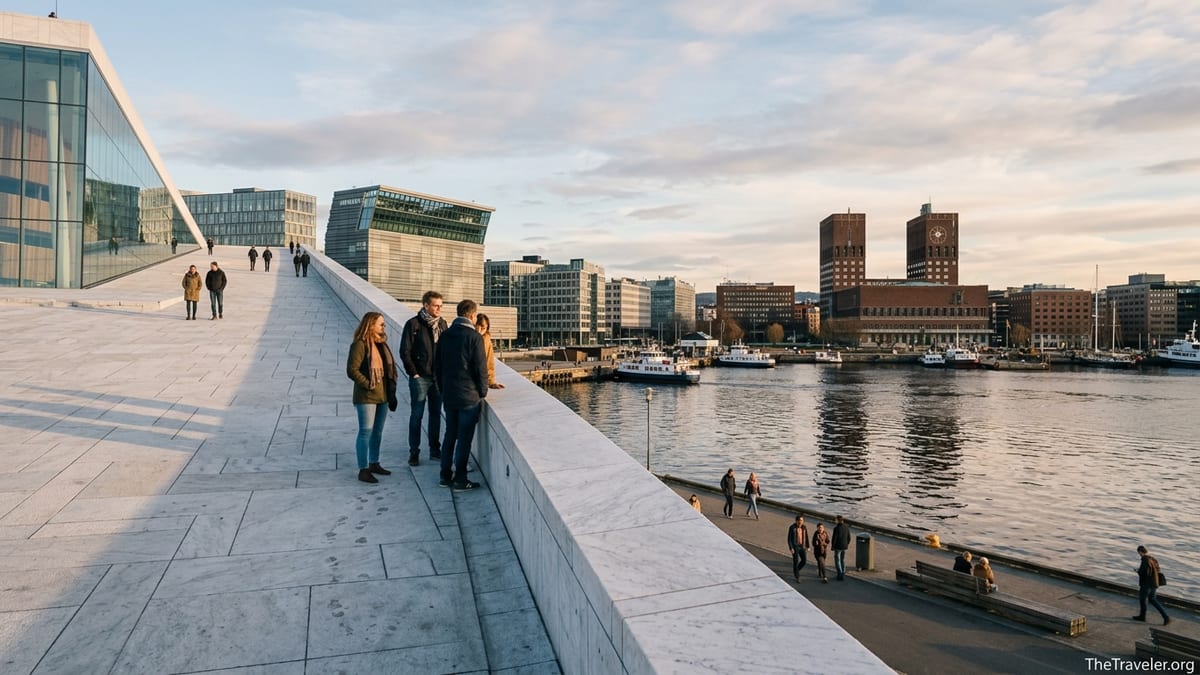
The Oslo Opera House and Oslo City Hall are less than 20 minutes apart on foot, yet they represent two very different faces of Norway. The Opera House is Norway’s flagship contemporary arts venue, a shard of white marble and glass that appears to rise from the Oslofjord. Opened in 2008 and designed by the architecture firm Snøhetta, it quickly became the icon of a modern, forward-looking Oslo and helped transform the Bjørvika waterfront into one of the city’s most photographed districts.
Oslo City Hall, by contrast, is a mid 20th century statement of democracy and everyday civic life. Officially opened in 1950 after wartime delays, its twin brick towers dominate the Pipervika harborfront. Inside, enormous murals, sculptures, and carved oak tell the story of Norway’s social democracy, resistance during the Second World War, and the rise of the welfare state. Since 1990, it has also been the venue for the Nobel Peace Prize ceremony, which gives the building global visibility every year on 10 December.
For travelers, the key difference is this: the Opera House is about space, views, and contemporary culture you can feel with your body as you walk its sloping roof. City Hall is about narrative and symbolism, a place where you read the walls to understand how Norwegians see their own history. Which one “deserves” your time ultimately depends on whether you want a sensory outdoor experience or an indoor immersion in art and politics.
Before choosing, it is also useful to keep in mind that both are easy to reach and usually free to enter. You can walk to the Opera House in about five minutes from Oslo Central Station, and the roof and foyer are free during opening hours. City Hall sits between the ferry piers of Rådhusbrygge and the restaurant-packed boardwalk of Aker Brygge, and its main halls are typically open for self-guided visits at no cost when civic events are not in session.
What You Actually Do at the Oslo Opera House
Most visitors experience the Oslo Opera House as an outdoor playground first and a cultural institution second. The building’s sloping white marble roof is designed as a public plaza, so you simply walk up from the waterfront, step onto the stone, and wander upwards. On a summer morning around 9 or 10, you might have long stretches of the roof almost to yourself, with joggers passing by and a few families taking photos against the backdrop of the Oslofjord. In winter, sections can be roped off for safety if ice forms, but as long as the weather cooperates, the idea remains the same: this is a building you climb, not just look at.
From the top, you look down over the harbor promenade and across to the island ferries, with Akershus Fortress to the west, the new Munch museum and Bjørvika skyline to the east, and, on a clear day, low hills in the distance. Travelers often combine this with neighboring sights in one block of time: for example, a common pattern is to walk the roof, then step next door to the Deichman Bjørvika main library for coffee and fjord views through its floor to ceiling windows, or continue along the waterfront path toward Sørenga’s harbor baths.
Inside, the public foyers showcase pale oak, sculptural staircases, and light filtering through glass facades. Even if you do not attend a performance, you can usually wander in, admire the main hall, check out the small shop, or pause at the Brasserie Opera for a drink. If you want to go deeper, guided tours in English typically last about 50 to 60 minutes and take you backstage to costume workshops, rehearsal rooms, and sometimes onto the main stage, depending on rehearsal schedules. Prices fluctuate, but you can expect to pay roughly the cost of a modest Oslo lunch for a tour, making it an accessible splurge for culture lovers.
The Opera House is also a strong candidate if you hope to catch a show. Ticket prices vary widely: you might find upper balcony seats for an opera or ballet at a price similar to a mid range restaurant meal, while prime stalls seats on a premiere night are more comparable to big city ticket prices elsewhere in Europe. For many travelers, even a relatively inexpensive ticket transforms the building from a viewpoint into a trip highlight, especially on a chilly evening when you emerge from the performance and see the marble roof glowing against the dark water.
What You Actually Do at Oslo City Hall
Walking into Oslo City Hall is a very different experience from stepping onto the Opera House roof. From the harbor side, you pass under the bronze astronomical clock and into a vast entrance hall lined with frescoes. This is the room you see on television each year when the Nobel Peace Prize is awarded. On most weekdays and many Saturdays outside major events, you can simply walk in, pick up a small leaflet in English, and start exploring on your own without a ticket or time slot.
The interior is dominated by monumental murals that depict scenes from Norwegian history, labor struggles, industrialization, and resistance during the Nazi occupation. You might stand for several minutes in front of a scene where workers build ships, or where fishermen and farmers share the same panel, and realize that this is how Norway chose to decorate the building that hosts foreign heads of state. For visitors used to classical allegories of justice and victory in other European city halls, the focus on everyday people is striking.
Upstairs, the smaller council chambers and reception rooms are decorated with carved wooden ceilings, tapestries, and more intimate paintings. Some rooms are only accessible on guided tours, which often start just outside the main hall and are led by local guides who explain details you would easily miss. A guide might point out, for instance, how one mural compresses the story of the German occupation into a series of symbolic scenes, from darkened harbor cranes to a sunrise over liberated Oslo in 1945.
Because City Hall is a working building, access can be affected by council sessions, official receptions, or Nobel-related preparations in early December. When it is open, however, many travelers are surprised by how long they stay. What looks from the outside like a heavy brick structure reveals a series of art filled spaces that can absorb an hour or more, especially for anyone with an interest in history, politics, or the Nobel Peace Prize.
Time, Season, and Weather: When Each Shines
Your decision between the Opera House and City Hall should take Oslo’s seasons and your schedule seriously. In summer, with long daylight stretching toward 10 or 11 at night, the Opera House roof can be magical. The white marble glows in low evening light, and locals lounge along the edges with ice cream or drinks picked up from nearby kiosks. If you are only in town for one bright Nordic evening, walking up the roof to watch the glow over the fjord is hard to beat. The experience costs nothing and can fit into a single free hour after dinner.
In winter, however, the open roof becomes less predictable. Snow and ice can close parts of the surface, and wind off the fjord can be sharp, even if temperatures appear only a few degrees below freezing on the weather app. On short, gray days in January or February, many travelers find City Hall a more comfortable choice. Its richly painted interiors are well lit, heated, and sheltered, turning a cold, wet morning into an atmospheric art visit that does not require you to bundle up for long periods outside.
Time of day also plays a role. The Opera House foyer and roof tend to feel busiest in the middle of the day when tour groups and day trippers arrive, while early morning and late evening are quieter. City Hall is most accessible during regular business hours, which makes it ideal for mid morning or mid afternoon. If you land at Oslo Airport in the morning, check into a central hotel, and want something low-effort before jet lag hits, you might start with City Hall while you are still getting your bearings.
Weather can flip your priorities in a heartbeat. On a warm, still June afternoon, it makes perfect sense to sit on the Opera House roof and then wander along the harbor past the sailboats. On a rainy October day, ducking into City Hall, followed by a coffee in the nearby Aker Brygge district, could be the far more pleasant option. Since the two buildings are only a scenic waterfront walk apart, many visitors keep both in mind and decide based on the sky that morning.
Costs, Logistics, and How Each Fits a Short Itinerary
In a city where a basic cafe sandwich can be noticeably more expensive than at home, budget conscious travelers pay close attention to what is free. The good news: both the Opera House roof and the main public areas of Oslo City Hall typically cost nothing to visit. You can climb the roof, wander the foyer, and photograph the interiors of City Hall without opening your wallet, aside from whatever you spend on coffee or snacks nearby.
Costs come into play if you choose extras. A backstage tour at the Opera House or a performance ticket will add noticeably to your daily budget but can turn the visit into a deeper cultural experience. Similarly, if you book a guided walking tour of Oslo that includes City Hall interiors, you are paying for the guide and the broader city experience rather than entry itself. If you are using the Oslo Pass city card, some city walking tours that start or end at these landmarks may offer discounts, which effectively offsets the cost of one museum visit elsewhere in town.
Logistics are straightforward. If you arrive by train from the airport, you can drop your luggage at a hotel near Oslo Central Station and reach the Opera House on foot in under ten minutes, even with a small suitcase. Many travelers with only a half day between connections choose to walk the roof, peek inside, and then loop back to the station via the Deichman library, never straying far from their departure point. City Hall fits naturally into days when you are exploring the older harborfront and shopping streets: you might start at the National Theatre, walk down Karl Johans gate past the Parliament, reach the harbor at Rådhusplassen, and step into City Hall before continuing to Aker Brygge for lunch.
If your time is extremely tight, consider geography. With less than two hours between commitments, the Opera House has a slight edge if you are already near the central station or the Munch museum. If you are staying closer to the harborfront hotels near Aker Brygge or the ferry terminals, City Hall becomes the easy drop in. Both are wheelchair accessible, although the Opera House’s exterior slope can be steep in places, and conditions can change with weather. Elevators inside both buildings serve the main public areas.
Which Landmark Suits Which Traveler
Different types of travelers tend to favor one landmark over the other. Photographers and design lovers often gravitate to the Opera House. The bright white surfaces, sharp angles, and reflections off the water make it one of the most photogenic modern buildings in Scandinavia. You can shoot wide angle roofscapes, minimalist close ups of marble textures, or portraits with the fjord as a backdrop, all in the space of an hour. Architecture students in particular often cite the Opera House as a key reason they added Oslo to their itinerary, since it is frequently discussed as a model of accessible public architecture.
History buffs and travelers fascinated by politics naturally lean toward City Hall. Inside, you can trace Norway’s 20th century story from poverty to oil funded affluence, see how the resistance is memorialized, and imagine Nobel laureates walking across the same floors each December. Visitors who have read about Nobel Peace Prize winners often find it moving to stand in the hall where the medal and diploma are physically handed over. It is a powerful, if understated, experience of how a small capital city hosts an event that draws global attention every year.
Families with children may appreciate the Opera House more, simply because it invites running, climbing, and open air exploration. A parent might grab takeaway coffees from a kiosk behind Deichman library while their kids race up the gentle slopes of the roof, pausing to look at boats and the floating sculpture in the fjord. City Hall, with its formal halls and quieter atmosphere, rewards curiosity and questions, but it can be less engaging for younger children who are not already interested in murals and stories.
For solo travelers and couples, personality matters. If you love long city walks and urban waterfronts, the Opera House integrates naturally into loops that include the harbor saunas, the Munch museum, and the growing cafe scene in Bjørvika. If you enjoy slower, reflective visits that deepen your sense of place, City Hall offers more to read, interpret, and think about. Many seasoned visitors end up recommending both: the Opera House early in a trip to orient yourself to modern Oslo, and City Hall later, once you have a feel for the city and want to understand its deeper layers.
How to Combine Both in One Visit
If you have half a day, you do not actually need to pick only one landmark. A realistic route for many travelers starts at Oslo Central Station, walks to the Opera House for a roof climb and quick look inside, and then follows the waterfront promenade west toward Akershus Fortress. From there, you continue along the quays to City Hall, step inside for 30 to 45 minutes, and finish at Aker Brygge or the nearby Nobel Peace Center for a late lunch. This sequence gives you both the modern and civic faces of Oslo in a single, coherent walk.
You can also reverse the order depending on the light. On a bright summer evening, starting at City Hall around 4 in the afternoon lets you enjoy the murals in soft interior light before emerging to a lively harborfront. You then walk east as the sun lowers over the fjord, reaching the Opera House when the marble roof is bathed in golden light. After taking photos and perhaps stopping at the brasserie inside for a glass of wine, you stroll back to your hotel or the central station as Oslo’s lights reflect in the water.
Guided tours can tie the two landmarks together in context. Several walking tours of Oslo’s city center either start near the Opera House and end close to City Hall, or do the reverse. On these tours, guides often use the two buildings to illustrate Oslo’s transformation: the Opera House as a symbol of the city reclaiming industrial waterfront for public use, and City Hall as a mid century response to political and social change. If you are short on time and want a curated overview, joining such a tour can be an efficient way to see both without worrying about logistics.
If combining both feels too ambitious, consider your broader itinerary. Travelers who already plan to visit multiple museums, such as the National Museum or the Resistance Museum at Akershus Fortress, may find that City Hall’s historical narrative overlaps with other stops. In that case, focusing on the Opera House as an outdoor architectural experience can add more variety to your day. Conversely, if your days are dominated by nature trips and outdoor walks, carving out an hour for City Hall’s murals can give your Oslo stay a richer cultural dimension.
The Takeaway
When travelers ask which landmark “deserves” their time more, the answer is rarely absolute. If you have clear blue skies, enjoy photography, and want to feel Oslo’s modern waterfront under your feet, the Oslo Opera House is likely to be the more memorable choice. Climbing the marble roof, gazing out over the fjord, and stepping briefly inside the luminous foyer gives you a sense of how contemporary Norwegians reshaped their city around public space and culture.
If you are more interested in Norway’s story, from occupation and resistance to the Nobel Peace Prize and the ideals of social democracy, Oslo City Hall will probably stay with you longer. Its murals, woodwork, and grand halls tell a narrative you cannot easily pick up elsewhere. On a gray or cold day, its warm interiors and free admission also make it a pragmatic, low stress option.
In a perfect itinerary, you would visit both. Start with the Opera House near the beginning of your stay to orient yourself along the revitalized fjordfront. Later, once you have walked the streets and maybe learned a little Norwegian history in museums or guidebooks, visit City Hall to see how the country frames its own identity in art and ceremony. If time forces you to choose, let the weather, your interests, and your starting point in the city decide. Either way, you will have spent your limited hours in Oslo at a place that locals truly see as a symbol of their capital.
FAQ
Q1. If I only have one hour in Oslo, should I visit the Opera House or City Hall?
With just one hour, the Opera House usually makes more sense, especially if you are near Oslo Central Station. You can walk to the building, climb the roof, take in fjord and city views, and step briefly inside, all within that time. City Hall can be rewarding in an hour too, but the murals and upper rooms feel less rushed if you have more breathing space.
Q2. Is the Oslo Opera House roof always open to walk on?
The roof is generally open year round, but access can be restricted during bad weather. In winter or after heavy rain, parts of the marble surface may be roped off if it is icy or slippery. It is always worth checking onsite signs and following barriers, and bringing footwear with good grip if you visit outside the summer season.
Q3. Does it cost anything to visit Oslo City Hall?
The main public areas of Oslo City Hall are normally free to visit. You simply enter during opening hours and explore the entrance hall and upper galleries on your own. You would only pay if you join a paid guided tour that includes City Hall as part of a wider walk or if you choose a private guide.
Q4. Which place is better for photos, the Opera House or City Hall?
For outdoor and architectural photography, the Opera House usually wins. The white marble roof, reflections in the fjord, and surrounding skyline offer many angles. City Hall is more photogenic inside than outside, with colorful murals and grand spaces that work well for interior shots. If photos are your top priority, plan for the Opera House in good light and treat City Hall as a bonus if time allows.
Q5. Can I see both landmarks comfortably in half a day?
Yes, seeing both in half a day is realistic. A common route is to start at the Opera House, spend 45 to 60 minutes on the roof and in the foyer, then follow the waterfront path past Akershus Fortress to City Hall. There, you can spend another 45 to 60 minutes inside before finishing with a meal or coffee at Aker Brygge.
Q6. Which landmark is better for understanding Norwegian history?
Oslo City Hall is the stronger choice if your focus is history. Its murals and interiors depict Norway’s political development, wartime experience, and social changes in vivid detail. The Nobel Peace Prize ceremony held there each year also gives it a global historical dimension. The Opera House, while historically important as a symbol of modern Oslo, is more about architecture and performing arts than historical storytelling.
Q7. Is either landmark included in guided city tours?
Many guided walking tours of central Oslo include at least one of the two. Some start near the Opera House and discuss the redevelopment of the waterfront before moving toward City Hall. Others begin at City Hall, explore the harborfront, and end near the Opera House. If you prefer structured commentary, look for tours that list these buildings in their route descriptions.
Q8. Which place is more suitable for children?
The Opera House tends to be more engaging for children because of the open space and walkable roof. Kids can climb gentle slopes, look at boats, and enjoy the outdoor setting. City Hall can work for older children who already have some interest in history or art, but younger ones may find the murals less immediately exciting compared with running around outside.
Q9. Are there good food and drink options near each landmark?
Yes, both areas are well served. Next to the Opera House you will find the Deichman library with its cafe, and the Bjørvika waterfront has several modern restaurants and coffee bars. Around City Hall, the Aker Brygge and Tjuvholmen districts are packed with eateries ranging from casual bakeries to upscale seafood places, many with outdoor seating facing the harbor in summer.
Q10. How should I decide between the two if the weather forecast is uncertain?
If the forecast suggests mixed or rainy weather, lean toward City Hall as your primary plan since it is entirely indoors. You can then treat the Opera House roof as a flexible extra if a dry window appears. On days with a clear or improving forecast, do the opposite: prioritize the Opera House for its outdoor experience and keep City Hall in mind as a backup if clouds roll in or temperatures drop.