


Oslo Central Station, known locally as Oslo S, is the beating heart of Norway’s rail network. Whether you are catching a budget local train to the airport, a scenic long distance service to Bergen, or a night train north, the way you book your ticket can make the difference between a relaxed journey and last minute stress. Here is how to navigate the main apps, machines and operators so you can board confidently and keep your trip running smoothly.
Get the latest updates straight to your inbox!
Understand the Train Operators You Are Booking
Before you open an app or walk up to a ticket machine at Oslo S, it helps to know who actually runs which trains. Most domestic long distance and many regional services are operated by Vy, the former state rail company that still dominates routes such as Oslo to Bergen, Trondheim and Stavanger. Other long distance lines out of the capital are run by Go-Ahead Nordic on the Sørland Line towards Kristiansand and Stavanger, and by SJ Norge on the Dovre Line and lines north towards Trondheim and Bodø. Airport express services are operated separately by Flytoget, which runs high frequency trains between Oslo Airport and Oslo S.
In practice this means that when you search for a departure on your phone or on a departure board at Oslo S, you will usually see the operator name under the train number. For example, a morning train to Bergen might be listed as a Vy InterCity or Regiontog service, while a departure to Stavanger via Kristiansand could be marked Go-Ahead. The airport express is branded clearly as Flytoget. Understanding this branding makes it easier to choose the right app or website if you decide not to use a unified planner.
For most travelers, especially visitors, the simplest approach is to start with Entur, Norway’s national travel planner and ticketing system, and then use operator apps like Vy or SJ only when you need extra features such as detailed seat selection or loyalty profiles. Once you know who runs your train, you can quickly double check in the relevant operator app if there are special offers, upgrade options or coach layouts that Entur does not show in as much detail.
This ecosystem can look fragmented from the outside, but the Norwegian authorities have made it easier in recent years by requiring rail operators to distribute tickets through Entur. That means you can usually compare departures and prices across Vy, SJ and Go-Ahead in one place, even if you ultimately board just one company’s train on the day.
Using the Entur App and Machines for Seamless Bookings
Entur is the closest thing Norway has to a one stop shop for public transport. The Entur app and website let you plan a route from almost any address in the country to another, combining local buses, ferries and national trains in one search. For train travel specifically, Entur allows you to buy tickets for almost all domestic rail journeys, including long distance routes from Oslo to Bergen, Trondheim, Stavanger and beyond. You can pay by international credit or debit card and carry the ticket digitally on your phone.
Imagine you are planning a trip from Oslo S to Bergen in July, one of the busiest times on this famous scenic line. In the Entur app you enter “Oslo S” to “Bergen” and your date. The results typically show several departures across the day, usually with a direct daytime train of around six and a half to seven hours, plus an overnight option on some dates. Entur displays approximate journey times, intermediate stops like Geilo and Voss, and where available, different ticket types such as standard seats and sleeper options. You can buy the ticket on the spot and it will appear as a QR code in the app, ready for inspection onboard.
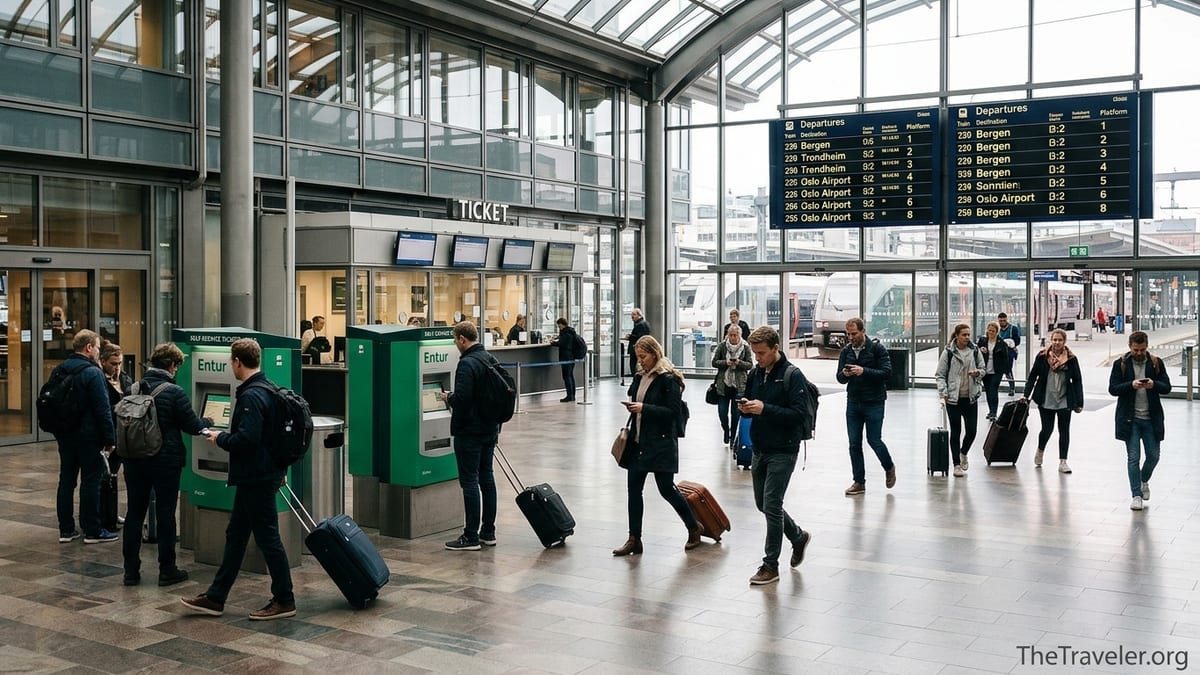
If you prefer not to rely on your phone, Oslo S has Entur ticket machines distributed in the concourse areas. These machines sell train tickets for all routes in Norway and can also handle many international cards. A traveler arriving without mobile data could, for example, walk off a regional bus into the main hall, use a machine to buy a ticket for the next Vy train to Trondheim, print the ticket or receive a digital code, and head straight to the platform. For additional reassurance, there is a staffed Entur ticket office at the station during the day where agents can help you with more complex itineraries, rail pass reservations or changes.
Entur is particularly useful if you are combining several operators in one journey. A practical example is traveling from a neighborhood in eastern Oslo to Stavanger for a conference. The app can show you a city bus or tram from your address to Oslo S, a Go-Ahead long distance train to Stavanger, and possibly a local bus at the other end, all in one search. In many cases you can buy the long distance rail leg directly and at least see the timings and platform details for the local connections, simplifying what might otherwise involve juggling multiple apps and timetables.
When to Book Directly With Vy, SJ or Go-Ahead
While Entur is excellent for planning and standard tickets, there are times when booking directly with the train operator is the smarter choice. The Vy app, for instance, often offers extra options like choosing a specific seat, adding a seat reservation to a flexible ticket, or upgrading to “Pluss” or sleeper cabins on routes such as the Oslo to Bergen night train. These details are sometimes presented more clearly in the operator’s own interface than in a general planner.
Consider an overnight journey from Oslo to Trondheim. Through Entur you may see the basic options and prices, but the SJ Norge app or website might give you richer information about compartment types, such as whether you can book an entire sleeper compartment for sole use or share with another traveler, and which carriages are closest to the dining car. By booking directly, some travelers feel more confident that they understand exactly what they are paying for and can manage details such as loyalty points or discount codes tied to that specific company.
Direct booking can also make changes and refunds easier. If your plans shift and you need to move your Oslo to Stavanger departure by a few hours, dealing with Go-Ahead’s own customer service through its app or website can sometimes simplify the process. For residents or frequent visitors who register an account with an operator, stored passenger details and past journeys can reduce the time needed to book recurring trips, like weekly commutes between Oslo and a regional town.
Price, however, is typically the same whether you book through Entur or an operator app for the same train and fare type. Regulations in Norway are designed so that booking channels offer consistent fares. That means the main reason to go direct is not to save money, but to access specific features or manage an ongoing relationship with that company. For most one time visitors who do not need complex seat preferences, Entur remains a reliable default.
Airport Trains and Local Options From Oslo S
One of the most common journeys from Oslo S is to Oslo Airport Gardermoen. Travelers are often surprised to discover that there are two distinct choices: the dedicated Flytoget airport express and the regular Vy trains that also serve the airport. Flytoget is heavily advertised and runs very frequently, with travel times of roughly 20 minutes between the airport and Oslo S. Its trains have a clear airport express branding and generally cost more than the regular options, with single adult tickets typically priced higher than standard regional fares for the same route.
Vy’s regular trains to the airport usually take only a few minutes longer, around 23 to 25 minutes. For budget conscious travelers, this can be an attractive alternative. For example, a visitor staying near Oslo S could purchase a local public transport ticket that covers both the city and the airport zone, or buy a standard Vy ticket to Oslo Airport, and pay noticeably less than the premium charged by the dedicated airport express. Many residents routinely choose this option, using the same apps and systems they use for everyday commuting, and simply allowing a few extra minutes for the journey.
From a booking perspective, you can buy Flytoget tickets through its own app, at its branded ticket machines at Oslo S and at the airport, or by using contactless payment gates at some stations. For the regular Vy trains, you can purchase tickets in the Vy app, on vy.no, at Entur machines or via the Entur app. A traveler landing with limited time might decide that the quickest option is to follow the signage for Flytoget, tap a card and board, while someone with more time and an eye on costs could open the Vy or Entur app and choose the next regular departure instead.
Beyond the airport route, Oslo S is a hub for local and regional trains throughout eastern Norway. Trains run to towns like Drammen, Ski and Lillehammer, often integrated with local transport tickets sold through the regional public transport authority’s app. When planning a day trip from Oslo to a nearby town, you might check both Entur and the relevant regional app to see whether a single ticket can cover both the city tram to Oslo S and the train onward, or whether it is more economical to buy separate tickets for each leg. Understanding these options in advance reduces the chance of confusion at the platform when you see several trains with different operator logos on the departure boards.
Planning Long Distance and Night Train Journeys From Oslo
Oslo S is the starting point for some of Europe’s most scenic rail journeys, including the famous Bergen Line and the routes north towards Trondheim and Bodø. Long distance trains on these lines can be very popular, especially in summer and during winter holidays, so planning ahead is essential. Tickets are usually released months in advance, and the cheapest fare categories and sleeper cabins tend to sell out earlier on weekend and holiday departures.
A typical example is the night train from Oslo to Bergen. On many dates there is one overnight departure in each direction that includes sleeper carriages with compact two berth compartments. Travelers can book either an entire compartment or a berth in a shared compartment, with prices adjusting based on flexibility and demand. Day trains on the same line offer standard seating and, on some services, a family coach with a play area. If you want a specific compartment type, it is wise to book as soon as your dates are firm, rather than waiting until you arrive in Norway.
To plan these trips, start by searching in Entur for your preferred date and time, then cross check in the Vy or SJ app if necessary to explore seating diagrams and upgrade options. If you are traveling with an Interrail or Eurail pass, you may need to take an extra step and buy only a seat reservation instead of a full ticket. In that case, many travelers arrange reservations through Entur’s channels or at the Entur ticket office at Oslo S, where staff are familiar with rail passes and can help you find trains where a reservation is strongly recommended, such as busy summer departures to Bergen.
Connections also matter on long distance journeys. For example, if you are connecting from a domestic flight at Oslo Airport onto a night train from Oslo S, it is usually safest to leave a generous buffer. Delays on incoming flights or airport baggage handling can eat into your transfer time. Rather than aiming for the very last regular train into Oslo S before your long distance departure, consider taking an earlier Vy or Flytoget service and allowing time for a quick meal at the station. Booking your airport train flexibly through an app gives you the option to board an earlier departure if your flight lands ahead of schedule.
Avoiding Common Booking Pitfalls at Oslo S
Most problems travelers encounter at Oslo S stem from last minute bookings and assumptions that the system works like in their home country. One frequent issue is arriving at the platform for a long distance train with the wrong type of ticket. For instance, a traveler might buy a local Oslo ticket in a city transport app, assuming it will cover a long journey to a distant town, only to discover at inspection that it is valid only for the urban zone around Oslo. To avoid this, always confirm in Entur or the relevant rail operator app that your ticket explicitly lists your origin and destination stations for intercity trips.
Another common pitfall is underestimating how busy popular routes can be in high season. Trains to Bergen, Trondheim and key tourist gateways can sell out in July and early August, especially in standard seat and sleeper categories. Some travelers rely on the idea of purchasing tickets at the station on the day, only to find limited availability or higher prices for last minute flexible fares. Making bookings at least several days in advance through apps or the Entur ticket office is a safer approach for any journey longer than a short regional hop.
Technical issues and connectivity can also cause stress if you are not prepared. While the Entur, Vy and other apps are generally stable, there are occasional outages or situations where foreign bank cards need an extra verification step. It is wise to take screenshots of your tickets and download them to your device so you can show them even if you temporarily lose mobile data deep in a tunnel or on a remote stretch of line. If you are worried about your phone battery, printing a paper ticket at an Entur machine in Oslo S before departure provides a physical backup.
Finally, make sure to double check the platform and coach information shortly before departure. Electronic boards at Oslo S update in real time if there are platform changes or if a train is shorter than usual, which affects where specific coaches stop along the platform. Even if your ticket shows a coach and seat number, glance at the overhead monitors on the platform to see diagrams that indicate where your coach will be when the train arrives. This small habit can prevent stressful last second dashes along a busy platform with luggage.
Practical Timeline for a Smooth Journey From Oslo S
Putting all of this together, it helps to think in terms of a simple timeline. For major long distance journeys such as Oslo to Bergen, Oslo to Trondheim or Oslo to Stavanger, aim to book at least one to two weeks in advance in shoulder seasons, and earlier if you are traveling during school holidays or around national celebrations. Use Entur first to compare departures and overall journey times, then use the relevant operator app to fine tune seat choices or add comfort upgrades if you wish.
For regional and local trains within a couple of hours of Oslo, you can usually wait until closer to your travel day, but it is still smart to check schedules a day or two ahead so you are aware of any planned engineering work or altered timetables. If you are catching an early morning train, consider buying your ticket the evening before while you have stable Wi-Fi at your accommodation, rather than relying on station machines at the last minute.
Airport transfers are more flexible, but planning pays off here too. Decide in advance whether you will use the premium Flytoget express or the regular Vy trains, based on your budget and the importance of a few minutes of saved time. Factor in airport check-in and security lines when choosing your departure from Oslo S to the airport. During busy travel periods, leaving an extra 15 to 30 minutes in your schedule can absorb any small delays on the rail leg.
On the day of travel, aim to arrive at Oslo S with enough time to orient yourself, especially if you are unfamiliar with the station. The main concourse can be busy, but clear signage points toward platforms, ticket machines, the Entur office and the Flytoget area. With your tickets already in hand, you can simply confirm your platform, perhaps pick up a snack or drink in the station, and walk calmly to the correct section of the platform well before your train rolls in.
The Takeaway
Booking trains from Oslo Central Station does not need to be complicated, even with multiple operators and ticketing channels in play. By starting with Entur for route planning and basic ticket purchases, then turning to operator apps like Vy, SJ or Go-Ahead when you want extra detail or upgrades, you can cover almost every scenario from local hops to long distance sleepers. Combining a bit of advance planning with simple habits such as checking platforms close to departure and carrying backup copies of your tickets goes a long way toward ensuring a stress free journey.
Whether you are dashing to the airport, winding over the mountains to Bergen, or heading north overnight toward the Arctic, Oslo S is designed to function as a clear, modern hub. Take the time to understand your options, make your key bookings before you reach the station, and you will be able to focus on the landscapes outside the window rather than the logistics on your phone.
FAQ
Q1. Do I need to book Norwegian trains in advance or can I buy on the day?
For short regional trips from Oslo S you can often buy on the day, but for popular long distance routes and night trains it is safer to book several days or weeks ahead, especially in summer and during holidays.
Q2. Is Entur always the best way to book trains from Oslo Central Station?
Entur is usually the best starting point because it covers most operators and routes, but operator apps like Vy or SJ can be better if you need specific seat choices, upgrades or to manage loyalty profiles.
Q3. Are ticket prices different between Entur and operator apps such as Vy?
For the same train and fare type, prices are generally similar whether you book through Entur or directly with the operator. Differences usually relate to extra features rather than base fares.
Q4. What is the cheapest way to get from Oslo Airport to Oslo S by train?
The regular Vy trains between Oslo Airport and Oslo S are typically cheaper than the Flytoget airport express and only take a few minutes longer, making them a good budget choice for many travelers.
Q5. Can I use foreign credit cards in ticket machines at Oslo Central Station?
Most Entur and Flytoget ticket machines accept major international credit and debit cards, though it is wise to have a backup payment method or use an app in case your card requires extra verification.
Q6. How do I handle seat reservations if I am traveling with an Interrail or Eurail pass?
With a rail pass you normally buy only a seat reservation instead of a full ticket. You can often arrange this through Entur channels or at the Entur ticket office at Oslo S, where staff are used to rail passes.
Q7. What should I do if my train ticket app does not work at the station?
If an app fails or you lose connectivity, show any screenshots or downloaded tickets you have, and if necessary visit the Entur ticket office or a machine at Oslo S to print or repurchase a ticket before boarding.
Q8. How early should I arrive at Oslo S before my train departs?
For domestic journeys without complex connections, arriving 20 to 30 minutes before departure usually allows time to find your platform. For important long distance or night trains, many travelers prefer 30 to 45 minutes.
Q9. Are paper tickets still necessary, or are digital tickets enough?
Digital tickets displayed in official apps are widely accepted on Norwegian trains, but printing a paper ticket from an Entur machine can be a useful backup if you worry about battery life or phone issues.
Q10. What happens if I miss my long distance train from Oslo Central Station?
What happens next depends on your ticket type. Flexible tickets may allow changes or refunds, while the cheapest advance fares are often more restricted, so contact the operator or Entur as soon as possible to discuss options.