


On an island famous for champagne-fuelled beach clubs and shoulder-to-shoulder sunbeds, Panormos Beach on the quieter north coast of Mykonos has long carried a certain promise: a wilder bay, fewer crowds, and a more understated kind of Cycladic beauty. But between the rise of high-end clubs like Principote, easier public transport, and a steady stream of social media posts, many travelers are now asking the same question: is Panormos still a hidden gem, or has it finally tipped into full-on hotspot territory?
Get the latest updates straight to your inbox!
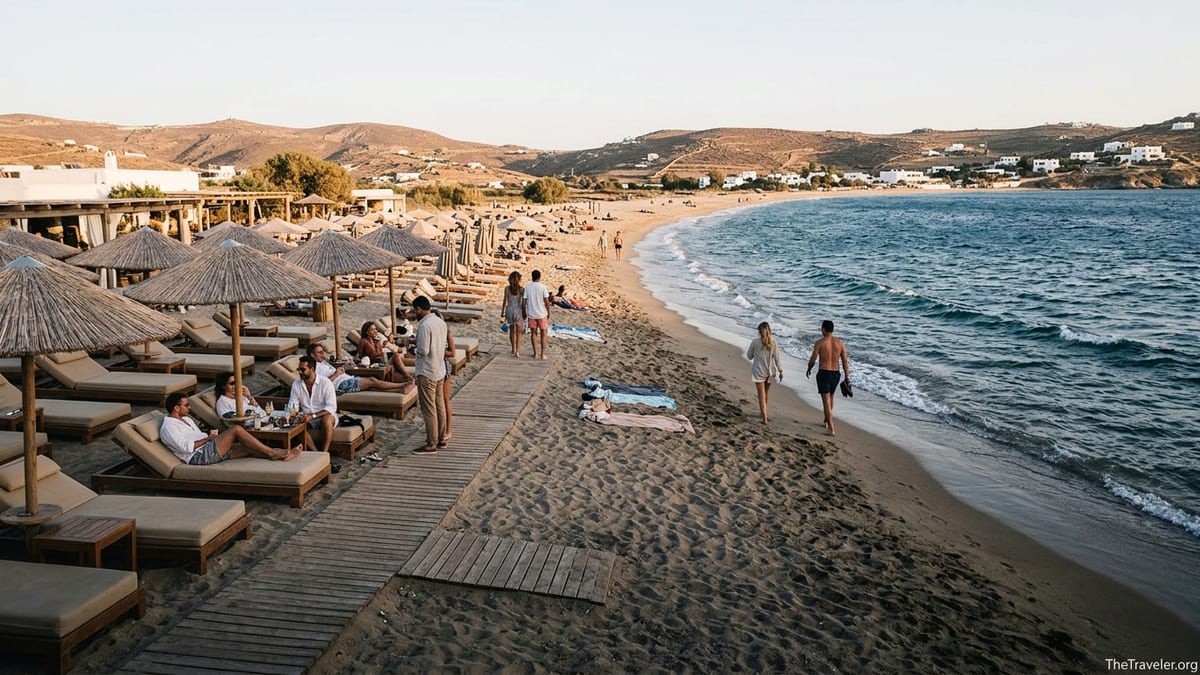
From remote cove to bus-stop destination
Not so long ago, Panormos was one of those beaches that required a bit of effort. You needed a car, a scooter, or a pricey taxi from Mykonos Town. Travelers who made the 15 to 20 minute drive north were rewarded with a wide, often half-empty bay, a small taverna, and long stretches of completely unorganized sand. It felt like a different island compared to busy Psarou or Paradise.
That picture has shifted. In recent years Panormos has been added to regular bus routes from the main town, especially in summer, and it now appears on most “best beaches in Mykonos” lists. Several current 2026 beach guides describe it as a “large, relaxing beach” that used to be a secret but has been “discovered” since buses started running there. On a typical July afternoon you will now see a steady flow of people arriving by bus with day bags and inflatable toys, not just rental cars and hotel transfers.
The bay itself remains beautiful: a broad crescent of pale sand, low dunes behind, and deep-blue water that can be choppy when the north wind picks up. That natural setting has not changed, and it is still noticeably less built-up than some southern beaches. What has changed is how easy it is to get there and how many businesses now share the shoreline.
This evolution means Panormos is no longer the semi-secret refuge it once was. It is on the map, firmly. But whether that makes it “too” popular depends on which part of the beach you use and how you like to spend a day by the sea.
The rise of Principote and the new luxury face of Panormos
The single biggest driver of Panormos’ rising profile is Principote, the upscale beach club and restaurant that now dominates one side of the bay. Marketed in 2026 as a place where “luxury rises to a whole new realm,” it has turned Panormos into a destination for the same crowd that might previously have stayed south around Psarou, Scorpios or Nammos.
Principote’s look is polished boho: handcrafted raffia umbrellas, teak walkways, and oversized lounge beds dressed in neutral linens. Service is deliberately indulgent. Staff bring icy wine buckets and sushi platters to your table; the restaurant pushes Mediterranean dishes with fresh fish and artfully plated salads. Many current reviews describe it as “chic,” “Instagrammable” and one of the most prestigious clubs in the Cyclades, and highlight the afternoon party atmosphere when the DJ turns the volume up.
Prices reflect the positioning. Recent travel and club guides quote typical spends of roughly 50 to 100 euros per person for a day with drinks and food, and considerably more for front-row sunbeds in peak season. Ordering a couple of cocktails, a shared starter and a main course can easily take a pair past 200 euros once service and small extras are added. For some visitors that feels like the full Mykonos experience; for others it is exactly what they are trying to escape.
What is important for would-be visitors is that Principote’s presence changes the character of the whole western side of Panormos. Expect curated music from mid-morning, a dressed-up crowd gathering from early afternoon, and a bookable, controlled environment. It is sophisticated and highly managed, not wild or low-key. If your image of a hidden gem is a small taverna and a towel on the sand, this part of Panormos will not feel hidden at all.
Where the bay still feels like a hidden gem
The good news for quieter travelers is that Panormos is big enough to hold more than one identity. Away from the main beach club area, the beach opens out into long stretches of public sand where you can still drop a towel for free and listen only to wind and waves when conditions are calm.
Several up-to-date beach guides in 2024 and 2026 highlight that roughly half of Panormos remains unorganized, with no sunbeds or fixed umbrellas. This section is often described as more relaxed, occasionally used by nudists at the far end, and noticeably quieter than southern hotspots like Paradise or Super Paradise. Families who are not looking for loud music but appreciate some distance from the densest crowds often gravitate here, bringing their own shade tents or simple beach mats.
That difference becomes very clear if you visit early in the day. Before 11 a.m., even in July, it is still common to see only a small scattering of people across the public half of the bay: a couple of paddleboarders, a lone swimmer, a few locals walking dogs. The sand is expansive enough that you can choose a spot dozens of meters from your nearest neighbor, something almost impossible on Mykonos’ more famous southern beaches once the first cruise ship tender arrives.
There is a trade-off. Outside the organized zone you will not find drink service, built-in shade, or background music. On windy days the northern exposure can make the water rougher, and the lack of dense buildings means there is little shelter from the Meltemi. For some this is exactly the charm: Panormos’ “hidden gem” quality now lives in these uncurated edges of the bay rather than in the whole beach.
Crowds, costs and what “too popular” really feels like
Popularity is not just about how many people show up. It is also about how a place manages the pressure. On that score, Panormos sits somewhere between the packed, heavily commercial southern beaches and the still-wild coves further along the north coast like Agios Sostis or Fokos.
In high season, expect the Principote section to feel fully booked and busy by early afternoon, especially on weekends and in August. Reservations for sunbeds and lunch are now effectively essential on those dates. The crowd skews towards couples and groups of friends who plan their day around a long lunch followed by a slow-burn party vibe, with music lifting significantly after around 4 p.m. That energy inevitably spills visually and audibly into the central section of the bay.
Prices are a second signal of how “discovered” Panormos has become. While you can still enjoy the public sand for free, there have been repeated reports around Mykonos of aggressive pricing and disputes over where private operators can place sunbeds. Travelers swapping experiences online describe paying over 60 euros for a pair of loungers on some beaches, compared with around 20 to 30 euros on quieter islands, and note that more exclusive venues sometimes push minimum spends far higher. Panormos is not the worst offender on the island, but the presence of a headline luxury club means the overall price level is no longer modest.
By contrast, if you walk ten to fifteen minutes along the sand away from the main cluster of beds, the experience changes. Here, the question is not whether Panormos is too popular, but whether you are prepared to accept a few more people on the shoreline in exchange for the convenience of bus access and one of the more natural-feeling bays within easy reach of Mykonos Town. In this sense Panormos feels “moderately discovered” rather than truly overrun.
Practical tips: how to find the side of Panormos you want
If you arrive at Panormos and feel that the first view is too crowded or polished, the simplest strategy is to keep walking. The unorganized section begins beyond the sunbed grids and continues to the quieter side of the bay. There are no fences on the sand, and public access is protected by Greek law, even if at times local management may try to claim more space than they should. The further you walk from the club, the more the music fades and the more it starts to feel like an old-school Cycladic beach again.
Timing matters. To maximise the hidden-gem feel, aim for shoulder months and quieter hours. Late May, early June and late September usually see far fewer visitors than peak July and August, and the sea is often calm enough to swim despite the northern exposure. Even in high season, arriving before 10 a.m. or after 6 p.m. transforms the atmosphere: you can watch the bay wake up or wind down without the midday crush or heat.
Transport choices also affect the vibe. Coming by bus from Mykonos Town is easy and economical, but it means stepping off alongside dozens of other travelers, many of whom will naturally cluster at the closest part of the beach. Hiring a small car or ATV allows you to time your arrival outside the peak bus schedule and explore nearby coves like Agios Sostis on the same day, spreading your time between more and less popular spots.
Finally, plan for limited facilities if you favor the wilder half of the bay. Bring a compact beach umbrella, plenty of water, and simple snacks if you do not intend to eat at the club. There are no small kiosks every hundred meters as on some more built-up Greek islands. A lightweight dry bag for your valuables and a windproof layer can also make a big difference if the Meltemi suddenly picks up.
Alternatives nearby if you decide Panormos is “too popular”
One advantage of Mykonos is that beaches change character dramatically within a few kilometres. If you come to Panormos, take one look at the sunbed lines or the afternoon party at Principote and decide it is not for you, there are easy fallbacks that still feel genuinely under the radar.
The most obvious is Agios Sostis, just around the headland to the east. This beach has no formal clubs, only a small, beloved taverna set back from the shore, and a steep-ish path down. Several recent island guides list it as one of the quietest and most natural beaches left on Mykonos, even in 2026. You will still see people here in July, but there are no organized rows of loungers and the water feels more like a simple village shore than a curated beach scene.
Further out, Fokos and Mersini on the northeast coast require more driving over less-developed roads, which naturally keeps numbers lower. They appeal to travelers who are willing to trade convenience and services for space and stillness. A common pattern for beach days now is to start at Panormos for a morning swim and coffee, then continue to one of these wilder coves for a long, quiet afternoon once the first wave of crowds arrives at the bus-accessible bays.
Even on the more developed south coast, there are softer options. Elia and Agrari, while by no means unknown, spread people across longer stretches of sand and include informal sections where it is still possible to lie down on your own towel without being asked for a sunbed fee. If your overall impression of Mykonos is that it is “too popular” everywhere, pairing it with a quieter island like Naxos or Sifnos in the same trip can restore a sense of balance.
The Takeaway
Panormos Beach is no longer a secret. It features in current Mykonos beach rankings, has regular bus service, and is home to one of the island’s most visible luxury clubs. In the western half of the bay, with its crafted sunbed decks, afternoon DJ sets and high per-person spend, it feels every bit as discovered as the better-known southern beaches, even if the scale is smaller.
Yet to dismiss Panormos as “already too popular” would miss half the story. The beach’s size, its split between organized and unorganized sections, and its north-coast setting give it a flexibility that many Mykonos shores have lost. Walk beyond the last row of loungers, come outside the busiest weeks, or arrive early and you can still experience a long, mostly open sweep of sand, shifting light, and the feeling of big Aegean sky that originally made Panormos a whispered-about gem.
For travelers who want both: a morning of near-solitude and an afternoon Negroni at a stylish beach club without changing bays, Panormos is an ideal compromise. For those seeking something truly off-radar, it is now a gateway rather than a destination, a convenient first stop before disappearing around the headland to more secluded coves. Either way, its story in 2026 is not one of loss so much as of transformation, from hidden cove to layered beach where the secret, if it survives at all, lies in how you choose to use it.
FAQ
Q1. Is Panormos Beach still worth visiting if I hate crowds?
If you avoid the main beach club area and visit early in the day or outside late July and August, Panormos can still feel spacious and relatively calm, especially along its unorganized sections.
Q2. How expensive is a day at Panormos compared with other Mykonos beaches?
Using the public sand is free, but sunbeds and food at the main club are firmly in the high-end range, with many visitors spending around 50 to 100 euros per person or more in peak season.
Q3. Do I need a reservation for sunbeds at Panormos?
For the luxury club section in summer, especially weekends and August, reservations are strongly recommended. The public areas of the beach require no booking and work on a first-come, first-served basis.
Q4. Is Panormos Beach family-friendly?
Yes, many families use the quieter parts of the bay, bringing their own umbrellas and toys. The organized area can feel more adult-focused in the late afternoon when the music and party atmosphere build.
Q5. How windy is Panormos compared with southern beaches?
Because it faces north, Panormos is more exposed to the Meltemi wind than beaches like Ornos or Psarou. On blustery days you can expect stronger waves and more surface chop in the water.
Q6. What is the best time of year to visit Panormos for a quieter experience?
Late May, early June and late September usually provide warm enough water, open services and significantly fewer people than high season, so the beach feels closer to its older, calmer reputation.
Q7. Can I reach Panormos Beach by public transport?
Yes, in summer there are regular buses from Mykonos Town that drop you close to the sand. This makes visiting easy without a car, but also increases midday crowd levels near the bus stop.
Q8. Are there any completely untouched areas left around Panormos?
The far ends of the bay remain unorganized and feel relatively wild, though you will almost always see other people in high season. For a truly remote feel, consider nearby Agios Sostis or Fokos as well.
Q9. Is Panormos suitable for budget travelers?
It can be, if you stick to the public beach, bring your own snacks and skip the high-end sunbeds. Using the luxury club facilities regularly, however, will quickly push daily costs into premium territory.
Q10. How does Panormos compare to famous southern beaches like Paradise?
Panormos is generally quieter and more spacious, with a mix of wild and upscale zones, while Paradise and Super Paradise are denser party strips where loud music and tightly packed sunbeds dominate the entire shore.