


Compact, walkable, and steeped in history, Princeton, New Jersey is the kind of place where you can step off the train in the morning and feel you have truly escaped by nightfall. Ivy-covered stone halls sit a few minutes’ walk from a Revolutionary War battlefield, cafes spill onto brick-lined squares, and wooded trails lead from the edge of town down to a historic canal. With a little planning, you can fit a surprising amount of architecture, stories, food, and fresh air into a single perfectly paced day.
Get the latest updates straight to your inbox!
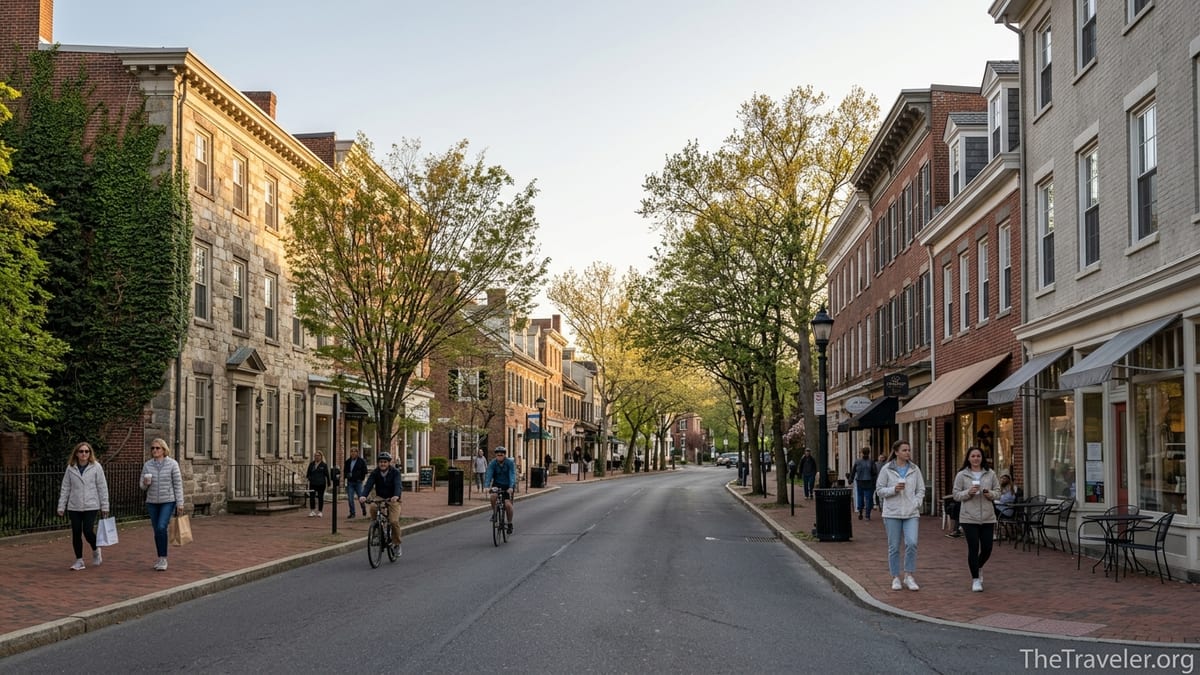
Starting the Morning on Nassau Street
Begin your day on Nassau Street, Princeton’s main east–west artery and the seam between Princeton University and the town itself. If you arrive by NJ Transit at Princeton Junction, the shuttle known locally as the “Dinky” drops you a short stroll from Nassau Street; drivers will find several paid municipal lots just off Palmer Square and Hulfish Street. Aim to get into town by 9 am so you can enjoy breakfast without rushing into the rest of the day.
For a light, modern start, Alfalfa on Nassau Street serves California-style breakfast burritos, grain bowls, and strong coffee in a bright space with counter service. Expect to pay in the range of 10 to 15 dollars for a satisfying breakfast bowl with eggs and vegetables, plus a few dollars more for a latte. If you are traveling with kids or prefer a classic American diner atmosphere, the long-running Nassau Diner further along the street leans into hearty plates of pancakes, omelets, and breakfast sandwiches at similar prices.
Princeton’s mornings unfold slowly, and Nassau Street is a good place to get your bearings. As you walk, you will pass everything from independent bookstores to university souvenir shops where visitors can pick up orange-and-black Princeton sweatshirts and caps. This is also a practical time to grab a bottle of water or sunscreen at one of the local pharmacies or grocery stores since you will spend much of the day outdoors.
If you enjoy starting with something sweet, Jammin’ Crepes, just off Nassau on the edge of campus, is known for made-to-order crepes that range from seasonal fruit fillings to savory combinations with local cheeses and vegetables. Portions are generous, and most people find that one crepe, priced around the low to mid-teens depending on ingredients, is enough to fuel the morning’s walking tour.
Exploring Princeton University’s Historic Campus
From Nassau Street, slip through FitzRandolph Gate near Nassau Hall and onto Princeton University’s main campus. Founded in the 18th century, parts of the university still feel more like a colonial college than a modern research institution, with low stone buildings and courtyards shaded by mature trees. Self-guided walking maps are often available at the university’s visitor center, but it is just as rewarding to wander with a few landmarks in mind.
Make your first stop Nassau Hall, the sandstone building that once briefly served as the capital of the United States in the 1780s. You can view it from the outside, set behind lawns and walkways that are usually open to the public during daylight hours. A stroll across the nearby green reveals newer Gothic-style dormitories and lecture halls, many built in the late 19th and early 20th centuries with pointed arches, leaded glass, and carved stone details that reward a slow look.
Continue toward the soaring Princeton University Chapel, one of the largest university chapels in the country, whose stained-glass windows and ribbed vaulting echo European cathedrals. Even if there are no formal tours scheduled on the day you visit, the chapel doors are often open outside of services, allowing quiet time inside. Visitors who enjoy art should also set aside time for the Princeton University Art Museum’s collections and galleries; when its main building is closed for renovation, the museum often hosts temporary exhibitions and sculpture installations around campus, so check posted signs and information boards as you walk.
Leave some time simply to sit on a bench and observe student life if the university is in session. Between classes, you will see students riding bikes, carrying coffee, or practicing instruments, and on warmer days there may be impromptu games on the lawns. This lived-in feel is part of what makes the campus compelling; you are not walking through a preserved monument but through a place actively used every day.
Stepping Back in Time at Princeton Battlefield and Nearby Sites
After an hour or two on campus, shift from collegiate history to Revolutionary War history at Princeton Battlefield State Park, a short drive or rideshare from downtown. The park preserves part of the site of the Battle of Princeton, fought in January 1777, when General George Washington led Continental troops against British forces. The field itself is now a broad, open expanse of grass with interpretive signs explaining troop movements and the course of the battle.
Near the center of the park, the Ionic Colonnade and a stone marker commemorate soldiers killed in the fighting. A modest parking area makes it easy to stop, read the signage, and walk out into the field to appreciate the scale of the landscape. Plan for at least 45 minutes here, more if you are traveling with someone particularly interested in military history and you want to trace the routes described on the maps.
Adjacent to the battlefield across Mercer Road is the Clarke House Museum, an 18th-century farmhouse where American General Hugh Mercer was taken after being mortally wounded in the battle. On select days, the house opens for guided or self-guided tours, typically for a small admission fee, giving visitors a look at period furnishings and artifacts. Tour hours can vary by season, so if stepping inside is important to you, check information in advance and plan your day around the posted opening times.
If you prefer not to drive, some visitors link the battlefield with central Princeton using ride-hailing services for the outbound journey and then follow local sidewalks and paths back toward town, though this can be a lengthy walk. For most travelers with only one day, it makes sense to treat the battlefield as a compact excursion between campus and lunch, returning to the central district by car or rideshare before early afternoon.
Lunch Around Palmer Square: From Casual to Refined
Back in town, the logical place to break for lunch is Palmer Square, the brick-and-stone shopping and dining district just off Nassau Street. The square’s central green is ringed with boutiques, cafes, and restaurants, and it functions as Princeton’s informal living room in good weather. Benches and low walls around the lawn provide plenty of seating if you want to enjoy a takeaway meal in the open air.
For a relaxed sit-down lunch, Witherspoon Grill on the edge of the square is a popular choice, known for its burgers, steaks, and seafood with entrees often in the 20 to 40 dollar range. Diners who prefer something lighter or plant-forward can head to a place like Theresa’s for pasta and salads or to one of the nearby salad and grain-bowl spots just off the square, where a custom bowl with greens, grains, and protein typically runs around 15 dollars.
Those on a tighter budget or in need of a quick bite between sights often walk a few minutes to long-standing student favorites such as Hoagie Haven or Tacoria on nearby streets. At these smaller spots, a generously filled sandwich or tacos can cost around 10 to 15 dollars and can be carried back to Palmer Square to eat outside if indoor seating is limited. During busy weekends and university events, lines can form at peak meal times, so consider an early or late lunch if your schedule allows.
Lunch is also a good time to sample something sweet from one of the bakeries or ice cream shops around the square. A scoop of locally made ice cream or a freshly baked cookie is an easy way to keep younger travelers motivated for the afternoon’s walks, and the treat becomes part of the memory of the day as much as the more formal sightseeing.
Afternoon Scenic Walks: Canal Towpath and Institute Woods
With lunch finished, shift from town to trail by heading toward the Delaware and Raritan Canal State Park, one of central New Jersey’s most attractive multi-use paths. The canal, completed in the 1830s to connect the Delaware and Raritan rivers, is now part of a state park with a flat towpath suitable for walking and cycling. In the Princeton area, the path runs between the canal on one side and Lake Carnegie on the other, creating a corridor of water, trees, and wildlife within easy reach of town.
Several access points lie close to Princeton, including bridges at Alexander Road, Washington Road, and Harrison Street, each with nearby parking. From these trailheads, you can choose anything from a gentle 30-minute stroll to a multi-mile walk. A popular option is to park near Washington Road and walk south along the towpath, enjoying views of rowing shells on Lake Carnegie on clear afternoons. The path is unpaved but generally well maintained, so sturdy walking shoes are usually sufficient in dry weather.
If you prefer woodland to waterside scenery, consider pairing the canal with a loop through Institute Woods, a protected forested area near the Institute for Advanced Study. Local conservation groups have maintained soft-surface trails here that wind through tall trees and open meadows, making this a favorite spot for birdwatchers and anyone looking for a quieter alternative to the busier canal path. Moderate loops of three to four miles are common, with largely flat terrain and occasional boardwalks over damp sections.
In all seasons, be prepared for changing conditions. After heavy rain, some segments of the towpath can be muddy or feature puddles, and shaded sections in winter may hold onto ice longer than nearby roads. Cell phone coverage is generally good in the Princeton area, but it is still wise to let someone know where you plan to walk if you are heading out alone and to carry a small daypack with water, a snack, and a light layer even in warmer months.
Golden Hour on Campus and Along the Elm Allée
As afternoon light softens, consider returning toward campus for a different perspective on the same spaces you explored earlier in the day. The limestone and sandstone facades of buildings around the main quadrangles warm noticeably in late-afternoon sun, and long shadows create patterns across the lawns that make familiar views feel new. Photographers will find this is often the best time for wide shots of collegiate Gothic towers framed by trees.
From the southern edge of campus, you can connect to Washington Road, which features the Washington Road Elm Allée, a straight stretch lined with elms and a parallel jogging path. This corridor leads gently downhill toward the canal, linking the university to the water. Even if you have already walked the towpath, the allée itself is worth a slow walk or jog as the last light filters through the leaves, giving a sense of how carefully the town’s green spaces connect to one another.
Alternatively, if your legs are tired from earlier hikes, you can simply settle on one of the benches near the university’s central greens or around the fountains near the Frist Campus Center and watch campus life shift into evening. Students returning from practice, tour groups gathering for twilight walks, and local residents out with dogs and strollers all contribute to a relaxed but lively atmosphere that contrasts with the midday tour groups.
This is also a convenient window if you would like to browse a campus bookstore or pick up a small souvenir. Many shops in and around Nassau Street remain open into early evening, and it is noticeably less crowded after day-trip tour buses have departed but before the dinner rush has fully arrived.
Dinner and an Evening Stroll in Downtown Princeton
For dinner, Princeton offers a spectrum from casual student-friendly spots to white-tablecloth dining, most within a short walk of Palmer Square. If you enjoy a lively atmosphere, consider returning to Witherspoon Grill for a more substantial evening meal, or try a nearby bistro serving seasonal American dishes, where main courses generally fall in the 25 to 40 dollar range. Reservations are strongly recommended on Friday and Saturday nights and during major university events, as the small dining rooms fill quickly.
Travelers looking for a cozier experience may choose one of the small trattorias or wine-focused restaurants tucked onto side streets off Nassau and Witherspoon, where candlelit tables and compact menus suit couples or solo travelers hoping for a quieter end to the day. Expect a similar price range but with more emphasis on shared plates and slower pacing. Many of these restaurants feature New Jersey wines and regional craft beers alongside better-known labels, offering an easy way to sample local producers without leaving town.
If you prefer something informal and quick, especially when traveling with children or a group, Princeton’s pizzerias and fast-casual spots remain open later into the evening. A shared large pizza from a popular local spot can feed several people for under 30 dollars, leaving room in your budget and your stomach for dessert. On warm nights, ice cream and gelato shops in and around Palmer Square attract lines of students and visitors well into the evening.
After dinner, take one last loop around the square and along Nassau Street. Streetlights and illuminated shop windows reflect off the brick sidewalks, and the university’s towers glow softly against the night sky. If you are staying overnight in town, this is a pleasant time to linger on a bench and absorb the soundscape of the town: distant bells from the chapel, low conversation from restaurant patios, and the occasional rumble of a bus on the main road.
Practical Tips for a Smooth Princeton Day Trip
A perfect day in Princeton benefits from a bit of logistical planning. If you are coming from New York City or Philadelphia, many travelers find it easiest to take a regional train to Princeton Junction and then transfer to the short shuttle train into town or to a local bus or rideshare. This avoids the stress of highway traffic and parking, especially on busy weekends. Drivers should check current parking rules on municipal signs; most central lots are paid during business hours but may allow free parking in the evenings.
Comfortable shoes are essential. Even if you do not plan a long hike, it is easy to log several miles simply moving between the train station, campus, Palmer Square, and canal access points. The town is largely flat, but the mix of brick, pavement, grass, and dirt paths can be tiring in unsupportive footwear. A small day bag with water, snacks, and a compact umbrella or rain jacket will keep you comfortable if the weather turns unexpectedly.
Budget-conscious visitors can keep costs moderate by choosing one sit-down meal and one casual or takeaway meal, pairing that with free or low-cost activities such as exploring campus, walking the canal, and visiting public outdoor art. Museum and historic house admissions in the area, when charged, are usually modest compared with big-city institutions. Families may also appreciate that many of Princeton’s highlights are outdoors and open to the public, reducing the need for advance ticketing.
Seasonality matters. In spring, flowering trees and campus gardens are at their best, and the canal corridor turns bright green. Summer brings lush foliage and more consistent warm weather, though heat and humidity can be significant in July and August. Autumn offers colorful foliage along the canal and in Institute Woods, making this a particularly photogenic time for scenic walks. Winter is quieter but still appealing on crisp, clear days, especially if you enjoy having trails and campus paths largely to yourself.
The Takeaway
Princeton’s appeal lies in how close everything feels. In a single day, you can watch the morning light hit colonial stone walls on campus, stand on a battlefield that shaped a nation’s early fortunes, linger over lunch on a pocket park in the town center, and then lose yourself for an hour along a canal once busy with 19th-century commerce. The transitions between history, daily life, and nature are measured in blocks rather than miles.
Whether you arrive as part of a college tour, a rail-based day trip from a nearby city, or a weekend escape with friends, a little forethought about timing and routes lets you stitch Princeton’s highlights into one continuous, satisfying narrative. Start with a good breakfast, pace your walks, leave room for an unplanned detour into a bookstore or along a side path, and you will likely end the day with the feeling that you have truly gotten to know this compact, layered town.
FAQ
Q1. Is Princeton a realistic day trip from New York City or Philadelphia?
Yes. Many visitors take regional trains from either city to Princeton Junction and connect into town, spending six to eight hours exploring before returning in the evening.
Q2. Do I need a car to follow this one-day itinerary?
No, a car is helpful but not essential. You can walk between campus, Nassau Street, Palmer Square, and some canal access points, and use rideshares or local taxis for the battlefield.
Q3. How much should I budget for a full day in Princeton?
Allow for two meals, snacks, and any museum or house admissions. Many travelers are comfortable with a budget in the range of 75 to 150 dollars per adult for the day, excluding transport.
Q4. Is Princeton University’s campus open to the public?
Generally yes, during daylight hours. Visitors can walk through outdoor spaces, though access to certain buildings may be restricted or require campus ID, and hours can vary.
Q5. Are the canal towpath and Institute Woods suitable for children?
Yes, both areas are popular with families. The trails are mostly flat, but parents should supervise children near water and bring appropriate footwear and snacks.
Q6. What is the best time of year to visit for scenic walks?
Spring and autumn are especially beautiful, with blooming trees and fall foliage. However, the canal towpath and campus paths are walkable in all seasons with suitable clothing.
Q7. Can I picnic on campus or in Princeton’s parks?
Informal picnicking on campus lawns and in public parks is common, provided you respect posted signs, avoid restricted areas, and clean up all trash afterward.
Q8. Are there vegetarian and vegan options in Princeton restaurants?
Yes. Many cafes and restaurants around Nassau Street and Palmer Square offer vegetarian and often vegan dishes, including salads, grain bowls, and plant-based mains.
Q9. Is Princeton walkable for travelers with limited mobility?
The town center and campus have paved paths, but some historic areas and trails include uneven surfaces. Those with mobility concerns may want to focus on central streets and accessible buildings.
Q10. Do I need to book restaurant reservations in advance?
For popular sit-down restaurants, especially on weekends or during university events, advance reservations are strongly recommended. Casual spots and takeout counters usually accept walk-ins.