


Ruka–Kuusamo sits in Finland’s far northeast, close to the Russian border and just below the Arctic Circle. For many travelers it is still a name on a ski race calendar or a footnote in a hiking guide, yet the region has quietly become one of Finland’s most popular year-round outdoor destinations. With one of the country’s largest ski resorts, famed wilderness trails like the Karhunkierros, and easy access to Oulanka National Park, it offers far more than just a week on the slopes. The question is not only whether Ruka–Kuusamo is worth visiting, but what exactly keeps visitors coming back in every season.
Get the latest updates straight to your inbox!
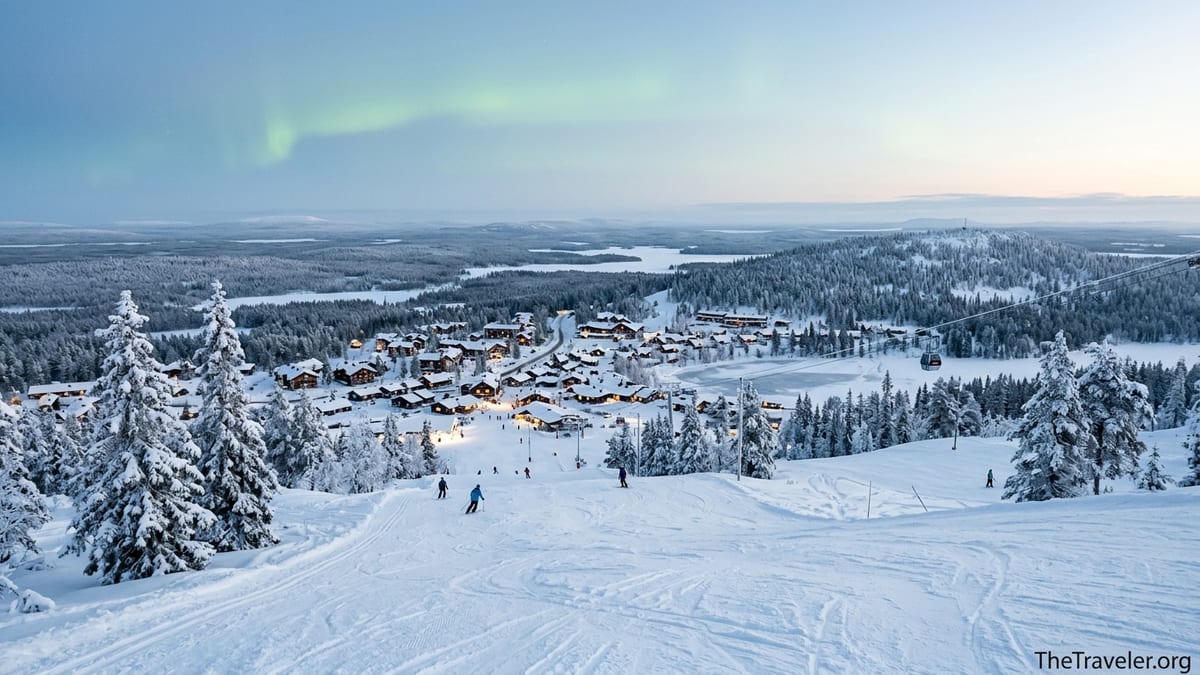
Where Is Ruka–Kuusamo and What Makes It Different?
Ruka–Kuusamo lies in northeastern Finland, in the North Ostrobothnia region, though the forests, fells and reindeer herds give it an unmistakably Lapland-like feel. Kuusamo is the small town and municipality; Ruka is the nearby fell that has grown into a compact ski village backed by a major resort. From Helsinki, travelers typically fly about 1.5 hours to Kuusamo Airport and then transfer 25 to 30 minutes by shuttle or taxi to Ruka Village. This combination of relative remoteness and straightforward access is a big part of the area’s appeal: it feels like proper wilderness without requiring long, complicated transfers.
What sets Ruka–Kuusamo apart from many European mountain areas is the way the ski resort, hiking trails and national parks are woven together in a tight radius. Within an hour’s journey from a hotel in Ruka Village you can step onto a World Cup ski slope, ski or bike more than 500 km of marked trails, or walk into Oulanka National Park, one of Finland’s best known protected areas. Visitors who come only for downhill skiing quickly discover that cross-country, snowshoeing, husky sledding and serious long-distance hiking are not optional extras but part of the region’s core identity.
The landscape itself has a distinct character. The fell of Rukatunturi rises to roughly 492 meters, modest by Alpine standards but dramatic when it rises above the surrounding spruce forest and frozen lakes. In winter the trees grow thick coats of rime ice and snow, while in summer the same hills are carpeted in blueberries and cloudberries. This mix of soft contours and rugged river gorges means Ruka–Kuusamo can feel gentle and family-friendly one moment, then truly wild the next, especially along the Oulanka River and the suspension bridges of the Karhunkierros trail.
For travelers comparing Finnish ski areas, Ruka’s location just south of the Arctic Circle also has a practical benefit: long seasons with slightly milder temperatures than some higher, more northerly resorts. You get many of the same Northern Lights, midnight sun and snow-sure conditions that define Lapland holidays, often with a little more daylight early and late in the season and slightly shorter transfer times.
Ruka Ski Resort: Long Seasons and Varied Slopes
Ruka is consistently described as one of Finland’s largest and most developed ski resorts. The fell offers around 39 to 41 slopes and more than 20 lifts, including several high-speed chairlifts and a gondola that links the different sides of the hill. The resort is known within Finland for having one of the country’s longest ski seasons. Snowmaking and careful grooming typically allow the first runs to open in October, with skiing continuing well into late April or early May in most years, and resort operators promote the expectation of more than 200 ski days each season.
On the slopes, visitors find an unusually broad spread of terrain for a single Finnish fell. Families and beginners gravitate to gentle blue runs in areas such as Vuosseli, where wide pistes and easy access to ski schools make first days on snow less intimidating. Snowboarders and freestyle skiers often head for dedicated snowparks and a FIS-standard slalom slope, while more advanced skiers can test themselves on steeper reds and the floodlit “Front Slope” that drops toward Ruka Village. Because around three dozen slopes are equipped with flood lighting, night skiing is a defining part of the experience; many guests spend the short winter days on excursions and then ski under lights between mid-afternoon and evening.
Real-world feedback from repeat visitors highlights how the resort manages to feel both manageable and surprisingly extensive. A group of British snowboarders writing in recent seasons described how three separate week-long trips were enough to explore the different faces of the hill at a relaxed pace, without the sense of having “done it all by day two” that can hit smaller resorts. At the same time, Ruka remains compact enough that older children can ski familiar runs semi-independently, and non-skiers can walk between cafes, shops and accommodation without needing a car.
Prices at Ruka are generally lower than in well-known Alpine resorts. As a rough reference, adult day lift passes in recent winters have tended to undercut many big-name French or Austrian mountains, and accommodation packages often bundle discounted lift tickets, especially in the Ski-Inn apartment hotels that sit directly on the slopes. For budget-conscious travelers, this combination of a long season, modern lifts and relatively moderate prices is one of the key “worth it” arguments in Ruka’s favor.
Beyond the Pistes: Winter Adventures and Arctic Atmosphere
Although the downhill skiing draws many visitors, Ruka–Kuusamo is much more than a ski resort. In winter, a dense network of cross-country ski tracks, snowmobile routes and snowshoe trails fans out from the village into the forests and over frozen lakes. Estimates for the total groomed cross-country network typically exceed 500 km, meaning that keen Nordic skiers can spend a full week tackling new loops without repeating the same track. Local tour companies offer guided safaris that make this infrastructure accessible to first-timers, from gentle evening snowshoe walks overlooking the lights of Ruka to full-day snowmobile trips into quiet corners of the Kuusamo backcountry.
Some of the most memorable winter experiences make use of the region’s national parks. Guiding companies operating out of Ruka regularly run excursions into Oulanka National Park, where visitors snowshoe past frozen rapids like Myllykoski and Jyrävä or follow sections of the Bear’s Trail that are groomed for cross-country skiing between Kiutaköngäs and Ruka. Typical half-day snowshoe tours last around 2.5 to 4.5 hours and include hot drinks around a campfire, while longer day trips often add a simple outdoor lunch cooked over open flames in traditional laavu shelters.
Animal-powered activities are another major draw. Husky sledding safaris, often ranging from 5 km taster runs to full-day adventures of 30 km or more, are widely offered around Ruka–Kuusamo. Travelers are typically given basic driving instructions, then pair up to mush their own small team of dogs through forest trails while the guide supervises. Reindeer sleigh rides, by contrast, tend to be slower, shorter and more focused on storytelling, with local herders explaining how semi-wild reindeer are still central to the region’s culture and economy. For many families, a combined half-day of huskies and reindeer, rounded off with a visit to a lakeside smoke sauna, becomes the highlight of the trip.
Winter also brings international sport. The Rukatunturi ski jumping hill complex hosts early-season FIS World Cup events, and on competition weekends the normally quiet hill is filled with television crews and fans from across Europe. Even outside event days, visitors can ride nearby lifts to admire the huge K-point hill and understand why this relatively low fell has such an outsized reputation in Nordic skiing and jumping circles. Combined with chances to see the Northern Lights on dark, clear nights or to walk through snow-laden forests in blue Arctic dusk, it is this layered winter atmosphere that convinces many travelers that Ruka–Kuusamo offers a fuller sense of the north than a simple week of resort skiing.
Summer and Autumn: Hiking, National Parks and the Karhunkierros
When the snow melts, Ruka–Kuusamo undergoes a quiet transformation. The same gondolas and trailheads that serve skiers become gateways to some of Finland’s most famous hikes and river landscapes. Oulanka National Park, which straddles the border between Northern Ostrobothnia and Lapland, covers roughly 270 square kilometers of protected forest, canyon-like river valleys and sandy pine heaths. Its best-known route, the Karhunkierros or Bear’s Trail, is widely regarded as one of Finland’s signature long-distance hikes and is a major reason summer and autumn travelers choose Kuusamo over better-known city or lake destinations.
The full Karhunkierros runs roughly 80 to 82 km between the village of Hautajärvi near the Arctic Circle and Ruka, with most of the distance inside Oulanka National Park. Many hikers take four to six days to complete the entire trail, overnighting at simple free wilderness huts, lean-to shelters or tent pitches along the way. For example, a common four-day itinerary starts at Hautajärvi, passes landmarks such as the Kiutaköngäs rapids and Oulanka Visitor Centre, then continues through more remote sections before finishing at Ruka. Regulations in the national park mean wild camping is mostly limited to marked sites, which helps concentrate impact and keeps the route feeling remarkably pristine even at busy times.
Not every visitor has the time or inclination for a multi-day trek, so the region promotes shorter variants such as the Pieni Karhunkierros, or “Little Bear Trail,” a circular route of about 12 km that showcases many of the park’s classic views in a single day. This loop crosses several suspension bridges, winds past the photogenic old mill at Myllykoski and skirts rushing waterfalls, making it a favorite for moderately fit hikers and photographers. In autumn, when birch and aspen leaves turn intense shades of yellow, international hiking communities frequently share images of these scenes, which in turn fuels interest among new visitors.
Beyond the Bear’s Trail, Kuusamo offers quieter alternatives like the Kiutaköngäs day walk, shorter family-friendly loops near Ruka, and water-based trips by canoe or packraft along calmer sections of the Oulanka and Kitka rivers. Local outfitters rent gear and organize transfers, which is especially useful for one-way river journeys or point-to-point hikes. Practical examples include two-night guided trips that combine hiking with an overnight stay in a rustic cabin complete with wood-fired sauna, giving first-time visitors a gentle introduction to Finnish hiking culture without having to navigate everything alone.
Wildlife, Seasons and the Feel of True Wilderness
Ruka–Kuusamo’s latitude and geography create sharply defined seasons, each with its own character. Winter tends to dominate the international marketing, yet many visitors come specifically for the relaxed light and lingering twilights of the shoulder seasons. In late May and June, near the period of the midnight sun, nights are bright enough for late-evening hikes or paddling, while in September and early October, the combination of colorful foliage and long evenings of astronomical darkness makes the region ideal for travelers who hope to combine day hikes with chances to see the Northern Lights.
Wildlife experiences are an increasingly important part of the area’s appeal. The forests around Kuusamo form part of a wider corridor of old-growth and semi-natural woodland stretching toward the Russian border, and specialist operators use hides and remote cabins to offer bear watching and photography trips in late spring, summer and early autumn. While sightings can never be guaranteed, travelers who join these overnight excursions often report encounters with brown bears, as well as white-tailed eagles, ospreys and other raptors. Even those who never leave the main trails typically see or hear more common species like willow grouse, Siberian jays or the occasional elk.
What surprises many first-time visitors is how quickly the landscape feels wild once you step away from the resort. From the edge of Ruka Village, it is possible to snowshoe or hike for an hour and see no buildings beyond the occasional forest hut. On the Karhunkierros, hikers walk long stretches where the only infrastructure is a wooden boardwalk over boggy ground or a simple log bridge across a stream. This sense of scale and emptiness can be profound, especially for travelers arriving from central Europe or the United Kingdom, where even national parks often feel busy and heavily managed.
At the same time, the Finnish approach to maintaining trails and shelters means that this wilderness is underpinned by subtle but reassuring infrastructure. Lean-to shelters are stocked with firewood, composting toilets appear at regular intervals along major routes, and visitor centers at Oulanka and nearby Hossa provide updated information on conditions, including warnings about high water that can affect suspension bridge crossings or river paddling. For travelers weighing whether Ruka–Kuusamo is “worth it,” this balance between accessible infrastructure and true backcountry atmosphere is one of the region’s strongest arguments.
Practicalities: Getting There, Getting Around and What It Costs
From a logistical standpoint, Ruka–Kuusamo is relatively straightforward for an Arctic destination. Several airlines operate seasonal and, at times, year-round flights between Helsinki and Kuusamo, with typical flight times of about 80 to 90 minutes. In winter, some European tour operators charter direct flights from cities such as London, Manchester or Amsterdam, primarily aimed at package holidaymakers bound for Ruka’s ski slopes. On arrival, shuttle buses, taxis and pre-booked transfers link Kuusamo Airport with Ruka Village and larger accommodation clusters. Travelers planning extensive explorations of the wider region sometimes rent a car at the airport, although a combination of local buses and organized excursions is enough for many visitors.
Public transport and shuttle options are geared around the main attractions. During peak winter and summer seasons, bus routes typically connect Ruka Village with Kuusamo town center, Oulanka National Park and certain trailheads, though schedules can be limited outside holidays. Tourism authorities and local operators advise checking timetables in advance, especially if you plan to visit the parks independently without a car. Within Ruka Village itself, much can be done on foot: hotels, rental shops, restaurants and key lifts are all clustered within a compact area, and many slope-side apartments allow you to ski to and from the door.
Costs in Ruka–Kuusamo are broadly in line with other rural parts of Finland, though visitors from southern Europe may find restaurant prices higher than at home. As an approximate guide, a mid-range pizza or burger in Ruka Village can cost similar to what you might pay in a Nordic capital, while a coffee and pastry in a slope-side cafe is usually a bit less than in downtown Helsinki. Accommodation ranges from simple hostel-style rooms and modest cabins to high-end villas with private saunas and outdoor hot tubs. In winter, a week in a basic self-catering apartment for a family of four can often be priced competitively with or below an equivalent trip to the Alps, especially once you factor in slightly cheaper lift passes and the possibility of cooking several meals at home.
Activity prices vary. A short husky ride of about one hour, including transfers and warm gear, might cost roughly what you would expect for a branded snowmobile excursion in central Europe, while full-day safaris and guided snowshoe tours command higher fees. On the other hand, many of the region’s most memorable experiences are either free or low-cost once you are there. Hiking in Oulanka National Park, skiing on public cross-country trails or spending an evening grilling sausages at a lakeside shelter under the Northern Lights all cost little more than the price of transport and your groceries.
Who Will Love Ruka–Kuusamo, and Who Might Not?
Ruka–Kuusamo tends to appeal most strongly to travelers who prioritize nature, outdoor activities and a quieter atmosphere over glamorous nightlife or extensive shopping. Active families, couples who enjoy hiking or skiing together, and solo travelers looking for an accessible taste of Arctic Finland often find that the region fits their needs very well. For example, a couple could spend a week in March combining mellow downhill skiing, one or two days of cross-country, a half-day husky safari and an evening snowshoe outing, all from the same small base, without needing to chase long transfers or manage complex logistics.
Summer and autumn are particularly rewarding for hikers, photographers and birdwatchers willing to accept changeable weather in exchange for fewer crowds. International backpackers who have walked parts of the Karhunkierros in recent seasons frequently compare it favorably to more famous European routes, praising the well-maintained shelters, the absence of commercialization along the trail and the chance to enjoy campfires and saunas deep in the forest. Those used to dramatic Alpine peaks sometimes arrive with low expectations and leave impressed by the quieter beauty of deep river gorges, old-growth spruce and vast, gently rolling fells.
Ruka–Kuusamo is less ideal for travelers who value dense cultural programming, big city energy or late-night partying. While Kuusamo town has basic services and some local museums, and Ruka Village includes bars and occasional live music, the nightlife is modest compared with central European resorts. Shopping is mostly limited to outdoor gear, souvenirs and everyday groceries. Those seeking long evenings of après-ski, large casinos or designer boutiques may find the region too subdued.
The climate can also be a deciding factor. Winters are genuinely cold, with temperatures routinely dropping well below freezing and occasionally hitting more extreme lows. Visitors who dislike short daylight hours or who struggle with very cold conditions may prefer to target March, April or autumn, when temperatures moderate and the light is kinder. Nonetheless, for many travelers it is precisely this combination of stark climate, deep snow and wilderness silence that makes Ruka–Kuusamo feel worth the journey.
The Takeaway
So is Ruka–Kuusamo worth visiting? For travelers drawn to nature, long ski seasons and authentic Arctic experiences, the answer is a strong yes. The region offers a rare mix of a sizable, modern ski resort, one of Finland’s most celebrated long-distance hiking routes and immediate access to a major national park, all linked by straightforward transport from Helsinki and other European hubs. Concrete experiences range from night skiing under floodlights and husky sledding through snow-laden forests, to crossing suspension bridges above roaring rapids on the Karhunkierros and sitting in a remote wilderness sauna as the Northern Lights ripple overhead.
At the same time, Ruka–Kuusamo is not for everyone. Those expecting towering Alpine peaks, intense nightlife or extensive urban culture may find the low fells and quiet evenings underwhelming. The climate demands proper clothing and a willingness to embrace cold, dark winter days. Yet for many visitors those very qualities are part of the attraction. The region’s understated infrastructure, reliable trails and blend of wilderness and comfort allow travelers to experience a side of northern Finland that feels both accessible and genuinely wild. If your ideal trip involves trading crowds and cities for snow, forest, rivers and a sauna by a frozen lake, Ruka–Kuusamo is likely to feel not just worth it, but unforgettable.
FAQ
Q1. When is the best time of year to visit Ruka–Kuusamo?
The best time depends on what you want to do. For skiing and snow-based activities, mid-December to late March typically offers the most reliable snow and daylight. Early season skiing often begins in October, while late spring skiing can continue into April, but conditions vary by year. For hiking and national parks, June to early October is ideal, with autumn colors usually peaking in September.
Q2. How do I get to Ruka–Kuusamo from abroad?
Most international visitors fly into Helsinki and then take a domestic flight of about 1.5 hours to Kuusamo Airport. From there, shuttle buses, pre-booked transfers and taxis connect to Ruka Village and other accommodation areas in roughly 25 to 30 minutes. In winter, some European tour operators also run charter flights directly to Kuusamo for ski packages.
Q3. Is Ruka–Kuusamo suitable for beginners and families?
Yes. The ski resort has many wide, gentle slopes, especially in areas like Vuosseli, and several ski schools offering lessons in English and other languages. Cross-country trails include shorter, easier loops close to the village, and many winter excursions, such as reindeer rides and short husky safaris, are designed specifically with children and first-timers in mind.
Q4. Do I need a car to explore the region?
A car is helpful but not essential. Many visitors stay in Ruka Village without driving, using lifts, local buses and guided tours to reach activities. Seasonal bus routes usually connect Ruka with Kuusamo town and Oulanka National Park, though timetables can be limited, especially outside peak periods. If you want full flexibility to visit more remote lakes, trailheads or nearby areas like Hossa National Park, renting a car at Kuusamo Airport is convenient.
Q5. How expensive is Ruka–Kuusamo compared with other ski destinations?
Overall costs are similar to other Nordic rural areas and often lower than major Alpine resorts. Lift passes, equipment rental and slope-side accommodation are generally competitive, while restaurant meals and alcoholic drinks may feel costly for visitors from southern Europe or North America. Self-catering in an apartment or cabin, using local supermarkets, can keep budgets under better control.
Q6. Can I see the Northern Lights in Ruka–Kuusamo?
Yes, it is possible, particularly from roughly late August to early April, when nights are dark enough. Clear skies and strong solar activity are required, so sightings cannot be guaranteed, but many winter visitors report seeing auroras at least once during a week-long stay. Staying slightly outside the brightest part of the village or joining a dedicated Northern Lights tour can improve your chances.
Q7. How difficult is the Karhunkierros (Bear’s Trail) hike?
The full 80 km to 82 km Karhunkierros is considered a moderate to challenging multi-day trek, mainly because of its length and some steep, root-filled sections rather than extreme altitude. Most reasonably fit hikers with some experience and proper gear can complete it over four to six days. Shorter sections and the 12 km Pieni Karhunkierros loop offer similar scenery for those who prefer day hikes.
Q8. What kind of clothing and equipment do I need in winter?
Layered clothing is essential: a moisture-wicking base layer, insulating mid-layer and windproof, waterproof outer shell. Warm gloves, a hat, thermal socks and insulated winter boots are important, especially for slower-paced activities like reindeer rides. Many tour operators provide outer clothing, boots and mittens for safaris, and ski rental shops can supply appropriate helmets and skis or snowboards.
Q9. Is Ruka–Kuusamo crowded?
Ruka Village and the main slopes can feel busy during peak holiday weeks, such as Christmas, New Year and school holidays in February and March. However, even on these dates, cross-country trails and nearby forests quickly feel quiet once you leave the immediate resort area. Outside peak periods, both the ski area and national park trails are generally calm, especially on weekdays.
Q10. Is Ruka–Kuusamo a good choice for non-skiers?
Yes, provided you enjoy nature and winter or wilderness activities. Non-skiers can join husky and reindeer safaris, snowshoe walks, snowmobile trips, Northern Lights excursions and sauna experiences. In summer and autumn, hiking, canoeing, berry picking and wildlife watching replace snow-based activities. Those looking mainly for urban sightseeing or cultural attractions, however, may be happier pairing a short stay in Ruka–Kuusamo with time in Helsinki or another Finnish city.