


Aavasaksa rarely makes it onto first‑time Lapland itineraries, yet this modest 242‑meter hill overlooking the Tornio River Valley has been drawing curious travelers since the 18th century. Today, it remains a low‑key but rewarding stop for road trippers, nature lovers, and anyone chasing the midnight sun without the crowds of more famous Lapland hotspots. So is Aavasaksa worth visiting, and what exactly do travelers love about this hidden Lapland gem?
Get the latest updates straight to your inbox!
Where Exactly Is Aavasaksa, and What Makes It Special?
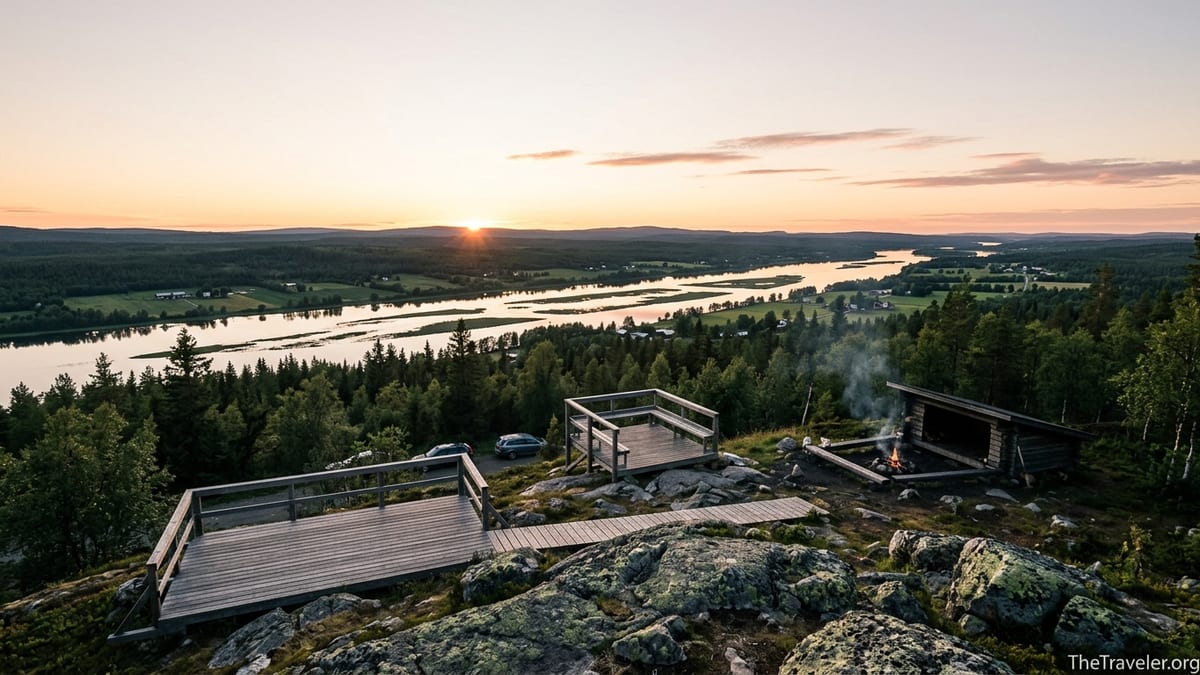
Aavasaksa is a forested hill in the municipality of Ylitornio in Finnish Lapland, a short drive north of the village center and just east of the Swedish border. Rising to around 242 meters, it does not impress with alpine heights, but with its position above the broad Tornio River Valley and surrounding fells. From the top, you look west toward Sweden and the Torne River, and east over the smaller Tengeliönjoki, with low wooded hills rolling to the horizon.
The hill has an outsized place in Finnish travel history. It is considered one of Finland’s earliest tourist destinations and is listed among the country’s official national landscapes. Early scientific expeditions came here in the 1730s to measure the shape of the Earth, and later 19th‑century travelers carved their names into the rocks while marveling at the midnight sun. Modern visitors still come for the same reason: big sky views and the sense of standing at the edge of the Arctic, without needing to trek deep into wilderness.
Aavasaksa also forms part of the Struve Geodetic Arc, a chain of survey points stretching from the Black Sea to the Arctic Ocean that is inscribed as a UNESCO World Heritage Site. On the summit you can see a monument that quietly hints at this scientific heritage, a detail that appeals to travelers who like their viewpoints with a story. Combined with its status as the southernmost place in Finland where the midnight sun is reliably visible around the summer solstice, it feels like a small hill with a surprisingly wide horizon both visually and historically.
For visitors driving the main north–south route through western Lapland, Aavasaksa is also practically convenient. The hill rises just off the main valley road that follows the Tornio River, so you can divert from a long drive between, for example, Rovaniemi and Kilpisjärvi or between Tornio and northern ski resorts for an hour or two without significant detour.
Midnight Sun Without the Crowds
Most people who make the effort to reach Aavasaksa do it for one reason: to watch the nightless night. Because of its latitude, Aavasaksa sits near the southern edge of the zone where the sun does not dip below the horizon in late June. That means that on clear evenings around the solstice, you can watch the sun skim the horizon over the river valley without setting at all, or set so shallowly that the sky never truly darkens.
In practice, many travelers aim to visit between roughly mid‑June and early July, when the odds of experiencing a true midnight sun moment are highest. A realistic scenario might be a road‑tripping couple who base themselves at a simple guesthouse in Ylitornio or at a lakeside caravan park nearby. After a late dinner, they drive the short, winding road to the summit around 10:30 p.m., park near the observation tower, and walk out to one of the wooden viewing platforms. By midnight, the sun hangs just above the horizon, bathing the valley in soft gold while swallows circle the tower and the forest below hums with mosquitoes.
Compared with watching the midnight sun in Rovaniemi or at busier fell resorts, the atmosphere on Aavasaksa is typically low‑key. On a clear solstice evening, you might share the hill with a handful of Finnish families having a barbecue at one of the free shelters, some local teenagers wrapped in blankets on the rocks, and a couple of campervans in the parking area. On a less famous night in late June, you may find nearly total quiet, with only a few cars pulling in as people take photos and then retreat to the warmth of their vehicles.
Because the summit area is accessible by car, Aavasaksa is especially attractive for travelers who want the midnight sun experience without a long hike. Families with small children, older travelers, and those on tight schedules can drive up shortly before midnight, enjoy the view, and be back in their accommodation within an hour. It is also a smart backup destination if clouds spoil plans farther north: residents of nearby Tornio and Övertorneå often drive up spontaneously when the sky looks promising.
Hiking, Barbecue Huts, and Easy Nature Time
Beyond midnight sun watching, Aavasaksa works well as a short hiking and picnic destination. A small network of marked trails loops through the forested slopes and connects several viewpoints, shelters, and the summit area. Popular routes, such as the Aavasaksa viewpoint loop, are short and well maintained, often combining gravel paths with boardwalk sections to protect the fragile ground and keep feet dry.
A typical day visit could look like this: you park at a lower trailhead, follow a gently ascending path for about an hour through spruce and birch forest, then emerge near the observation tower. Along the way you might stop at one of the lean‑to shelters equipped with a fire ring and wood pile. These public barbecue huts are a distinctively Finnish feature. Families bring their own sausages, coffee, and marshmallows, light a fire, and linger for an unhurried lunch with valley views. Even international visitors who arrive unprepared often end up staying longer than planned after sharing a bench and conversation with locals.
For hikers used to more developed alpine resorts, it is worth noting that Aavasaksa’s trails are simple rather than spectacular. Distances are short, elevation gain is modest, and waymarking is clear. That makes the area suitable for travelers with limited hiking experience or those stopping on a long driving day. Outdoor apps that cover Lapland’s trails often show the main Aavasaksa loop as taking under an hour at a leisurely pace, though most visitors stretch the outing with photo stops and breaks at the shelters.
In summer and early autumn, the forest floor around the trails turns into a casual forager’s paradise. In August and early September, you may find locals and visitors alike crouched beside the path picking bilberries and lingonberries, or heading deeper into the woods with mushroom baskets. Even a beginner can recognize the deep blue bilberries that stain fingers and tongues, and many travelers consider a handful of berries eaten straight from the bush as much a highlight as the summit views.
Winter: Quiet Slopes and Snowy Road Trips
Aavasaksa is not only a summer destination. In winter, the hill turns into a small, family‑friendly ski area and a quiet winter viewpoint. Local ski slopes operate on the hill’s side, offering a handful of runs that suit beginners and intermediate skiers who want uncrowded pistes instead of the bustle of major Lapland resorts. For families staying in Ylitornio or driving through western Lapland on a broader road trip, an afternoon here can be a relaxed alternative to more commercial ski centers.
Conditions in midwinter are typically cold, with temperatures often well below freezing and days very short around late December. Instead of midnight sun, the draw becomes subtle polar light: long blue hours, pastel sunrises, and the possibility of northern lights. On clear nights, the summit area provides a relatively dark vantage point above the valley’s scattered lights. Travelers who are comfortable driving winter roads sometimes time their arrival for early evening, park near the top, and wait in their car between quick checks of the sky.
Practical winter considerations matter. The road to the summit is usually plowed, but can be narrow and slippery after snowfall. Rental cars are fitted with winter tires, yet cautious driving is advisable, especially for those not used to icy conditions. Some travelers choose instead to visit during late winter and early spring, from March into early April, when days are longer, light is brighter, and snow conditions are often at their best for skiing and snow play.
Because Aavasaksa sits near the main valley route, it also fits neatly into broader winter itineraries. A realistic plan for an independent traveler might involve flying into Rovaniemi, picking up a rental car, driving west to Tornio for a night, then following the river valley north. Aavasaksa becomes a natural stop between southern coastal towns and northern destinations like Pallas‑Yllästunturi National Park, offering a break from highway driving and a chance to stretch legs in crisp air.
How to Get There, and Where to Stay Nearby
Reaching Aavasaksa is straightforward for drivers. The hill lies north of Ylitornio along the Tornio River Valley corridor, which is connected by good paved roads to coastal towns like Tornio and inland hubs such as Rovaniemi. Most international travelers fly into Rovaniemi or Oulu, then rent a car and head toward western Lapland. From Tornio, the drive upstream along the river to Ylitornio feels leisurely, with farms, villages, and forested ridges lining both sides of the valley.
Public transport options exist but are less convenient. Trains serve the region along the western Lapland railway, with a small station named for Aavasaksa located in the vicinity, and there are bus services linking the Tornio Valley communities. However, services can be infrequent and may not align neatly with the best times to be on the hill, such as late evening for the midnight sun. Travelers who prefer flexibility, or who want to explore both sides of the Finland‑Sweden border, usually opt for a rental car.
Accommodation around Aavasaksa leans toward small‑scale and outdoors‑oriented rather than big hotels. In and near Ylitornio you can expect simple guesthouses, riverside cottages, and holiday apartments. Caravanners and motorhome travelers often base themselves at lakeside caravan parks along roads like the Aavasaksa–Muurola route, where services might include electric hookups, a shared sauna, a grill shelter, and a tiny lakeside beach. These sites become sociable hubs in summer evenings as families cook over open fires and children play near the shore.
For those who enjoy self‑catering, renting a wooden cottage along the river or by one of the nearby lakes can be particularly rewarding. A typical setup includes a small kitchen, a private sauna, and a terrace facing either the water or the forest. Many visitors plan their days around slow mornings, midday excursions to places like Aavasaksa, and evenings grilling fish or sausages outside the cottage while watching the light linger over the valley.
Is Aavasaksa Right for You? What Type of Traveler It Suits
Aavasaksa is best suited to travelers who appreciate atmosphere and subtle beauty more than high drama. If your idea of Lapland is all about husky safaris, ice hotels, and fully packaged Santa experiences, you may find the hill modest. Here, the appeal lies in low‑key experiences: watching mist rise from the river in the small hours of a June night, warming hands over a barbecue fire in a shelter, or tracing the faint line of the border river toward Sweden from the tower.
Independent road trippers often value Aavasaksa as a stop that breaks up long drives and creates a sense of discovery. The hill can feel like a reward after stretches of straight highway: you turn off onto a smaller road, climb through silent forest, and emerge suddenly onto open rock with sweeping views. For repeat visitors to Finland who have already ticked off the big names, it provides a chance to see Lapland from a slightly different angle, closer to everyday local life in the Tornio Valley.
Families with children appreciate the manageable scale. Trails are short, barbecue huts provide clear destinations and incentives for younger walkers, and the ability to drive close to the top removes worries about stamina or time. Couples on romantic road trips enjoy the quiet summit at midnight, where you can often find a rock ledge to yourselves even at the height of summer.
On the other hand, travelers who want strenuous trekking or extensive services on site may be underwhelmed. There is no sprawling resort at the summit, and facilities are limited mainly to viewing structures, shelters, and small service buildings. The nearest full range of supermarkets, fuel stations, and indoor restaurants remains down in Ylitornio and neighboring communities. As long as expectations are aligned with this quieter profile, most visitors come away feeling that Aavasaksa has delivered more than its modest height suggests.
The Takeaway
So, is Aavasaksa worth visiting? For many travelers, the answer is yes, provided you understand what it offers. This is not a bucket‑list mountain with dramatic ridges or extreme sports, but a gently rising hill that combines far‑reaching views, a deep history of exploration, and one of the most accessible midnight sun experiences in Finland. It fits naturally into a road trip through the Tornio River Valley, whether in the glowing light of early summer or under the heavy snow of late winter.
What people tend to remember is not a single attraction, but a mood: the quiet crackle of a campfire at a hilltop shelter, the surprise of realizing that midnight feels like late afternoon, the way the river seems to bind together forest, farms, and two countries below. For travelers who like their Lapland moments a little off the main tourist track, Aavasaksa’s combination of history, landscape, and simplicity makes it a small but satisfying gem.
FAQ
Q1. Where is Aavasaksa located in Lapland?
Aavasaksa is a hill in the municipality of Ylitornio in western Finnish Lapland, overlooking the Tornio River Valley near the border with Sweden.
Q2. How high is Aavasaksa and how hard is the climb?
Aavasaksa is about 242 meters above sea level, and because you can drive close to the top, the remaining walk is short and considered easy for most visitors.
Q3. When is the best time to see the midnight sun at Aavasaksa?
The best period is around the summer solstice, roughly from mid‑June to early July, when nights remain brightest and the sun may not dip below the horizon.
Q4. Do I need a car to visit Aavasaksa?
Public transport exists in the region, but services are limited, especially late at night. For flexibility and midnight sun visits, having a rental car is strongly recommended.
Q5. Are there hiking trails on Aavasaksa?
Yes, there are short marked trails and loops that lead through the forest to viewpoints, shelters, and the summit area, suitable for casual hikers and families.
Q6. What facilities are available at the top?
At the summit you can expect viewing platforms or a tower, picnic spots, and free public barbecue shelters with fire rings, but no large resort or extensive services.
Q7. Can I visit Aavasaksa in winter?
Yes, winter visits are possible, with a small local ski area on the slopes and snowy viewpoints, although driving conditions can be icy and daylight is limited in midwinter.
Q8. Is Aavasaksa suitable for families with children?
It is well suited to families, thanks to short walks, the option to drive close to the top, and barbecue huts that make for fun, relaxed picnics.
Q9. How long should I plan to spend at Aavasaksa?
Many travelers stop for one to three hours, enough time for a short hike, a picnic, and enjoying the views, or longer if staying for the midnight sun.
Q10. Is Aavasaksa a good alternative to busier Lapland destinations?
Yes, it appeals to travelers seeking quieter experiences and authentic local landscapes, and pairs well with better‑known Lapland attractions on a wider itinerary.