


Say “South Jersey” and most travelers picture Atlantic City’s casino lights, crowded boardwalks and summer traffic on the Atlantic City Expressway. Locals know a different South Jersey entirely: quiet pine forests where tea-colored rivers curve through sand, walkable small towns with independent restaurants and art spaces, and vineyard-lined back roads that feel more like rural Europe than a state better known for parkway tolls. Once you leave the slot machines behind, an unexpectedly rich region opens up, especially for travelers who like their trips grounded in real neighborhoods and nature instead of neon.
Get the latest updates straight to your inbox!
Beyond the Boardwalk: Rethinking the Map of South Jersey
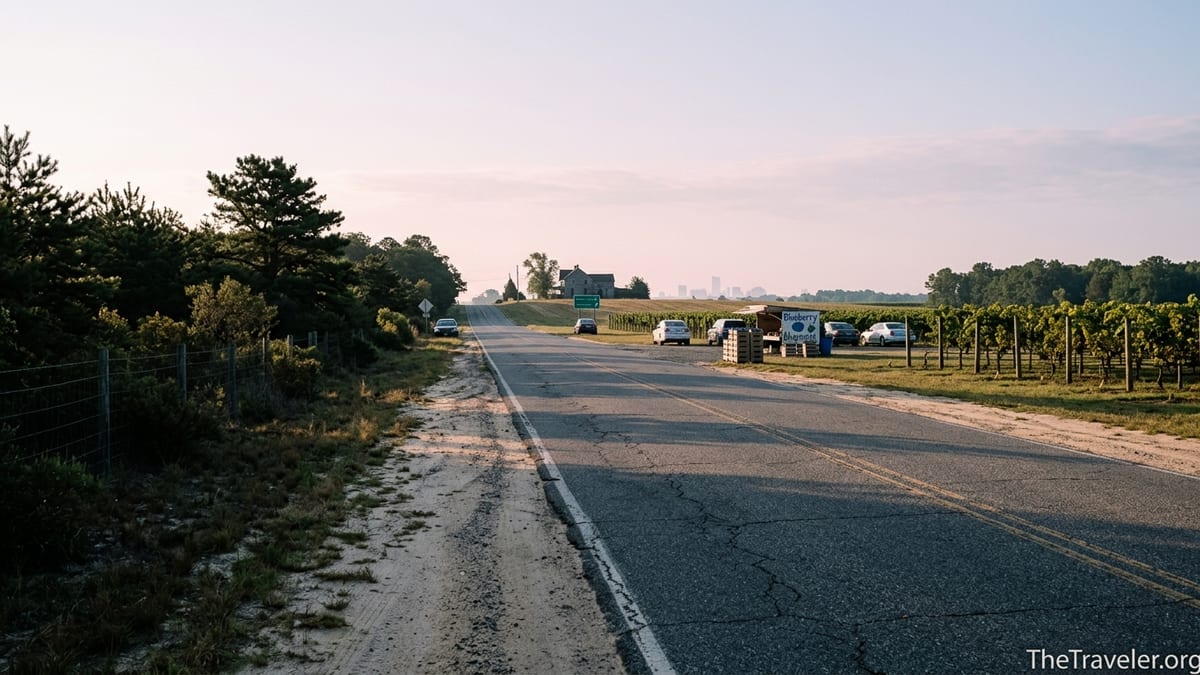
The idea that South Jersey begins and ends with Atlantic City misses most of what makes the region distinctive. Once you travel just 20 or 30 minutes inland or down the coast, the landscape changes quickly. The highway billboards fall away, motels give way to low cranberry bogs and cedar swamps, and the sky seems to widen over flat, sandy pine forest. Driving Route 206 toward Shamong or Route 542 toward Hammonton feels less like a detour from the beach and more like entering a different state altogether.
The distances are manageable, which makes these places ideal side trips from a shore vacation. From Atlantic City, it is roughly 45 minutes to the walkable restaurant row in Collingswood, about an hour to the wine and brewery trail around Hammonton, and less than an hour to the heart of Wharton State Forest. Many visitors already pass within a few miles of these landscapes without realizing it, cruising through on the Garden State Parkway or Atlantic City Expressway on their way to a hotel room with a casino view.
Shifting your mental map is the first step to understanding South Jersey. Instead of seeing Atlantic City as the region’s center, think of it as just one node in a web that includes historic mill towns like Batsto Village, riverfront cities such as Millville and Vineland, and compact boroughs like Haddonfield and Collingswood that trade on walkability and culture rather than ocean frontage. Once you start connecting those dots, a long weekend can easily stretch into a deeper exploration.
The Pine Barrens: South Jersey’s Wild Heart
The single biggest surprise for many first-time visitors is the Pine Barrens, a vast mosaic of pitch pine forest, bogs and slow, tea-colored rivers that occupies a large swath of inland South Jersey. Wharton State Forest, the largest tract in the state park system, anchors this landscape with more than 100,000 acres of protected land, including lakes, campgrounds and miles of sand roads and trails. Day trippers who only know the jersey shoreline’s congestion often find the quiet startling here, especially on a weekday evening when the wind is the loudest sound.
For a tangible taste of the Pine Barrens, many travelers start at Atsion Recreation Area, about 45 minutes inland from Atlantic City via Route 206. The small lake here has a guarded swimming beach in summer, basic changing facilities and shaded picnic tables within sight of the water. Nearby outfitters rent canoes and kayaks for about the price of a modest restaurant meal, allowing beginners to paddle short loops on Atsion Lake before progressing to slower downstream trips on the Mullica or Batsto Rivers. The water appears dark amber yet clear, stained by tannins from the surrounding cedar and pine.
Canoe and kayak trips offer a memorable alternative to sitting on a crowded boardwalk. A typical self-guided paddle on the Batsto River between Quaker Bridge and Batsto Lake takes around four hours. Outfitters based near Batsto and Atsion will shuttle paddlers and boats, so you can float with the current through narrow bends, duck under overhanging branches and look for turtles sunning on logs without worrying about how to get back to your car. For many visitors, this quiet, tea-colored waterway becomes their defining image of South Jersey, supplanting neon casino facades.
Hikers are equally well served. The Batona Trail, a long-distance path stretching more than 50 miles through the pines, passes directly through Wharton State Forest and connects to other preserves. Travelers who are not up for multiday treks can sample short segments from trailheads near Batsto Village or Atsion, where loop trails wind through sandy pitch pine and oak forest. Even a three- or four-mile walk here can be enough to understand the region’s appeal, especially on a crisp fall afternoon when the forest glows gold and red and pine needles soften every footstep.
Batsto Village and the Stories Hidden in the Pines
If you think of the Pine Barrens as empty wilderness, Batsto Village tells a more complicated story. This preserved 18th and 19th century ironworks and glassmaking village sits within Wharton State Forest and is one of the most atmospheric historic sites in New Jersey. A modest parking fee during peak season supports access to the village, where visitors can wander past a white mansion, workers’ cottages, a general store and a mill, all clustered near the dam that now forms Batsto Lake.
It is an easy place to imagine the industrial past of South Jersey, when bog iron from local streams and charcoal from surrounding forests fueled a thriving economy long before casinos arrived on the coast. Today, interpretive exhibits in the visitor center explain how the village’s fortunes rose and fell along with the iron and glass industries. On many weekends, staff and volunteers lead guided walks that delve into topics ranging from architecture and industry to the ecology of the surrounding wetlands, making it a worthwhile stop for history-minded travelers.
Batsto also serves as a gateway for deeper excursions. Several signed hiking and biking trails begin here, including loops around Batsto Lake that showcase classic Pine Barrens scenery within a short walk of the parking lot. Kayakers finishing a paddle on the Batsto River glide under the dam toward the village’s shoreline, where the river widens into the lake. Many visitors combine a morning paddle with an afternoon stroll through the historic streets, followed by a drive to a nearby winery or farm stand for a low-key dinner.
For travelers used to the Atlantic City boardwalk’s sensory overload, Batsto Village feels almost meditative. There are no flashing lights here, no loudspeakers or sidewalk barkers, just interpretive signs, the creak of pines and an occasional group of school children on a field trip. It is one of the clearest reminders that South Jersey’s story is much older and richer than the recent casino decades might suggest.
Walkable Towns: Collingswood, Haddonfield and Beyond
While the Pine Barrens show South Jersey’s wild side, its compact towns reveal a different dimension. Collingswood and Haddonfield, both in Camden County and roughly an hour’s drive from Atlantic City, regularly appear in lists of the region’s most desirable communities. They owe their appeal not to ocean views but to leafy streets, historic homes and active main streets lined with independent businesses.
Collingswood’s downtown, centered on Haddon Avenue, is particularly eye-opening for visitors who assume South Jersey is all strip malls and highway diners. Long-time residents describe it as one of the most walkable spots in the region, with a 24-hour train station linking it directly to Philadelphia and blocks of restaurants serving everything from handmade pasta to vegan comfort food. Because Collingswood is officially a dry town, many restaurants operate on a bring-your-own-bottle model, which shapes the evening rhythm as couples stroll in with bottles from local wine shops instead of ordering cocktails from a bar.
Neighboring Haddonfield leans a bit more historic in tone, with colonial-era buildings and a downtown overlay district that prioritizes preservation. It was one of the first municipalities in New Jersey to create a formal historic district, and that early decision shows in the intact streetscapes and careful restorations. Travelers coming from Atlantic City often remark on how different it feels to sit at a sidewalk cafe here, looking up at 18th and 19th century facades rather than high-rise hotels.
Other towns across South Jersey offer similar experiences on a smaller scale. Moorestown and Merchantville to the north, Pitman in Gloucester County, and Medford closer to the pines all maintain compact business districts with enough cafes, bakeries, bookstores and boutiques to reward an afternoon on foot. These places challenge the stereotype that you have to cross into Philadelphia to find walkable, village-style streets. For travelers willing to add an extra night to their shore itinerary, an overnight in one of these towns can provide a welcome reset from the crowds.
Hammonton, Wineries and the Taste of Blueberry Country
Roughly halfway between Atlantic City and Philadelphia sits Hammonton, a small town that has quietly built a reputation as a food and wine destination. Surrounded by farms and pine forest, Hammonton markets itself as the Blueberry Capital and backs up the claim with seasonal farm stands, pick-your-own fields and blueberry-themed desserts at local bakeries each summer. Yet what surprises many visitors is how lively the town stays after harvest season ends.
In and around Hammonton, several wineries operate tasting rooms set among vineyards and pine fringes. At spots on the local wine and ale trail, travelers can sample regional reds and whites while lingering over gastropub-style menus on outdoor patios when the weather cooperates. Many offer live music on weekends from late spring into fall, turning a simple tasting into a relaxed evening outing. Modest per-glass prices and shared small plates make these stops approachable even for travelers who usually stick to beer at the shore.
Downtown, Hammonton’s restaurants and bars draw both locals and visitors from around South Jersey. A modern wine bar uncorks an extensive list that includes local bottles alongside international favorites, while places like Rocco’s Town House serve classic American dishes in atmospheric brick interiors. Newer spots add craft cocktails or updated Italian cooking to the mix, reflecting the town’s evolving palate without losing the blue-collar friendliness that has long defined the area.
Food-focused travelers should also pay attention to Hammonton and neighboring towns for another reason: hoagies. Across South Jersey, small delis and specialty markets quietly turn out sandwiches that rival their better-known Philadelphia counterparts. In Hammonton, a stacked Italian hoagie layered with prosciutto, soppressata, capicola and marinated vegetables can cost roughly what a simple boardwalk lunch might, yet feel far more memorable. Similar creativity shows up in Cherry Hill and Mount Holly, where shops add ingredients like broccoli rabe, sharp provolone or Japanese-inspired sauces to the traditional hoagie format.
Art, Glass and Riverfront Revivals in Millville and Vineland
Head southwest from Atlantic City and the landscape shifts again, this time toward the Delaware Bay and the small cities of Millville and Vineland. Historically, this area grew around glassmaking and manufacturing, thanks in part to abundant sand and access to river transport. While many factories have quieted, the legacy lives on in attractions such as the WheatonArts complex in Millville, where glassblowers still work in hot shops and galleries showcase both regional and international artisans.
Downtown Millville leans into its role as an arts hub. Its Glasstown Arts District encourages galleries, studios and performance spaces to cluster along a compact stretch of High Street, while seasonal events bring food vendors and musicians outside. Travelers who only know South Jersey from the Atlantic City boardwalk can find it jarring, in a good way, to stand on a brick-lined downtown block here, watching a glassblowing demonstration before wandering into a cafe housed in a former bank or hardware store.
Vineland, Millville’s neighbor and partner in a joint urban enterprise zone, has pursued a different but complementary path. With a larger population and grid of tree-lined streets, Vineland combines big-box retail on its outskirts with pockets of older architecture closer to the center. In recent years, national retirement and finance publications have highlighted Vineland as an affordable place to retire in New Jersey, noting its relatively modest housing costs and easy access to both shore towns and healthcare facilities. For travelers, that affordability can show up in hotel prices that are often lower than coastal equivalents during peak season.
Spending a night in Millville or Vineland instead of directly on the beach can change the tone of a South Jersey trip. Riverfront parks, modest local diners, and quiet residential streets provide a low-key contrast to Atlantic City tower hotels. From here, it is an easy drive to bayside birding spots, the Pine Barrens or the shore, making these small cities practical bases for a multi-day, hub-and-spoke itinerary focused on variety rather than a single destination.
Eating Your Way Through South Jersey
Food is often the fastest way to overturn assumptions about a place, and South Jersey’s dining scene is no exception. Travelers who expect little beyond fried boardwalk fare and chain restaurants find an unusually diverse mix of kitchens once they step inland. Immigrant communities, Italian American families, and new-school chefs have collectively turned the region into a quiet culinary destination, especially for those who enjoy casual but thoughtful cooking.
Hoagies remain the cornerstone. In strip mall delis from Cherry Hill to Hammonton, counters piled high with cured meats and sharp cheeses churn out sandwiches that justify detours from major highways. A specialty Italian hoagie with multiple cured meats, provolone, olive oil and long hot peppers will often run in the low to mid-teens, yet easily feed two people for lunch. Creative versions layer teriyaki-glazed chicken with Japanese mayo or load still-warm pork with garlicky broccoli rabe and sharp provolone, reflecting both tradition and experimentation.
Beyond sandwiches, South Jersey towns support a wide assortment of independent restaurants. On a single evening in Collingswood, for example, travelers might choose between a BYO Italian trattoria serving slow-braised short rib over house-made gnocchi, a modern Mexican kitchen with regionally sourced produce, or a vegan cafe turning local mushrooms and grains into hearty grain bowls. Haddonfield’s brick storefronts house upscale bistros and long-running family favorites, while Hammonton’s downtown increasingly mixes old-school taverns with places offering curated wine lists and inventive small plates.
Even shore towns beyond Atlantic City deserve fresh attention. To the south, Cape May pairs Victorian architecture with a serious restaurant scene, where small dining rooms focus on local seafood and seasonal vegetables. Farther up the barrier islands, towns such as Ocean City and Avalon offer their own mix of family-friendly pizzerias, ice cream shops and quietly ambitious kitchens tucked above street level. The broader point is simple: limiting your understanding of South Jersey food to casino buffets and boardwalk pizza shortchanges the region dramatically.
The Takeaway
To know South Jersey only through Atlantic City is to read a single, noisy chapter of a much longer book. Within an hour’s drive of the casinos, travelers can wander 18th century industrial villages preserved in pine forest, paddle along quiet, tannin-stained rivers, sip local wine on a Hammonton patio as the sun drops behind the vines, or stroll past historic facades in Collingswood and Haddonfield while considering which independent restaurant to try next. None of these experiences require special gear or insider status, just a willingness to explore slightly beyond the usual exits.
The reward for that curiosity is a far more textured picture of the region. You begin to see how pine barrens and cranberry bogs, walkable downtowns and modest riverfront cities, wineries, hoagie shops and glass studios all weave together into a South Jersey that feels at once grounded and surprising. On your next trip, consider treating Atlantic City not as the destination but as a jumping-off point. Check in to a small-town inn instead of a casino tower, trade one boardwalk day for a Pine Barrens paddle, and let the quieter corners of South Jersey redraw your mental map of the state.
FAQ
Q1. How far are the Pine Barrens from Atlantic City?
The core Pine Barrens destinations in Wharton State Forest, such as Atsion and Batsto Village, are typically about a 45 to 60 minute drive from Atlantic City, depending on traffic and your precise starting point.
Q2. Can I visit Batsto Village without hiking or paddling?
Yes. Batsto Village is reachable by paved road and has a parking area close to the historic buildings. You can explore the mansion exterior, general store, worker houses and mill on foot along easy, mostly level paths.
Q3. Do I need my own kayak to paddle South Jersey rivers?
No. Several outfitters near Atsion, Batsto and other access points rent canoes and kayaks and provide shuttle service. You can usually book a half-day trip that includes the boat, paddles, life jackets and transportation for a single per-person fee.
Q4. Are Collingswood and Haddonfield worth visiting if I am staying at the shore?
They are. Both towns offer walkable main streets with independent restaurants, cafes and shops, and make a pleasant day or evening trip from most shore towns. Many travelers combine a visit with a stop in Philadelphia or other inland attractions.
Q5. When is the best time of year to explore South Jersey beyond Atlantic City?
Late spring and fall are especially appealing, with mild temperatures, fewer crowds and colorful foliage in the Pine Barrens. Summer works well too, but inland forests and towns can feel quieter than the shore, which some visitors prefer.
Q6. Is it easy to find wineries and breweries near Hammonton?
Yes. The area around Hammonton supports several wineries and a growing number of breweries, many of which participate in local wine and ale trails. Tasting rooms are generally well signed from nearby roads, and some offer seasonal events and live music.
Q7. Are there family-friendly activities outside Atlantic City?
Plenty. Families can swim and picnic at lakes like Atsion, take short hikes on marked trails near Batsto, visit glassmaking demonstrations in Millville, or enjoy ice cream shops and playgrounds in walkable towns such as Collingswood, Haddonfield and Pitman.
Q8. How expensive are meals in South Jersey’s small towns compared to Atlantic City?
In many cases, meals inland are more affordable. A substantial hoagie or casual entree in towns like Hammonton, Collingswood or Millville often costs less than comparable dishes in casino restaurants, and portions tend to be generous.
Q9. Do I need a car to explore South Jersey beyond Atlantic City?
A car provides the most flexibility, especially for reaching Pine Barrens trailheads, wineries and smaller towns. Limited public transit exists between some communities, but schedules and connections can be challenging for short visits.
Q10. Is it realistic to combine Atlantic City, the Pine Barrens and small towns in one weekend?
It is. Many travelers spend one day or night in Atlantic City, another day exploring the Pine Barrens around Batsto or Atsion, and the remaining time in walkable towns like Collingswood, Haddonfield or Hammonton, creating a varied yet compact itinerary.