


Stockholm Arlanda is Sweden’s busiest airport and the main gateway for international visitors. On paper it promises smooth Nordic efficiency, modern terminals and fast rail links to the city. In reality, traveler opinions are more nuanced. Many praise its clean design, clear signage and simple train access, while others complain about long security queues, expensive transport and confusing terminal changes. Whether Arlanda feels “easy” to use often depends on when you travel, how prepared you are, and which parts of the airport you pass through.
Get the latest updates straight to your inbox!
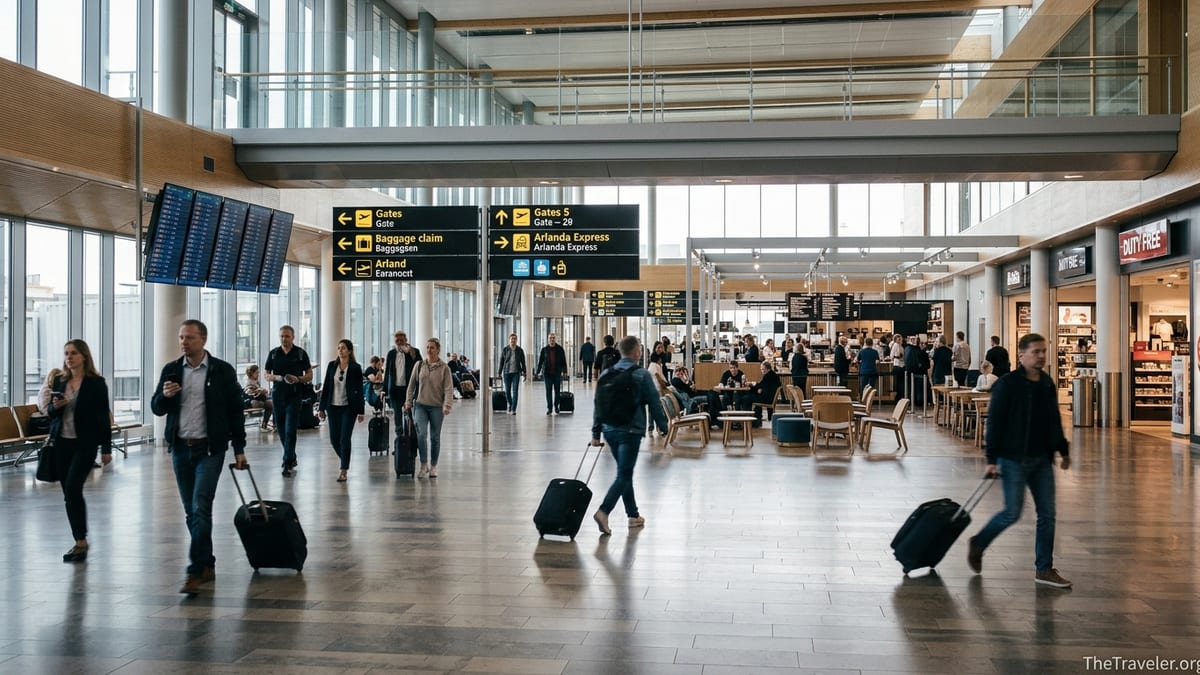
First Impressions: Layout, Terminals and Wayfinding
Arlanda has four terminals, numbered 2, 3, 4 and 5, plus a central area called SkyCity. Terminals 2 and 5 handle most international traffic, while 3 and 4 focus on regional and low-cost Schengen routes. Since 2022, Terminals 4 and 5 have been connected airside, so many passengers experience them as one large terminal with different gate zones rather than separate buildings. For most travelers, this consolidation has made transfers within the main complex noticeably simpler.
Wayfinding is generally a strong point. Recent airport maps show clear color-coded signs for gate areas, security, baggage claim and transport, and most passengers report that once they know their terminal, following the signage is straightforward. The main public floor is level 3, which helps keep walking routes predictable. SkyCity, set between Terminals 4 and 5, acts as a hub where you find the main rail station, hotels, restaurants and a cluster of services, so you rarely need to hunt through multiple buildings for basics like food or an ATM.
That said, the airport’s evolution has created a few pain points. Some travelers mention that older online guides still refer to “Terminal 4” as a fully separate unit, which can cause confusion when you land at a gate labeled C in what is now effectively part of Terminal 5. Others note that walking distances can be long if you arrive at one end of Terminal 5 and depart from the former Terminal 4 gates at the opposite side. For most healthy travelers, this is just extra exercise, but for families, older passengers or those with tight connections, it can feel less user-friendly.
Information desks and help points in Terminals 2, 4 and 5 add an additional layer of support. Staff are generally described in reviews as polite and fluent in English, which helps reduce the stress of navigating a new layout. The airport’s own chatbot offers quick answers to common questions, but most travelers still rely on physical signage and announcements on the day.
Getting To and From the City: Fast but Often Pricey
From an ease-of-use perspective, Arlanda scores highly on connectivity. The Arlanda Express train runs directly between the airport and Stockholm Central in about 18 minutes, with dedicated stations serving the southern terminals (2, 3 and 4) and Terminal 5. Trains run frequently throughout the day, and platforms are integrated with the terminal complex, so the physical process of catching the Express is simple: follow the yellow signs from arrivals, buy a ticket at a machine or staffed counter, and roll your suitcase straight onto the platform.
Where travelers hesitate is cost. As of 2024, a standard one-way Arlanda Express ticket costs around 340 SEK, significantly more than commuter trains or buses. Many business travelers with expenses find this acceptable, calling the Express the most “frictionless” way into town. Independent travelers and families, however, often describe a mental calculation: is saving 20 minutes of travel time worth paying several times the cost of public transport. Reviews and forum posts frequently compare Arlanda Express unfavorably with cities like Helsinki, where airport trains are priced closer to regular local transit.
For a cheaper but still reasonably straightforward option, the SL commuter train from Stockholm City to Arlanda takes slightly longer and usually requires an airport supplement or specific ticket bundle. Travelers familiar with Swedish public transport report that the process is not difficult: you buy an SL ticket that includes the Arlanda station fee, tap in, and ride directly to the airport station in SkyCity. It is a little less intuitive for first-time visitors, since the fee structure and ticket types are not as prominently marketed at the airport as the Arlanda Express.
Airport buses run from several central locations to Arlanda in roughly 40 to 45 minutes depending on traffic. These are typically cheaper than the Express and easier to understand for visitors who prefer simply buying a single ticket from a kiosk or driver. The trade-off is less predictability at rush hour or during winter weather. From a usability standpoint, the airport itself makes catching these services reasonably clear with signposted coach stops outside arrivals, but reading up on the most suitable bus line in advance still helps.
Check-in, Security and Passport Control: When Easy Becomes Stressful
No matter how good the layout is, an airport never feels easy to use if queues dominate the experience. Stockholm Arlanda’s reputation in this area is mixed. Aggregated reviews in recent years show generally positive comments about check-in and security efficiency outside peak times. Many travelers mention breezing through security in 10 to 20 minutes for mid-day departures, especially out of Terminal 5 where newer security lanes allow passengers to keep laptops and liquids in their bags.
The story changes during busy holiday periods or early morning departure waves. Travelers have reported lines snaking from security into SkyCity, with total wait times of an hour or more. Some still recall severe bottlenecks in 2021 and 2022, when staff shortages caused major delays. While staffing levels and technology have improved since then, occasional long waits still appear in traveler reports during summer weekends or major travel weekends such as Christmas and Easter. For families, anyone with mobility issues or tight connections, these spikes in waiting time can turn an otherwise orderly airport into a stressful maze.
Passport control can also be a variable experience. For Schengen flights, there is no exit immigration, so passengers typically move from security straight to their gate, which feels very straightforward. For non-Schengen departures and arrivals, however, you pass through border control where the line length depends heavily on how many widebody flights arrive or depart around the same time. Automated e-gates for EU and EEA passengers help, but non-EU travelers, especially those arriving on long-haul services, occasionally describe 30 to 40 minute waits at border control during peaks.
Travelers who describe Arlanda as “easy” typically highlight two habits: arriving earlier than the minimum suggested time, and checking in online to skip the airline counter queue. For example, a traveler taking a morning SAS flight within Europe might arrive 2 hours before departure, proceed directly to automated bag drop, and reach the gate within 40 minutes. Another passenger on a charter airline during school holidays who arrives less than 90 minutes before departure might encounter a full check-in hall, a slow security line and a tense jog to the gate. The infrastructure is the same; the experience feels completely different based on timing and preparation.
Transfers and Connections: How Smooth Is Changing Planes?
Arlanda serves as a hub for SAS and several regional carriers, so many passengers use it purely as a transfer point. If you are on one ticket, especially within the SAS network or major alliances, connecting is usually straightforward. Your luggage is checked through, your boarding pass for the onward flight is issued at origin, and your job in Stockholm is mainly to follow the transfer signs and walk between gate areas. The airside link between Terminals 4 and 5 means that many domestic-to-international or Schengen-to-Schengen connections now happen inside one continuous security zone.
Walking times, however, can be longer than some travelers expect. For instance, arriving at a D gate in Terminal 5 and departing from a C gate in the former Terminal 4 can involve a 10 to 15 minute walk through corridors and commercial areas. This is manageable with a one-hour connection but becomes uncomfortable if your incoming flight is delayed. Some travelers describe Arlanda as feeling “spread out” compared with compact hubs like Copenhagen, even though the number of terminals is similar.
Unprotected self-connections are more risky. A traveler might book a regional flight to Arlanda on one low-cost carrier and a separate long-haul flight from a different terminal. In this case you must collect your luggage, exit through customs, walk to the correct check-in area, drop your bag and pass security again. During quiet times this might take under an hour, but during morning or evening peaks it can take significantly longer. Several traveler anecdotes highlight that what looks like a comfortable 2-hour gap on paper can feel tight if your first flight is even slightly delayed.
There are also airside transfer buses linking remote gate areas, which can help with certain combinations of terminals or flights. However, these services are not as heavily advertised as the main walking routes. From a usability standpoint, anyone planning a connection of less than 75 minutes, especially when switching between airlines on separate tickets, should study the current terminal map and leave generous margin for walking and queues.
Comfort, Food, Shopping and Services Inside the Terminals
Once past security, most travelers describe Stockholm Arlanda as a clean, modern place to spend time. Terminal 5 in particular has seen investment in new security lanes, a marketplace-style central area and expanded dining options. You will find the usual mix of Nordic cafes, international chains, duty-free shops and travel essentials. Prices, however, are frequently described as high even by Scandinavian standards. A simple airport meal for one can easily cost the equivalent of 15 to 25 US dollars, and a takeaway coffee often runs higher than in downtown Stockholm.
Wi-Fi is free for several hours, which most passengers find sufficient for checking email, downloading entertainment or catching up on work. Some reviews mention inconsistent speeds at peak times, but overall connectivity is considered better than at many European mid-size hubs. Power outlets and USB ports are scattered throughout gate areas, though they can be in demand at popular seating zones near windows or close to family play areas.
For travelers with longer layovers, SkyCity and the adjacent hotel cluster provide additional comfort. The large on-airport hotel built into the terminal complex is popular with passengers catching early departures or arriving late at night. Guests appreciate being able to walk straight from the lobby to check-in within minutes, avoiding shuttle buses or taxis. Rooms are typically described as modern and quiet, though some note that crowded reception lines during peak hours can mirror the busy feel of the airport outside.
Families generally find Arlanda manageable. Stroller-friendly lifts and ramps are common, and baby-care rooms are clearly marked. Small play corners near certain gates help entertain children during delays. Solo travelers and business passengers often comment positively on the number of quiet corners and work-friendly spaces, particularly near the newer gates in Terminal 5. Lounges operated by airlines and independent operators add another level of comfort for those with access, with showers and hot food making longer connections more pleasant.
Costs, Practicalities and Accessibility
Beyond the headline question of “Is it easy to use,” many travelers weigh how Arlanda feels in terms of value and practical logistics. Transport costs to and from the airport are a recurring theme. With the Arlanda Express priced at a premium and even commuter train tickets including an airport station supplement, some visitors feel they pay a lot simply to reach central Stockholm. A commonly shared strategy is to use the Express only when time is tight, and otherwise opt for buses or commuter trains to save money at the expense of 15 to 30 extra minutes of travel.
Inside the terminals, food and drink are unquestionably expensive compared with many European airports, though not out of line with Scandinavian norms. Travelers who arrive prepared often bring snacks or refillable water bottles, taking advantage of drinking fountains after security. Duty-free shopping offers the usual range of cosmetics, spirits and Nordic specialty products, but bargain hunters are unlikely to be impressed. Most visitors see these stores as convenient for last-minute gifts rather than sources of real savings.
On the positive side, basic services are well covered. There are information points, baggage wrapping, currency exchange counters, lockers in certain areas, and car rental desks clustered near arrivals. Accessibility for passengers with reduced mobility is generally good, with lifts, escalators, and assistance services that can be prebooked through airlines. The obstacle is less the presence of facilities and more the potential walking distances between gates, so arranging wheelchair assistance in advance can turn a challenging connection into a manageable one.
Driving to Arlanda is relatively straightforward via the E4 motorway from both Stockholm and Uppsala. Signage to long-term and short-term parking is clear, and prebooking online often secures better prices and clearer directions. However, parking fees can quickly add up, especially for multi-day trips. Many local travelers compare the total cost of parking plus fuel with the price of public transport for their group before deciding whether driving is truly the easiest option.
What Travelers Really Think: Balancing Pros and Cons
When you read through large numbers of reviews and recent trip reports, a pattern emerges. On average, travelers rate Stockholm Arlanda as solid but not exceptional. Many describe it as clean, organized and reasonably efficient, particularly outside peak seasons. The connected terminals and central SkyCity hub mean that most essential services are easy to reach without changing buildings or dealing with outdated infrastructure. English-language signage and staff help international visitors feel at ease, and the airport rarely feels chaotic in the way some mega-hubs do.
The criticism centers on three areas: queues, prices and distances. Long security or passport control lines during busy periods shape some of the most negative reviews, especially from travelers who nearly missed flights after arriving what they thought was “early enough.” High costs for transport and food leave others with the impression that Arlanda is functional but expensive. And while the internal layout is logical, a few passengers feel misled by maps that understate how much walking might be needed between certain gate areas or between the rail station and far-flung piers.
There are also subtle differences between terminals. Terminal 5, with its newer security technology and refreshed commercial zones, tends to receive more positive comments than smaller terminals where facilities feel a bit older. Domestic travelers who regularly fly within Scandinavia often praise Arlanda as entirely adequate and far less stressful than some larger hubs in continental Europe. Long-haul leisure travelers passing through only once every few years, especially in peak summer, are more likely to remember the cost of the Arlanda Express or a long queue more vividly than the airport’s clean design.
Ultimately, whether the airport feels “easy” to use depends largely on expectations and planning. Travelers who arrive well in advance, pre-book transport or parking, and check terminal information before flying are more likely to find Arlanda straightforward. Those who assume that a midsize Northern European hub will always be quiet and cheap can end up surprised.
The Takeaway
Stockholm Arlanda Airport is neither a horror story nor a flawless model of Nordic efficiency. It occupies a middle ground: generally clean, logical and well connected, but with specific weak points that can trip up the unprepared. Its strongest features are clear signage, a consolidated terminal complex centered on SkyCity, and fast rail access to downtown Stockholm. Its main drawbacks are occasional long queues at peak times, relatively high prices for both airport transport and on-site services, and sometimes underestimated walking distances.
If you approach Arlanda with realistic expectations, it can be an easy airport to use. Check which terminal you are using before you travel. Build in extra time during school holidays or early morning waves. Decide in advance whether speed or price matters more for getting to and from the city, and choose between the Arlanda Express, commuter trains or buses accordingly. For transfers, aim for comfortable connection times and avoid booking tight self-connections on separate tickets if you can.
For most travelers, the result will be a smooth, if not spectacular, experience. You may pay a bit more for the convenience, and you might walk more than you expected, but you are unlikely to face the confusion or outright chaos seen at some larger hubs. In that sense, Stockholm Arlanda delivers what many visitors want: a dependable gateway to Sweden that works well most of the time, especially for those willing to prepare a little.
FAQ
Q1. Is Stockholm Arlanda Airport easy for first-time visitors to navigate?
Yes, most first-time visitors find Arlanda straightforward thanks to clear English signage, a central SkyCity hub and logical terminal layouts. The main challenge is walking distance rather than getting lost.
Q2. How early should I arrive at Arlanda before my flight?
For European flights, arriving about 2 hours before departure is usually enough outside peak holidays. For long-haul or during busy seasons, 2.5 to 3 hours offers a safer buffer for check-in and security.
Q3. Is the Arlanda Express worth the price?
The Arlanda Express is the fastest and most convenient option, taking around 18 minutes to central Stockholm. Many travelers find it worth paying for when time is tight, but budget-conscious visitors often prefer commuter trains or buses.
Q4. Are security queues at Arlanda really that bad?
At quiet times, security can be very quick, especially in Terminal 5 with its newer lanes. During early morning waves or holiday peaks, queues can still be long, so extra time is recommended.
Q5. Is transferring between terminals at Arlanda difficult?
Most connections are manageable on foot because Terminals 4 and 5 are linked airside. However, you should allow at least 45 to 60 minutes for transfers, more if you need to collect and re-check luggage on separate tickets.
Q6. Is Stockholm Arlanda Airport accessible for travelers with reduced mobility?
Yes. The airport provides lifts, ramps and assistance services that can be prebooked through your airline. Because walking distances can be long, arranging wheelchair or buggy assistance in advance is a good idea.
Q7. How easy is it to get from Arlanda to central Stockholm on public transport?
It is relatively easy. Options include the Arlanda Express, commuter trains and several airport bus services. The Express is simplest but most expensive, while buses and commuter trains are cheaper but slower.
Q8. Are there good food and shopping options inside the terminals?
Yes, especially in Terminal 5, which has a wide range of cafes, restaurants and duty-free shops. Many travelers find the quality good but prices noticeably higher than in central Stockholm.
Q9. Is Arlanda a good airport for long layovers?
For a few hours, Arlanda is comfortable, with free Wi-Fi, lounges, and several cafes. For overnight or early-morning flights, the on-site hotels connected to the terminal make longer layovers easier.
Q10. Overall, is Stockholm Arlanda Airport considered user-friendly?
Overall, yes. Most travelers find Arlanda clean, organized and reasonably efficient, especially outside peak periods. Its downsides are mostly related to price and occasional crowding rather than fundamental design problems.