


Flying into Stockholm, you will almost always see two airport names pop up: Stockholm Arlanda Airport (ARN) and Stockholm Bromma Airport (BMA). On a booking screen they can look interchangeable, but in real life they are very different gateways into Sweden’s capital. Your choice will shape how long it takes to reach your hotel, how much you pay for transport, and even what kind of trip you end up having. This guide walks through the key differences, with concrete examples and up-to-date information, so you can decide which Stockholm airport fits your plans best.
Get the latest updates straight to your inbox!
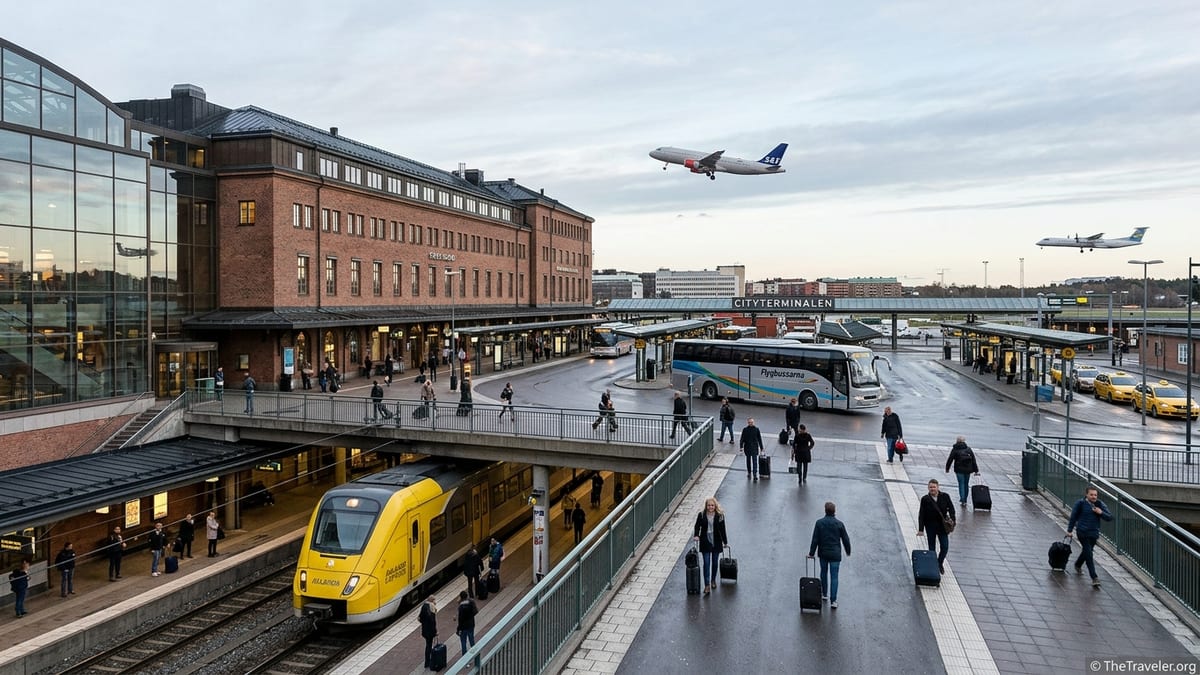
Stockholm’s Two Main Airports in a Nutshell
Stockholm Arlanda Airport is Sweden’s primary international gateway, located roughly 40 to 45 kilometers north of central Stockholm. It handles the bulk of the country’s long haul and European traffic, with more than 100 direct routes in a typical year and the full range of legacy airlines and low cost carriers operating there. If you see direct flights from North America, the Middle East, or Asia into Stockholm, they almost always land at Arlanda.
Stockholm Bromma Airport sits just west of the city center, only around 8 to 9 kilometers away. Historically the city’s first airport, it has evolved into a small, close in field focused mainly on domestic flights and a limited number of regional European routes, such as Brussels or Helsinki. It has shorter runways, strict noise rules, and caps on traffic, so airline choice is much narrower than at Arlanda, but the trade off is speed and convenience once you land.
For most international leisure travelers, Arlanda will be the default. However, if you are flying in from another Swedish city or on a specific business route that still uses Bromma, or you find a niche regional flight to BMA, understanding each airport’s pros and cons will help you avoid surprises and plan your arrival with realistic timing and costs.
There is an ongoing political debate about Bromma’s long term future, and Sweden’s airport operator and the City of Stockholm have signaled interest in eventually closing it, yet the current national government has said it will not allow closure during its mandate period, which runs through 2026. That means Bromma will remain operational for the near term, but it also underlines how tightly constrained its growth and facilities are compared with Arlanda.
Location and Access: City Proximity vs Speed
When you look at a map, the contrast is clear. Arlanda is far out along the E4 motorway, roughly a 30 to 45 minute drive from central Stockholm in normal traffic. Bromma, by comparison, sits inside the urban area, and in light traffic you can reach Kungsholmen or the central station in 15 to 20 minutes by taxi or rideshare. In pure distance and road time, Bromma feels more like London City Airport, while Arlanda is closer to Heathrow or Charles de Gaulle in its relationship to the city.
For Arlanda, the flagship connection is the Arlanda Express high speed train, which covers the airport to Stockholm Central in around 18 to 20 minutes. It runs frequently and has its own dedicated platforms directly under the terminal complex, so the experience can be very smooth: you walk off your flight, follow bright yellow signs, tap your ticket, and sit down. The trade off is price, which many Stockholm residents openly describe as expensive; a one way adult ticket is typically a significant fraction of a budget airline fare. Coach services, such as the airport buses to Cityterminalen, take about 40 to 45 minutes, cost noticeably less than Arlanda Express, and still drop you just a short indoor walk from Stockholm Central Station and the metro hub.
If you are watching your budget, public transport via the regional commuter trains or local buses is technically possible from Arlanda, but there is an extra station access fee on top of a normal Stockholm public transport ticket. Some travelers avoid that surcharge by taking a local bus from the terminal area to Märsta and then a commuter train from there, turning the journey into roughly an hour or more, but saving money over Arlanda Express or a taxi. This route can make sense for long term visitors already buying multi day SL passes, but is usually tedious after an overnight flight.
Bromma’s strength is simplicity. Several city bus lines and a tram connection link the airport to nearby metro stations, and there are also dedicated airport coaches to Cityterminalen. Because the distance is short, taxi or rideshare fares from Bromma can be lower in absolute terms than from Arlanda, especially if traffic is light. A business traveler landing at Bromma mid morning can realistically be in a meeting room near Stockholm City Hall within 30 minutes of stepping off the plane, something that is rare from Arlanda unless you are willing to pay for Arlanda Express and your flight, immigration, and baggage all run perfectly on time.
Airlines, Destinations, and Flight Options
The decision between Arlanda and Bromma often starts at the booking stage, when you see different airports listed for Stockholm. Arlanda is where you will find most global carriers: Scandinavian Airlines, major European network airlines, and low cost operators on intra European routes, along with occasional long haul services operated by airlines from North America or the Middle East. For example, if you are flying nonstop from New York, Doha, or Bangkok into Stockholm, those flights are routed to Arlanda.
Arlanda’s network is broad within Europe too. You can typically find multiple daily options to major hubs like Frankfurt, Amsterdam, London Heathrow, and Copenhagen. That matters if you are connecting onward to other parts of Sweden or Scandinavia, because it means more flexibility and resilience if one flight is delayed. Domestic Swedish routes, such as to Kiruna, Luleå, or Umeå, now primarily use Arlanda as well, especially after some regional airlines shifted away from Bromma.
Bromma, on the other hand, has seen changing airline patterns over the last decade. For years, it was the operational base for one of Sweden’s regional carriers, which focused on high frequency domestic flights for business travelers. That airline has since concentrated most of its operations at Arlanda, and Bromma’s route map has become more limited. Today, Bromma is best thought of as a niche airport: a handful of domestic routes and a small selection of nearby international destinations like Brussels or Helsinki, typically operated with smaller regional aircraft.
In practice, this means leisure travelers coming from outside the Nordic region will almost always be flying into Arlanda. If you are based in Sweden or close by and booking a quick business trip, you might have an option into Bromma that aligns well with office locations in western or central Stockholm. However, if you are traveling as a family, trying to connect to a long haul flight, or need flexibility in case of disruptions, Arlanda’s greater range of airlines and frequencies is a safer bet.
Time, Cost, and Realistic Door to Door Scenarios
Choosing an airport is really about the full door to door journey rather than flight time alone. A good way to decide is to walk through realistic scenarios. Consider an American couple landing at Arlanda on a summer morning, staying at a hotel near Stockholm Central. If their long haul flight arrives at 09:00, it is reasonable to expect 20 to 40 minutes for passport control and baggage, depending on queues. Taking the Arlanda Express, they reach Stockholm Central around 10:00, then walk 5 to 10 minutes to their hotel. They are likely checking in or at least storing bags by 10:15 or 10:30. Swapping the train for an airport coach adds maybe 20 minutes to that schedule but can save enough money to pay for a nice lunch.
Now imagine a Swedish consultant flying back from Gothenburg to Stockholm Bromma late on a Sunday, heading home to an apartment in the inner city. With a compact cabin bag and no passport control, they might leave the aircraft, walk through the small terminal in a few minutes, grab the tram or a bus toward Alvik or the central station, and be home in under 40 minutes door to door. For this traveler, Bromma’s proximity and compact size are the main advantage, even though the flight options are fewer.
Budget conscious solo travelers often compare Arlanda Express with coaches and public transport. Discussions among Stockholm residents routinely point out that two people taking a rideshare from Arlanda can sometimes end up paying a similar total to the train, especially at off peak times, while a Flygbussarna coach ticket is usually significantly cheaper than Arlanda Express and still reasonably fast. If you are arriving late at night or travelling with a lot of luggage, a pre booked taxi or rideshare from Arlanda may offer the best balance of cost and convenience, particularly if you are staying in a neighborhood without easy access to the central station.
From Bromma, taxis and rideshares will almost always be cheaper in absolute terms because the distance is shorter, but you still need to factor in city traffic. On a weekday afternoon, the journey into town can stretch to 30 or 40 minutes despite the short distance. If you are staying near a metro or tram connection, taking public transport from Bromma can offer predictable timing and help you avoid congestion, though you will be managing your luggage through local vehicles rather than a dedicated airport link.
Airport Experience, Facilities, and Comfort
Arlanda feels like a conventional medium to large European hub. It has multiple terminals, a central “SkyCity” area between Terminals 4 and 5 with cafes, shops, and a hotel, and a mixture of old and newly renovated spaces. Recent years have seen construction works in some parts of the airport as the operator reconfigures domestic facilities, which can occasionally affect traffic patterns around the terminal or shuffle walking routes inside. For most passengers, though, the core experience remains what you would expect: security checkpoints with modern scanners, a mix of duty free and Scandinavian design shops, and significant seating near the gates.
Because Arlanda serves long haul flights, you will find full service lounges, including airline lounges, plus a range of coffee chains and restaurants that open early and stay open late. This is important if you arrive from outside Europe and have a tight connection to a domestic flight, or if you have a long layover and want somewhere quiet to work. There are also luggage storage options in several terminals and in SkyCity, which can be handy if you are planning a quick train trip into town between flights.
Bromma is more compact and feels more like a regional business airport. The terminal is smaller, walking distances are short, and check in, security, and boarding areas are close together. That can be a major relief if you are traveling with carry on only and know your airline well, since you can arrive relatively late by big airport standards. On the other hand, the range of shops and food outlets is limited, so if you are used to sprawling duty free and multiple restaurant choices, Bromma might feel bare bones.
Families with young children may appreciate Arlanda’s wider choice of amenities, including more spacious waiting areas and play corners, while solo business travelers who prioritize speed and predictability may value Bromma’s no nonsense layout. If you have accessibility needs or limited mobility, Arlanda’s multiple terminals and larger distances can be more demanding, but it also offers more comprehensive facilities and assistance services. With Bromma, the compact size simplifies navigation, but you should check in advance what assistance services your airline and the airport can provide, especially on early or late flights.
Best Airport by Trip Type
For long haul leisure trips, Arlanda is the clear winner. If you are flying from North America, Asia, or most of Europe on a major airline, your choices will naturally cluster at Arlanda. In this case, your main decision is not which airport, but which transfer mode to use once you land. Many first time visitors opt for Arlanda Express on arrival for the peace of mind of a fast, direct train into the city, then experiment with cheaper options such as airport coaches or public transport on the way back once they have a feel for Stockholm’s layout.
For domestic and short haul regional business travel, Bromma can still be ideal when a suitable route exists. If your office is near the western parts of central Stockholm or around the Solna and Sundbyberg areas, Bromma’s geographic position is excellent, and you may find that door to door time is significantly shorter than via Arlanda, even if the flight schedules are a little less flexible. A consultant flying Stockholm Bromma to Brussels for a day of meetings near the EU quarter, for example, might choose Bromma specifically to minimize early morning travel through Stockholm’s suburbs.
For budget city breaks inside Europe, Arlanda often offers more competition between airlines and therefore more attractive fares. Low cost carriers typically use Arlanda rather than Bromma, and promotions or seasonal routes are more likely to appear there. That said, keep an eye on the total journey cost. If a flight into Bromma costs slightly more than an Arlanda ticket but saves you a long, expensive transfer, the real difference may vanish once you factor in airport transport and your time.
For families, especially those traveling with strollers and multiple suitcases, Arlanda’s frequency of services to and from the city makes life easier, particularly outside peak hours. You will almost always find an airport coach, train, or taxi option that fits your schedule. Bromma’s small scale can also be family friendly, but only if the flight times and routes match your needs, which is not yet common for long distance visitors.
Sustainability, Future Plans, and Reliability
Sustainability is a central theme in Swedish transport policy, and it touches both airports. Arlanda has worked for years on environmental certifications and measures to reduce emissions around the airfield, such as centralized deicing areas and investments in cleaner ground operations. Rail access through Arlanda Express and the commuter trains also at least offers low emission ways to reach the city, though the station fees and ticket prices remain contentious in public debate.
Bromma faces a different challenge. It is located inside the urban area with strict noise and environmental constraints, and there has been long running political discussion about whether the land could be better used for housing and other development. Sweden’s state airport operator has publicly indicated that Bromma is structurally loss making and that concentrating traffic at Arlanda would be more efficient. The current national government, however, has said it will not permit closure before the end of its present mandate period, which means that at least through 2026, travelers can expect Bromma to continue operating broadly as it does today.
From a reliability perspective, Arlanda’s larger route network gives it an edge. If a flight is canceled or badly delayed, airlines have more alternative departures and partner airlines at Arlanda through which they can rebook you. For example, if your morning flight from Frankfurt to Arlanda is canceled, there may be later departures the same day on multiple carriers, or alternative routings via Copenhagen or Oslo. At Bromma, with fewer airlines and destinations, disruptions can mean longer waits or a forced transfer to Arlanda or another airport altogether.
Weather is another consideration. Both airports can see snow and ice in winter, but Arlanda is better equipped for heavy traffic under those conditions, with multiple runways and dedicated deicing areas. While storms or freezing fog can still cause delays, the infrastructure is designed for high throughput even in Nordic winters. Bromma, with fewer facilities and shorter runways, can be more sensitive to poor weather, and on marginal days flights may be diverted to Arlanda or canceled more quickly.
The Takeaway
If you are an international visitor planning a city break in Stockholm, Arlanda is your natural choice. It has the widest range of flights, predictable connections into the city by train, coach, or taxi, and enough facilities to make both red eye arrivals and long layovers manageable. The main downside is cost, especially if you default to the premium airport train without considering coaches or carefully booked public transport.
Bromma’s appeal lies in its proximity and simplicity. For domestic and regional business travelers with access to the specific routes offered, it can deliver exceptionally short door to door times. However, its limited network, political uncertainty over the long term, and smaller scale mean it is rarely the right starting point for long haul or complex itineraries. When both airports appear as booking options, ask yourself whether your priority is maximum flight choice and flexibility, or minimal ground travel once you land.
The practical rule of thumb is straightforward. Flying from outside the Nordic region, or needing multiple daily options and robust backup plans: choose Arlanda. Flying point to point on a well established domestic or nearby European business route, and staying in central or western Stockholm: Bromma may give you back precious minutes of your day. Either way, understanding how each airport fits into Stockholm’s transport network will let you budget your time and money realistically and start your Swedish trip on the right note.
FAQ
Q1. Which airport is better for first time visitors to Stockholm, Arlanda or Bromma?
For most first time visitors, Arlanda is better because it has far more international flights, frequent connections into the city by train and coaches, and a wider choice of facilities and services in case of delays or missed connections.
Q2. How long does it take to get from each airport to central Stockholm?
From Arlanda, the express train takes around 20 minutes, airport coaches about 40 to 45 minutes, and taxis roughly 30 to 45 minutes depending on traffic. From Bromma, public transport or taxi usually takes between 20 and 40 minutes, with more variability at rush hour.
Q3. Is it cheaper to fly into Bromma instead of Arlanda?
Airfares into Bromma are not automatically cheaper; in many markets, Arlanda has more competition between airlines and therefore sharper prices. However, Bromma’s shorter distance to the city can reduce ground transport costs, so you should compare total trip cost rather than flight price alone.
Q4. Which airport should I choose if I have a tight connection to a long haul flight?
Choose Arlanda if you have a tight connection to or from a long haul flight. The vast majority of intercontinental services use Arlanda, and airlines can usually rebook disrupted passengers more easily there than at Bromma, which has fewer onward options.
Q5. Are there good public transport options from both airports?
Yes. Arlanda has the Arlanda Express train, airport coaches, and regional public transport options that connect via buses and commuter trains. Bromma is linked to the city by local buses, a tram connection, and airport coaches. Arlanda’s options are more numerous, but Bromma’s are usually sufficient for its smaller passenger volumes.
Q6. Is Bromma Airport going to close soon?
There has been political debate about closing Bromma and shifting traffic to Arlanda, and Sweden’s airport operator has expressed support for that idea. However, the current national government has said it will not allow closure during its mandate period through 2026, so travelers can plan on Bromma remaining open in the short term.
Q7. Which airport is better for business travelers?
It depends on the route. For international business trips or complex itineraries, Arlanda is better because of its broader network and lounges. For point to point domestic or nearby European routes that still operate from Bromma, that airport can be more convenient because of its proximity to central Stockholm and shorter processing times.
Q8. Are taxis and rideshares reliable at both Arlanda and Bromma?
Yes, taxis and rideshares are widely available at both airports. At Arlanda, licensed taxi queues are clearly marked and rideshare pick up zones are signposted. At Bromma, the smaller scale means it is generally quick to locate a taxi or your pre booked car, though at very late or early hours you may wish to reserve in advance.
Q9. Which airport is better if I am traveling with children?
Arlanda is usually better for families because of its wider choice of food outlets, larger waiting areas, frequent transport services, and more extensive assistance options. Bromma’s small size can be convenient for quick trips, but the limited amenities may feel restrictive on longer waits or in case of delays.
Q10. Can I easily transfer between Arlanda and Bromma if my flights use different airports?
Transfers between Arlanda and Bromma are possible but not seamless. You would typically travel via central Stockholm using airport coaches or a combination of trains and buses, and you should allow several hours for the transfer, especially if you need to collect and recheck luggage. When booking, it is usually safer to keep all flights at the same Stockholm airport if you can.