


The United Arab Emirates (UAE) has built a reputation as one of the most stable and predictable states in the Middle East, attracting millions of expatriate workers and long-term residents. In early 2026, however, intensified regional conflict and direct missile and drone attacks on Gulf cities have sharpened questions about how politically stable the UAE really is for foreigners weighing relocation. This briefing evaluates the UAE’s political stability from an expatriate risk perspective, focusing on state resilience, internal security, governance characteristics, and exposure to regional shocks.
Macro Political Stability and Regime Resilience
The UAE is a federal monarchy made up of seven emirates under long-standing ruling families. Leadership transitions are managed within a small elite and have historically been orderly, with no successful coups or revolutions since the federation’s creation in 1971. This continuity has underpinned a multi-decade record of internal political stability compared with many neighboring states.
International risk and sovereign rating agencies consistently score the UAE as one of the most politically and institutionally stable countries in the wider Middle East. Composite stability indices that aggregate governance quality, rule of law, social order and absence of large-scale violence generally place the UAE in the upper tier of emerging markets globally. A 2025 country risk report gave the UAE a composite stability score in the high 60s out of 100, driven by effective administration and predictable policy making.
For expatriates, this macro stability translates into low probability of abrupt regime change, currency crises triggered by political shocks, or sudden nationalization campaigns. Policy shifts affecting foreign workers and investors typically occur gradually and are signaled in advance, which supports long-term career and business planning.
At the same time, the system is highly centralized and personalized. Decision making is concentrated in a small leadership circle, and formal political participation is narrow. This limits the risk of messy electoral transitions but also means that key policy directions depend heavily on the preferences of the ruling elite rather than institutional checks and balances.
Internal Security, Crime and Terrorism Risk
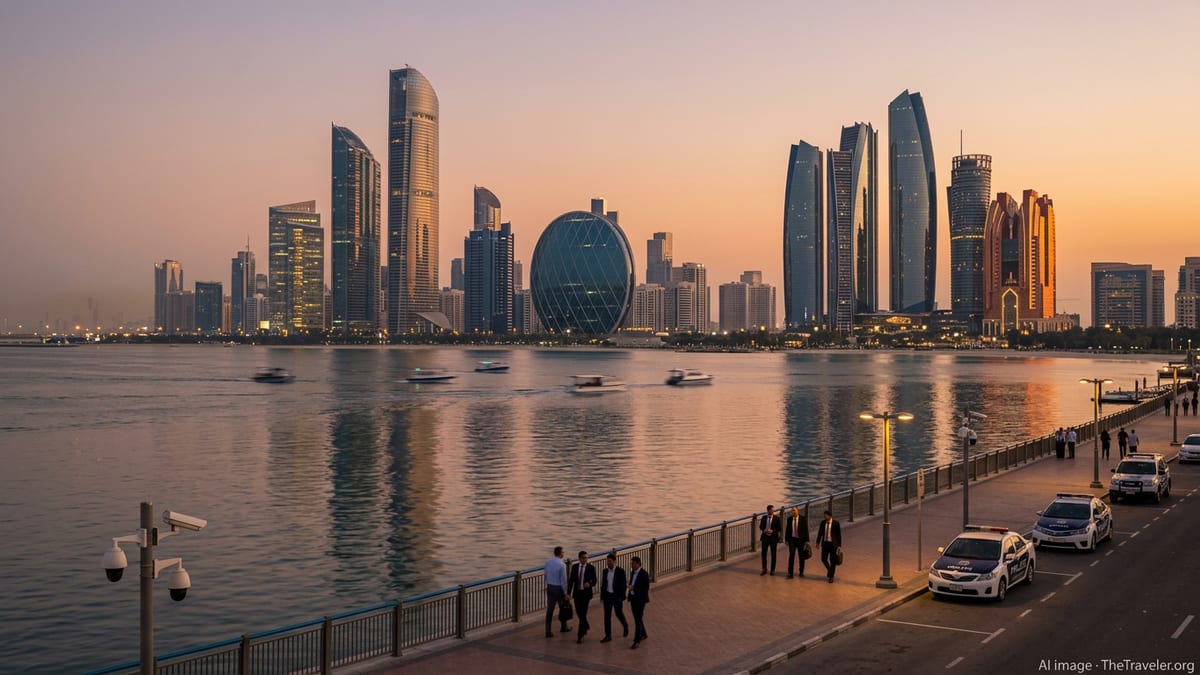
Domestically, the UAE maintains a dense internal security apparatus and exerts strong control over public space. Major cities such as Abu Dhabi and Dubai report very low rates of violent street crime relative to global metropolitan averages. For most expatriates, day-to-day personal security in residential and business districts is high, with visible policing, extensive CCTV coverage and strict enforcement of basic public order regulations.
The principal non-criminal security risk has historically been terrorism. Emirati authorities invest heavily in intelligence, border control and counterterrorism cooperation with international partners. Western government advisories currently describe the overall terrorism threat in the UAE as credible but mitigated, noting that successful attacks have been infrequent. The last major incident prior to the current regional crisis was a 2022 drone and missile strike on Abu Dhabi that killed several people and targeted fuel and airport infrastructure.
Regional escalation since late February 2026 has raised the profile of missile and drone risks. Iran has launched large salvos of ballistic missiles and drones against multiple Gulf states, including the UAE. Emirati air defenses intercepted the vast majority of these projectiles, but a small number impacted Emirati territory, causing limited civilian casualties and infrastructure damage. This demonstrates both the effectiveness of the country’s defense systems and the reality that the UAE can be directly targeted in regional conflicts.
For expatriates, the net picture is paradoxical: daily on-the-ground safety remains very high by global standards, while low-probability high-impact events such as missile or drone attacks have become a more visible part of the risk landscape. Corporate security teams increasingly factor in shelter-in-place planning, air raid alert protocols, and business continuity arrangements alongside conventional crime and terrorism mitigation measures.
Regional Geopolitics and External Shock Exposure
The UAE’s strategic geography and foreign policy create both stability benefits and exposure to external shocks. The country sits near the Strait of Hormuz, a critical maritime chokepoint for global energy flows. It has deep security partnerships with major powers and has been active in regional conflicts, notably in Yemen and the Red Sea, primarily to secure trade routes and counter perceived threats.
These relationships deliver significant deterrence value. The presence of allied military assets, integrated air and missile defense networks, and intelligence sharing have all contributed to keeping large-scale conflict away from Emirati cities for many years. However, the current 2026 Strait of Hormuz crisis illustrates that even well-defended states can be drawn into broader confrontations. Shipping through the strait fell sharply after strikes on Iran and retaliatory missile and drone attacks on Gulf capitals, disrupting trade and raising concern about escalation.
From an expatriate perspective, the main political risk is not state collapse but temporary disruptions: closure or rerouting of air and sea routes, heightened security checks, intermittent alerts or curfews, and potential restrictions on movement during acute phases of conflict. In severe scenarios, employers may activate evacuation or relocation plans, especially for staff in high-profile sectors or critical infrastructure.
It is important to distinguish between chronic instability and episodic external shocks. The UAE has demonstrated strong institutional capacity to manage crises, restore essential services quickly and maintain central government functionality. Nevertheless, individuals considering relocation must accept that living in a strategically exposed Gulf state entails some level of geopolitical risk that is structurally higher than in most Western European or North American locations.
Governance Model, Political Freedoms and Public Dissent
The UAE’s internal political stability is closely linked to extensive restrictions on political pluralism, public dissent and independent civil society. There are no legal political parties, independent trade unions are severely constrained, and public demonstrations are generally prohibited. Formal political participation for citizens is limited to a partially elected advisory body with narrow powers, while expatriates have no political rights in domestic governance.
Laws governing speech, association and cyber activity are broad and carry significant penalties. Human rights organizations report that criticism of the ruling system, rulers, or state institutions, including online, can lead to detention or prosecution. Counterterrorism and cybercrime legislation is written in expansive terms that allow authorities to treat some forms of peaceful activism or opposition as security offenses.
For expatriates, this environment has two main implications. First, it reduces the likelihood of large-scale protests, strikes or civil unrest disrupting daily life. Organized political movements that might otherwise challenge the regime or mobilize mass demonstrations are largely absent, which contributes to the impression of surface calm and continuity in public order.
Second, it materially limits the space for expatriates to engage in political expression, activism or public advocacy on sensitive issues. Participation in unauthorized gatherings, public criticism of domestic or foreign policy, or online commentary perceived as insulting state symbols can lead to legal consequences, including detention and deportation. Professionals in media, academia and civil society related fields need to adapt their working practices to this constrained environment.
Institutional Capacity, Rule of Law and Predictability
Political stability for expatriates depends not only on regime durability but also on governance quality and the reliability of institutions. The UAE scores strongly in international comparisons for government effectiveness, regulatory quality and control of corruption, particularly in its main commercial centers. Administrative processes are usually streamlined, and high-level policy objectives are implemented with considerable state capacity.
Civil and political rights protections, by contrast, are limited. Courts rarely challenge executive authority on politically sensitive matters, and security-related cases may involve restricted due process. Nonetheless, for routine civil, commercial and employment disputes, expatriates generally encounter a functioning legal system with established procedures, at least in major emirates. Regulatory changes affecting business and labor markets are typically announced with transition periods, supporting planning and compliance.
This combination produces a distinctive form of stability: high institutional reliability for economic and administrative matters, combined with limited legal recourse in cases that intersect with politics or national security. For most foreign professionals and their families operating within legal and social expectations, this environment feels predictable and secure. Those whose work touches on rights advocacy, investigative journalism or political analysis face significantly higher exposure to arbitrary outcomes.
Another relevant factor is the state’s fiscal strength. Hydrocarbon revenues, sovereign wealth funds and successful diversification efforts give the government substantial capacity to sustain public spending and absorb external shocks. Strong public finances reduce the risk of austerity-driven social unrest or abrupt cuts to state services that might otherwise undermine political stability.
Implications for Different Expatriate Profiles
The political stability profile of the UAE affects expatriate groups differently. Corporate assignees in finance, technology, energy and logistics typically benefit from strong rule-based economic governance and low crime, while facing elevated but still statistically low physical security risks linked to regional tensions. Their primary considerations are employer security protocols, crisis communication systems, and clarity on evacuation or relocation plans in extreme scenarios.
Expatriates engaged in education, media, non-governmental organizations or cultural sectors face a more complex environment. Content that touches on political reform, human rights, religion or regional conflicts must be handled with caution, and institutions often impose internal guidelines more restrictive than formal law to avoid reputational or legal exposure. This can affect academic freedom, editorial choices and the scope of permissible public debate.
Long-term resident families may prioritize the overall feeling of order and safety over political participation. For them, the key political stability questions relate to the likelihood of sudden deterioration in security, forced departures during crises, or rapid policy changes affecting residency frameworks. Historical experience suggests that while the UAE can be targeted during regional wars, state institutions have remained intact and have moved quickly to reassure residents and restore normality after shocks.
Individuals with strong personal or professional ties to politically sensitive causes or activism abroad should assess the potential for their external engagements to attract scrutiny within the UAE. The boundary between domestic political activity and overseas expression can be interpreted broadly by security authorities, which adds a layer of personal political risk for a small but important subset of expatriates.
The Takeaway
For relocation decision making, the UAE presents a dual political stability profile. On one side, it offers one of the most durable and institutionally capable states in the Middle East, with low crime, effective administration, strong fiscal buffers and a governance model that minimizes overt domestic political conflict. Abrupt regime change or systemic state failure is highly unlikely under current conditions.
On the other side, the country is embedded in a volatile regional security environment and pursues an active foreign and security policy. Events since February 2026 have shown that even well-defended Gulf states can experience direct missile and drone attacks, temporary disruption of air and sea routes, and elevated geopolitical risk. Additionally, the stability of the system is maintained through significant restrictions on political freedoms and public dissent, which constrain the scope of acceptable expression for both citizens and expatriates.
For most foreign professionals and families, the practical outcome is a high degree of day-to-day safety and policy predictability, offset by low-probability high-impact regional security risks and a tightly controlled political sphere. Organizations relocating staff should treat the UAE as politically stable in structural terms, while investing in robust security, crisis management and legal compliance frameworks. Individual expats should evaluate not only their tolerance for geopolitical risk but also their comfort with living in a state that prioritizes order and regime security over participatory politics.
FAQ
Q1. Is the UAE considered politically stable compared with other countries in the region?
The UAE is widely regarded as one of the most politically stable states in the Middle East, with long-standing ruling families, no history of coups since independence, and relatively strong administrative capacity.
Q2. How have the 2026 regional conflicts affected political stability in the UAE?
The 2026 escalation has led to missile and drone attacks on Emirati territory and major disruption around the Strait of Hormuz, but state institutions have remained functional and authorities have emphasized defensive measures and crisis management.
Q3. What is the main political risk for expatriates living in the UAE?
For most expatriates, the primary political risk is exposure to regional geopolitical shocks such as missile or drone strikes and temporary transport disruptions, rather than internal unrest or regime change.
Q4. Are protests and political demonstrations common in the UAE?
No, public protests and political demonstrations are heavily restricted and generally prohibited, which reduces the likelihood of large-scale street unrest affecting daily life.
Q5. Can expatriates engage in political activism or public criticism of the government?
Expatriates face significant legal and practical constraints on political activism, public criticism of the ruling system, or participation in unauthorized gatherings, and such activities can lead to detention, fines or deportation.
Q6. How safe is the UAE from terrorism and violent crime?
Violent street crime levels are low and counterterrorism capabilities are strong, but there remains a residual threat of terrorism and, in the current context, long-range attacks by regional actors.
Q7. Does the UAE’s governance model provide predictable rules for expatriates?
Yes, in economic and administrative matters rules are generally clear and predictably enforced, though political and security-related cases allow wide discretion to authorities.
Q8. How likely is sudden political change that could force expatriates to leave?
The risk of sudden regime change is currently assessed as low; if expatriates are forced to leave, it is more likely to result from temporary security escalations or employer decisions than from internal political collapse.
Q9. Are some expatriate professions more exposed to political risk than others?
Yes, those working in media, academia, non-governmental organizations and rights-focused sectors face higher sensitivity around content and public expression than those in purely commercial roles.
Q10. Overall, is the UAE a politically viable relocation option in 2026?
For many expatriates, the UAE remains a politically viable option, offering strong internal stability and governance, provided they accept regional security risks and a tightly controlled political environment.