


More news on this day
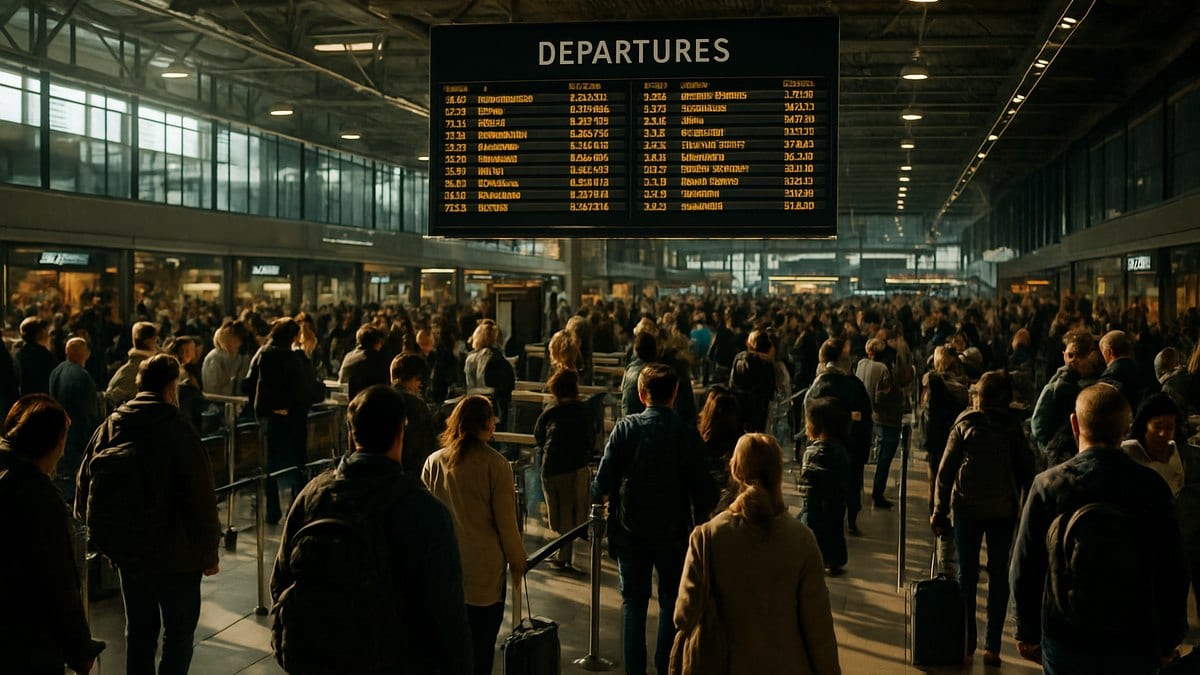
Hundreds of travelers have been stranded at European airports in April 2026 after a series of security-related failures, from staff shortages at checkpoints to bottlenecks linked to the European Union’s new biometric border system.
Get the latest news straight to your inbox!
Ryanair Flight Leaves Without Passengers After Security Staffing Breakdown
One of the most widely reported incidents this month occurred at France’s Vatry Airport, where a Ryanair flight to Marrakech departed on April 14 without any of its 192 ticketed passengers on board. According to published coverage, travelers were unable to clear airport security in time because of a failure to provide sufficient screening staff, despite having arrived at the terminal in advance of departure.
Publicly available information shows that passengers remained stuck in queues while the aircraft was prepared, boarded with crew only, and eventually took off empty. Reports indicate that the episode has intensified scrutiny of how European airports and airlines coordinate during security bottlenecks, particularly when staffing falls below expected levels.
The incident has also sharpened debate around passenger rights in such cases. Commentators note that under European air passenger regulations, travelers may be entitled to compensation when they are denied boarding for reasons attributable to operational shortcomings rather than extraordinary external events.
Biometric Border Rollout Creates Gridlock at Schengen Entry Points
Separate disruption has emerged around the rollout of the European Union’s Entry/Exit System, a new biometric border database that became fully operational for many Schengen-area airports in April 2026. The system captures fingerprints and facial images from non EU travelers as they cross the external border, replacing traditional passport stamping.
Reports from Italy and Spain describe terminals jammed with passengers waiting to complete initial biometric registration, with queues spilling into general departure areas. At Milan Linate, multiple accounts indicate that more than 120 easyJet passengers bound for the United Kingdom missed flights between April 12 and April 19 after being held up in border control lines even after finishing airline check in and standard security screening.
Coverage from Spanish media and travel-focused outlets points to similar strain at airports across the Iberian Peninsula following the system’s activation on April 10. Travelers have reported multi hour waits at passport control, particularly during peak holiday departures, as border police and airport operators adapt to new procedures and equipment.
Industry groups had warned ahead of Easter that the transition period would be challenging. A joint communication from airline and airport associations in late March highlighted the risk of “systemic disruption” if staffing, space and contingency planning were not aligned with the new security requirements.
Cyber Vulnerabilities and Legacy Incidents Raise Broader Security Concerns
Although the most acute April 2026 problems have centered on staffing and procedural changes at physical checkpoints, recent history underlines how digital security failures can rapidly cascade into airport operations. A cyberattack on check in and boarding software provided by Collins Aerospace in September 2025 forced several major European hubs to revert to manual processing, triggering long queues, cancellations and stranded passengers across the network.
Analyses from international organizations and aviation commentators describe that 2025 incident as a wake up call on cyber resilience. The event demonstrated how dependence on shared IT platforms for passenger processing, gate management and baggage handling can turn a single compromised system into a multi country operational crisis.
Commentary published since then notes that airports, airlines and technology vendors remain deeply interconnected, with critical systems tied to both operational technology and the wider internet. The pattern of disruptions, ranging from ransomware attacks to localized power failures, has fueled calls for more robust backup arrangements so that security controls can continue without leaving passengers stranded when primary systems fail.
Legal and Regulatory Pressure Over Security Shortcomings
Legal developments are adding further pressure on aviation stakeholders to address security related failures that delay passengers. A recent opinion from the Court of Justice of the European Union, published in early March 2026, examined whether “widespread shortcomings” in airport security checks could entitle passengers to compensation from airlines when missed departures are linked to inadequate processing capacity at checkpoints.
According to publicly available court documents, the case centers on travelers who arrived at an airport with sufficient time before departure but were delayed at security screening to the point of missing their flight. The proceedings are closely watched by consumer advocates and airline groups, as any decision tightening liability could reshape how carriers and airports share responsibility for managing security queues.
Analysts note that the April 2026 incidents at Vatry, Milan and other European airports are likely to be cited in ongoing debates about accountability. If legal interpretations move toward classifying certain security failures as avoidable operational issues rather than unforeseeable external events, airlines and airports may be compelled to adjust staffing models, investment plans and contingency protocols.
Passengers Face Mounting Costs While Operators Reassess Plans
For those stranded this month, the immediate effects have been financial and personal rather than structural. Travelers caught in security induced delays across European airports report paying out of pocket for hotels, meals and rebooked tickets after missing flights, while some have described losing prepaid accommodation and tours at their destinations.
Consumer advocates argue that inconsistent handling of rebooking, vouchers and care obligations continues to undermine confidence, particularly among leisure travelers for whom a single missed departure can wipe out much of a planned holiday. Travel industry commentary suggests that clear, proactive communication before and during disruptions could significantly reduce anxiety and secondary costs for passengers.
Airport operators and airlines, meanwhile, appear to be revisiting their assumptions about peak season capacity and security throughput. Public documents and industry statements point to accelerated hiring plans for screening staff, expanded trial use of automated lanes, and renewed investment in backup IT systems designed to keep security and border controls functioning during outages.
While these measures may ease pressures in the coming months, the April 2026 disruptions highlight an uncomfortable reality for European travelers. As airports balance tighter security requirements, new biometric infrastructure and growing traffic volumes, even localized failures can leave hundreds of people stranded far from their destinations with little warning.