


The University of Helsinki often appears on lists of top universities in Europe, but for prospective international students the real question is more practical: what is it actually like to study and live there, and do graduates feel it was worth it? Drawing on recent rankings, university surveys, student stories and real cost-of-living examples, this guide unpacks what students and alumni really say about the University of Helsinki in 2024–2026 so you can judge whether it is a good choice for you.
Get the latest updates straight to your inbox!
How the University of Helsinki Ranks Globally
The University of Helsinki is consistently placed among the top 150 universities in the world in major rankings. In the 2025 Times Higher Education World University Rankings, it sits just above the 100 mark globally, and its own annual report shows that its average position across leading rankings has remained close to the low 100s in recent years. This keeps Helsinki in the top 1 percent of universities worldwide, and usually in the top three in Finland, alongside Aalto University and the University of Oulu.
Ranking details matter because they influence how your degree is perceived by employers and other universities. For example, the 2024 Academic Ranking of World Universities lists Helsinki around the global top 100, reflecting its strong research output in fields like life sciences, environmental science and humanities. Independent rankings such as the Center for World University Rankings also place it roughly in the 120s worldwide, highlighting research quality and alumni employment outcomes.
Subject rankings give a more granular picture that students often care about. In several disciplines such as ecology, atmospheric sciences and education, Helsinki performs particularly well compared with other Nordic universities. For instance, in sustainability-related rankings, the university has climbed rapidly, with its 2025 sustainability ranking placing it well inside the global top 20. That reinforces its appeal to students interested in climate, the Arctic, biodiversity, or social aspects of sustainability.
Students and graduates generally report that these rankings align with their lived experience: they describe feeling that the name “University of Helsinki” is recognized when applying for PhD positions in Germany or the Netherlands, or for jobs with international organizations in Europe. While a ranking number on its own does not guarantee a great experience, it does indicate that Helsinki operates in a competitive global league.
What Students Say About Academics and Teaching
On the academic side, international students usually highlight the combination of rigorous coursework and relatively informal classroom culture. In master’s programmes taught in English, it is common to have small seminar groups of 15–25 students where discussion is expected. Several student stories on the university’s own admissions pages describe how lecturers are approachable by email and during office hours, and how it is normal to address professors by their first name rather than a formal title.
Surveys back up many of these impressions. The University of Helsinki has participated multiple times in the International Student Barometer, a large global survey that tracks international students’ perceptions of teaching, support and overall satisfaction. In recent rounds, Helsinki has performed particularly well in areas such as academic learning, safety and campus environment, while some students reported that integration with Finnish society and the complexity of administrative processes can be more challenging.
Real student testimonials from programmes like Intercultural Encounters point to a few recurring strengths. Alumni talk about the intellectual freedom to design their study path, chances to work closely with research groups, and the value of learning from classmates from dozens of countries. One graduate noted that their cohort included students from Europe, Asia, Africa and Latin America, and that the intense group projects and thesis supervision prepared them well for a subsequent PhD at Helsinki.
At the same time, students also mention drawbacks that are important to weigh. Assessment can be heavily reading-based, with many research articles and independent assignments, which may surprise those coming from more exam-focused systems. International students sometimes comment that feedback can be brief and that you are expected to be self-directed. For someone looking for a highly structured, tightly guided curriculum, this Nordic style can feel loose. For others, it is exactly the kind of autonomy that fosters research skills and critical thinking.
Student Life and Community in the City
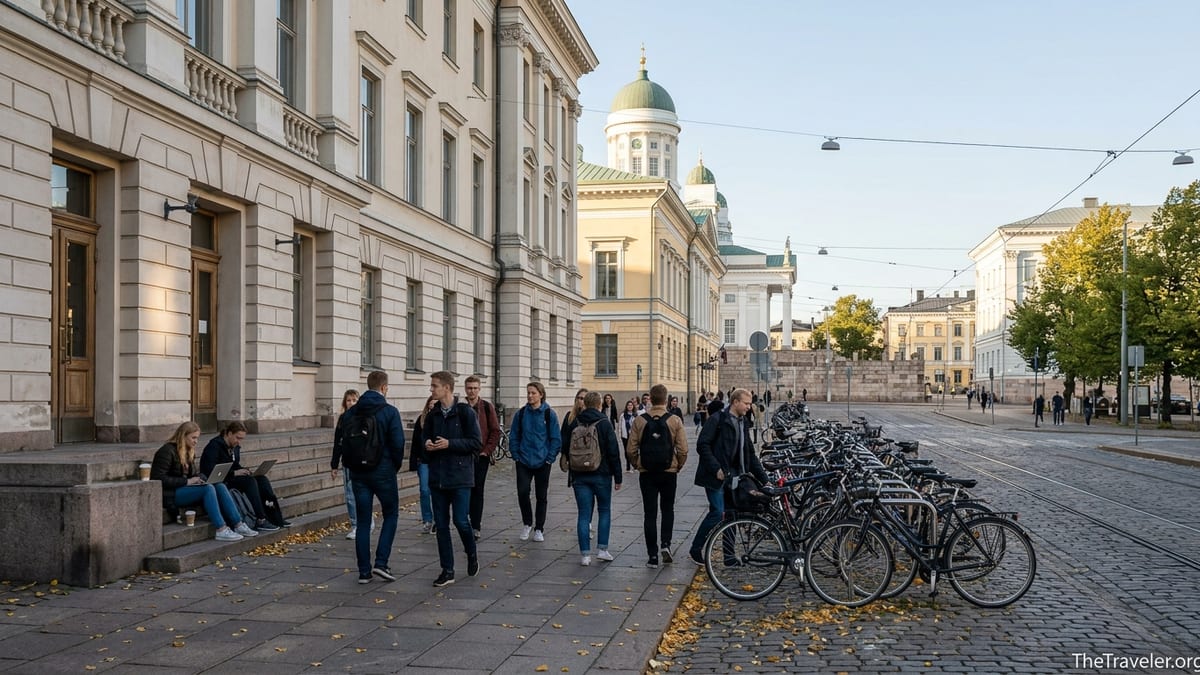
Helsinki is a compact capital where the university’s campuses blend into everyday city life rather than sitting in an isolated campus bubble. Many international students describe studying at the City Centre Campus and then walking five minutes to Esplanadi Park or the harbor, or taking a short tram ride to the Kallio district for cafes and nightlife. This integration means that your student experience is tied closely to the broader urban culture, from design shops to seaside saunas.
Student organizations play a major role in building community. The Student Union of the University of Helsinki, known as HYY, is one of the oldest and most influential in the Nordic region. Membership, which is mandatory for most degree students and included in the annual student union fee, gives access to discounted student lunches at university cafeterias, student-priced public transport tickets, legal advice services, and participation in hundreds of clubs. These can range from faculty-specific associations to niche groups for board games, hiking, choir singing or coding.
International and exchange students often mention that joining these associations, plus events like orientation week and language tandem meetups, is the fastest route into a social circle. A common real-world story is the student who signs up for a subject association excursion to Nuuksio National Park, spends the day hiking among lakes and spruce trees, and ends up with a friend group they keep throughout their degree. Social events like the Finnish student tradition of “sitsit” (semi-formal dinner parties with songs) can look a bit formal at first, but are usually remembered as highlights of student life.
On the flip side, some students on forums remark that if you do not proactively join activities, Helsinki can feel quiet, especially in winter. Locals may seem reserved and it can take time to move from friendly small talk to deeper friendships. Students who arrive in September but hesitate to attend orientation events sometimes realize by November that many social groups have already formed. The experience tends to be best for those willing to push themselves a bit socially, join one or two associations early, and accept that making Finnish friends can be a slow but rewarding process.
Costs, Housing and Everyday Practicalities
For many international applicants, the biggest concern is not academic quality but whether they can realistically afford life in Helsinki. Finland abolished tuition fees for EU and EEA students, so those students pay no tuition, while non-EU/EEA students generally pay significant yearly fees for English-language bachelor’s and master’s programmes. On top of that, everyone needs to cover their own living expenses, which are relatively high by European standards.
The university advises prospective students to prepare a budget that covers rent, food, transport, health fees, and personal expenses. A realistic figure many students quote on forums is that a frugal student might need around 800 to 1,200 euros per month, depending on rent and lifestyle. In practice, real examples vary. Some students renting through HOAS, the main student housing foundation in the Helsinki region, report paying around 350 to 500 euros per month for a shared flat or student studio, while others in private rentals pay 700 euros or more for a small studio closer to the center.
Day-to-day costs add up. Local students frequently mention that a monthly public transport pass for students with the Helsinki Regional Transport Authority typically costs around 40 to 60 euros depending on the zones. Many international students say they keep their grocery budget near 200 to 300 euros per month by shopping at budget supermarket chains, cooking at home, and taking advantage of subsidized student lunches at university cafeterias, where a hot meal with salad and bread is usually around 3 euros for students. Even modest entertainment, like an occasional bar night in Kallio or a concert, can push monthly costs upwards if not carefully planned.
Some students thrive on a tight budget, using free library spaces to study, outdoor sports areas for exercise, and low-cost student tickets for cultural events at places like the Finnish National Opera or city museums. Others, particularly non-EU students limited in how much paid work they can do while studying and facing language barriers in the job market, describe financial pressure as the hardest part of their Helsinki experience. A few accounts online speak frankly about needing to visit food aid distributions or rely on savings when part-time work proved hard to find.
Employment Prospects and Alumni Outcomes
One of the strongest arguments in favor of the University of Helsinki is the reported employment situation of its graduates. According to the university’s recent career monitoring surveys, a very high share of alumni are employed within a few years of graduation and unemployment rates among graduates are low compared with the wider labor market. In a survey of master’s graduates a few years after finishing their studies, a clear majority reported that their degree was a good match for their job and that they could make full use of the skills developed at university.
These overall numbers, however, conceal differences between fields and between Finnish and international graduates. Alumni profiles on the university’s website show many success stories: a former social sciences student working for the City of Helsinki on integration policy, an environmental science graduate employed by the Finnish Meteorological Institute, a computer science alumnus joining a major game studio, and humanities graduates moving into communications or NGOs. It is common to see master’s graduates proceed directly into doctoral studies at Helsinki or other European universities, leveraging the research focus of their programmes.
At the same time, both alumni testimonials and student comments on independent forums highlight that it can be significantly harder for non-Finnish speakers to break into the Finnish job market, especially in social sciences and humanities. One international graduate from the Intercultural Encounters programme noted that, while the degree broadened their horizons and helped them develop critical thinking and research skills, many of their international friends found it “super difficult” to land a permanent job in Finland without fluent Finnish. Some solved this by aiming for international organizations, remote work for companies abroad, or continuing to a PhD where English is the working language.
For students in fields where English is more widely used, such as IT, data science or some areas of natural sciences, graduates typically report better odds of staying in Finland if they want to. Tech companies in the Helsinki metropolitan area often recruit in English, and internships arranged through university projects provide a bridge into the labor market. Overall, students who arrive expecting a Nordic welfare state where any degree automatically leads to a secure local job can be disappointed. Those who prepare early by networking, improving their Finnish, seeking internships and being mobile in their job search often view the University of Helsinki as a strong launchpad.
International Environment and Support Services
The University of Helsinki portrays itself as highly international, and the numbers support this image. Recent statistics show that around one-third of teaching and research staff come from abroad, and there is a wide range of master’s programmes taught entirely in English. Internationalization is built into many strategies and action plans, which aim to make research, teaching and administrative services accessible across languages and cultures.
For students, this international environment shows up in everyday encounters. In English-taught programmes it is common for a classroom to include students from more than 20 nationalities, and professors themselves may be from Finland, other European countries, Asia or North America. Support services such as Student Services, career counseling and the international exchange office usually provide service in English, and the university’s digital systems, from course registration to library portals, are available in multiple languages.
Exchange opportunities are another side of this international character. Helsinki students can spend a semester or year abroad through Erasmus and other exchange agreements with universities across Europe, Asia and North America. Information sessions introduce options ranging from a semester in Oslo or Vienna to an exchange in Tokyo or Vancouver. For many local and international students alike, this outward mobility is part of the appeal: you can study in Helsinki but still add another country to your academic path.
Support at the beginning of studies is generally well organized. Orientation weeks include campus tours, introduction courses on Finnish academic culture, sessions on residence permits and healthcare, and social activities run by tutors. Nevertheless, some international students report that bureaucracy around residence permits, registering with local authorities and navigating the Finnish social security system can still feel overwhelming. The students who cope best often mention making heavy use of official instructions, tutor support, and peer advice in student WhatsApp or Telegram groups.
Real Student Experiences: The Good and the Difficult
Beyond official surveys, informal spaces like student blogs and online forums provide a candid picture of what studying at the University of Helsinki feels like day to day. Many international students describe a sense of safety and order that is hard to overstate: walking home through central Helsinki at 10 p.m. feels uneventful, trams run predictably even in winter, and libraries are quiet and well-equipped. For students who have studied in more chaotic cities, this reliability can be a major relief.
Weather, of course, is a recurring theme. Students recall arriving from warm climates and facing their first November, when daylight shrinks and temperatures hover around freezing. Some struggle with low energy or mood, while others embrace the Finnish strategy of investing in a good coat, using campus saunas, and saying yes to winter activities like ice skating or visiting the sea pools. Many point out that spring and early summer in Helsinki, when evenings stretch long and locals flock to outdoor terraces and parks, more than compensate for the darker months.
The most difficult experiences often cluster around money and loneliness. There are real accounts of first-year international students discovering their budget is not enough after energy prices or rents increase, or realizing that working at low hourly wages is not sustainable. Likewise, a student who keeps to themselves, perhaps focused on online communities from home, may find by the end of the first year that they feel only loosely connected to Helsinki. On the other hand, success stories tend to involve people who deliberately build routines: joining a sports club, taking a weekly Finnish class, attending subject association events and using the university’s mental health support when needed.
Overall, students and graduates rarely describe their time at the University of Helsinki as glamorous. Instead, they talk about a steady, research-driven, sometimes demanding environment in a safe but fairly expensive city. Those who arrive with realistic expectations, a willingness to navigate bureaucracy, and an interest in the Nordic way of doing things generally say it was a very good choice.
The Takeaway
So, is the University of Helsinki a good choice? The answer depends on what you are looking for, but a few conclusions emerge clearly from what students and graduates say. Academically, the university is strong, especially in research-intensive and sustainability-related fields, and its global rankings and graduate surveys show that a Helsinki degree is widely respected. Teaching is often described as high quality but relatively independent, favoring students who are comfortable with self-directed learning and critical reading.
Student life can be rich and varied, anchored by a powerful student union and a city that offers both cultural life and access to forests and the Baltic Sea. Yet it rewards initiative: you get the most from Helsinki if you go to orientation events, join associations, and make the first move socially. The international environment is genuine, but integrating into Finnish society beyond the campus can require patience, especially when learning the language.
The downsides are equally clear. Living costs are high, housing can be competitive, and part-time jobs are not guaranteed, especially for students without Finnish skills. For some international graduates, staying in Finland after the degree is a challenge, even though the overall employment statistics are positive. Anyone considering Helsinki should prepare a realistic financial plan and be ready to search widely for internships or jobs.
If you value academic freedom, a research-oriented atmosphere, and the idea of studying in a safe, orderly Nordic capital, the University of Helsinki often turns out to be an excellent choice. If your priority is low living costs, an extremely lively nightlife culture, or a guaranteed job in Finland after graduation regardless of language, it may not match your expectations. Understanding these trade-offs through the lens of real student and graduate experiences is the key to deciding whether Helsinki is right for you.
FAQ
Q1. Is the University of Helsinki a good choice for international students?
The University of Helsinki is generally considered an excellent choice for international students who value research-focused teaching, a safe environment and a genuinely international classroom. However, it suits self-directed learners best and requires a realistic plan for living costs and employment.
Q2. How expensive is it to live as a student in Helsinki?
Most students estimate they need roughly 800 to 1,200 euros per month to live modestly, including rent, food, transport and basic personal expenses. Costs vary widely depending on housing choices and lifestyle.
Q3. What are typical housing options for students?
Common options include student housing through foundations such as HOAS, where a room in a shared flat or a small studio may cost 350 to 500 euros, and private-market rentals, which are often more expensive but can be closer to the city center.
Q4. Do I need to speak Finnish to study at the University of Helsinki?
No, many bachelor’s and master’s programmes are taught entirely in English, and services are available in English. However, learning Finnish can significantly help with everyday life and is often important for finding work in Finland, especially outside the tech and research sectors.
Q5. How good are the job prospects after graduating?
Career surveys show that most University of Helsinki graduates find work and are satisfied with how their degree supports their career. International graduates may face extra challenges if they want to stay in Finland, particularly without strong Finnish skills, but many succeed by targeting international organizations, tech roles or further studies.
Q6. What is student life like beyond academics?
Student life centers on active student associations, cultural events, and easy access to nature. Many students balance library days with evenings in cafes, saunas, or nearby national parks. Social life tends to be less loud than in some other capitals but can be very close-knit once you find your circles.
Q7. Is Helsinki safe for students?
Helsinki is widely viewed as very safe, with low violent crime rates and reliable public transport. Students frequently walk or use trams late in the evening without issues, though normal big-city awareness is still recommended.
Q8. How hard is it to get into the University of Helsinki?
Competition varies by programme, but admission to many English-taught degrees is selective, particularly in popular fields like data science or environmental studies. Strong academic records, well-prepared application documents and, where required, proof of English proficiency are essential.
Q9. Can I work part-time while studying?
Many students do some part-time work, but opportunities depend on language skills and the job market. English-only positions exist, especially in tech and some service roles, yet it is risky to rely on part-time work to fully fund living costs, particularly for non-EU students.
Q10. Who is the University of Helsinki best suited for?
The university is best suited for students who value academic depth, are comfortable with independent study, and are curious about Nordic culture. It is especially attractive to those interested in research, sustainability, and living in a calm, high-cost but high-quality capital city.