


More news on this day
Italian high-speed operator Italo has signed a multibillion-euro contract for a new fleet of Siemens Velaro trains, paving the way for open access passenger services on Germany’s core high-speed corridors from 2028.
Get the latest news straight to your inbox!
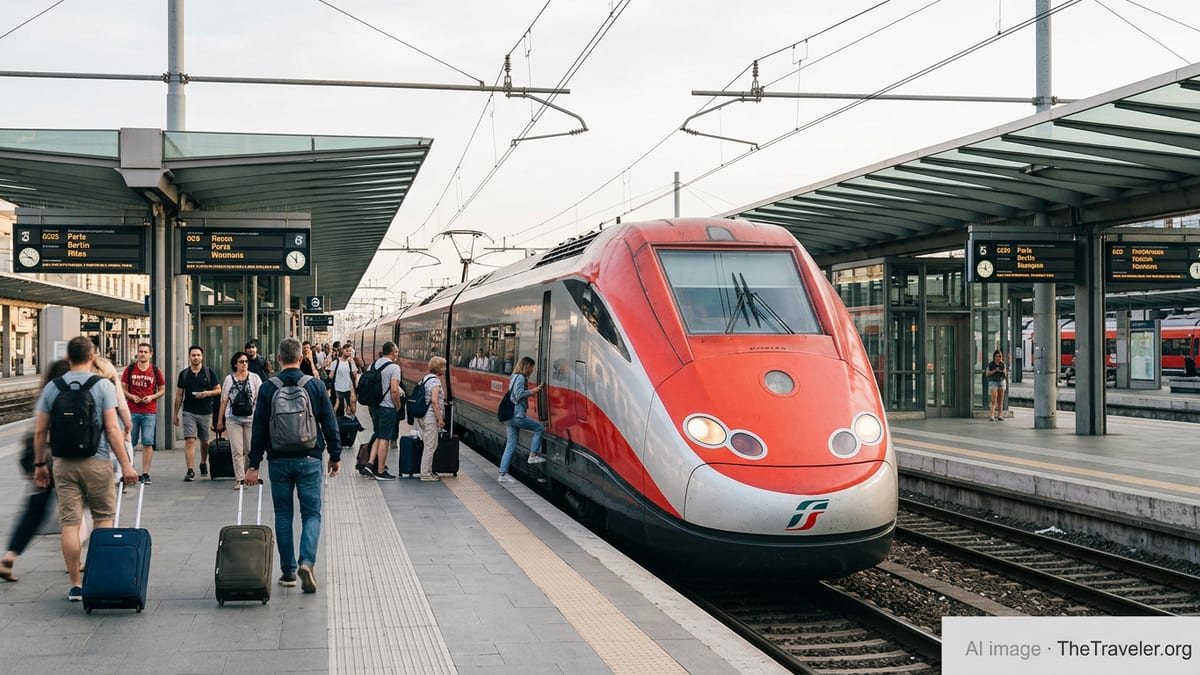
Multibillion-euro Velaro contract underpins German market entry
Publicly available information from European and German media indicates that Italo will invest around 3 to 3.6 billion euros in a new Velaro Multi System fleet from Siemens Mobility to support its first services in Germany. Reports describe the initial firm order as covering 26 trainsets with options for additional units, positioning the Italian company for a large-scale entry into a long-distance market that has so far been dominated by Deutsche Bahn and, to a lesser extent, FlixTrain.
The trains will be derived from Siemens’ Velaro family of high-speed multiple units, which already form the backbone of several European fleets. The Velaro platform, originally developed from the ICE 3 design in Germany, is designed for operation at up to 320 km/h and has been adapted for multiple national networks over the past two decades. The new Italian-ordered sets will be configured specifically for intensive use on German infrastructure and cross-border connections where required.
According to business press coverage in Italy, the order is one of the largest rolling stock investments ever made by a private European rail operator. The decision confirms Italo’s intention to compete for passengers on heavily trafficked German axes by offering a premium high-speed product based on entirely new trains, rather than reusing its existing Italian fleet.
Train design: high speed, multi-system capability and upgraded comfort
Technical details published in financial and industry reports show that the Velaro Multi System units for Italo will be formed of eight cars, offering around 450 seats per train. The onboard layout is expected to include three distinct travel environments, typically branded in Italian service as Club Executive, Prima Business and Smart, alongside a bistrot area. The configuration mirrors Italo’s current approach in Italy, which combines a clear class hierarchy with a strong focus on lounge-style seating and onboard services.
The new trains are being specified for a maximum operating speed of 320 km/h, in line with the latest generation of European high-speed equipment. Multi-system traction and signalling capabilities are intended to support operation across different German and potentially neighbouring railway standards. While initial deployment will focus on domestic German corridors, the technical platform is designed for future interoperability should regulatory and commercial conditions encourage cross-border services.
Passenger-facing technology is also a central part of the concept. Reports highlight that the trains will be equipped with 5G connectivity and satellite-based broadband, building on Italo’s recent move to introduce Starlink connectivity across its Italian fleet. Power sockets at each seat, upgraded lighting and modern interior design are expected to align the new Velaro sets with other latest-generation European high-speed fleets, targeting business travellers and long-distance leisure passengers alike.
Planned routes: Munich to the Rhine-Ruhr and the north
Italo’s current planning, as described in German and Italian coverage, envisages the first services starting in April 2028, subject to final path allocation and regulatory steps. The company is focusing on two principal corridors: a southern axis linking Munich with Cologne and Dortmund via the Rhine-Ruhr, and a northbound route connecting Munich with Berlin and onward to Hamburg. Both align with Germany’s densest long-distance flows and make extensive use of purpose-built high-speed infrastructure.
The planned Munich–Cologne–Dortmund service would run over the high-speed line between Frankfurt and Cologne, one of the country’s fastest and most capacity-constrained routes. The Munich–Berlin–Hamburg axis would leverage the upgraded Berlin–Munich corridor, where line speeds up to 300 km/h already support competitive rail journey times. By targeting these corridors, Italo is positioning itself directly against Deutsche Bahn’s ICE network on routes with strong existing demand and clear potential for modal shift from air and road.
Public information suggests that the long lead time to 2028 reflects both the production schedule for the Velaro fleet and the need to secure long-term track access in a network that is already heavily used. Industry analysis notes that capacity on Germany’s busiest long-distance lines is tight, meaning that framework agreements for train paths are a prerequisite for any meaningful new entrant.
Regulatory changes open space for new competition
The German regulatory environment has recently shifted in a way that favors new operators. Decisions by the federal network regulator on framework agreements for long-distance capacity have been interpreted by commentators as clearing an important obstacle for Italo and other open access providers. Recent rulings are intended to balance the need for incumbents to plan long-term services with the requirement to keep parts of the network accessible to competitors.
Germany’s long-distance rail market has so far seen only limited private competition, primarily in the form of FlixTrain’s lower-cost services. High access charges and bottlenecks on busy lines have discouraged large-scale entries similar to those seen in Italy and Spain. Italo’s move, backed by a major rolling stock investment and a strategy focused on high-frequency, high-quality services, suggests that the market environment is now viewed as sufficiently attractive to justify substantial private capital.
Analysts following European rail liberalisation point out that the arrival of a second full-service high-speed operator in Germany could replicate some of the effects observed in Italy, where competition between Italo and state-owned Trenitalia has been linked to higher frequencies, sharper pricing and product differentiation. However, the German network’s structural constraints and complex timetable may limit how far new entrants can expand beyond the initial trunk routes.
Implications for European high-speed rail and passengers
Italo’s Velaro order is being widely interpreted as a signal that private operators see long-term growth potential in Europe’s cross-border and domestic high-speed rail market. By choosing a platform already proven on German tracks, the company reduces technical risk and can focus on service quality, pricing and brand positioning in a new country. For Siemens Mobility, the contract consolidates the Velaro family’s role as a reference design for high-speed operators seeking multi-country capabilities.
For passengers, the prospect of Italo-branded trains running between major German cities promises more choice in terms of schedules, onboard experience and fares. Competitive pressure on long-distance ticket prices could make rail more attractive relative to domestic air travel, particularly on corridors where journey times are already under four hours. The emphasis on modern interiors and high-bandwidth connectivity may also appeal to business travellers who rely on productive time while in transit.
At a policy level, the development underscores the broader European Union objective of creating a more integrated, liberalised rail market. Open access operations supported by interoperable rolling stock and harmonised technical standards are a key element of that vision. If Italo succeeds in establishing a strong foothold in Germany using its new Velaro fleet, other private and state-backed operators may be encouraged to consider similar cross-border expansions, further reshaping the continent’s high-speed rail landscape.