


Immigration enforcement in Italy has become more visible and data driven in recent years, affecting how foreign residents experience checks, renewals, and compliance expectations. For potential movers, understanding how rigorously Italy enforces residence rules, how authorities treat overstays, and how removal measures operate in practice is essential to evaluating long-term relocation risk.
Overview of Italy’s Current Immigration Enforcement Environment
Italy combines relatively large legal migrant populations with an enforcement system that emphasizes documentation checks, residence permit control, and targeted removal actions rather than mass expulsions. At the start of 2023, about 5 million foreign citizens resided in Italy, including roughly 3.7 million non EU nationals with regular status, and that figure has since risen to nearly 3.8 million non EU residents with valid stay permits. This scale shapes enforcement, which must balance control with the realities of an integrated foreign population in the labor market and communities.
While political rhetoric often focuses on irregular sea arrivals, day to day enforcement affecting foreign residents revolves more around the management of residence permits, registration with municipal and police authorities, and occasional workplace or street checks. Policy changes such as the 2023 Cutro Decree and subsequent measures have strengthened border and asylum procedures, but for already resident foreign nationals, the key exposure points remain renewals, documentation inspections, and compliance with registration and address rules.
Eurostat and Italian data show that Italy regularly issues tens of thousands of expulsion orders each year to third country nationals found to be irregularly present or in breach of conditions. However, actual removals are far lower than the number of orders, reflecting legal challenges, logistical constraints, and limited return agreements with origin states. This gap is central for relocation decisions: enforcement is real and can produce legal insecurity, but it does not result in automatic repatriation for most cases.
Italy also participates in wider European enforcement initiatives, including implementation of the EU’s New Pact on Migration and Asylum, which stresses identity, security, and biometrics checks for those arriving irregularly at external borders. For lawfully resident foreign nationals, these developments indirectly raise expectations around consistent documentation, traceability in population registers, and clear proof of lawful stay.
Residence Permits: Control, Renewal Pressure, and Documentation Checks
For non EU foreign residents, the residence permit (permesso di soggiorno) is the main anchor of legal status and the primary focus of enforcement practices. Italian authorities have modernized and partially digitized the issuance and renewal system, but practical bottlenecks remain. Recent accounts and official guidance indicate that appointments for issuing or renewing permits can take many months, sometimes more than a year in busy provinces. During this time, the receipt or appointment letter functions as provisional proof of status, and enforcement officers are expected to recognize it during checks.
The volume of permits illustrates the importance of this control mechanism. In 2023 Italy issued over 330,000 residence permits of various types, including work, family, study, and protection categories, and between 2023 and 2025 the government reported granting more than 450,000 permits in total. Authorities have increasingly used permit type and duration as levers of control, channeling many new arrivals into temporary protection or short term permits, which then require frequent renewals and contact with enforcement bodies such as local police headquarters.
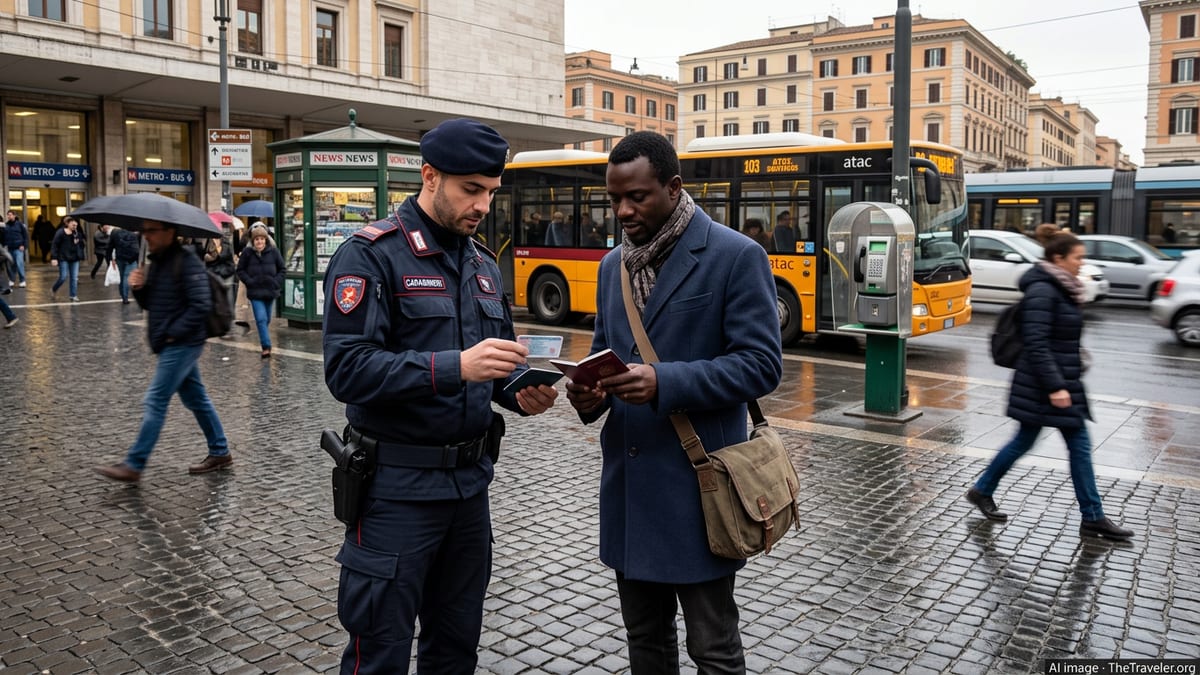
Enforcement in this area focuses less on raids and more on verification of the authenticity and validity of permits. Police and Carabinieri have authority to request identification documents in public spaces, while local immigration offices run systematic checks when processing renewals, including verification of employment contracts, income, family composition, and in some cases housing conditions. New legislation in late 2025 introduced periodic checks on organizations that sponsor foreign volunteer workers, to ensure that declared activities and conditions genuinely match legal requirements, further tightening control over specific residence categories.
For foreign residents, this environment means that keeping documentation current, retaining receipts from the post office and police, and being able to produce them promptly during checks is critical. While isolated episodes of inconsistent enforcement exist across provinces, the broader trend is toward regularized, documentation based control with growing use of digital records, biometric data, and interagency information sharing.
Irregular Stay, Overstays, and Practical Risk for Foreign Residents
Statistics indicate that Italy hosts a significant but not overwhelming irregular migrant population relative to total foreign residents. One recent analytical estimate put irregular migrants at roughly 320,000 individuals, amounting to around 5 to 6 percent of all foreigners in the country. This group largely consists of people who entered legally but fell out of status due to expired permits, rejected renewals, or loss of employment, rather than solely those who arrived clandestinely.
Eurostat data show that the number of third country nationals found to be illegally present in Italy fluctuated over the last decade, but recent years recorded tens of thousands of detections annually. These figures only capture individuals who come to the attention of authorities, usually through border apprehensions, police checks, workplace inspections, or administrative procedures. For foreign residents, the main pathway into irregularity is administrative: missed renewal deadlines, incomplete documentation, or changes in employment that undermine the legal basis of the permit.
Enforcement responses to overstays and irregular stay are structured but uneven. In many cases, individuals found to be without valid permits receive formal expulsion orders that instruct them to leave the country within a defined period, sometimes accompanied by reporting obligations. Data from Italian and European sources suggest that the number of such orders substantially exceeds the number of actual removals. This means that while the legal risk is significant, the practical risk of immediate physical removal is lower, though it remains real for certain profiles, including repeat offenders and persons assessed as security risks.
For otherwise law abiding foreign residents who accidentally overstay or face administrative delays, authorities often consider evidence of ongoing ties, pending applications, and family life before moving toward detention or enforced removal. However, discretion is wide and practices vary between regions. The consistent trend is that Italy expects foreign residents to take active responsibility for maintaining compliant status, including monitoring expiry dates and pursuing timely renewals even amid appointment backlogs.
Detention, Expulsions, and Return Enforcement Capacity
The sharpest edge of Italy’s enforcement system is detention and expulsion from pre removal centers, known as CPRs. These facilities hold foreign nationals who have received expulsion orders and are awaiting removal. A recent report by civil society researchers found that in 2023 only around 10 percent of migrants detained in CPRs were actually deported, with roughly 2,987 removals out of more than 28,000 people transiting through such centers. This indicates limited removal capacity and difficulties in securing travel documents and cooperation from countries of origin.
At European level, returns following an order to leave remain relatively low. Across the EU in 2024, approximately 110,000 third country nationals were returned after receiving expulsion orders, compared with more than 450,000 orders issued, implying a repatriation rate of about one quarter. Italy is part of this wider pattern of enforcement asymmetry: expulsion decisions are common, but logistical, legal, and diplomatic limits constrain actual returns.
This enforcement structure has several consequences for foreign residents. First, the primary immediate impact of serious status violations is likely to be legal precariousness and constraints on regularizing status, rather than swift physical removal. Second, those who enter the detention and return pipeline can face lengthy deprivation of liberty with uncertain outcomes, given that many detainees are eventually released without removal when it proves impossible to organize repatriation. Third, higher political pressure has led to calls for expanding CPR capacity and increasing the length of permitted detention, raising potential exposure for certain categories of irregular migrants.
Foreign residents who maintain lawful status, stable documentation, and no criminal record are statistically unlikely to encounter this part of the system directly. However, the existence of an intensive but only partially effective detention and return framework contributes to a climate of strict formal rules combined with selective, capacity limited enforcement.
Workplace, Border, and Internal Controls Affecting Foreign Residents
Workplace enforcement is an important but often under reported dimension of Italy’s immigration control. Employers are legally required to ensure that non EU workers hold valid permits that authorize employment and to report changes that could affect status. In practice, labor inspectors and law enforcement agencies conduct targeted checks in sectors known for irregular employment, such as agriculture, construction, domestic work, and hospitality. These inspections may lead to fines for employers, administrative sanctions, and in some cases expulsion orders for workers found without valid documentation.
Recent political scrutiny of alleged fraud under so called labor flow decrees, which regulate the entry of foreign workers within annual quotas, has prompted plans to tighten controls on employer sponsorship and to combat fictitious job offers. Officials have highlighted cases where intermediaries and companies obtained quotas without providing real employment, leaving incoming workers exposed to irregularity. These policy debates suggest that future enforcement will increasingly scrutinize the credibility of job contracts used to obtain and renew residence permits.
At borders, Italy applies EU external border rules, including systematic checks on third country nationals, verification of visa and residence status, and use of biometric databases. For legal residents, valid residence cards combined with passports generally facilitate re entry, but lapses in validity or missing documents can trigger secondary checks, reporting obligations, or denial of entry. Internal controls, such as roadblocks, station checks, and urban security operations, provide additional points at which police may verify identities and residence status.
This multi layer enforcement approach means that foreign residents may encounter checks in several everyday contexts: during travel, in rental registration procedures, when registering with municipal authorities, or at workplaces. Although many checks are routine and brief, the system rewards those who carry originals or clear copies of their permits, keep their registration records updated, and ensure that contract relationships (employment or self employment) align with the conditions of their residence titles.
Legal Protections, Appeals, and Regional Variations in Practice
Italy operates within a dense legal framework that provides procedural safeguards for foreign residents subject to enforcement action. Expulsion orders can generally be appealed before administrative or ordinary courts, depending on the legal basis, and removal measures must respect human rights obligations, including protection of family unity and non refoulement. Legal aid and NGO support are available in many regions, though access can be inconsistent and dependent on local networks.
Court decisions over the last decade have repeatedly limited overly broad or automatic removal practices, especially in cases involving long term residents, families with minor children, and individuals integrated into the labor market. In parallel, EU legislation and case law require proportionality assessments and individualized examination before expulsion, particularly for those who hold or previously held long term residence permits. These legal protections do not eliminate enforcement risk but create meaningful channels to contest decisions.
Regional variation in enforcement intensity remains significant. Large urban centers with high foreign populations may perform more frequent checks but also tend to have more experienced immigration units and better developed legal assistance ecosystems. Smaller provinces can exhibit longer delays in processing residence permits and more reliance on formal documentation, sometimes increasing day to day uncertainty for residents. There is also variation in how strictly municipalities enforce conditions for residence registration, which can indirectly affect access to services and the perceived legitimacy of stay.
For relocation planning, it is therefore important to view Italy’s immigration enforcement not as a uniform national experience but as a framework applied differently across territories. Choice of region and city can influence the likelihood of encountering checks, the speed of resolving administrative issues, and the quality of support when challenges arise.
The Takeaway
Italy’s immigration enforcement trends present a mixed picture for foreign residents contemplating relocation. On one hand, the country hosts millions of regular foreign residents, issues hundreds of thousands of permits, and rarely translates expulsion orders into actual physical removals. On the other hand, enforcement is real at the level of documentation checks, renewal scrutiny, and administrative sanctions for irregularities, creating legal and practical pressure to maintain continuous compliance.
Key structural features include extensive reliance on residence permits as the central control tool, capacity constrained but expanding detention and expulsion systems, growing focus on fraud prevention in work related migration, and notable regional diversity in how rules are applied. For most law abiding foreign residents with stable employment or family ties, the main risk lies not in sudden deportation but in bureaucratic vulnerability: delays, lost appointments, or gaps in documentation that can complicate status.
As Italy continues to align with evolving EU enforcement standards and domestic political attention remains high on migration issues, foreign residents can expect continued emphasis on traceability, up to date records, and verifiable links between legal status and real world activities. Those evaluating relocation should factor in the need for active management of their immigration position, timely renewals, thorough record keeping, and, where possible, professional assistance in complex or borderline cases. Within this context, Italy remains a feasible but administratively demanding destination from an immigration enforcement perspective.
FAQ
Q1. How likely is deportation for foreign residents who fall out of status in Italy?
Actual removals are relatively infrequent compared with the number of expulsion orders, but individuals who lose status face significant legal uncertainty, difficulties re regularizing, and possible detention or enforced return if considered a priority case.
Q2. How strict are document checks for foreign residents in everyday life?
Police have broad powers to verify identity, and foreign residents may be asked to show passports and residence permits during street checks, at transport hubs, or in administrative procedures. Those who carry valid documents or official receipts for pending renewals generally navigate checks with limited difficulty.
Q3. What happens if a residence permit expires while renewal is still being processed?
When a renewal application is filed on time, the receipt issued by the post office or Questura typically serves as proof of continued lawful stay. Authorities are expected to treat this documentation as valid during checks, although experiences can vary between regions.
Q4. Are long term residents treated differently in enforcement actions?
Yes. Long term residence permit holders and those with strong family or employment ties benefit from higher legal protection. Courts and administrative authorities must consider integration, family life, and proportionality before enforcing expulsion, which reduces but does not eliminate enforcement risk.
Q5. How do workplace inspections affect foreign employees?
During labor inspections, officers verify that non EU employees hold valid permits authorizing work. If irregularities are found, employers may face fines and sanctions, while workers risk administrative measures, including expulsion orders, especially if no valid title to stay is identified.
Q6. Are certain regions of Italy known for tighter immigration enforcement?
Large northern and central cities tend to conduct more frequent checks due to higher foreign populations, but they also often provide more structured procedures and support. Smaller provinces may show stricter attitudes on documentation and longer processing times, leading to different enforcement experiences.
Q7. How does Italy handle EU citizens in terms of immigration enforcement?
EU citizens enjoy freedom of movement and are generally not subject to the same permit based controls as third country nationals. However, they are still expected to register residency for longer stays, and enforcement may focus on registration and access to services rather than removal.
Q8. What role do detention centers (CPRs) play for foreign residents?
CPRs are used mainly for third country nationals under expulsion orders who are considered removable. Only a minority of those detained are actually deported, but the prospect of detention remains a serious consequence for individuals who become irregular and are prioritized for removal.
Q9. Can foreign residents appeal an expulsion order in Italy?
In most cases, yes. Expulsion decisions are subject to judicial or administrative appeal, and courts often assess proportionality, family ties, and integration. Successful appeals can overturn or modify enforcement measures, particularly for well established residents.
Q10. How are upcoming policy changes likely to affect enforcement for residents?
Recent and forthcoming reforms suggest tighter scrutiny of employer sponsorships, more systematic verification of sponsoring organizations, and closer alignment with EU level enforcement tools. Foreign residents should anticipate continued emphasis on documentation accuracy and compliance with residence conditions.