


Mexico’s property market has recorded several years of price growth above inflation, fueled by nearshoring, tourism demand and foreign capital. For potential relocators and cross‑border buyers, the key question is whether current valuations signal a developing real estate bubble or a relatively sustainable re‑pricing of housing and residential land. This briefing evaluates bubble risk using recent price dynamics, credit conditions, supply constraints and regional segmentation to provide decision‑grade context for relocation planning.
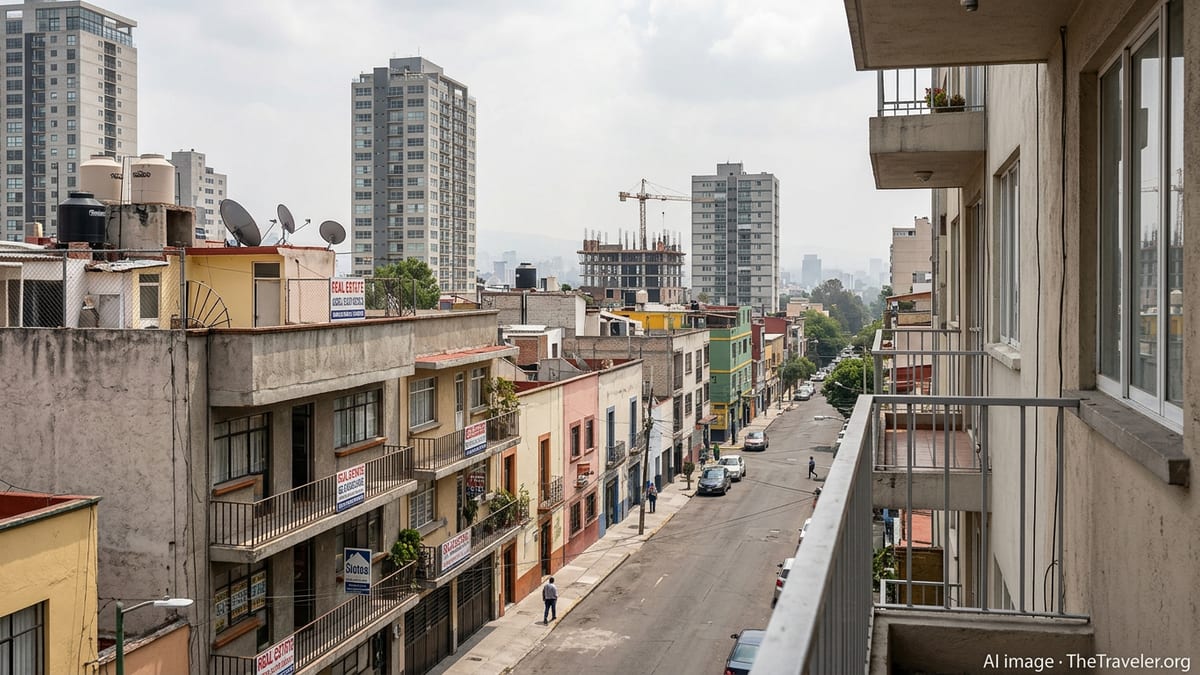
Overview of Mexico’s Current Property Market Dynamics
Mexico’s residential market has expanded rapidly since the pandemic period, with national house price indices showing annual gains in the high single digits to low double digits in 2023 and 2024. Recent data indicate that growth has decelerated modestly but remains clearly above general inflation. Estimates for late 2024 and early 2025 point to nationwide annual housing price increases in the range of roughly 6 to 9 percent, compared with consumer price inflation closer to 4 percent. This pattern implies an ongoing real appreciation of housing assets, an important element in bubble risk assessments.
Official data from the federal housing finance agency show that in early 2025 the average value of owner‑occupied housing was approaching 1.9 million pesos, with year‑on‑year appreciation around 8 percent and stronger gains above 9 percent in major metropolitan zones such as Tijuana, León, Guadalajara, Puebla–Tlaxcala and Monterrey. At the same time, average mortgage interest rates reported by the central bank were near the mid‑teens in percentage terms, broadly around 11 to 12 percent, signaling that price increases are occurring in a relatively high‑rate environment rather than being solely a function of ultra‑cheap credit.
Sector reports for 2025 describe a market in which new residential construction has lagged demand. One nationwide review of the first half of 2024 recorded a near 10 percent rise in home prices alongside a modest contraction in housing starts, widening an existing structural housing deficit estimated in the millions of units. This combination of demand‑side pressure and constrained new supply underpins much of the price appreciation observed in urban and industrial corridors, complicating any simple narrative that recent gains are purely speculative.
For relocation decisions, the headline conclusion is that Mexico is experiencing sustained and regionally uneven price inflation in housing, occurring against a backdrop of healthy but slowing economic growth and elevated borrowing costs. These features affect affordability and entry timing but are distinct from the extreme dislocations seen in classic pre‑crisis bubbles characterized by explosive credit growth and double‑digit real price surges nationwide.
Bubble Risk Indicators: Prices, Credit and Valuation Metrics
Standard frameworks for assessing property bubbles focus on several structural indicators: the pace and duration of real (inflation‑adjusted) price growth, the relationship between prices and household income, price‑to‑rent ratios, leverage and mortgage expansion, and construction activity relative to demographic needs. In Mexico, most of these metrics point to elevated but not yet extreme risk levels at the national scale, with specific hotspots that warrant closer attention.
Long‑term series compiled from central bank and international datasets suggest that real residential property prices in Mexico have risen substantially over the past decade, with cumulative real gains of roughly 30 to 40 percent since the mid‑2010s. This is meaningful appreciation but still below the explosive doubling in real terms that preceded housing crises in several advanced economies. Price growth has been strongest since around 2020 and has outpaced wage growth in many regions, eroding affordability and gradually increasing the price‑to‑income ratio in major cities.
Mortgage market dynamics provide a partial counterweight to bubble concerns. Average mortgage rates in excess of 10 percent impose a natural brake on speculative borrowing, and there is little evidence of a sudden surge in highly leveraged households using exotic loan products. Instead, a significant part of the market remains driven by salaried borrowers using formal payroll‑linked mortgages, public housing institute financing, or cash buyers including foreign purchasers and high‑income locals. While housing debt has grown, the pattern more closely resembles gradual deepening of a historically shallow mortgage market than a rapid credit bubble.
Valuation metrics such as price‑to‑rent ratios show localized overheating in specific neighborhoods of Mexico City and in certain coastal resort areas where short‑term rental expectations are capitalized into sale prices. In those micro‑markets, acquisition prices often imply rental yields that are low relative to local risk and operating costs, a classic early warning sign of speculative overshoot. Nationwide, however, rental yields remain higher than in many developed markets, implying that the overall system is expensive but not universally detached from underlying cash flows.
Regional Hotspots and Foreign Capital Pressures
Bubble risk in Mexico is highly regionalized. Industrial and nearshoring hubs in the north, along with prime coastal destinations and central urban cores, exhibit behavior much closer to a potential mini‑bubble than the national averages suggest. Understanding these regional patterns is crucial for relocating households choosing where to buy or rent.
Monterrey, the principal city of Nuevo León and a major beneficiary of nearshoring, illustrates these dynamics. Recent private‑sector analysis points to average residential prices above 70,000 pesos per square meter in some segments, with annual price growth frequently exceeding 10 percent between 2020 and 2024 and an additional spike estimated at around 15 percent in 2024 alone. This acceleration is closely linked to a sharp rise in foreign direct investment and record industrial space absorption, generating both investor enthusiasm and genuine housing demand from a growing workforce.
Mexico City, while more mature, has experienced intense neighborhood‑level appreciation and gentrification. Reports in 2025 noted that central districts were approaching asking prices near the equivalent of several thousand euros per square meter, with local mortgage rates above 10 percent and cumulative rent increases of around 50 percent since 2020. This has provoked resident protests over displacement and short‑term rental conversions. For relocation candidates, the key takeaway is that specific inner‑city zones may carry elevated downside risk if regulatory measures to curb speculation or restrict short‑term rentals are expanded.
Coastal and resort markets such as Los Cabos, Puerto Vallarta and parts of the Riviera Maya show some of the most stretched valuations relative to local incomes, due in part to foreign second‑home buyers and international investors. Mid‑2020s estimates place average home prices in Los Cabos in the high single‑digit millions of pesos, sometimes exceeding the equivalent of 700,000 US dollars in dollar‑denominated marketing, while average condominium prices in popular resort towns are often several times typical Mexican household annual income. Transaction data also suggest that in some resort markets, foreign purchasers may account for 40 percent or more of buyers. These conditions can sustain high price levels but leave markets vulnerable to shocks in global tourism, external demand or exchange rates.
Supply Constraints, Housing Deficit and Construction Trends
One factor differentiating Mexico’s situation from classic speculative bubbles is the ongoing structural shortage of adequate housing. Public and private analyses estimate a national housing deficit measured in several million units, representing more than one fifth of the country’s occupied homes. This deficit includes both quantitative shortages and qualitative deficits in overcrowded or substandard dwellings.
Recent housing market reports indicate that new housing construction has not kept pace with demographic growth and urbanization in many regions. For example, national statistics for the first half of 2024 registered a mid‑single‑digit percentage decline in new dwelling construction even as prices rose nearly 10 percent over the same period. Developers cite higher construction material costs, regulatory bottlenecks and elevated financing costs as reasons for cautious project pipelines, particularly in mass‑market and affordable segments where margins have been squeezed.
This supply backdrop influences bubble risk in two opposing ways. On the one hand, persistent undersupply means that a significant component of price growth reflects genuine scarcity rather than pure speculation, particularly in working‑ and middle‑class segments where most domestic buyers operate. On the other hand, supply constraints in sought‑after neighborhoods can amplify localized price spikes when new demand sources appear, such as digital nomads, nearshoring professionals or foreign retirees, intensifying distributional tensions and pushing native residents to peripheral locations.
For would‑be relocators, limited new supply in central business districts and high‑amenity neighborhoods implies compressed inventory and competitive bidding for quality stock. This can increase entry prices and make timing more sensitive, but it also suggests that in many urban corridors, a portion of current valuations is anchored in enduring scarcity rather than transient investor sentiment.
Macroeconomic, Policy and External Shock Scenarios
Macro conditions and policy responses will shape whether current elevated valuations stabilize, correct gradually or experience sharper reversals. As of 2025 and early 2026, Mexico faces both tailwinds and headwinds that interact with housing markets in complex ways.
On the positive side, nearshoring and manufacturing reconfiguration have brought substantial foreign investment into northern states and major logistics hubs, boosting employment and supporting housing demand in those regions. Public authorities have also pursued programs to regularize property titles and issue new deeds in the hundreds of thousands, which can improve market depth and reduce legal risk for buyers. Over the medium term, these factors underpin baseline demand for both ownership and rental housing, particularly in export‑oriented corridors.
On the risk side, geopolitical and trade tensions are material. A significant escalation of trade disputes with major partners could depress exports, weaken employment in manufacturing centers and dampen household incomes. Some modeling exercises suggest that prolonged high tariffs could shave several percentage points off annual GDP, which would in turn pressure housing demand, especially in the very regions currently enjoying nearshoring windfalls. Higher for longer domestic interest rates to contain inflation would further strain affordability for leveraged buyers and might trigger localized price corrections.
Regulatory action is another wild card. Rising public concern over gentrification and short‑term rentals in Mexico City and other urban cores has already prompted discussions of rent caps, restrictions on tourist rentals and tighter enforcement of zoning and building standards. Aggressive application of such policies could compress investor yields and cool speculative demand, particularly in highly financialized micro‑markets. For relocation planning, this increases legal and policy risk for short‑term rental or purely investment‑driven acquisitions, while potentially improving stability and affordability in long‑term residential segments if reforms are carefully calibrated.
Implications for Relocators: Risk Profile by Segment
From a relocation and long‑term residency perspective, the question is not only whether a national bubble exists, but how risk differs by city, market segment and holding strategy. Broadly, Mexico’s market can be divided into three overlapping risk tiers: structurally undersupplied primary residences, growth‑driven but cyclical industrial and nearshoring hubs, and high‑beta coastal and central urban investment zones.
Primary residence markets in secondary cities and outer metropolitan areas, where prices are lower and demand is rooted in local incomes, generally exhibit moderate bubble risk. Here, price growth above inflation reflects both supply shortages and gradual credit deepening, and future corrections are more likely to take the form of stagnating values in nominal terms rather than sharp collapses. For relocating households intending to live in the property long term, downside risks in these segments are attenuated, although liquidity can be limited.
Industrial and nearshoring corridors such as Monterrey, parts of Saltillo and the broader northern belt carry a higher cyclical risk profile. Prices have adjusted upward quickly to reflect surging economic activity, and any reversal in trade or investment flows could slow demand. However, because much of the price action is linked to genuine employment and wage growth, these markets currently appear more cyclical than purely speculative.
Coastal resorts, high‑end enclaves in Mexico City and certain gentrifying neighborhoods have the most bubble‑like characteristics: values far above local income capacity, heavy reliance on foreign or investor capital, and sensitivity to tourism, exchange rates and policy changes on rentals. For relocators placing a high weight on capital preservation, purchasing in these zones warrants additional caution, careful yield analysis and a long time horizon that can absorb potential price volatility.
The Takeaway
Overall, Mexico’s property market in 2026 presents as overheated in specific regions but not yet a classic nationwide bubble. National price growth remains robust but has started to moderate, mortgage lending is constrained by relatively high interest rates, and a large structural housing deficit supports underlying demand. At the same time, regional hotspots in nearshoring hubs, central Mexico City and tourist‑driven coastal markets show signs of stretched valuations and social pushback, indicating elevated local bubble risk.
For individuals considering relocation, this environment calls for granular, city‑ and neighborhood‑level analysis rather than reliance on national averages. The safest segments for long‑term owner‑occupiers tend to be structurally undersupplied but income‑anchored markets, while high‑amenity coastal and inner‑city pockets should be approached with the assumption of higher future price volatility. Aligning purchase decisions with actual housing needs and realistic holding periods is more important in Mexico’s current cycle than attempting to time the market for short‑term speculative gains.
Decision‑grade relocation planning should incorporate scenario analysis for trade shocks, interest rate paths and potential regulatory changes affecting rentals and foreign ownership structures. While no property market is immune to correction, Mexico’s combination of demographic demand, urbanization and housing scarcity suggests that, outside of a severe macroeconomic downturn, adjustments are more likely to be uneven and localized than uniformly catastrophic.
FAQ
Q1. Is Mexico currently in a nationwide housing bubble?
Mexico shows elevated prices and localized overheating, but indicators such as mortgage growth, national price trends and structural housing shortages suggest a mixed picture rather than a clear nationwide bubble. Risk is concentrated in specific urban and coastal hotspots rather than uniformly across the country.
Q2. Which Mexican cities show the highest bubble risk for property buyers?
The highest bubble risk appears in central neighborhoods of Mexico City, nearshoring‑driven markets such as Monterrey and high‑end coastal destinations including Los Cabos and parts of the Riviera Maya and Puerto Vallarta, where prices are far above local income capacity and depend heavily on external demand.
Q3. How fast are residential prices rising in Mexico?
Recent data indicate nationwide annual housing price growth in the range of roughly 6 to 9 percent, with stronger gains around or above 9 percent in several major metropolitan areas. This remains above consumer inflation, implying continued real appreciation.
Q4. Do high mortgage rates reduce the risk of a bubble?
Average mortgage rates above 10 percent make speculative borrowing more expensive and limit highly leveraged purchases, which helps contain classic credit‑driven bubbles. However, high rates also worsen affordability and can increase vulnerability for households that do take on large debts near the top of the cycle.
Q5. How important are foreign buyers in driving Mexico’s property prices?
Foreign buyers are highly influential in specific markets, particularly coastal resorts, some central districts of Mexico City and popular digital nomad neighborhoods. In these areas they can represent a substantial share of transactions and have a disproportionate impact on prices, but their role is more modest in inland mass‑market housing.
Q6. What role does the housing deficit play in bubble risk?
Mexico’s multi‑million‑unit housing deficit provides a structural demand base that supports prices, especially in primary residence segments. This reduces the likelihood of nationwide price collapse but does not eliminate the risk of local corrections where values have become detached from local incomes or rental fundamentals.
Q7. Are short‑term rentals contributing to speculative excess?
Short‑term rentals contribute to speculative dynamics in select neighborhoods, particularly in Mexico City and tourist zones where entire buildings are oriented toward platforms for temporary stays. This can push prices beyond what long‑term residents can afford and increases vulnerability to tourism or regulatory shocks.
Q8. How could trade tensions or economic shocks affect the property market?
Escalating trade disputes or external shocks that reduce exports could weaken employment in industrial hubs, slow wage growth and dampen housing demand, especially in northern states. Such scenarios would most likely trigger corrections in regions heavily dependent on nearshoring and manufacturing rather than evenly across the country.
Q9. What should long‑term relocators prioritize to manage bubble risk?
Long‑term relocators should prioritize markets where prices are more closely linked to local incomes, focus on fundamental housing needs rather than speculative upside and evaluate rental yields, vacancy patterns and neighborhood‑level supply pipelines. Diversifying away from the most saturated tourist micro‑markets can also reduce exposure to volatility.
Q10. Is it safer to rent rather than buy in high‑risk Mexican markets?
In neighborhoods or cities displaying clear signs of overvaluation and policy uncertainty, renting can provide flexibility and reduce exposure to short‑term price corrections. Many relocators choose to rent initially while monitoring market conditions, then consider purchase once local dynamics and regulatory trends are better understood.