


Italy offers a paradox for potential relocators: a political system long associated with rapid government turnover now exhibits unusual executive stability under Prime Minister Giorgia Meloni, while underlying institutional and societal frictions continue to generate medium-term uncertainty. Understanding this balance between surface-level stability and deeper structural vulnerabilities is essential for evaluating Italy as a long-term relocation destination.
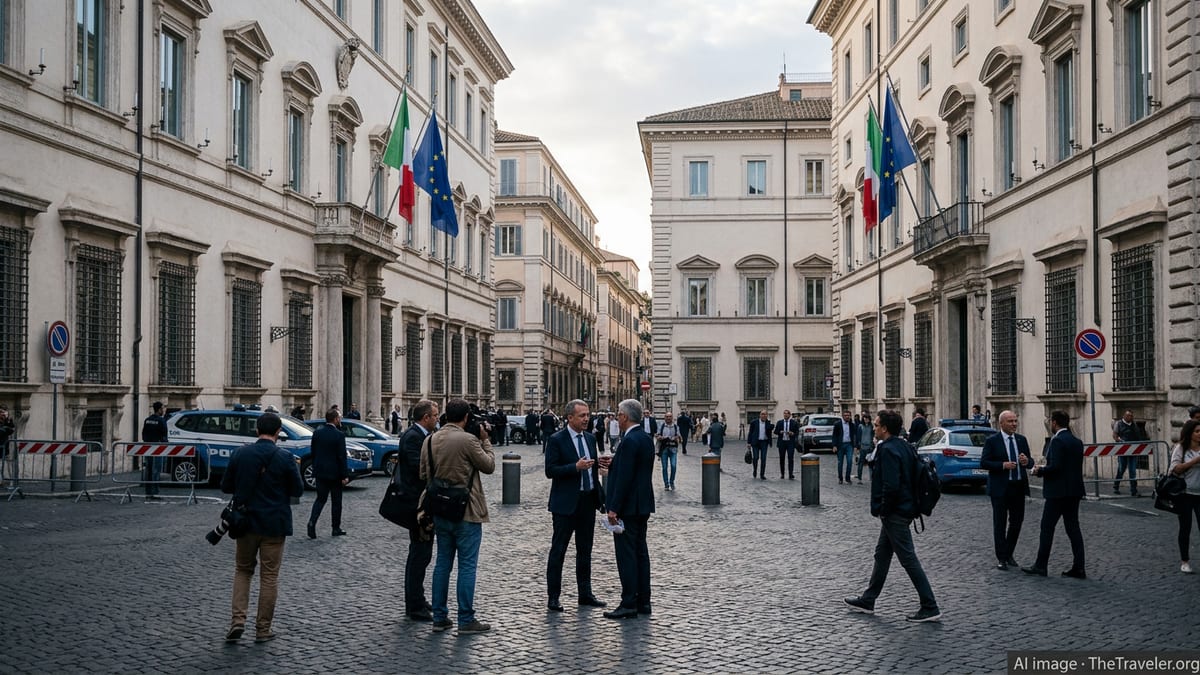
Current Political Stability Profile
Italy is a high-income democracy with functioning institutions, a written constitution, and active participation in the European Union and NATO. These anchoring factors significantly reduce the likelihood of abrupt regime change or systemic breakdown compared with many non-OECD states. Nonetheless, its politics have historically been characterized by fragmented party systems and frequent cabinet changes.
In recent years, the World Bank’s Political Stability and Absence of Violence index has placed Italy around the middle of the high-income group, with a score slightly above zero on a scale from approximately minus 2.5 to plus 2.5. This indicates moderate stability: clearly less fragile than emerging democracies, but more exposed to political disruption than the most stable European peers such as the Nordics or some central European states.
For relocators, this translates into a generally predictable political environment with low probability of coups or violent conflict, but a higher-than-average risk of policy shifts, coalition renegotiations, and institutional tension between the executive, parliament, and the presidency.
Day-to-day life in Italian cities is rarely affected directly by national political turbulence. However, professionals and companies dependent on regulatory clarity or long planning horizons should account for a political system that remains prone to contentious reforms and periodic confrontation between branches of government.
The Meloni Government and Executive Durability
Since October 2022, Italy has been governed by a right-leaning coalition led by Giorgia Meloni’s Brothers of Italy party, supported by the League and the remnants of Forza Italia. This government broke a pattern of short-lived executives. By early 2025, it had become one of the longest-serving governments in the history of the Italian Republic, ranking around fifth in terms of longevity and later climbing further in the historical rankings.
From a political-stability perspective, this continuity is significant. Italy previously experienced almost annual government changes after the global financial crisis, creating a perception of chronic instability. The current coalition, while internally heterogeneous, has maintained a working majority, passed multiple budget laws, and preserved market confidence, as reflected in the narrowing spread between Italian and core euro-area government bonds.
This durability suggests that, at least in the medium term, Italy is less likely to see abrupt collapses of the Cabinet that were common in earlier decades. For expatriates, this reduces the risk of sudden, unplanned political upheavals that might disrupt regulatory frameworks or economic planning.
However, stability in office does not eliminate political contention. Tensions inside the coalition periodically surface around fiscal priorities, EU policy, and security legislation. These disputes are usually resolved through negotiation rather than government collapse, which indicates a shift from existential to transactional instability: policy battles occur, but the executive persists.
Institutional Checks, Democratic Quality, and Rule-of-Law Concerns
Italy’s constitution provides multiple checks on the executive, including a directly elected parliament, a president with limited but important guardianship powers, a constitutional court, and a relatively independent judiciary. In practice, the president has occasionally moderated or delayed government initiatives where constitutional doubts exist, especially on security and justice reforms.
At the same time, several civil-society and academic assessments in recent years have flagged signs of democratic backsliding risk. Concerns focus on attempts to increase political influence over public media, proposals to expand executive control over judicial appointments or the attorney general’s office, and the heavy use of decree-laws to push through contested security measures. These debates do not imply an imminent authoritarian shift, but they do point to a more confrontational relationship between the government and elements of the judiciary, media, and civil-society sectors.
In comparative democracy indexes, Italy still ranks as a free or fully democratic state, yet often with slightly weaker scores than some Western European neighbors on rule-of-law, corruption control, and media independence. For relocators with high sensitivity to civil-liberties trajectories, this mix of robust formal institutions and growing political pressure on some watchdog bodies is an important nuance.
In practical terms, the presence of a strong constitutional court, an active president, and engagement from EU institutions creates a multilayered safeguard environment. Controversial reforms often face legal challenges or are watered down. This produces friction and delay but also demonstrates institutional resilience, which is a stabilizing factor for long-term residents.
Structural Drivers of Political Risk
Beyond personalities and current coalitions, several structural features shape Italy’s long-term political risk profile. These include economic performance, public debt dynamics, demographic pressures, and geographic divides between regions. Each of these interacts with politics in ways that can either stabilize or destabilize future governments.
Public debt is a central background factor. Italy’s government debt level remains among the highest in the euro area in percentage of GDP, with the nominal stock surpassing 3 trillion euro in recent estimates. While current borrowing costs are moderate and markets have recently priced Italy similar to France in terms of sovereign risk, this depends on continued discipline in fiscal policy and the credibility of medium-term debt-reduction paths.
Weak productivity growth, persistent youth unemployment in some regions, and a rapidly aging population all present long-run challenges. If these pressures intensify without effective policy responses, they could fuel political volatility, populist cycles, and protest movements. That said, Italy has previously navigated severe crises, including the eurozone debt episode and the pandemic, without institutional breakdown, which underlines considerable systemic resilience.
For skilled professionals and investors, the structural risk is less about immediate instability and more about the possibility of repeated cycles of reform attempts, resistance, and partial reversals. This environment can create uncertainty around long-horizon projects, though it rarely translates into day-to-day insecurity for residents.
Regional and Social Polarization Dynamics
Italy’s political landscape is shaped by deep regional and social divides. The historic north-south gap in income, employment, and infrastructure remains significant, and these disparities often correlate with different political preferences and protest intensities. Northern regions tend to support parties favoring fiscal autonomy and business-friendly policies, while parts of the south have higher support for redistributive platforms and anti-establishment movements.
Regional polarization is intensified by debates around autonomy and decentralization. Over the past decade, some wealthier regions in the north have advocated for expanded devolved powers and greater control over tax revenues. While existing referendums and negotiations have not fundamentally altered Italy’s unitary structure, they add a layer of political contention that can resurface in periods of fiscal stress.
Socially, Italy has experienced episodes of protest around labor reforms, environmental issues, migration policy, and international conflicts. These protests are typically peaceful and channeled through formal mechanisms such as demonstrations and strikes. However, they contribute to a climate of intermittent tension and can pressure governments into rapid policy shifts or partial retreats.
For relocators, the practical implication is that levels of political engagement and protest activity vary by region and sector. Residents in major urban centers may periodically encounter demonstrations or strikes that disrupt transport and public services, but these events are generally predictable, regulated, and rarely escalate into uncontrolled violence.
Security Environment and Risk of Political Violence
Italy’s internal security environment is relatively stable by global standards. The risk of large-scale political violence, civil war, or nationwide insurrection is extremely low. Occasional political violence incidents have occurred in recent decades, but they are isolated and not indicative of a return to the widespread domestic terrorism experienced in the 1970s and 1980s.
Contemporary security debates focus more on organized crime, migration management, and policing practices than on insurgent political groups. The state maintains effective control over its territory, and security agencies are embedded in European and transatlantic cooperation frameworks. Recent security legislation, including stricter public-order and migration-control measures, has raised civil-liberties concerns but not produced generalized instability.
The risk profile for expatriates is similar to that of other major Western European countries: exposure to low-probability, high-impact threats such as terrorism is present but statistically small, while more routine concerns involve petty crime and localized disorder around major demonstrations. Political polarization can sharpen rhetoric and intensify protests, yet the overall probability of systemic breakdown remains low.
In summary, Italy offers a relatively secure environment for long-term residence, with political risk manifesting more through policy volatility and legal debates than through physical threats to residents.
Forward-Looking Risks: Constitutional Reform and EU Friction
Looking ahead over the next decade, two themes will be central to Italy’s political-stability trajectory: constitutional reforms that could reshape executive power, and the country’s relationship with the European Union’s fiscal and rule-of-law frameworks. Both areas present scenarios that could either consolidate stability or increase conflict, depending on implementation and political context.
The current government has promoted the idea of introducing a directly elected prime minister to increase executive stability and reduce backroom coalition bargaining. Supporters argue this would align Italy with semi-presidential or premier-centered systems elsewhere in Europe, reducing fragmentation and making governments more accountable. Critics warn that poorly designed reforms could weaken parliamentary oversight and concentrate power, especially if combined with partisan pressure on the judiciary and public media.
Any substantial constitutional change in Italy requires complex procedures, and often referendums. This slows down abrupt shifts but also means that reform cycles can become politically charged, polarizing public debate for extended periods. For relocators with long planning horizons, the primary concern is not so much the specific institutional design adopted, but the risk that drawn-out constitutional battles create prolonged uncertainty and delay other policy priorities.
Italy’s relationship with EU fiscal rules and rule-of-law expectations is another long-term variable. So far, the current administration has broadly complied with deficit-reduction commitments and sought to reassure financial markets, which has supported perceptions of stability. However, if future governments deviate markedly from EU budgetary norms or challenge rule-of-law mechanisms, this could trigger market tension, legal disputes, and elevated political risk spreads, indirectly affecting economic stability for residents.
The Takeaway
Italy today combines historically rare executive continuity with enduring structural and institutional tensions. For relocation decisions, this means that near-term political disruptions are relatively unlikely compared with Italy’s past cycles of short-lived governments, but that longer-term uncertainty around institutional reform, fiscal sustainability, and democratic quality persists.
From a risk-management perspective, Italy can be considered a medium-stability advanced democracy. The probability of systemic breakdown is low, buffered by EU membership, entrenched constitutional safeguards, and a diversified economy. The more relevant risks for expatriates and internationally mobile professionals lie in policy volatility, contested reforms, and potential shifts in the balance between executive authority and institutional checks.
Relocators who prioritize macro-level security and basic democratic guarantees will generally find Italy acceptable, provided they are comfortable with a noisy and occasionally confrontational political environment. Those who require very high rule-of-law scores, minimal policy turbulence, or perfectly predictable regulatory trajectories may perceive Italy as somewhat more exposed than some northern European alternatives.
Overall, Italy’s political trajectory over the next decade will likely be defined less by dramatic shocks than by incremental contests over institutional design, fiscal policy, and the country’s role within the European project. Monitoring these dynamics provides the most effective way to update a relocation risk assessment over time.
FAQ
Q1. How politically stable is Italy compared with other Western European countries?
Italy is moderately stable: less fragile than many non-OECD states but somewhat more prone to policy volatility and institutional conflict than the most stable Western European democracies.
Q2. How likely is it that Italy experiences a sudden government collapse?
The risk has decreased in recent years. While coalition tensions exist, the current pattern is one of governments completing longer terms compared with the frequent collapses seen in earlier decades.
Q3. Could constitutional reforms in Italy significantly change the political system?
Yes, proposed reforms to introduce a directly elected prime minister could alter the balance between the executive and parliament, but complex procedures and potential referendums make abrupt change unlikely.
Q4. Does political tension in Italy typically affect everyday safety for residents?
Generally no. Political tension tends to manifest through protests, legal disputes, and media debate rather than widespread violence, so everyday security for residents remains broadly comparable to other EU states.
Q5. How serious are concerns about democratic backsliding in Italy?
There are credible concerns about pressure on media and the judiciary, but Italy remains a pluralist democracy with active opposition, constitutional oversight, and engagement from European institutions.
Q6. Are regional differences in Italy a political stability risk?
Yes, north-south economic and political divides and debates over regional autonomy can fuel periodic conflict and populist cycles, but they have not threatened national integrity in recent years.
Q7. How does Italy’s public debt affect political stability?
High public debt increases sensitivity to financial-market sentiment and EU fiscal rules, which can constrain governments and trigger contentious budget negotiations, adding to political risk.
Q8. Is the risk of political violence or civil conflict high in Italy?
No. The risk of large-scale political violence or civil conflict is very low. Political risk is primarily institutional and policy related rather than physical security related.
Q9. How predictable is Italy’s policy environment for long-term planning?
Policies can change with shifting coalitions and public pressure. Core institutional and EU commitments are stable, but sector-specific rules may face periodic adjustment or delay.
Q10. What should relocators monitor to track Italy’s long-term political risks?
Key indicators include the progress and design of constitutional reforms, public-debt and deficit trends, EU relations, rule-of-law assessments, and the durability of future governing coalitions.