


More news on this day
Italy is facing growing pressure at its major airports as Europe’s new Entry/Exit System reaches full operation, with reports of long queues, sporadic deactivations of biometric checks and an uneven patchwork of responses across France, Greece and Germany.
Get the latest news straight to your inbox!
What the EES Is and Why It Matters for Travelers
The European Union’s Entry/Exit System is a continent-wide digital border database designed to register non-EU nationals every time they cross the external borders of the Schengen area. Instead of relying on passport stamps, the system stores biographic and biometric data, including fingerprints and facial images, alongside records of entry and exit dates.
The system began a phased rollout in October 2025 and became fully operational at all external Schengen border crossing points on 10 April 2026. Publicly available information from European institutions describes it as a key modernization step intended to tighten border security, track overstays more accurately and automate checks for third-country visitors arriving for short stays.
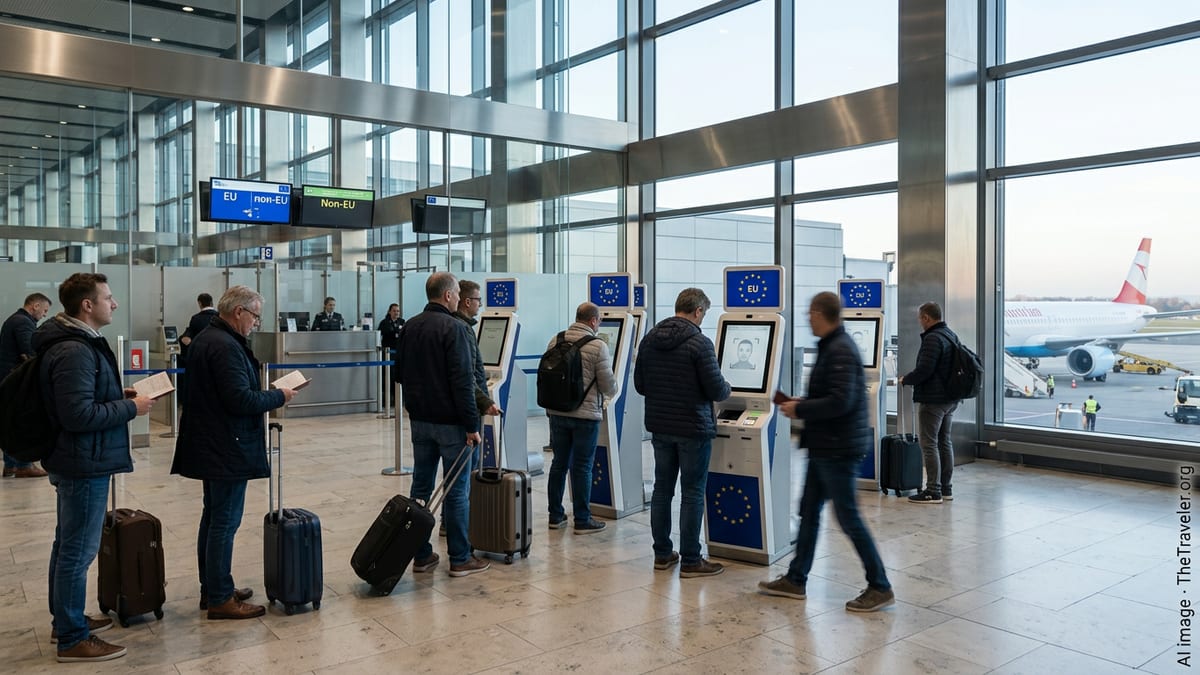
For travelers, the change is most visible at airports, ferry ports and certain rail hubs where new kiosks or counters have been added for biometric capture. First-time registration under EES generally takes longer than a traditional passport stamp, which has created a sharp adjustment period as passenger volumes rebound strongly in the post-pandemic era.
While the long-term goal is faster and more consistent border control, the early months of full deployment have exposed infrastructure gaps, staffing shortfalls and technical glitches in several countries, including some of Europe’s busiest tourist gateways.
Italy’s Airports Under Strain as Summer Peaks
In Italy, reports from passengers and local media point to mounting pressure at key hubs such as Milan Malpensa, Rome Fiumicino, Pisa and Florence since the system became fully active in April. Travelers describe long lines at passport control for non-EU arrivals, as officers juggle biometric enrollment with routine checks at facilities that were already operating near capacity.
At Milan Malpensa, anecdotal accounts suggest that EES kiosks and counters have struggled to keep pace with peak-hour arrivals from North America and the United Kingdom. Some travelers report being warned to arrive significantly earlier than usual for outbound flights because queues for exit checks and security can stretch far beyond pre-EES norms.
Smaller regional airports popular with tourists, including Pisa and Florence, appear particularly exposed. With limited space for dedicated EES infrastructure and fewer border officers, even moderate surges in passenger numbers have reportedly resulted in bottlenecks. Accounts from the spring and early summer noted missed flights when lines for non-EU passport control extended well beyond one hour.
Italy has also been drawn into a broader political debate about how strictly to apply the new checks. While Greece has introduced targeted relaxations for British travelers, publicly available coverage indicates that Italy and Portugal have signaled they do not intend to follow suit, arguing that consistent application is necessary to preserve the system’s integrity.
France, Greece and Germany Expose a Patchwork of Approaches
Across the EU, France, Greece and Germany have become bellwethers for how national authorities are handling the tension between strict digital controls and the practical realities of holiday-season crowds. Reports from French airports, including Paris Charles de Gaulle, describe periods of heavy congestion attributed to malfunctioning biometric kiosks and staffing mismatches with flight banks.
Coverage from earlier in the year highlighted that airport operators in France publicly urged policymakers to consider slowing or pausing elements of the rollout to avoid severe disruption during peak summer travel. An industry analysis circulated by European airport and airline associations warned that border-control processing times had risen by up to 70 percent at some facilities, with waiting times occasionally approaching three hours during surges.
Greece presents a contrasting case. The country’s civil aviation authorities have formally acknowledged full implementation of EES at its air borders, yet multiple travel reports suggest selective easing for certain nationalities, particularly British tourists, at some locations. In practice, this has meant that in periods of intense congestion, Greek border guards may rely on traditional passport checks rather than full biometric enrollment to keep lines moving.
Germany, meanwhile, has been cited in public discussions as generally applying the system more strictly, with fewer reports of widespread suspension. However, travelers recount isolated cases in which EES records did not correctly register previous exits, leading to confusion over remaining days allowed under the 90-day-in-180 rule. Such incidents underline the stakes of data accuracy when a centralized digital system replaces ink stamps.
Mounting Pressure From the Aviation Industry
European airport and airline associations have been warning for months that the combination of complex biometric procedures and high passenger volumes could prove disruptive without additional resources. In a series of public statements since late 2025, organizations representing airports, carriers and air transport stakeholders called for adjustments to the EES rollout, stressing the risk of “systemic disruptions” to passenger flows.
A December 2025 communication by European airport representatives singled out France, Germany, Greece, Iceland, Italy, Portugal and Spain as particularly affected by early operational issues. The analysis pointed to extended processing times for third-country nationals and expressed concern that only a relatively small share of passengers were yet being routed through the new system, suggesting that full-scale usage could push some facilities beyond their limits.
In March 2026, as the date for full activation approached, another joint industry warning emphasized that introducing full EES checks during busy travel periods would likely generate queues and missed connections unless border-control staffing and physical layouts were rapidly upgraded. Subsequent accounts from airports across Europe indicate that many of these concerns have materialized to some degree, especially where infrastructure upgrades lagged behind policy timelines.
Against this backdrop, the aviation sector continues to press for greater flexibility, streamlined procedures for low-risk travelers and a more gradual ramp-up of biometric obligations at the busiest entry points. Italy’s experience this summer is being closely watched as a test of how much strain airports can absorb before ad hoc workarounds become the norm.
On-the-Ground Reality: Workarounds, Deactivations and Traveler Tips
Recent reports suggest that some European airports, including facilities in Italy, France and Germany, are intermittently deactivating or bypassing EES checks during extreme peaks in order to clear backlogs. Public discussions describe situations in which border officers temporarily revert to manual passport inspection for entire planeloads of travelers when biometric kiosks fail, queues spill into gate areas or connecting times become critical.
Such workarounds are not officially framed as suspensions of the system but rather as pragmatic responses to “exceptional circumstances.” A letter circulated in early August and referenced in European media discussions indicates that several governments, including Italy, France, Germany, Greece, Portugal and others, have reiterated support for EES while also warning Brussels that operational difficulties are significant and should not be underestimated.
For travelers planning trips to Italy and other Schengen destinations in the coming months, the practical implications are clear. Non-EU nationals should assume that first-time EES registration may add extra time at border control, particularly when arriving at busy hubs or during early-morning and late-afternoon waves of long-haul flights. Allowing additional buffer time for connections and airport transfers is strongly advised.
Passengers are also encouraged by travel industry guidance to check airline notifications and airport advisories before departure, as local arrangements can change quickly in response to congestion. While queues and confusion remain possible, early signs from some airports suggest that processing times are gradually improving as staff become more familiar with the system and technical issues are resolved. Italy’s challenge will be to accelerate that learning curve while preserving the tourism appeal on which many of its regions depend.