


In 2027, travelers who want to enjoy Japan’s flowers before the crowds of cherry blossom season have a quieter, more fragrant option: ume, or Japanese plum blossoms. From January in coastal onsen towns to elegant shrine gardens in Kyoto by late February, plum trees open weeks before most sakura, rewarding visitors who do not mind cooler weather with softer light, rich perfume and far fewer tour buses.
Get the latest updates straight to your inbox!
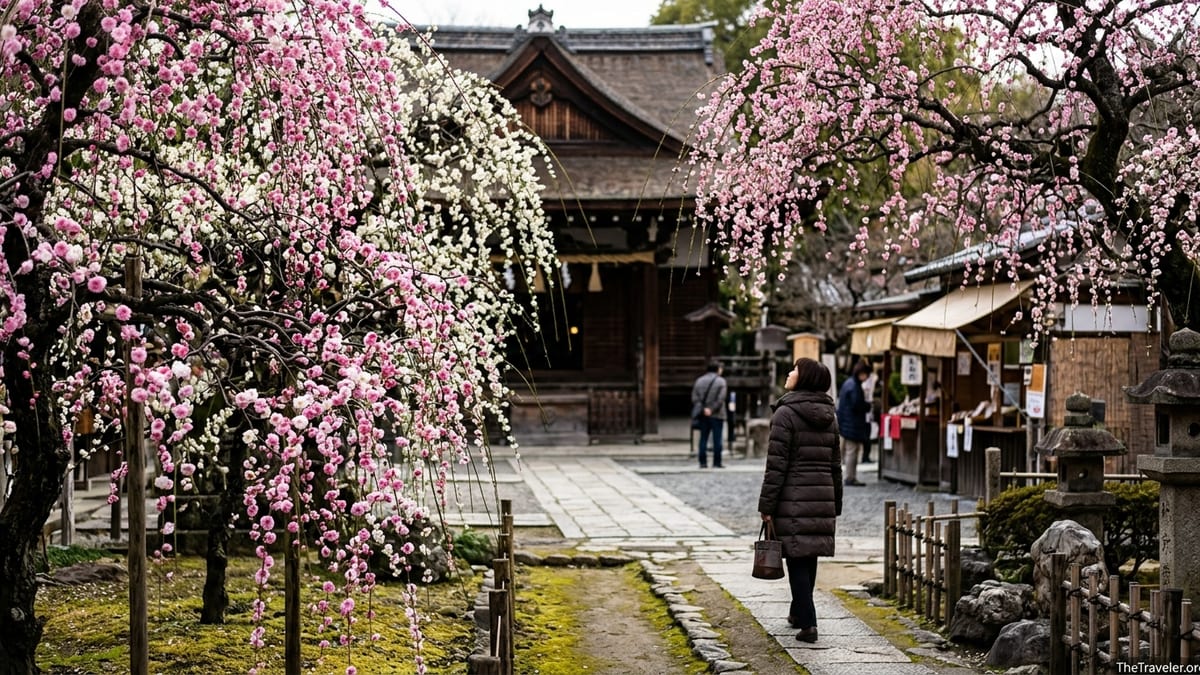
Ume versus sakura: timing, fragrance and meaning
Although they are often confused in photos, ume and sakura are quite different experiences on the ground. Plum blossoms usually appear from January to March depending on the region, while mainstream cherry blossom season in much of Honshu does not start until late March. Travelers who are in Tokyo on, for example, 20 February 2027 will likely find pink and white ume in full swing while most cherry trees remain bare.
Ume flowers have a strong, sweet fragrance that you can smell as soon as you enter a grove, especially in enclosed temple gardens such as Kyoto’s Jonangu Shrine or Tokyo’s Yushima Tenmangu. Individual flowers are thicker and more rounded than cherry blossoms, and they often cling close to dark, gnarled branches that make striking silhouettes in photographs. Sakura petals are lighter, with a more delicate scent and a short peak that can last only a few days in wind or rain.
Culturally, ume has long been a symbol of resilience and the first sign of spring in classical Japanese poetry, associated with scholars and refined taste. Shrines like Dazaifu Tenmangu in Fukuoka and Kitano Tenmangu in Kyoto are dedicated to the Heian scholar Sugawara no Michizane and are famous for their plum trees. Cherry blossoms carry stronger associations with transience, mass hanami picnics and school graduations. For visitors, plum-viewing tends to feel more local and contemplative, with small food stalls and tea tents rather than rowdy evening parties.
For trip planning, the practical difference is that ume lets you see blossoms in January and February when airfares and hotel prices may still be lower than at sakura peak. However, the weather is wintry and some mountain regions can be very cold, so it is important to balance floral goals with comfort and travel logistics.
How the 2027 plum season unfolds across Japan
Plum season in 2027 will begin along the Pacific coast and in onsen towns, then move inland and north. Atami Baien in Shizuoka Prefecture, a classic early-blooming garden, has confirmed its 2027 Atami Baien Plum Festival from 9 January to 7 March 2027, with nearly 500 trees of multiple varieties opening in succession so that some part of the garden is usually in bloom through the period. This makes Atami a reliable target if you are traveling as early as mid January.
From early February, more destinations near Tokyo come into play. The 2027 Yugawara Plum Festival, Ume no Utage, at Yugawara Plum Grove in Kanagawa is scheduled from 6 February to 7 March 2027, with around 4,000 trees on a hillside above town and an entry fee reported at 300 yen, free for Yugawara residents and overnight guests. The Setagaya Plum Festival at Hanegi Park in Tokyo is widely listed for 6 February to 28 February 2027, with some local listings indicating activities continuing to 7 March, so visitors in the capital during those weeks can plan plum-viewing without leaving the city.
In western Japan, Kyoto’s Jonangu Shrine has announced its 2027 Weeping Plum and Camellia Festival from 18 February to 22 March. This timing reflects the general Kansai pattern, where lowland Kyoto, Osaka and neighboring Nara tend to hit good plum viewing from late February into mid March. Fukuoka’s Dazaifu Tenmangu and surrounding groves in northern Kyushu also follow a similar calendar, though exact 2027 festival periods may be confirmed closer to winter.
It is important to understand that festival dates are operating periods, not guarantees of perfect peak. Because plum varieties open at different times and there is no detailed national ume forecast, organizers set wide windows. Warm spells might bring an early flush in late January, while a cold snap can hold flowers back into March. When planning 2027 travel, treat festival dates as a bracket for likely bloom rather than a promise, and check each venue’s official bloom diary a few days before your visit.
Key plum-viewing locations and how to visit them
Atami Baien is one of the best early-season destinations. From Tokyo Station, the JR Tokaido Shinkansen Kodama or some Hikari services reach Atami in about 45 minutes, with an unreserved one-way fare in the range of 4,000 to 4,500 yen in 2026 pricing. Local JR Tokaido Line trains are cheaper, typically around 2,000 yen one way, but take about 1 hour 50 minutes and can be crowded on weekends. From Atami Station, local buses run to Atami Baien in roughly 15 minutes, and recent guides indicate a modest admission charge during festival season, so budget a few hundred yen for the garden itself.
Within Tokyo, Yushima Tenmangu in Bunkyo ward and Hanegi Park in Setagaya are prime urban spots. Yushima Tenmangu is a short walk from Yushima or Ueno stations and is easily combined with museums in Ueno Park, making it an ideal half-day stop. There is usually no entry fee to the shrine precincts, although some festival events or special exhibitions might be ticketed. Hanegi Park, home to the Setagaya Plum Festival, is reached via the Odakyu Line to Umegaoka Station, about 10 minutes from Shinjuku on a regular commuter train, at a fare of roughly 210 to 250 yen one way.
Further afield, Kairakuen Garden in Mito, Ibaraki Prefecture, is one of Japan’s Three Great Gardens and is renowned for more than 3,000 plum trees. From Tokyo Station, the JR Joban Line limited express Hitachi or Tokiwa takes about 1 hour 10 minutes to Mito, with a one-way fare usually in the 3,500 to 4,000 yen range depending on service and seat class. Many years, a temporary Kairakuen Station operates on event days, but even when it does not, buses and local trains from Mito make the transfer straightforward. There is often a small garden admission fee on festival days; visitors should confirm the exact 2027 charges closer to the trip.
Yugawara Plum Grove, Jonangu Shrine, Kitano Tenmangu, Osaka Castle Park and Dazaifu Tenmangu form a loose arc through western Japan for travelers continuing beyond Tokyo. Most of these sites have either free basic entry (as at Osaka Castle Park’s public grounds) or a modest garden fee (typically in the low hundreds of yen at shrine sub-gardens), which keeps daily costs manageable even when visiting several locations.
Crowds, photography and which places merit an overnight stay
Plum spots vary widely in scale and atmosphere. Compact city shrines such as Yushima Tenmangu and Kitano Tenmangu can feel crowded on weekend afternoons in late February, especially during exam season when students come to pray for success. However, the crowds are mainly domestic visitors and families, and early mornings on weekdays are usually quiet enough to photograph blossoms without many people in the frame.
Large hillside groves such as Yugawara and Kairakuen spread visitors out over a wide area, so even on popular days you can often find less congested vantage points. Telephoto lenses work well at these locations, compressing layers of red and white blossoms, while wide-angle shots are rewarding at shrines like Jonangu, where weeping plum branches cascade almost to the ground. Photographers should be prepared for strong winter light and high contrast in January and early February, which softens into more flattering tones toward March.
In terms of time commitment, Atami Baien and Yugawara Plum Grove both justify overnight stays if you enjoy hot-spring culture. Atami and Yugawara are full-fledged onsen resorts, and ryokan prices in late January and early February can start in the 15,000 to 25,000 yen per person range with dinner and breakfast included at midrange properties, rising higher on Saturdays. Staying overnight gives you flexibility to visit the grove in the morning and again in late afternoon when light changes.
By contrast, Kairakuen from Tokyo, Setagaya’s Hanegi Park, Yushima Tenmangu, Osaka Castle Park and even Kyoto’s Kitano Tenmangu are all very manageable as half-day excursions. Allow a morning or afternoon for each, plus transit time. Jonangu Shrine, located in southern Kyoto, can be combined with Fushimi’s sake district or other south Kyoto sights, so many visitors allocate a full day for the area without necessarily spending an extra night compared with a standard Kyoto base.
Kitano Tenmangu’s Baikasai and other special events
One of the most atmospheric dates in the plum calendar is 25 February, when Kitano Tenmangu in Kyoto holds its annual Baikasai. This festival is fixed to 25 February each year, including 2027, to commemorate Sugawara no Michizane. The shrine grounds fill with worshippers, and one of the highlights is an outdoor tea ceremony where geiko and maiko from the nearby Kamishichiken district serve tea to the public.
The tea ceremony is typically ticketed and sells out quickly. Recent years have seen prices in the low thousands of yen per person, which includes matcha and sweets served under temporary pavilions set up among the plum trees. Tickets are usually sold through Kyoto tourist information outlets and sometimes on the day in limited numbers, but travelers with a fixed 25 February 2027 itinerary should plan to check sales information as soon as it is released in winter 2026 to avoid disappointment.
Crowds at Baikasai are intense compared with ordinary plum-viewing days. Expect lines for shrine offerings, tight conditions for photography and possible waiting times for restrooms and nearby buses. If you value a quiet atmosphere over ceremony, you might instead visit Kitano Tenmangu on a weekday around 20 February or in early March, when many trees are still in bloom but the grounds are calmer.
Other notable experiences include evening illuminations at some gardens, occasional koto performances at Kairakuen and local food stalls at Yugawara’s Ume no Utage and Setagaya’s festival. In 2027, individual event programs will be finalized closer to the season, so travelers should check each venue’s latest Japanese language notices or visitor information a week or two ahead.
Weather, bloom strategies and reading official updates
Planning around ume means making peace with winter. In Tokyo, late January and February morning lows can sit near freezing, and even midday temperatures often stay in the single digits Celsius. Kyoto and Mito can feel colder due to inland locations, while Atami and Yugawara enjoy slightly milder coastal conditions. Travelers should pack warm layers, gloves and a hat, especially for long periods of standing in gardens or photographing at dawn.
Bloom strategies can be thought of as early, middle and late. Early-season seekers aim for places like Atami Baien from mid January to early February 2027, prioritizing the novelty of winter blossoms and hot-spring stays. Mid-season travelers time visits for mid to late February, combining Tokyo spots such as Setagaya and Yushima with Kansai destinations like Jonangu and Kitano Tenmangu. Late-season visitors focus on higher latitudes and inland groves in March, such as Kairakuen and some regional parks in Tohoku, or on finishing ume just as early sakura begin to open in late March.
Official websites and local tourism boards often publish bloom updates with photos, but they can lean optimistic for promotional reasons. Wording such as “best viewing” may cover a broad span, from the first strong showing through near the end of flowering. Independent blogs and social media posts can help cross check, but they are not always verified. In 2027, without a detailed ume forecast equivalent to the cherry blossom forecasts published by major weather companies, the safest strategy is to leave a few flexible days in your schedule so you can adjust when you see how far along trees are on arrival.
Physical accessibility varies by site. City shrines like Yushima Tenmangu and Kitano Tenmangu involve some steps and stone paths, while large parks such as Osaka Castle Park and many sections of Kairakuen have paved routes suitable for wheelchairs, though slopes can be steep. Yugawara Plum Grove sits on a hillside with uneven trails that may be challenging for visitors with mobility issues. Before finalizing a 2027 itinerary, travelers with accessibility needs should review each garden’s latest facilities information.
Sample 2027 itineraries: Tokyo base, Kyoto focus and extended ume route
A three day Tokyo based plum itinerary in late February 2027 could work as follows. On Day 1, stay within the city: visit Yushima Tenmangu in the morning, walk through Ueno Park’s museums, and head to Hanegi Park in Setagaya for the plum festival in the afternoon. Local Tokyo transit on a day like this might cost around 1,000 to 1,500 yen per person using regular IC card fares.
On Day 2, make a full day trip to Kairakuen in Mito. From Tokyo Station, take a JR Joban Line limited express to Mito at about 3,500 to 4,000 yen one way, plus a small local transfer cost. Adding a modest garden admission and simple meals, a realistic daily budget for transport and activities is approximately 10,000 to 12,000 yen per person, not including accommodation. Day 3 could then be devoted to an early start for Atami Baien, using either the shinkansen for speed or local trains to reduce costs, followed by a late afternoon dip at an Atami onsen before returning to Tokyo in the evening.
A Kyoto focused three day plan for late February or early March 2027 might start with Kitano Tenmangu and nearby Kamishichiken on Day 1, including time at the monthly Tenjin-san market if your dates coincide with the 25th. Local Kyoto buses and subways typically add up to 800 to 1,500 yen per day in transit costs. Day 2 could focus on Jonangu Shrine’s weeping plum and camellia garden, combined with Fushimi’s sake breweries or other south Kyoto sights, while Day 3 sends you by JR to Osaka for plum viewing around Osaka Castle Park and time in the city’s shopping districts.
For serious flower enthusiasts with a week or more, an extended route could start in Tokyo with Setagaya and Yushima, move to Atami and Yugawara for coastal groves and hot springs, then continue by shinkansen to Kyoto for Jonangu and Kitano Tenmangu, and finally on to Fukuoka for Dazaifu Tenmangu before looping back. A seven to ten day rail-focused trip of this sort might justify a nationwide rail pass or a combination of regional passes, depending on 2027 pricing and eligibility rules. Midrange city hotels in Tokyo, Kyoto and Osaka in February 2026 have often ranged from about 10,000 to 18,000 yen per room per night for two people, and similar levels can be expected in 2027, though popular weekends and Baikasai dates may be higher.
When building any of these itineraries, travelers should factor in not only train and accommodation costs but also admission fees, local buses or taxis in smaller cities, and a contingency fund for weather induced changes. Flexibility is particularly helpful around the edges of the season, when a warm or cold winter can shift plum timing by a week in either direction.
Bloom calendar overview and choosing ume versus sakura
The following simplified bloom calendar reflects typical patterns and currently announced 2027 festivals. From early to mid January, Atami Baien already has some trees in flower, especially early cultivars, although the garden as a whole will still be developing. From late January into early February, Atami strengthens, and some early varieties appear around coastal Kansai and Kyushu.
From 6 February 2027, Yugawara’s Ume no Utage and Setagaya’s plum festival are underway, creating a core Tokyo region window through late February. Around 18 February, Jonangu’s weeping plum garden opens for its 2027 festival, overlapping with growing color at Kitano Tenmangu and urban spots in Osaka and Fukuoka. By late February to mid March, Kairakuen, many Tokyo parks and shrine groves across Honshu are in good condition, and this period offers the most choices within a single trip.
By mid to late March, lowland ume in central Japan begin to fade just as mainstream cherry blossoms approach their own openings in cities like Tokyo, Kyoto and Osaka. Travelers aiming for both in a single journey might time their 2027 visit so that the first half, around late February, focuses on plums in Tokyo and Kansai, and the second half, in late March or early April, targets cherries, possibly moving northward to Tohoku if central cities are past peak.
For visitors deciding between an ume focused trip and a later sakura one, the key trade offs are atmosphere, weather and crowd levels. Plum viewing in January and February usually means colder temperatures and shorter daylight but gentler tourism pressure, more interactions with local festival culture and, often, more affordable accommodation. Cherry blossom season brings iconic postcard scenes and longer days, but also higher prices, denser crowds and more competition for restaurant reservations and train seats. In 2027, travelers who value a slower pace, fragrant gardens and hot springs may find that planning around plum blossoms offers a richly rewarding alternative to the better known cherry rush.