


Landing at Jeddah’s King Abdulaziz International Airport is the final flight of your Umrah journey, but there is still one crucial leg left: getting from the airport to your hotel near Masjid al Haram in Makkah. Between the Haramain high speed train, airport taxis, Uber and Careem, private transfers, and buses, the choice can feel overwhelming, especially when you are in ihram, tired from a long flight, and carrying luggage. This guide walks you through each option with realistic 2026 prices, timings, and practical tips so you can choose the transfer that best fits your budget, family situation, and energy level.
Get the latest updates straight to your inbox!
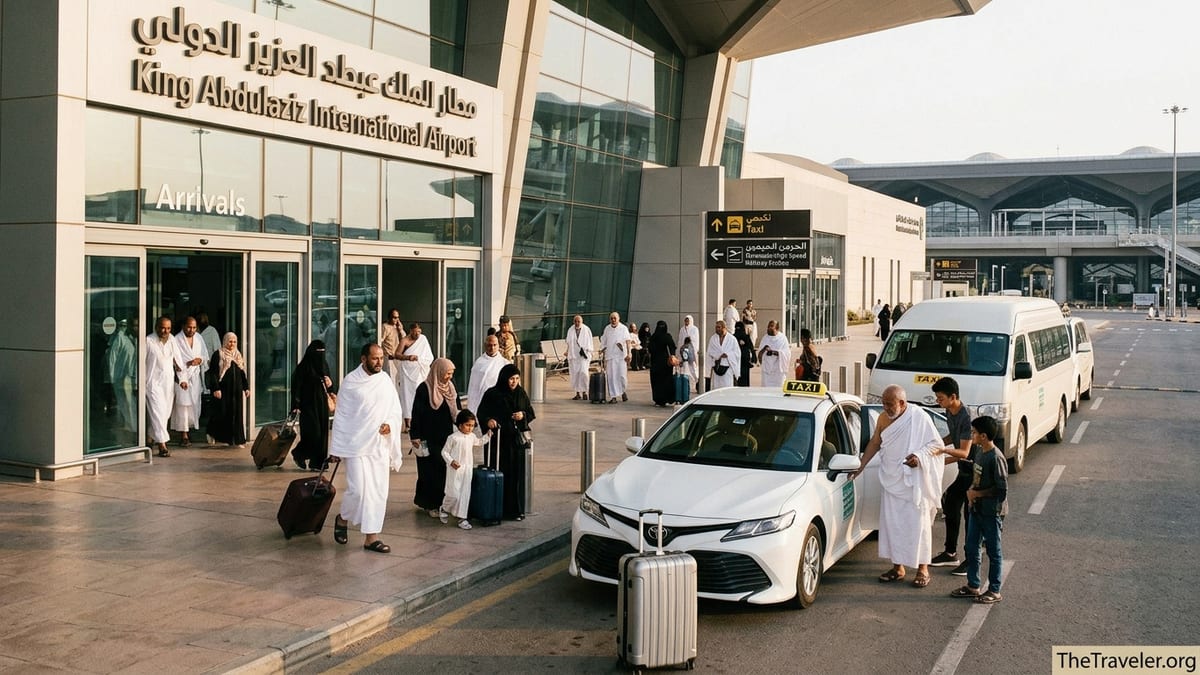
Key Things to Know Before You Leave Jeddah Airport
The distance from King Abdulaziz International Airport (JED) to central Makkah is roughly 80 to 100 kilometers depending on your hotel’s location near the Haram. In normal traffic, a direct road journey takes around 60 to 90 minutes. During busy Umrah seasons and Ramadan, that same trip can stretch well beyond two hours, especially in the final few kilometers around the central Haram area.
Most international Umrah flights now arrive at Terminal 1, which is directly connected by road to both the Haramain high speed train station and the airport taxi and ride hailing pick up areas. Older “north terminal” facilities are used less for international Umrah traffic but you may still see references to them in older blogs and social media posts. Always check your ticket to confirm your arrival terminal, as it affects how easily you can reach train and taxi services.
In 2026, the main public options from Jeddah Airport to Makkah are the Haramain High Speed Railway, on demand airport taxis (often called “green taxis”), ride hailing apps like Uber and Careem, pre booked private transfers, and coach or bus services including SAPTCO and package operator coaches. Some Umrah packages will include group transport directly from the airport to your hotel; others simply drop you at Jeddah and leave transfers to you. Read your package details carefully so you know whether you need to arrange this leg yourself.
Because pricing can fluctuate with fuel costs, demand, and major religious seasons, you should treat all cost figures below as approximate ranges to help with planning rather than guaranteed fares. Having a realistic range in mind, however, will help you recognize fair offers and avoid overpaying the moment you exit arrivals.
Haramain High Speed Train: Fast, Comfortable, but Not Door to Door
The Haramain High Speed Railway is the most modern way to travel between Jeddah Airport and Makkah. Trains run from the dedicated King Abdulaziz Airport Station to Makkah Station in the Rusaiyfah district. The actual train ride is quick, around 30 minutes, in air conditioned, reserved seat coaches with space above seats and at carriage ends for luggage. Many recent Umrah travelers describe it as the most comfortable option, especially after long haul flights, with predictable departure times and minimal traffic worries.
Typical economy class fares between the airport and Makkah vary by date, time and how early you book, but many 2026 bookings fall in the approximate range of 60 to 100 SAR per adult one way, with discounts at off peak times and higher fares at very popular times such as Thursday evenings and Ramadan nights. Children and infants often benefit from reduced fares, so families should always check the official booking channels carefully when comparing with taxis.
The biggest limitation of the Haramain train is that it does not take you directly to your hotel or the Haram. Makkah Station is several kilometers from Masjid al Haram, on the city’s ring road, so you will need a second short transfer by taxi, Uber, Careem, hotel shuttle, or dedicated feeder bus. In practice, that last leg often costs around 30 to 60 SAR for a taxi for central hotels such as the Jabal Omar towers or Ajyad area, assuming normal traffic. Some seasons see free or low cost shuttle buses connecting the station to park and ride locations closer to the Haram, but these can be crowded at peak times.
The Haramain option is usually best for solo travelers and small groups who are relatively light on luggage, comfortable managing a change of transport in ihram, and arriving at times that line up well with train departures. For example, if you land at 3 p.m., clear immigration and baggage by 4:30 p.m., and can catch a 5:30 p.m. train, you may reach Makkah Station around 6 p.m. and your hotel by around 6:30 or 7 p.m., often faster than a car stuck in rush hour traffic on the highway.
Airport Taxis and Ride Hailing (Uber and Careem)
For many Umrah travelers, especially first timers and families, the simplest option is a car directly from the airport to the hotel. At Jeddah Airport, this usually means licensed airport taxis waiting outside arrivals, often in a “green taxi” branded area, or arranging a ride via Uber or Careem. Both apps are widely used in Jeddah and Makkah, though actual pick up rules inside the terminal area can change and are sometimes influenced by airport agreements with taxi companies.
Recent travelers in 2025 and early 2026 commonly report negotiated taxi fares from Jeddah Airport to central Makkah hotels in the range of about 180 to 260 SAR for a regular sedan, with larger MPV or van style vehicles costing more. Some Umrah tour operators quote around 250 to 400 SAR for private car or minivan transfers on this route as part of their optional upgrades. In ride hailing apps, base estimates for mid sized cars on normal days can sometimes be around 180 to 240 SAR, but surge pricing during busy periods can easily push that higher, especially on Thursday evenings, weekends, and the last ten nights of Ramadan.
The main advantages of a taxi or Uber or Careem are simplicity and door to door convenience. You clear immigration, collect your luggage, walk out to the official taxi rank or ride hailing pick up point, and go directly to your hotel lobby at the Jabal Omar complex, Clock Tower, Misfalah, Aziziya, or wherever you are staying. There are no train timetables to coordinate, and you avoid moving suitcases across stations in ihram.
The trade off is that you are at the mercy of road traffic and, if using apps or informal negotiation, dynamic pricing. In very busy periods, such as evenings in Ramadan or during large Umrah waves outside Hajj, it is not unusual to hear of travelers paying more than 250 SAR for the same journey that others managed for under 200 SAR at quieter times. If you choose a taxi at the airport, look for the official counters or clearly marked ranks, confirm the destination (ideally showing your hotel address in Arabic on your phone), and agree the all inclusive price before loading luggage. For Uber or Careem, verify the fare in the app and confirm you are entering the correct car by checking the plate number.
Pre Booked Private Transfers and Hotel Cars
If you prefer certainty and minimal negotiation on arrival, a pre booked private transfer can be a strong option. Many specialist Umrah transport companies and local Saudi operators offer fixed price packages that include a driver waiting at arrivals with your name, helping with luggage, and taking you directly to your hotel in Makkah. Some international Umrah agencies also bundle these transfers into their packages, especially for small groups and families.
As of 2024 and 2025 rate cards still used in 2026, typical prices for a private car or minivan from Jeddah Airport to Makkah range roughly from 250 to 450 SAR one way, depending on vehicle size and exact hotel area. For example, one operator’s published list shows around 260 SAR for a standard car, 300 to 375 SAR for an SUV or larger MPV, and higher rates for premium vans suitable for six to seven passengers with large luggage. Corporate or “executive” Umrah packages sometimes quote higher, reflecting newer vehicles and additional services.
Some hotels near the Haram, particularly in the Clock Tower complex or major chains like Hilton and Fairmont in Jabal Omar, may offer their own chauffeur services for direct airport to hotel transfers. These are usually more expensive than a regular taxi but can be worthwhile if you value having the charge billed to your room, guaranteed vehicle quality, or drivers familiar with the exact hotel access roads and drop off points, which can be confusing in the tight one way system around the Haram.
Pre booked transfers are especially attractive if you are traveling with elderly parents, young children, or a larger family group with multiple suitcases and Zamzam water on the return. Knowing that a driver will be waiting, without having to negotiate in a foreign language after a long flight, reduces stress. The main downside is cost compared with a well negotiated taxi or a combination of train and local taxi, so budget conscious solo travelers may find them overkill.
Bus and Coach Options, Including Package Buses
While there is no single dedicated low cost airport express bus that all Umrah travelers use between Jeddah Airport and Makkah, buses and coaches still play a big role in moving pilgrims, especially those on group or government organized packages. Large operators often arrange air conditioned coaches that collect pilgrims directly from the airport and transport them as a group to pre arranged hotels or drop off points near the Haram.
If your Umrah package includes transport, these buses can be very convenient, particularly for first time pilgrims who want everything handled for them. You may, however, face waiting times while the coach fills with passengers from multiple flights or terminals, and the journey can take longer than a private car due to scheduled stops at several hotels. It is not unusual for group coaches to take two to three hours door to door, especially when accounting for loading luggage and distributing pilgrims in congested central areas.
For independent travelers, intercity operators such as SAPTCO connect Jeddah and Makkah, but these services more commonly run between city centers or bus stations rather than directly from the airport arrivals area. In practice, that means you would first need to reach a bus terminal from the airport by taxi, then board a scheduled bus to Makkah, and finally take another short ride from the Makkah bus terminal to your hotel. By the time you add these stages and costs together, many pilgrims find the price advantage over direct taxis or the train is relatively small, while the complexity is significantly higher.
Buses may still make sense if you are extremely budget sensitive, traveling light, and comfortable navigating multiple transfers, or if your specific Umrah group has arranged a private coach that you can simply board outside the terminal. Always confirm in advance exactly where your bus will depart from, what luggage allowance applies, and whether it drops you near your actual hotel or at a general meeting point from which you must walk.
Choosing the Right Option by Budget, Luggage and Family Needs
When comparing transfer options, consider three main factors: your total door to door budget, how much luggage you are carrying, and who is traveling with you. For a solo traveler or couple with one suitcase each arriving at a time that matches a Haramain departure, the train plus short taxi from Makkah Station can be both comfortable and cost effective. For example, two adults might pay roughly 150 to 200 SAR total for train tickets plus 40 SAR for a station to hotel taxi, often less than a heavily surged ride hailing fare directly from the airport.
For a family of five with several large suitcases and possibly a stroller, a direct seven seat taxi or pre booked minivan for around 300 to 400 SAR can be more practical, even if the per person cost is higher than the train. You avoid lifting luggage multiple times, and children can settle in for a single ride without transfers. Families traveling with elderly relatives often value the ability to stop on the highway for short breaks if needed, something that is easier in a private car than on a train schedule.
If you are on a tight budget but still value a relatively smooth experience, you might aim for a non surged Uber or Careem or an on the spot negotiated airport taxi closer to 180 to 200 SAR, especially outside of peak periods. Travelers on online forums frequently mention successfully negotiating lower fares by politely comparing offers with app prices and being willing to walk a little further to the official ranks rather than accepting the first unofficial tout who approaches within the terminal.
For those whose primary concern is reducing stress and decision making, such as first time Umrah pilgrims traveling from faraway countries, pre booking a transfer through a reputable Umrah agency or transport company can be worth the premium. In that case, you know in advance exactly what you will pay, where the driver will meet you, and how many passengers and bags are included, which allows you to focus on your intentions and worship rather than logistics.
Practical Tips on Ihram, Luggage and Hotel Drop Off Near the Haram
Most male pilgrims prefer to enter ihram before crossing the miqat in the air, which means they arrive at Jeddah already in the two white garments. If you plan to use the train, remember that you may need to walk moderate distances inside the terminal and station, ride escalators, and handle luggage while in sandals. It can be helpful to keep a light bag or small backpack for documents and essentials separate from heavy suitcases, so you are not constantly rearranging Ihram while managing large bags.
On the road to Makkah, some private drivers will offer to stop at service areas where you can refresh, use the restroom, or adjust your ihram before entering the city. After a long flight, a short stop like this can make the final hour more comfortable. Buses and group coaches may schedule similar rest breaks, but these are less flexible than in a privately hired car, so do not assume you can stop at any moment.
Once you reach Makkah, the last few streets near Masjid al Haram are often the slowest. Major hotel clusters like Jabal Omar, the Clock Tower complex, and the Ajyad and Misfalah areas are surrounded by one way systems, tunnels, and security controlled drop off points that can confuse even experienced drivers. Some travelers report being dropped a short walk away rather than directly at the hotel entrance at extremely busy times, especially during Friday prayers and late nights in Ramadan, when access roads are temporarily blocked.
To minimize confusion, keep your hotel’s Arabic name and a screenshot of its location ready on your phone, and clarify with your driver whether they can reach the main entrance or will drop you at a nearby point. Many large hotels operate their own small shuttle vans between agreed meeting points and the hotel during peak closures. If you are concerned about mobility for elderly relatives, you may wish to choose a hotel with easier vehicle access, even if it is slightly further from the Haram’s immediate perimeter.
The Takeaway
There is no single “best” way to travel from Jeddah Airport to Makkah for every Umrah pilgrim. The Haramain high speed train offers a fast, modern, and relatively affordable option that works especially well for light travelers who do not mind one change of transport at Makkah Station. Airport taxis and ride hailing services provide simple, door to door convenience, at a price that can be reasonable in off peak periods but higher when demand surges. Pre booked private transfers and hotel cars sit at the premium end, offering maximum comfort and predictability for families and groups.
When choosing your transfer, think about your arrival time, how tired you are likely to feel after the flight, the ages and mobility of everyone in your group, and how much luggage you will carry. For some, saving 50 or 100 SAR is worth an extra transfer; for others, especially with children or elderly parents, the most important thing is a single, straightforward ride directly to the hotel door.
Whichever option you select, planning ahead will make your first hours in Saudi Arabia noticeably calmer. Check approximate fares for your dates, download Uber or Careem in advance if you plan to use them, confirm whether your hotel or Umrah agent already provides a shuttle, and keep your hotel address ready in Arabic. With those basics in place, the final journey from Jeddah to Makkah can become a smooth transition into worship rather than a stressful logistics challenge.
FAQ
Q1. How long does it take to travel from Jeddah Airport to Makkah?
The direct road journey usually takes about 60 to 90 minutes in normal traffic, but during busy Umrah seasons and Ramadan it can extend well beyond two hours, especially near the Haram where congestion is heaviest.
Q2. Is the Haramain train cheaper than a taxi from Jeddah Airport to Makkah?
For solo travelers or couples, the Haramain train plus a short taxi from Makkah Station to the hotel can often work out slightly cheaper than a direct taxi, while for larger families a single seven seat taxi or minivan may be better value on a per person basis.
Q3. Can I take Uber or Careem directly from Jeddah Airport to my hotel in Makkah?
Yes, ride hailing services like Uber and Careem operate between the airport and Makkah, but pick up rules and prices can vary with demand, and at very busy times surge pricing may make them more expensive than a negotiated airport taxi or pre booked transfer.
Q4. Are there luggage restrictions on the Haramain High Speed Railway?
The train allows normal checked baggage and cabin luggage, with space above seats and at carriage ends, but if you have many large suitcases or bulky Zamzam water containers a private car or van may be more convenient than managing everything through stations.
Q5. Do any buses go directly from Jeddah Airport to Makkah for independent travelers?
Most scheduled buses, such as those operated by national companies, run between city bus stations rather than directly from the airport arrivals area, so you would usually need at least one extra taxi ride to connect, which reduces the price advantage compared with taxis or the train.
Q6. What is a realistic taxi fare from Jeddah Airport to central Makkah in 2026?
Recent traveler reports and operator quotes suggest that a fair range for a standard sedan to central Makkah hotels is often in the region of 180 to 260 SAR at non peak times, with larger vehicles and very busy periods attracting higher fares.
Q7. Should I book my airport to Makkah transfer in advance or decide on arrival?
If you want price certainty and a driver waiting with a sign, especially for elderly relatives or young children, pre booking is recommended; confident independent travelers sometimes prefer to compare taxi and ride hailing options on arrival to look for lower prices.
Q8. What is the best option if I am traveling alone and on a budget?
A combination of the Haramain train from the airport to Makkah Station followed by a short local taxi or ride hail to your hotel is often the best balance of comfort and cost for solo travelers and couples, particularly outside peak holiday and Ramadan periods.
Q9. How close can vehicles get to the Haram and central hotels?
Access changes with crowd levels, but in general vehicles can reach most major hotels like those in the Jabal Omar and Clock Tower complexes, although at very busy times some roads may be temporarily closed and drivers might drop passengers a short walk away from the entrance.
Q10. Is it better to change into ihram at the airport or stay in travel clothes until Makkah?
Many pilgrims in flights crossing the miqat enter ihram before landing, but if your route does not cross the miqat in the air or you prefer more comfort during transfers, you can plan with a scholar in advance and consider changing at a suitable location, such as a rest area on the road or your hotel, depending on your specific fiqh guidance.