


Arriving at Jeddah’s King Abdulaziz International Airport can feel intense, especially if you are heading straight to Makkah, Madinah, or central Jeddah after a long-haul flight. Knowing exactly where to meet your Uber or Careem driver, how much a ride is likely to cost, and when a regular taxi or private transfer makes more sense will save both time and stress. This guide focuses on real, on-the-ground details for using app rides and taxis at JED in 2026, with a clear breakdown of Terminal 1, the North Terminal, and the seasonal Hajj and Umrah facilities.
Get the latest updates straight to your inbox!
Understanding Jeddah Airport Terminals and Ground Transport Layout
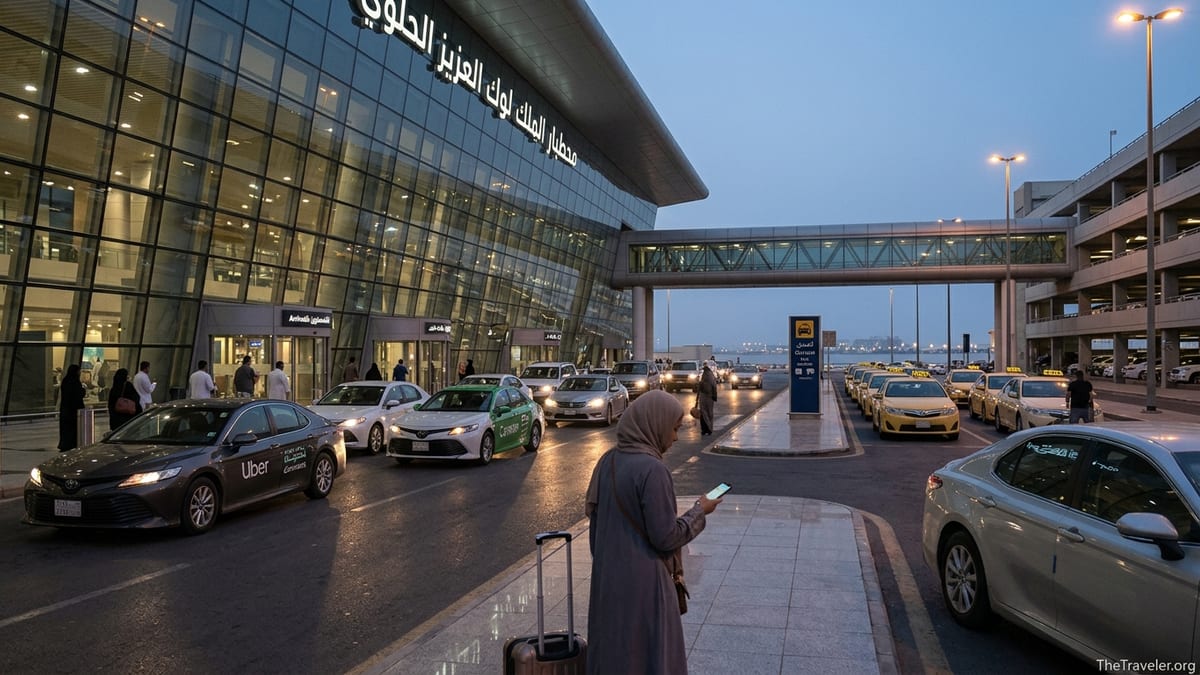
King Abdulaziz International Airport (JED) now operates around three main areas for passengers: the large, modern Terminal 1, the older North Terminal, and the Hajj and Umrah terminal complex used seasonally for pilgrimage traffic. For most international and domestic travelers outside peak Hajj, arrivals and departures are concentrated in Terminal 1, which is directly connected to a multi‑story car park, taxi ranks and the Haramain high-speed rail station via an elevated transport center. In practice, that means most Uber and Careem pickups will happen from Terminal 1.
The North Terminal is still used by a number of international carriers and low-cost airlines. Travelers arriving there will find a simpler ground transport setup, with taxis waiting just outside arrivals and ride-hailing cars meeting passengers at curbside or in nearby short‑stay parking, depending on where the driver can stop without blocking traffic. Expect fewer signs and less clear wayfinding than in Terminal 1, so you will rely more on in‑app directions and messaging the driver.
The Hajj and Umrah terminal complex operates intensively during Hajj and parts of the Umrah season. During these times, movement of vehicles is more tightly managed, and many pilgrims travel on prearranged group buses or private coaches. Uber and Careem can still operate, but access can be restricted to specific gates or parking areas. If you are arriving on a Hajj package, it is usually easier to follow the instructions from your tour operator rather than trying to arrange an app car directly from the terminal.
From a ground transport perspective, think of JED as a campus: Terminal 1 is the best equipped and most ride‑share friendly, the North Terminal is more basic but workable, and the Hajj complex is highly managed and most suitable for prebooked group transport. This context will help you interpret what you see in your Uber or Careem app when you land.
Uber and Careem Pickup at Terminal 1: Step‑by‑Step
At Terminal 1, Uber and Careem operate in a similar way to other major Gulf airports. After baggage claim and customs, you exit into the arrivals hall. From here, you will follow the signs to ground transport and parking, typically through sliding doors that lead outside and then across to the multi‑story car park and transport center. Within the apps, you will normally see “Jeddah Airport Terminal 1” or an equivalent landmark suggested as a pickup point.
A common real‑world pattern is to walk straight out of arrivals, ignore informal touts who may approach you inside the terminal, and continue following the signs for taxi and app pickups. Many travelers report that the smoothest option is to head to the short‑stay parking or the main curb outside the multi‑story car park connected to Terminal 1, then drop a pin there in Uber or Careem. Once you are at the curb, order your ride and watch the vehicle icon on your phone. Because Terminal 1 is busy, drivers often complete back‑to‑back airport runs and are familiar with common meeting spots such as “Level 1 car park exit” or “Arrivals curb opposite door X,” which you can confirm through a quick chat in the app.
Timing matters. In quieter midday periods, an UberX or Careem Go to central Jeddah might arrive in 5 to 10 minutes and cost in the region of 45 to 65 SAR, depending on traffic and dynamic pricing. Late at night during Umrah peaks, wait times can jump to 15 to 25 minutes and prices can climb closer to 80 SAR or more for the same route. If you are heading directly to Makkah, typical app fares from Terminal 1 in 2026 often fall somewhere around 170 to 260 SAR for a standard car when demand is moderate, with larger vehicles for families and extra luggage costing more.
One practical example: a couple arriving from London at 23:30, with two checked suitcases, might exit Terminal 1 around 00:15 after immigration. They head to the transport center, order a Careem Go to an Al Hamra hotel on the Corniche, see an estimated pickup time of 8 minutes and a fare estimate around 60 SAR. In the app chat, they tell the driver, “We are at Terminal 1 arrivals, near the short‑stay parking exit.” The driver replies “Wait near door 5 by the taxis,” pulls up and they are on their way without haggling or handling cash if they have a card linked in the app.
Uber and Careem Pickup at the North Terminal and Hajj Areas
At the North Terminal, the experience is a bit more old‑school. The arrivals hall leads directly out to a curb where taxis cluster and private cars circulate. There may not be a clearly branded Uber or Careem zone, so the easiest method is usually to step outside, walk past the tight taxi crowd for a minute or two until you reach a less congested stretch of curb or a nearby parking area, then request your ride from there. Drivers who service the North Terminal are used to messages like “In front of arrivals, near exit 3, wearing a blue backpack,” so do not hesitate to describe your exact spot.
Because the North Terminal can be patchy for mobile data at busy times, it helps to request the ride as soon as you see a signal, even if you are still inside. If the app suggests “Jeddah Airport North Terminal” as a predefined pickup point, choose it, but then send the driver a quick message with more specific instructions. Travelers regularly report that Uber and Careem rides from the North Terminal into central Jeddah cost roughly similar amounts to Terminal 1, often in the 50 to 70 SAR range for standard rides when traffic is moderate.
For the Hajj and Umrah terminal complex, the situation changes during pilgrimage season. Many pilgrims are moved in bulk using big coaches operated by licensed Hajj companies, and car access is channeled through security checkpoints. In practice, that means an Uber or Careem may need to meet you at an outer parking lot rather than directly outside your arrival hall. For example, a pilgrim traveling independently at the tail end of Umrah season might be instructed to take a shuttle bus from the arrival tent area to a designated public parking area, where they then request a Careem to Jeddah’s Al Balad. The in‑app pickup point might not say “Hajj Terminal” explicitly, so it is wise to check your booking documents or ask ground staff which public parking area you can access with ride‑hailing cars.
If your trip involves changing between terminals, such as arriving at Terminal 1 and departing from the North Terminal on a separate ticket, it is entirely feasible to use Uber or Careem for the short transfer. In real terms, travelers report spending roughly 20 to 30 SAR and 10 to 20 minutes driving airside‑adjacent roads between the terminals, versus waiting for infrequent shuttle buses. This can be a good use of app rides when you have tight connection times or elderly relatives and heavy luggage.
Prices, Ride Types, and Luggage Considerations
Both Uber and Careem in Jeddah offer a variety of ride categories, though exact names can change. As of 2026, you are likely to see an entry‑level option such as UberX or Careem Go, mid‑range comfort options, and larger vehicles like UberXL or Careem Max for groups and extra bags. From JED to popular areas in Jeddah, ballpark estimates for an UberX or Careem Go typically land somewhere around 45 to 75 SAR to neighborhoods like Al Salamah, Al Hamra or near the Corniche, assuming normal traffic and no extreme surge.
For longer routes, such as JED to the central area of Makkah near the Haram, a standard car might usually show estimates around 170 to 260 SAR, sometimes more at very busy times. To Madinah, the journey is much longer, and while you may still see Uber or Careem offers, many travelers choose prebooked private transfers or intercity buses instead because the total fare can climb high. Always treat these figures as approximate and check the live estimate in your app, as dynamic pricing responds quickly to spikes in demand during holidays, Friday evenings, or stormy weather.
Luggage is a key factor when choosing your ride type. A solo traveler with one cabin bag and one medium suitcase will usually be fine with the cheapest category. A family of four arriving for Umrah with four large checked bags and two cabin trolleys is more realistic in a larger vehicle, even if the app allows them to select a smaller one. In practice, many travelers report that trying to squeeze four adults plus four big suitcases into a basic sedan leads to repacking on the curb and tense discussions with the driver. If in doubt, pick the larger category and pay a bit extra to avoid this stress.
Children and car seats can also affect your decision. Ride‑sharing cars in Jeddah do not routinely come with child seats by default. If you are arriving with toddlers, consider bringing a travel booster or arranging a private transfer that explicitly includes appropriate seats. Informal practice in the region is often relaxed, but if you prefer higher safety standards, preplanning this element is important.
When a Regular Taxi or Private Transfer Is Easier
Despite the convenience of Uber and Careem, there are times when taking a regular airport taxi or booking a private transfer in advance is simply easier at JED. One obvious example is very late at night during peak Umrah periods, when thousands of passengers can arrive in waves and app availability may be stretched. If you open Uber and Careem and see long wait times and sharply elevated prices, walking over to the official taxi rank outside Terminal 1 can save half an hour or more, even if the taxi fare is slightly higher than the app estimate in quieter seasons.
Official airport taxis typically operate with a meter or a standard tariff, though enforcement can vary. To central Jeddah hotels in 2026, many travelers report paying somewhere around 80 to 120 SAR for a metered taxi ride depending on exact location and traffic. To Makkah, set fares are often quoted in the 250 to 350 SAR range for a standard sedan, with larger vans costing more. If a driver offers a flat cash price substantially higher than what your app is showing for an Uber or Careem, you can either negotiate politely or walk away and try another car. You are not obliged to accept the first offer.
Private transfers come into their own for complex journeys. For example, a group of six adults flying in on separate itineraries, all meeting at Terminal 1 with eight large suitcases and heading directly to a Makkah hotel two hours away, will usually be happier in a prebooked 10‑seater van with a named driver waiting in arrivals. In 2026, many Saudi and regional operators offer such services with online payment and clear package pricing. While the headline cost might be higher than a standard UberX, once you divide it per person and factor in the convenience of a guaranteed large vehicle, it often represents good value.
Weather can be another reason to choose taxis or transfers. Jeddah’s climate is hot and humid for much of the year, and waiting 20 minutes outside for an app car in the middle of August can be unpleasant, particularly for older travelers or families with infants. An official taxi rank with a queue system typically moves faster in these conditions, and the difference of 20 or 30 SAR is rarely worth the physical discomfort.
Practical Tips for Smooth App Rides at JED
A few simple habits make ride‑hailing at Jeddah Airport substantially smoother. First, ensure your mobile plan will work on arrival, whether via roaming or a local SIM. Both Uber and Careem rely on data for live location tracking and messaging. Many passengers pick up an eSIM in advance or buy a Saudi SIM card from kiosks in the arrivals area of Terminal 1 before heading out to request their ride.
Second, always double‑check the terminal and pickup point in the app. It is easy to select “King Abdulaziz Airport” generically and then discover your driver is waiting at Terminal 1 while you are outside the North Terminal. If you are unsure, look at the flight information screens or your boarding pass to confirm the exact terminal, then type that into the search bar in your ride‑hailing app so the pin matches your real position.
Third, communicate clearly with your driver. A short message such as “Terminal 1 arrivals, outside door 4, near taxi sign” is often more useful than relying purely on the GPS pin, especially in multi‑level parking areas and under covered walkways where GPS can drift. Sharing a quick description of your clothing or luggage color also helps in busy crowds. Be cautious of anyone who approaches you saying “Uber” or “Careem” without verifying their identity through the app and checking the license plate and driver name.
Finally, think about payment. Both Uber and Careem allow you to pay by card saved in the app, by local digital wallets, or in many cases by cash. If you plan to pay cash, keep small denominations in Saudi riyals, as drivers might not have change for large notes just after midnight. If you are using a foreign credit card, it is sensible to inform your bank in advance that you will be making transactions in Saudi Arabia, to reduce the chance of a security block on your first airport ride.
Example Itineraries: What Using Rideshare Looks Like in Practice
Imagine you are a solo traveler arriving from Dubai into Terminal 1 at 14:00, with only hand luggage and a hotel booked in the Al Salamah district. Immigration is light, so you exit into arrivals at 14:30. You have roaming on your phone, open Uber, and see UberX showing 6‑minute pickup and an estimated fare of around 55 SAR. You follow the ground transport signs, step outside to the curb opposite the main exit, and drop a pin near the taxi area. You message the driver “In front of T1 arrivals near door 3,” and at 14:38 you are in an air‑conditioned sedan heading into town. Total time from stepping off the plane to reaching your hotel is under 90 minutes.
Now consider a family of five arriving for Umrah at 02:00 during a busy Ramadan weekend, landing at the North Terminal with four large suitcases and three carry‑ons. After a long queue at immigration, they emerge around 03:15, tired and hot. The Uber app shows high surge pricing and a 20‑minute wait for a large vehicle. Careem is similar. Outside, they see a line of taxis, ask two drivers for a fare to their Makkah accommodation, receive quotes of 320 SAR and 280 SAR, and eventually agree on 270 SAR with a driver offering a spacious van. They are rolling towards Makkah by 03:30, having accepted a slightly higher fare for immediate departure and more room for luggage.
A third example involves a self‑transfer between terminals. A traveler lands at Terminal 1 at 09:00 on a European carrier, booked separately from a low‑cost flight leaving the North Terminal at 12:00. After clearing arrivals by 09:45, they decide not to wait for the shuttle and instead order a Careem Go from the Terminal 1 curb to the North Terminal. The app shows a fare estimate around 25 SAR and a pickup in 7 minutes. By 10:10 they are standing outside the North Terminal departures area, with plenty of time to check in for the connecting flight.
These snapshots capture how the same airport can produce different best choices depending on arrival time, passenger profile, luggage volume, and terminal. Thinking through your own situation in advance will help you decide whether Uber, Careem, a taxi, or a private transfer suits you best on the day.
The Takeaway
Jeddah’s King Abdulaziz International Airport is one of the busiest gateways in the region, but using Uber, Careem, or a taxi from its terminals is straightforward once you understand the basic layout. Terminal 1 is well integrated with modern ground transport options and is the primary hub for app pickups, the North Terminal works reliably if you are willing to walk a little away from the crowds to meet your driver, and the Hajj and Umrah complex favors prearranged group transport during peak seasons.
In terms of cost, app rides are often competitive for solo travelers and small groups, particularly for city transfers into Jeddah or point‑to‑point trips between terminals. For large families, heavy luggage, or very late‑night arrivals in peak pilgrimage periods, official taxis or prebooked private transfers may offer better overall value and comfort, even if the sticker price seems higher at first glance.
Whichever option you choose, a handful of simple practices will keep the experience smooth: confirm your terminal, follow airport signs to the general ground transport areas, use clear messages in the app to describe your location, verify your driver and vehicle before getting in, and have a realistic expectation of price and waiting time. With this approach, getting from the aircraft door at JED to your hotel in Jeddah, Makkah, or beyond becomes just another manageable step of your journey rather than a source of stress.
FAQ
Q1. Can I use Uber and Careem from all terminals at Jeddah Airport?
Yes, you can generally use Uber and Careem from Terminal 1 and the North Terminal, and in many cases from the Hajj and Umrah areas, although access around the Hajj complex can be more restricted during peak pilgrimage times and may require meeting the driver at an outer parking or shuttle drop‑off point.
Q2. Where exactly is the Uber or Careem pickup point at Terminal 1?
At Terminal 1, most travelers meet their Uber or Careem driver outside the arrivals level near the ground transport and short‑stay parking area, often across the road from the main exit. It is best to follow signs toward taxis and parking, then drop a pin at the curb and send your driver a short message such as “Arrivals curb near door 4 by the taxi sign” to make the meeting point clear.
Q3. How much does an Uber or Careem from Jeddah Airport to central Jeddah cost?
Prices vary with traffic and demand, but a standard UberX or Careem Go from either Terminal 1 or the North Terminal to popular central districts of Jeddah typically falls somewhere around 45 to 75 SAR in normal conditions, with higher fares possible during busy evening periods or religious holidays.
Q4. How much should I expect to pay from Jeddah Airport to Makkah using ride‑hailing?
For a standard car, approximate fares from Jeddah Airport to central Makkah near the Haram often land in the 170 to 260 SAR range under typical conditions, though prices can rise during peak Hajj and Umrah periods or heavy traffic. Larger vehicles suitable for families or many suitcases will cost more, so always check the live estimate in the app before confirming.
Q5. Is it better to use Uber or take an airport taxi late at night?
Late at night, especially during busy pilgrimage seasons, Uber and Careem can show longer wait times and surge pricing. If you arrive to find high app fares and long estimated pickups, joining the queue at the official taxi rank outside your terminal is often faster, even if the fare is slightly higher than what you might pay during a quieter period.
Q6. Can I pay for Uber or Careem in cash at Jeddah Airport?
Both Uber and Careem in Jeddah support multiple payment methods, including cards stored in the app and, in many cases, cash payments directly to the driver. If you plan to pay cash, keep some smaller Saudi riyal notes handy, as drivers may not always have change for large denominations immediately after midnight or in very busy periods.
Q7. What should I do if I cannot see my driver at the pickup point?
If you do not see your driver, first double‑check that you are at the right terminal and level, then use the in‑app call or chat function to confirm the exact spot, such as “Terminal 1 arrivals, door 5, near the taxi sign.” Verify the vehicle license plate and driver details before getting into any car, and if the driver does not show after a reasonable time you can cancel and request another ride.
Q8. Are there child seats available in Uber or Careem at JED?
Standard Uber and Careem rides at Jeddah Airport do not typically include child seats by default. If you are traveling with young children, you should bring your own portable child seat or arrange a private transfer that explicitly includes appropriate seats, as this is not guaranteed in regular ride‑hailing vehicles.
Q9. How long does it take to transfer between Terminal 1 and the North Terminal by car?
Travel time between Terminal 1 and the North Terminal by Uber, Careem, or taxi is usually around 10 to 20 minutes in light to moderate traffic, though it can be longer at very busy times. Many travelers choose an app ride for this short transfer, which often costs in the region of 20 to 30 SAR, to avoid waiting for terminal shuttle buses.
Q10. Is it safe to use Uber and Careem from Jeddah Airport?
In general, Uber and Careem are considered safe and widely used by residents and visitors in Jeddah. For a safer experience, always book through the official app, verify the driver’s name and car plate before entering, avoid sharing personal details, and decline offers from unofficial drivers who approach you inside the terminal claiming to be from a ride‑hailing service but are not visible in your app.