


As Vilnius grows busier and pricier, more travellers are looking to Lithuania’s second tier of cities for long weekends and side trips. Two names stand out: Kaunas, the country’s modernist-era cultural powerhouse, and Klaipėda, the historic port that is also the gateway to the Curonian Spit and Baltic beaches. Both are easy to reach from Vilnius by train and bus, but they offer very different atmospheres, price points and types of experiences.
Get the latest updates straight to your inbox!
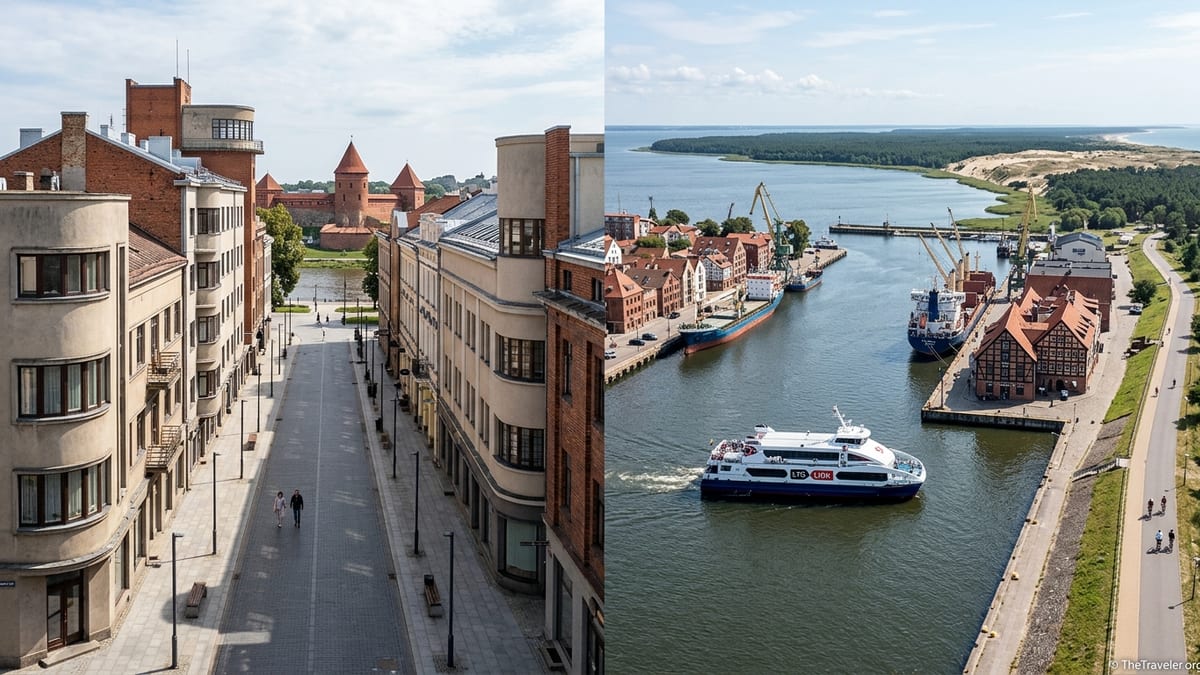
Kaunas vs Klaipėda: character, architecture and first impressions
Kaunas wears its interwar history on its sleeve. When the city served as temporary capital between the world wars, it exploded with modernist construction. Today that legacy is visible in whole districts of streamlined facades, ribbon windows and rounded corners that recently earned central Kaunas recognition on the UNESCO World Heritage List as an exceptional example of modernist urbanism. The main pedestrian artery, Laisvės alėja, is lined with 1930s apartment blocks, cafes and cultural venues that still define the city’s look and feel.
Klaipėda’s personality comes from water rather than concrete. Lithuania’s only seaport has a compact Old Town of narrow streets and half-timbered warehouses, remnants of its Prussian and German past, wrapped around a busy riverfront. Instead of Kaunas’s geometric facades, you see ships, cranes and the silhouettes of ferries shuttling across to the Curonian Spit. Theatre Square, with its distinctive statue of Ann from Tharau, is the city’s social living room and an easy landmark for orienting yourself.
For culture-focused visitors, Kaunas feels like a museum campus stretched across an entire city: in a single afternoon you can move from the red-brick towers of Kaunas Castle to the Čiurlionis National Museum of Art and the sombre Ninth Fort Museum. In Klaipėda the cultural offering is more spread between land and sea. The Lithuanian Sea Museum, set in a former coastal fort on the Curonian Spit, anchors the city’s museum scene, but a big part of Klaipėda’s appeal lies outdoors on the promenades, quays and beaches nearby.
First-time visitors deciding between the two should think in terms of focus. If you are excited by 20th century architecture, galleries and history layered into a compact urban core, Kaunas is an obvious choice. If you want sea air, maritime history and quick access to dunes and bike paths, Klaipėda is the better bet.
Getting there: Vilnius–Kaunas and Vilnius–Klaipėda by train and bus
Lithuania’s national operator LTG Link connects Vilnius with both Kaunas and Klaipėda, and in 2026 the rail network is noticeably more convenient than a few years ago. On the flagship Vilnius–Kaunas route, LTG Link now runs express services advertised at 59 minutes, reinforced by recent timetable updates and a transport ministry announcement that highlighted the non-stop expresses between the two cities. On many daytime departures, journey times sit around 1 hour 10 minutes to 1 hour 20 minutes; the fastest expresses shave that down to just under an hour.
Pricing on Vilnius–Kaunas is now dynamic, but official examples released in 2026 show a standard second-class fare of around 8.60 euro, with promotions and temporary campaigns cutting some tickets to roughly 4.30 euro during discount periods. Same-day bookings without offers tend to land somewhere in the middle single digits for adults. Trains run from Vilnius Central Station to Kaunas Railway Station up to roughly once an hour during the day, creating a very straightforward corridor for day trips and short stays.
Vilnius–Klaipėda is a longer intercity line, typically around 4 hours in duration depending on whether the train is semi-fast or stops more often. LTG Link’s own communications in 2025 and 2026 describe the Vilnius–Klaipėda corridor as one of its busiest long-distance routes, and they introduced a third-class seating option to bring down prices. Recent examples from the operator give a standard third-class one-way fare of about 14.70 euro, with advance purchase and periodic promotions advertising savings of up to 40 percent off headline prices. In practice, travellers checking several weeks ahead often see fares between roughly 12 and 18 euro one way, depending on time of day and demand.
Coaches still compete on both routes, generally taking about 1 hour 40 minutes between Vilnius and Kaunas and around 4 hours 30 minutes between Vilnius and Klaipėda. At the time of writing, long-distance bus tickets purchased in advance can undercut flexible train fares, but most visitors find the trains more comfortable, with guaranteed toilets, power sockets, Wi-Fi on many services and easier boarding at central stations.
Airports, bus terminals and reaching the city centres
For travellers flying in, Kaunas Airport sits closer to its city than Vilnius Airport does to central Vilnius, and public transport is straightforward. Kaunas city bus 29 runs directly from the terminal to the bus station and railway station, taking about 40 to 45 minutes. City and tourism information sources updated in 2026 quote a ticket bought from the driver at around 1 to 1.50 euro, payable in cash or by bank card, with late evening and post-midnight departures timed to match budget airline arrivals. From Kaunas railway station it is a 15 to 20 minute walk or a short trolleybus ride along Laisvės alėja into the main pedestrian core.
In Klaipėda the nearest air gateway is Palanga Airport, roughly 30 kilometres north along the coast. A public bus links Palanga Airport with Palanga town and Klaipėda bus station, where you can transfer to city buses or walk to many central hotels. Planning tools recommended by the airport send passengers to the Klaipėda city transport planner to check exact routes and times, but a typical trip by bus from the airport to Klaipėda centre takes around 50 to 60 minutes and costs only a few euros. For late arrivals, pre-booked taxis and car-share vehicles fill the gap, though they can be significantly more expensive than public buses.
Intercity bus terminals in both cities double as useful hubs for local transport. In Kaunas, the bus and train stations stand side by side, with city buses and trolleybuses lining up on adjacent streets. You can step off your Vilnius–Kaunas train, cross the square and be on a local bus towards the Old Town or Šančiai district within minutes. Klaipėda’s coach station is within walking distance of its railway station and has signposted links to city bus routes that run to Old Town, the waterfront and the northern beach district of Melnragė.
For travellers prioritising a painless arrival, Kaunas has the slight edge. The bus 29 shuttle from the airport is cheap and frequent, and many central hotels are walkable from the stations. Klaipėda requires at least one transfer if you are flying, although once you arrive at the coach or rail station, moving around the compact centre is still easy.
What to see: castles, museums, sea life and urban strolls
Kaunas offers an unusually dense concentration of serious museums in a small radius. Kaunas Castle, a restored brick fortress at the junction of the Neris and Nemunas rivers, sets the historical tone and provides views back over the Old Town and Laisvės alėja. A short walk away, the M. K. Čiurlionis National Museum of Art presents the paintings and music of Lithuania’s most celebrated symbolist artist alongside international exhibitions. Admission charges here and at other major Kaunas institutions generally sit in the single digits in euros for adults, with cheaper student and family tickets.
On the outskirts, the Ninth Fort Museum and memorial complex confronts some of the darkest chapters of 20th century Lithuanian history. The fort served as a Tsarist military outpost, then a Nazi execution site and finally a Soviet prison; exhibitions combine original cells and tunnels with documentation of the Holocaust and Soviet repression. Reaching Ninth Fort from central Kaunas usually requires a city bus or taxi, but the journey is under 20 minutes by car, making it easy to fold into a two-day stay.
Laisvės alėja, the 1.6 kilometre-long pedestrian boulevard, forms the backbone of most city walks. Its interwar apartment houses, theatres and cafes are among the best everyday examples of Kaunas’s modernist architecture. Visitors without specialised architectural knowledge can still appreciate clear details such as curved balconies at the former post office or the strong horizontal lines of 1930s residential blocks near the Vytautas the Great War Museum.
Klaipėda’s headline attractions revolve around water and the port. The Old Town’s cobbled streets and courtyards contain small galleries and cafes rather than large national museums, though the Clock Museum and the small but atmospheric Castle Museum explore local history and timekeeping. Theatre Square hosts markets and festivals and is an obvious anchor for an afternoon of wandering. The major museum draw is across the water: the Lithuanian Sea Museum and Dolphinarium, housed in the former Fort No. 1 on the Curonian Spit. Families in particular tend to devote half a day to its aquariums, maritime exhibits and shows, with ticket prices in recent seasons typically a bit higher than most inland museums to reflect the scale of the complex.
Ferries, Curonian Spit access, cycling and beaches
From Klaipėda, reaching the Curonian Spit starts with a ferry crossing. Passenger ferries to Smiltynė leave from the Old Ferry Terminal close to the Old Town, while car ferries operate from the New Ferry Terminal slightly further south. Municipal schedules published for the cold season show departures running from early morning until late evening, often every 20 to 30 minutes or so at busier times. The trip across the lagoon is short, taking roughly 10 minutes, and foot passenger tickets are among the cheapest in Europe for this type of service, generally costing well under 2 euro each way for adults based on recent tariffs.
Smiltynė itself is a thin strip of forest, dunes and sandy beach directly opposite Klaipėda. From the ferry landing, you can either walk 20 to 30 minutes through pine forest to the sea or rent a bike and follow the paved paths that parallel the shore. Local advice shared by residents in 2026 highlights Smiltynė beach as one of the quietest on the Lithuanian coast, especially in the mornings, precisely because you need to take the boat and walk or cycle a little to reach it.
For longer excursions down the Curonian Spit to Juodkrantė or Nida, you need to combine the ferry with buses or private vehicles. Buses to the spit’s villages depart from a stop near the Smiltynė ferry landing, following a single main road that threads its way through dunes and forest. Journey times from Smiltynė to Nida are roughly 1 hour 20 minutes by bus, with a handful of departures per day varying by season. There is also a continuous cycling route along much of the spit, but covering the full distance from Klaipėda to Nida and back in one day is a serious undertaking suitable for confident cyclists only.
Kaunas, sitting at the confluence of two major rivers, has pleasant embankment paths and small beaches at river bends, but it is not a sea destination. Summer visitors often split their time, pairing a culture-heavy stay in Kaunas with a later trip to Klaipėda and the coast. Within the city, rental bikes and scooters make it easy to cruise along the Nemunas embankment or reach green suburbs like Panemunė, but you do not get dunes or open sea views as you do in Klaipėda and on the Curonian Spit.
Accommodation, prices and seasonal differences
In 2026, Lithuania’s second-tier cities remain relatively affordable by wider European standards, but the coast shows a clear summer premium. Surveys of booking platforms toward the end of summer 2026 indicated dorm beds starting around 11 to 12 euro in Kaunas and approximately 10 euro in Klaipėda outside peak dates, with mid-range double rooms in both cities often landing between 55 and 90 euro per night. International chains such as Moxy Kaunas Center put guests directly on Laisvės alėja, while independent guesthouses and apartments cluster in the Old Town streets behind the main boulevard.
In Klaipėda, accommodation choice depends heavily on location. Old Town guesthouses around Theatre Square are attractive for atmosphere and convenience to cafes and pubs, while a separate cluster of simple hotels and apartments serves travellers who prioritise being within walking distance of the Old Ferry Terminal to Smiltynė. Budget travellers often trade character for practicality, picking functional lodgings near the bus or train station that still sit only 10 to 15 minutes on foot from the historic centre.
Prices in Klaipėda can climb sharply in July and early August, particularly on weekends when domestic holidaymakers and travellers to the Curonian Spit converge. It is common to see mid-range doubles that cost 60 to 80 euro in May or September jump to 100 euro or more on sold-out summer Saturdays near the ferry terminals. Kaunas, by contrast, experiences a softer seasonal curve. While big events and festivals can push up rates temporarily, a centrally located double room often remains under 80 euro even in midsummer, and deep winter discounts can drop well-located properties into the 40 to 50 euro range.
Food and drink costs are slightly higher in Klaipėda’s Old Town and waterfront than in equivalent Kaunas neighbourhoods, reflecting stronger seasonal demand. In 2026, a sit-down lunch of soup and a main course in a mid-range Kaunas bistro might come to 10 to 14 euro per person without drinks, while similar meals in Klaipėda’s historic centre could run closer to 12 to 16 euro. Street food around markets, bakeries and kebab shops helps keep daily budgets reasonable in both cities.
Two-day itineraries, optional third days and sample budgets
A focused two-day itinerary in Kaunas for a couple arriving from Vilnius might start with a morning express train costing around 15 to 20 euro in total for two adults, depending on offers. Day one could be dedicated to the historic core: walking from the station through the New Town, checking into a hotel near Laisvės alėja, then spending the afternoon at Kaunas Castle and wandering the Old Town streets. Dinner on the boulevard and an evening drink in one of the modernist-era courtyards finish the day.
Day two could revolve around museums. A morning visit to the Čiurlionis National Museum and Vytautas the Great War Museum, with combined tickets likely totalling under 20 euro for two adults, could be followed by a tram or bus to the Ninth Fort in the afternoon. Add cafe stops and dinner and a couple can comfortably spend about 60 to 80 euro per day on food and local transport if they choose mid-range options. With accommodation at roughly 70 euro per night for a well-located double, a realistic two-night Kaunas stay for two using trains and public transport might come in around 260 to 320 euro, including rail tickets, museum admissions, local buses and meals.
In Klaipėda, a similar two-day framework works, but the activities shift toward water. A couple arriving on a Vilnius–Klaipėda train, paying somewhere around 30 to 40 euro for two one-way third-class tickets, could check into an Old Town guesthouse at perhaps 80 to 100 euro per night outside peak dates. The rest of day one could be spent exploring the Old Town, Theatre Square and waterfront, with a modest museum such as the Clock Museum as an indoor option if the weather turns.
Day two focuses on Smiltynė and the Lithuanian Sea Museum. Two return ferry tickets to Smiltynė might cost in the region of 4 to 6 euro in total, with the museum admission adding another few tens of euros for two adults, depending on whether you include dolphin shows. Renting bikes on the Klaipėda or Smiltynė side and spending the rest of the day cycling to quieter stretches of beach allows you to make full use of the coast without hiring a car. With meals and coffees at 60 to 90 euro for the day, a two-night Klaipėda stay for a couple, including return train travel from Vilnius, ferries and museum entry, typically lands in the 320 to 380 euro range outside the very peak of summer.
An optional third day in Kaunas might be devoted to deeper dives into modernism, joining a guided architecture walk that highlights UNESCO-listed buildings or visiting smaller galleries and creative hubs in the Šančiai or Žaliakalnis districts. In Klaipėda, that third day is best used to push further along the Curonian Spit to Juodkrantė or Nida, whether by bus or bike, accepting higher transport and, if you stay overnight there, accommodation costs in exchange for access to some of the Baltic’s most famous dune landscapes.
Weather, seasons, accessibility and practicalities
Both cities share the Baltic climate’s sharp seasonal contrasts. In June and July, long evenings and daytime highs often in the low 20s Celsius make outdoor cafes in Kaunas and sunset walks along Smiltynė beach particularly attractive. Winter tells a different story. From late November through January, daylight in Lithuania can shrink to less than eight hours, and rain, sleet or snow are all possible. For Kaunas, that still works reasonably well, since most highlights are museums, galleries and cafes. Klaipėda’s appeal becomes more introspective in winter, with stormy sea views and quieter streets, but many travellers prefer to save their beach and Curonian Spit time for late spring to early autumn.
Ferry services between Klaipėda and Smiltynė generally run year-round, but schedules shift between summer and the cold season. Municipal tables for autumn and winter emphasise that crossings operate from early morning until late evening, yet frequencies can be lower than in July. Strong winds, ice or maintenance can occasionally disrupt services, though full cancellations are rare. Before planning very tight connections in shoulder seasons, it is wise to check the most recent timetable close to your travel dates.
Accessibility has improved across Lithuanian public transport in recent years. LTG Link notes that all trips in some published long-distance timetables are wheelchair accessible, and new or refurbished trains tend to have low-floor entrances, accessible toilets and reserved spaces. City buses in Kaunas and Klaipėda are increasingly low-floor as well, though some older vehicles remain. Pavements in Kaunas’s modernist districts are generally broad and smooth, while parts of Klaipėda Old Town’s cobbled lanes can be challenging for travellers with mobility issues.
Language rarely presents serious problems for visitors. Staff at major train stations, bus terminals and museums typically speak some English, and ticket machines at railway stations offer English-language interfaces. In restaurants and cafes menus are often bilingual, particularly in central Kaunas and Klaipėda’s Old Town and waterfront zones. Contactless card payments are widely accepted, including on many city buses, meaning you can navigate both cities and surrounding regions with only minimal cash.
So, which city wins for your type of trip?
When the focus is architecture, Kaunas is the clear winner. Its UNESCO-listed modernist city centre, together with Laisvės alėja and carefully curated museums like the Čiurlionis National Museum and Ninth Fort, provide a depth of cultural material that Klaipėda cannot match on land. For visitors whose priority is to understand 20th century Lithuania through buildings, art and history, Kaunas offers more to work with in a compact, walkable area.
For museum variety and indoor attractions, Kaunas again edges ahead, though Klaipėda’s Lithuanian Sea Museum is arguably the country’s most distinctive single museum. Families often choose Klaipėda precisely because that complex combines aquariums, maritime history and performances, and then adds ferries and beaches into the mix. If you have children and can travel in late spring or summer, Klaipėda is usually a better all-round package.
Beaches and summer holidays are firmly Klaipėda’s domain. Smiltynė’s vast sandy shore, the cycling paths through coastal forest and easy onward access down the Curonian Spit beat anything Kaunas can offer in terms of outdoor summer recreation. However, for short, flexible trips straight from Vilnius, Kaunas’s frequent sub-90-minute trains, lower and more stable accommodation prices and strong cafe culture make it an outstanding choice for a spontaneous weekend.
For travellers with enough time, the best strategy is not to choose at all. Spend two nights in Kaunas focusing on modernism, museums and river walks, then take a long-distance train to Klaipėda for two or three nights of maritime history and Baltic coast exploring. Together they show how much Lithuania offers beyond Vilnius, and how easy it is in 2026 to move between inland culture and seaside landscapes without a car.