


More news on this day
Japan Airlines (JAL) and All Nippon Airways (ANA) have sharply raised the fuel surcharges on international tickets and tightened how quickly those fees respond to jet fuel swings, meaning long-haul fares for the 2026–27 winter holidays now embed much higher, pre-set fuel costs driven by this year’s spike in Singapore kerosene prices following the Iran conflict.
Get the latest news straight to your inbox!
How Japan’s Fuel Surcharge System Works
Both JAL and ANA publish fuel surcharge tables that sit on top of base airfares and taxes for international tickets. For passenger itineraries, the surcharge applied in a given two-month ticketing window is set from a banded table that links specific fuel price ranges to fixed yen amounts on each route segment.
JAL’s current charts for fiscal 2026 show that the surcharge level is based on the two-month average price of Singapore kerosene, converted to yen, with the resulting band then locked in for tickets issued over the following two months. The airline’s table for tickets issued between April 2026 and March 2027 explicitly uses this two-month Singapore kerosene benchmark and notes that no surcharge applies if the average falls below 6,000 yen per barrel.
ANA describes a similar mechanism: its international passenger fuel surcharge is recalculated every two months using the average Singapore kerosene price from the prior two months, with the applicable band and amounts published in advance of each issuance period. Both carriers state that these surcharges require approval from Japan’s Ministry of Land, Infrastructure, Transport and Tourism, ensuring the methodology and band levels are filed with regulators rather than adjusted ad hoc.
June–July 2026 Hikes and New Upper Limits
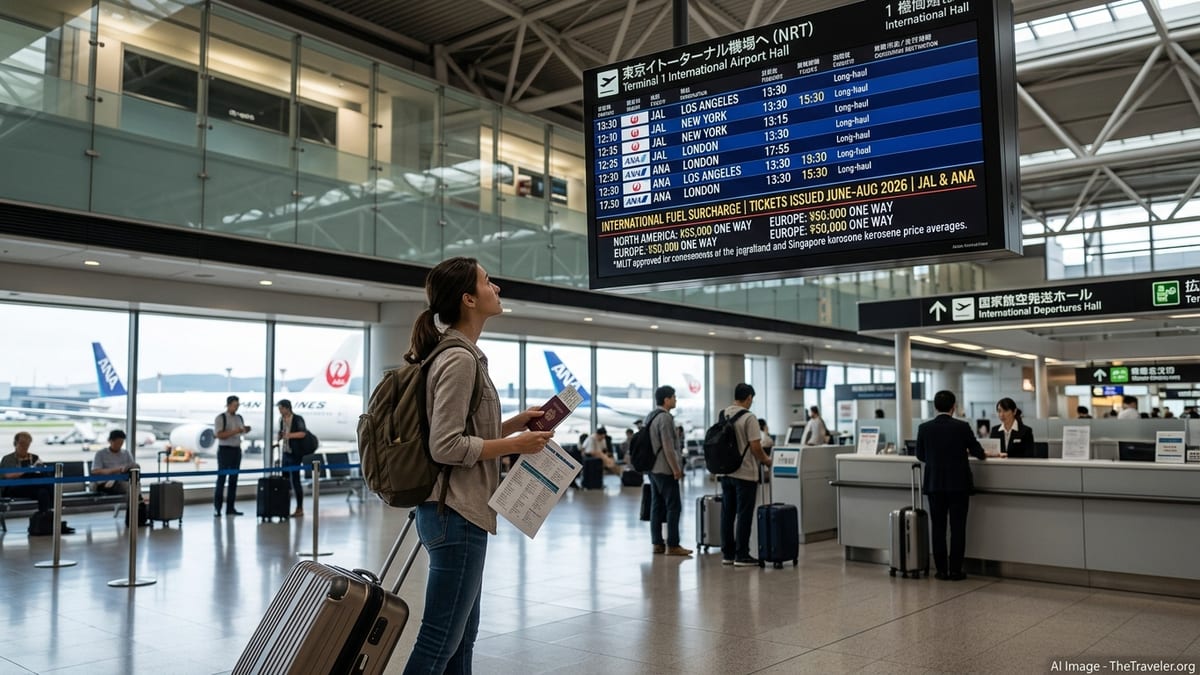
Coverage in early April 2026 from Japanese media, including the Japan Times and national TV news, reported that JAL and ANA would “up to double” their fuel surcharges on international flights for tickets issued from June, after the Iran war sent oil and jet fuel prices sharply higher. For short-haul markets such as Japan–South Korea or Vladivostok, reports noted surcharges rising from around 3,000 yen to roughly 6,000 yen one way, illustrating how the published tables translate fuel shocks directly into higher line-item charges.
On longer routes, televised explanations in April detailed much steeper increases for the June–July ticketing window, citing ANA’s surcharge for Japan–Europe and Japan–North America rising from about 31,900 yen to roughly 55,000 yen one way, and JAL’s from about 29,000 yen to around 50,000 yen. These examples represent jumps on the order of 21,000 to 23,000 yen per direction, driven by the February–March average of Singapore kerosene that fed into the June–July tables.
At the same time, JAL and ANA moved to raise the upper limits of their fuel surcharge tables so they could continue to publish higher bands if jet fuel climbed further. Cargo documents from both groups in 2026 show a parallel shift toward finer and more frequent indexing, moving from broader multi-month averages to shorter reference periods for Singapore kerosene so that surcharges, once approved, can respond more quickly to price volatility.
What Travelers Pay Today on Key Long-Haul Routes
The immediate effect for travelers booking winter 2026–27 holidays is that current surcharge tables for tickets issued in late 2026 already reflect this year’s elevated fuel prices. JAL’s latest international surcharge detail for tickets issued in October 2026 shows, for example, a one-way surcharge of 26,000 yen on Japan–Thailand, Malaysia, Singapore, Brunei and some Russia routes, significantly higher than pre-conflict levels and separate from the underlying fare and taxes.
For intercontinental routes such as Japan–North America or Japan–Europe, the April hikes mean that current passenger surcharges on JAL and ANA are now tens of thousands of yen per direction. Media reports around the June–July adjustment cited one-way surcharges in the 50,000 to 55,000 yen range on these long-haul markets after the increase, a scale that can rival discounted winter base fares on some dates. At an exchange rate near 150 yen to the U.S. dollar, a 50,000 yen surcharge alone equates to roughly 330 U.S. dollars for a single long-haul leg.
These fuel surcharges are charged per passenger and per flight segment. They are collected alongside airport fees and other taxes at the time of ticketing, which means a return trip between Japan and North America or Europe can easily carry fuel surcharges of 100,000 yen or more on top of the underlying airfare. The exact yen amounts for each region and issuance window are listed in the current JAL and ANA tables and can be higher or lower than the June–July examples depending on the most recent fuel averages.
Link to the Iran Conflict and Jet Fuel Prices
The timing of the June–July 2026 hikes directly followed the Iran war’s impact on global oil markets. Analysis from industry bodies and tourism economists earlier this year traced a sharp jump in crude prices after the Strait of Hormuz was disrupted, with jet fuel in Singapore reaching record or near-record levels relative to crude. IATA’s June 2026 outlook highlighted Singapore jet fuel briefly above 230 U.S. dollars per barrel, underscoring how the crisis pushed aviation-specific fuel far above earlier assumptions.
Japanese media explicitly linked JAL and ANA’s April surcharge announcements to this fuel shock. Reports noted that the higher caps and steeper bands were designed to pass through the increased cost of jet fuel into transparent, itemized charges rather than embed the entire impact in headline fares. Airline financial briefings in 2026 similarly cited higher Singapore kerosene prices and a weaker yen as major drivers of fuel expense, helping explain why Japanese carriers leaned heavily on surcharges once MLIT approved the revised tables.
While some airlines in Europe and North America offset part of the fuel spike through hedging, industry commentary has pointed out that many Asia-Pacific carriers, including in Japan, entered 2026 with more limited hedging coverage. That left them more exposed to spot jet fuel prices and increased the pressure to adjust surcharges frequently when the Iran conflict pushed jet fuel cracks higher.
What Winter Travelers Should Check Next
For travelers planning trips between Japan and North America or Europe over Christmas, New Year and early 2027, the key practical step is to consult the latest fuel surcharge tables published by JAL and ANA for the specific ticketing period. Because passenger surcharges are recalculated every two months using the most recent two-month Singapore kerosene averages, the exact yen amounts for December 2026 or January 2027 ticketing windows depend on fuel prices in the preceding months.
The April 2026 decision to nearly double intercontinental surcharges and raise table caps has already been priced into today’s long-haul tickets, so winter travelers should not assume a return to pre-conflict levels unless Singapore kerosene falls substantially and remains low long enough to shift the bands. At the same time, it is not possible to say that all winter 2026–27 flights will see further increases; any additional change will be determined by the kerosene averages that feed into future tables and by MLIT’s approval of any revisions proposed by the airlines.
Because the surcharge is a separate, published line item, prospective passengers can verify its size before booking by checking the current tables and comparing them with the base fare on their preferred dates. Closer to publication and booking, those planning Japan–U.S. or Japan–Europe trips should reconfirm the latest JAL and ANA charts so they understand how much of their winter ticket price reflects fuel surcharges that have been locked in under Japan’s transparent but highly sensitive fuel indexing system.