


More news on this day
A nationwide Federal Aviation Administration ground stop triggered by a telecommunications failure on Friday, November 13, 2026, halted most U.S. departures for several hours and set off days of rolling delays and cancellations that heavily affected Austin–Bergstrom International Airport (AUS) and other major hubs.
Get the latest news straight to your inbox!
What happened on November 13
According to the FAA and the U.S. Department of Transportation, intermittent telecommunications outages affecting communications and radar systems at multiple air traffic control centers led the agency to order a nationwide ground stop on the afternoon of November 13, 2026. The stop began shortly before 4 p.m. Eastern time and was lifted that evening, after roughly four and a half hours, once the network was stabilized and controllers could safely manage traffic again.
In a post-incident question-and-answer update, the FAA said operators canceled approximately 12,462 flights on November 13, including more than 9,000 cancellations by major airlines, as carriers chose to keep aircraft on the ground while the scope of the outage was assessed and recovery plans were put in place.
Federal officials have attributed the event to a telecommunications failure within the FAA’s network and said there is no evidence that the outage was caused by a cyberattack. A formal root-cause investigation is still under way, but regulators have reiterated that the ground stop was imposed out of what they describe as an abundance of caution to preserve safety while critical systems were unstable.
How disruptions cascaded through the weekend
Although the nationwide ground stop was lifted on the evening of November 13, the knock-on effects extended well into the weekend as aircraft and crews fell out of position and airlines worked to rebuild their schedules. Flight-tracking services reported that nearly 7,000 flights were delayed or canceled across the United States on November 13, and that more than 11,000 additional disruptions accumulated between November 14 and November 15 as the network recovered.
Many of these later disruptions were not the result of ongoing technical failures, but rather the operational challenges of restarting a tightly timed system after a sudden halt. Aircraft that ended the day in unexpected cities, crew members who had reached duty limits, and passengers needing reaccommodation all contributed to longer lines, missed connections, and rolling rebookings through Sunday.
Travelers heading into the traditional late-November peak were particularly affected. The ground stop and its aftermath struck less than two weeks before Thanksgiving, compressing already busy schedules and leaving some passengers competing for the remaining seats on alternative flights as airlines tried to absorb stranded travelers into subsequent departures.
Impact at Austin–Bergstrom and other local airports
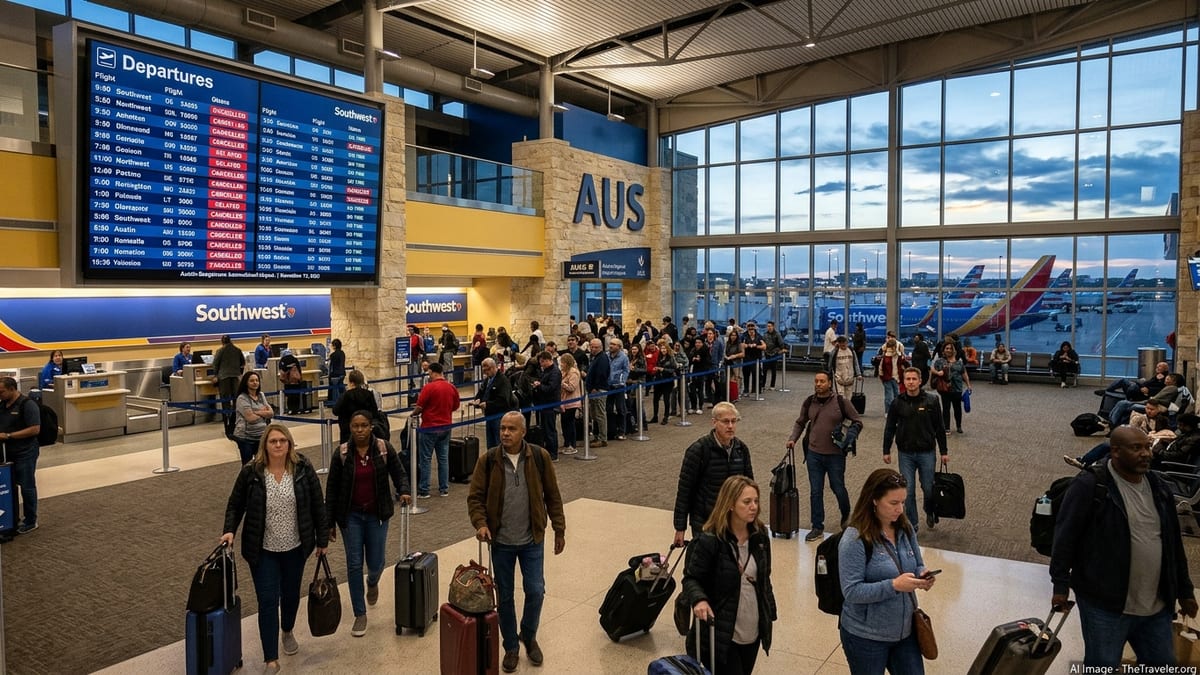
Austin–Bergstrom International Airport saw an outsized impact from the disruption. Local outlet FOX 7 Austin reported on Saturday evening, November 14, that AUS had recorded more than 150 delays and over 120 cancellations by that point in the weekend as airlines continued to adjust operations following the nationwide ground stop.
Coverage from Austin media described travelers facing repeated cancellations and rebookings, with some groups, including collegiate sports teams traveling through the region, remaining stranded overnight while they waited for available seats. Similar scenes played out at other mid-sized and major U.S. airports, where long queues formed at ticket counters and customer-service desks as passengers sought new routings.
By contrast, federal situation reports and live FAA traffic-management data for Thursday, November 19 indicate that system-wide conditions have largely normalized. At AUS, current FAA advisories point mainly to routine, weather-related arrival-management delays rather than ongoing effects from the telecommunications failure, suggesting that most of the operational fallout from the ground stop has now been worked through.
What travelers should do in future system outages
The November 13 ground stop underscores how quickly a single point of failure in air traffic control infrastructure can ripple through U.S. air travel. Even a several-hour halt to departures translated into thousands of cancellations on the first day and many thousands more delays and cancellations over the recovery period, particularly when it occurred close to a major holiday travel surge.
During similar events, travelers are unlikely to receive complete information from airport screens alone. The most reliable way to track an individual itinerary is to use airline mobile apps or websites for real-time flight status, gate changes, and rebooking options, and to monitor the FAA’s official flight-status portal for broader information about ground stops, arrival-management programs, and other traffic-management initiatives affecting specific airports.
For upcoming trips, passengers may want to build extra connection time into itineraries during busy seasons, keep essential items in carry-on bags in case of unplanned overnight stays, and confirm contact details with airlines so that rebooking notices arrive quickly. While regulators continue investigating the telecommunications failure and considering longer-term modernization steps, day-to-day resilience for travelers will continue to depend heavily on staying informed and acting quickly when large-scale system disruptions occur.