


More news on this day
Japan’s Meteorological Agency is warning that the first strong cold surge of the season from November 20 could bring heavy snow to Sea of Japan–side regions, raising short-notice disruption risks for road and rail travel in Hokuriku and parts of Tohoku just as the late‑November travel period begins.
Get the latest news straight to your inbox!
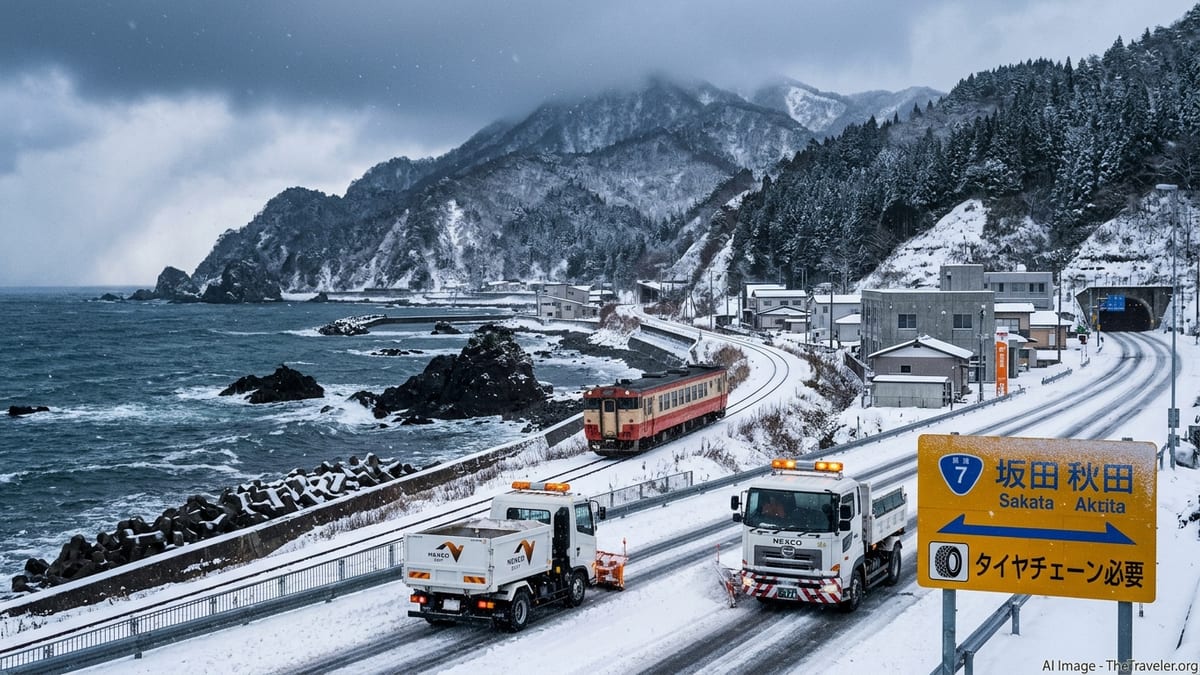
JMA Flags Early-Season Heavy Snow Along Sea of Japan Coast
In guidance issued this week, the Japan Meteorological Agency (JMA) forecasts a marked shift to a winter-type pressure pattern from Friday, November 20, as cold air spreads south over Japan. Short-term commentary and one-week outlooks indicate that areas facing the Sea of Japan, including Hokuriku and northern Tohoku, are likely to see periods of snow and rain, with snow dominance in higher elevations and inland zones.
Recent forecast discussion highlights a risk of heavy snow and snow accretion affecting transport on November 20 in northern regions, particularly where cold upper-air temperatures coincide with strong onshore flow. JMA-linked advisory maps on the morning of November 20 already showed numerous heavy snow advisories across Sea of Japan–side prefectures, including parts of Niigata and the broader Hokuriku belt. These advisories are below the highest-level “Emergency Warning” tier but still signal conditions that can quickly impair visibility and road surface safety.
Media summaries of JMA projections indicate that mountainous areas of Hokuriku and inland parts of Yamagata and Fukushima could see significant accumulations through November 21, while northern Tohoku prefectures such as Aomori and Akita are expected to alternate between rain, mixed precipitation and snow over a roughly three-day period. For lowland cities like Kanazawa, Niigata and Akita, the main concern is slushy roads, brief whiteout-like bursts in heavier showers, and rapid changes in travel conditions as temperatures fluctuate around freezing.
JR East: Local Lines Already Disrupted, Shinkansen Still Running
As of the morning of November 20, JR East’s official train status page shows that the Ōu Line between Mamurogawa and Yokobori in Yamagata Prefecture is temporarily suspended due to heavy snow, with no stated time for service to resume. The same page notes additional delays on other sections of the Ōu Line caused by fallen trees, underscoring how quickly early-season snow and wind can affect local infrastructure.
JR East has also issued advance notices that adverse weather on November 20 and 21 may cause delays or cancellations on selected conventional lines, including services in northern Tohoku. Separate operational bulletins outline planned suspensions on some Niigata-area lines because of forecast strong winds on November 20. At the time of writing, Shinkansen routes referenced on JR East’s English-language information portal, including Tohoku, Joetsu, Hokuriku, Yamagata and Akita Shinkansen, remain generally operational, with no wide-scale shutdown reported.
For travelers, the practical impact is most acute on local and regional trains that feed into Shinkansen hubs. Day-trippers heading from Sendai, Akita or Niigata into mountain or onsen towns should be prepared for partial cancellations, slower running speeds and possible gaps in service even when bullet trains are still departing broadly on time. Replacement bus transport is not guaranteed on weather-affected rural sections, and JR East’s current notices for the Ōu Line specify that no substitute transportation is being arranged on the suspended segment.
Expressway Operators Warn of Possible Closures in Hokuriku and Niigata
On the roads, a joint notice from the Hokuriku Regional Development Bureau, transport authorities and expressway operators including NEXCO East and NEXCO Central, issued on November 19, warns that snowfall and accumulation are expected in Hokuriku from November 20 to 22. The advisory highlights the potential for preventative closures on expressways and urges drivers to adjust travel plans if heavy snow develops, particularly in mountainous stretches.
NEXCO East’s public information channels for Niigata and surrounding areas show that operators are already managing incidents and short-term closures unrelated to the latest snowfall, and they routinely caution that when abnormal snow is forecast, sections of expressway can be closed in advance to prevent large-scale vehicle strandings. In heavy-snow belts, national highways running parallel to the expressways, as well as local roads, can also be closed simultaneously when visibility drops and accumulation builds, limiting detour options.
Travelers planning to drive rental cars between Niigata, Toyama, Kanazawa and inland resort areas over the November 20 to 22 window should expect winter conditions to appear with little lead time, particularly at higher elevations. Japanese road authorities stress the use of winter tires or snow chains where required; non-winter-equipped vehicles may be denied access to some expressway sections or be unable to proceed safely on local roads if snow intensifies.
What Late-November Travelers Should Do Now
For visitors heading to Hokuriku, Tohoku or nearby mountain regions in the coming days, the current situation is a forecast-driven alert rather than a nationwide shutdown. However, the combination of JMA heavy snow advisories, an early-season cold surge and already disrupted local rail segments indicates elevated risk of short-notice changes through the weekend of November 20 to 22.
Travel planners should build extra time into itineraries that rely on conventional JR lines in northern Honshu, particularly routes serving inland Yamagata and Akita, side branches from Niigata, and lines crossing mountain passes. On the day of travel, it is prudent to check JR East’s live train information for both Shinkansen and local services, confirm whether any segments are suspended or operating with significant delays, and hold flexible seat reservations where possible.
Drivers should monitor NEXCO East and other expressway operators’ real-time traffic and closure updates, and confirm that their rental car is fitted with appropriate winter equipment before departure. Because Japan’s national tourism information highlights JMA “Emergency Warnings” for snowstorms or heavy snow as the highest alert tier, travelers should also keep an eye on the latest JMA warnings and advisories for their specific prefectures. Over the next 48 to 72 hours, the key questions for travelers are whether additional local lines join the Ōu Line in suspension, whether warning-level snowfall materializes in mountain belts, and whether expressway closures in Hokuriku and Niigata become more widespread as the cold surge peaks.