


More news on this day
VIA Rail is actively studying how passenger trains could return to Quebec’s long‑silent Gaspésie line once a nearly CA$870 million provincial rehabilitation is finished, a potential shift that would reopen car‑free access to one of eastern Canada’s most scenic coastal regions but that still lacks firm dates, timetables or fares.
Get the latest news straight to your inbox!
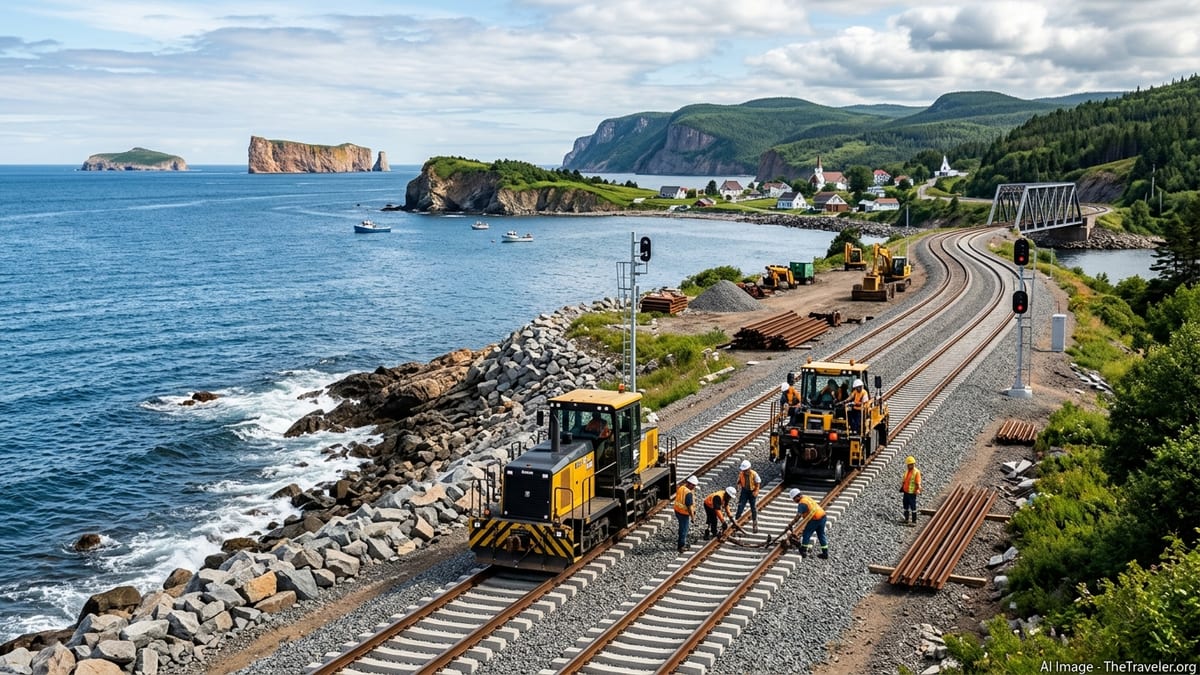
Quebec’s CA$870 million railway rebuild enters its final stretch
The Gaspésie rail project is a multi‑year effort by Quebec to restore the 325‑kilometre line between Matapédia and Gaspé for both freight and future passenger use. The province confirmed in June 2023 that it would invest more than CA$870 million to rehabilitate the corridor in three segments, with the political objective of seeing rail service reach Gaspé again once works are complete.
According to the latest project summary from Quebec’s transport ministry, major rehabilitation works on the central Caplan to Port‑Daniel–Gascons section were completed in December 2025, while work continues on other parts of the line, including structures near Gaspé. The province describes the goal as enabling the “resumption of passenger and freight service between Matapédia and Gaspé,” but no operational restart date has been confirmed and timelines are being adjusted as construction progresses.
The rehabilitation includes track renewal, bridge and culvert work and stabilization in areas exposed to coastal erosion or unstable rock faces. Until those safety‑critical elements are finished and certified, the line remains closed to regular passenger traffic even as pressure builds locally to see trains return.
Fifteen years without VIA Rail east of Matapédia
VIA Rail’s former Montréal–Gaspé service, branded as the Chaleur in its later years, last served Gaspé in December 2011 before deteriorating infrastructure led to a series of cutbacks. By August 2013 VIA formally suspended service between Matapédia, New Carlisle and Gaspé, leaving the Ocean as the only VIA train on the shared main line between Montréal and Matapédia.
Since then, only intermittent, funding‑dependent tourist operations by the Société du chemin de fer de la Gaspésie have run over portions of the route, while most leisure travelers have relied on cars, regional buses and limited air links. VIA’s current long‑distance services from Montréal and Québec City reach Matapédia and then continue into New Brunswick, with no scheduled passenger trains onward along the south shore of the Gaspé Peninsula.
The absence of through rail service has been particularly conspicuous in a region that markets multi‑day coastal road trips and national park access. Without a passenger train, visitors who prefer not to drive face longer coach journeys or complex combinations of train and bus to reach destinations such as Percé or Forillon National Park.
VIA Rail studies options but sets no launch date
Local media, rail advocacy groups and questions at VIA Rail’s 2025 and 2026 annual public meetings indicate that the operator has confirmed it is “studying options” for restoring passenger service tied to Quebec’s rehabilitation program. Those options reportedly include at least two concepts: resuming a regular intercity connection from the existing network to the Gaspé Peninsula and exploring a seasonal tourist‑oriented train branded around the region’s coastal scenery.
To date, VIA has not published any formal service plan, schedule, rolling‑stock assignment or fare structure for a revived Gaspésie route. Any new operation would depend on the provincial government handing over a line that is certified for passenger speeds and on securing the necessary federal funding and internal fleet capacity. References by advocates and politicians to potential start windows remain expectations rather than commitments.
VIA’s core Québec corridor trains between Montréal and Québec City, which already run multiple times per day, are unaffected by the Gaspésie file. The planning under way concerns only the long‑suspended branch east of Matapédia and how, if at all, it might be reintegrated into the national passenger rail network as infrastructure comes back into service.
Tourism recovery strengthens the case for rail access
The reopening of the Gaspésie line is unfolding against a wider tourism rebound in Canada. Statistics Canada and Destination Canada estimate that visitors generated on the order of CA$130 billion in direct tourism revenue in 2024, with roughly 19.9 million international arrivals helping the sector surpass its pre‑pandemic spending levels. Early 2025 data show tourism remaining one of the country’s faster‑growing service industries.
For Quebec and the Gaspé Peninsula, a restored passenger line would not, on its own, transform Canada’s national tourism profile, but it could meaningfully change how a specific coastal region is accessed. Regional tourism authorities currently highlight road trips as the primary way to explore Gaspésie, with train travel only getting visitors as far as Matapédia before they transfer to buses or rental cars. A through rail option could appeal to domestic travelers from Montréal and Québec City as well as to overseas visitors looking for lower‑carbon or car‑free itineraries.
Any dedicated tourist train concept that VIA or local partners might pursue would be layering onto this broader recovery rather than creating it. The concrete benefit for travelers would be an additional, more comfortable long‑distance mode to reach coastal villages and park gateways, provided the service is scheduled at daylight hours that make the scenery and connections practical.
What travelers should watch next
Until Quebec’s rehabilitation is complete and safety approvals are in place, travelers should assume that no VIA Rail services operate east of Matapédia and that reaching most of Gaspésie still requires road or bus travel beyond the existing rail terminus. Prospective visitors can currently use VIA’s Ocean and other corridor trains to reach Mont‑Joli, Amqui and Matapédia, then continue by coach to their final destinations.
The key signposts for a future rail‑based vacation option will be updated bulletins from Quebec’s transport ministry on construction milestones, followed by any formal timetable publications or service notices from VIA Rail announcing the return of passenger operations on the Matapédia–Gaspé line. Separate announcements from the Société du chemin de fer de la Gaspésie or regional tourism boards would signal if a distinct seasonal tourist train product, with its own booking calendar, is being created alongside or instead of regular scheduled service.
Until those concrete steps appear, the Gaspésie line remains a promising case study in how infrastructure investment and tourism demand can align, but not yet a bookable vacation train. Travelers interested in being among the first passengers back to the Peninsula should monitor official channels for dated statements on opening segments, frequencies and ticket sales before making firm rail‑dependent plans.