


More news on this day
Kazakhstan’s flag carrier Air Astana is sharpening its focus on comfort in the economy cabin, positioning its Economy Sleeper product as part of a wider strategy to capture long-haul transit traffic and align with a global shift toward premium leisure travel.
Get the latest news straight to your inbox!
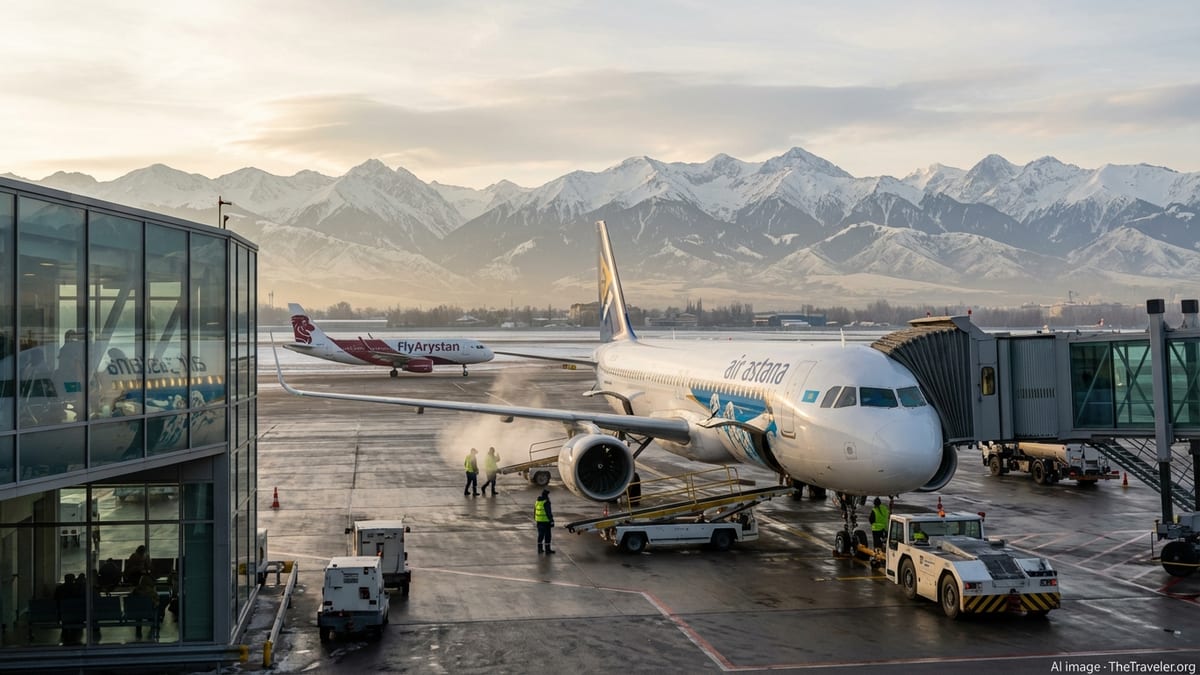
Economy Sleeper Aligned With Global Premium Economy Boom
Across the world, airlines are investing in products that bridge the gap between standard economy and business class, as travelers show a growing willingness to pay more for comfort on long sectors. Industry data and recent fleet strategies indicate that premium economy and enhanced economy products are among the fastest-growing cabin segments, particularly on routes of six hours or longer. Air Astana’s Economy Sleeper concept, which combines a standard economy seat with a blocked adjacent seat and added bedding, fits squarely into this trend.
Publicly available airline information shows that Economy Sleeper is offered on selected long-haul services where Air Astana deploys widebody or longer-range narrowbody aircraft, such as routes linking Almaty and Astana with major European and Asian gateways. Rather than introducing a fully separate cabin, the airline uses a flexible cabin-management model that allows it to convert sections of the economy cabin into sleeper spaces when demand justifies the higher-yield product.
This approach reflects broader market experimentation, as carriers test different ways to monetize space without committing to large-scale cabin refits. By enhancing privacy and the ability to lie flat within the footprint of standard economy seating, Air Astana is targeting travelers who are price-sensitive but still prioritise rest on overnight flights.
The product also taps into a post-pandemic shift in passenger expectations, with travelers increasingly comparing the entire journey experience, including sleep quality and personal space, when choosing between competing hubs. For Kazakhstan, that presents an opportunity to distinguish itself from larger rivals in the Gulf and Europe.
Kazakhstan’s Aviation Growth Sets the Stage
Air Astana’s focus on upgraded economy comfort comes as Kazakhstan accelerates expansion of its aviation sector. Government transport plans and recent reporting highlight ambitious targets to increase the national aircraft fleet and broaden international connectivity by the end of this decade, supported by airport upgrades in key cities such as Almaty and Astana.
Air Astana and its low-cost subsidiary FlyArystan have reported steady passenger growth and rising international market share in recent years, helped by liberalization of air access and new route rights. Financial and operational updates for 2024 and 2025 point to double-digit increases in capacity and traffic, underpinned by new aircraft deliveries and a streamlined fleet focused on Airbus A320-family jets and Boeing 767s, with long-term plans to introduce Boeing 787s and a significant tranche of additional A320neo-family aircraft.
The group’s network strategy increasingly targets sixth-freedom traffic, funnelling passengers between Europe, Asia, India, China and the Gulf through hubs in Kazakhstan. Reports on first-half 2025 performance describe strong growth in connecting flows, aided by new services to cities in China, India and Southeast Asia. Products such as Economy Sleeper are designed to support that connecting role by improving the appeal of overnight and ultra-long sectors that make up these flows.
At the national level, this dovetails with efforts to promote Kazakhstan as a more prominent player on trans-Eurasian routes. Infrastructure investments, new terminal capacity and the arrival of more foreign carriers are gradually putting the country on the map for travelers who might once have defaulted to hubs in Istanbul, Doha or Dubai.
Network Expansion Increases Sleeper Opportunities
Recent route announcements illustrate how Air Astana’s evolving network could widen the use of Economy Sleeper. Over the past 18 to 24 months, the airline has launched or planned additional services to destinations such as Guangzhou, Kuala Lumpur and new points in India and Saudi Arabia, while preparing to add Tokyo to the map from 2026. Industry coverage notes that several Airbus A321LR aircraft have been modified with auxiliary fuel tanks to support longer sectors from Kazakhstan into Europe and Asia.
These longer-range narrowbodies create more city pairs where an enhanced sleep option in economy becomes relevant, particularly on night flights with block times of six to nine hours. Air Astana has already used its A321LRs to extend routes such as Almaty to London and Frankfurt, and Astana to leisure destinations including Phuket and Nha Trang. As the airline takes additional A320neo-family aircraft and eventually transitions widebody flying to next-generation 787s, the cabin layout choices on those jets are expected to determine how widely Economy Sleeper can be deployed.
Investor and fleet-planning materials suggest that Air Astana wants to balance density with yield, using flexible premium products within the economy cabin to lift revenue without eroding the value of its business class. Economy Sleeper provides one such lever, allowing the airline to adjust the number of sleeper rows based on advance bookings and seasonal demand.
The strategy also offers a hedge against volatility. If premium demand weakens on a specific route or during off-peak periods, the carrier can revert those seats to standard economy, maintaining competitive fares while still providing a distinctive comfort option on busier departures.
Competing for Transit Traffic in Central Asia
Central Asia has become a more contested aviation region as foreign airlines ramp up services and local carriers pursue growth. Reports from regional media highlight the arrival of new low-cost and full-service entrants from the Middle East, India and East Asia into Kazakhstan’s main gateways in 2024 and 2025. Against that backdrop, Air Astana is leveraging both schedule connectivity and product differentiation to retain its leading role.
Transit traffic is a particular focus. Published analyses of the group’s performance in 2025 describe a sharp increase in passengers using Kazakhstan as a one-stop option between secondary cities in Europe and Asia, often choosing Almaty or Astana over more congested hubs. Products like Economy Sleeper are marketed to these travelers as part of a seamless transfer experience, with coordinated connection windows and through-checked baggage.
As other airlines in the region invest in premium economy cabins or introduce similar sleeper concepts in economy, competition for high-yield leisure and small-business segments is likely to intensify. However, Air Astana’s position as the dominant home carrier and its growing network breadth give it an advantage in tailoring offerings for specific origin-and-destination markets across Central Asia, the Caucasus and beyond.
For Kazakhstan’s tourism ambitions, improved comfort on long-haul services can also play a role in encouraging more visitors to explore the country rather than simply transiting. Travel industry observers note that better rest and cabin comfort often translate into higher satisfaction scores and a greater likelihood of travelers adding stopovers or side trips on repeat journeys.
What Travelers Can Expect Next
For passengers, the most visible aspect of Air Astana’s comfort strategy remains the experience on board. Economy Sleeper typically includes additional soft furnishings, upgraded pillows and blankets, and a structured arrangement of two or three adjacent seats that form a flat or near-flat surface. Travelers booking the product can expect more space than in a standard economy seat, along with priority treatment in certain airport processes where available.
Looking ahead, the airline’s public communications and financial disclosures point toward further fleet renewal, digital upgrades and refinements to in-flight entertainment and connectivity. In 2025, Air Astana introduced an updated entertainment interface and expanded mobile app functionality, developments that suggest any future evolution of Economy Sleeper will be integrated into a more personalized digital journey, from booking through to arrival.
As new aircraft join the fleet and longer-haul routes come online, industry analysts anticipate that the carrier will continue testing variations of its economy sleeper model, potentially adjusting pricing, seat allocation and included services in response to demand. That mirrors a global pattern, as airlines worldwide search for ways to package space and comfort in increasingly granular ways.
For Kazakhstan, the stakes go beyond one airline product. Air Astana’s Economy Sleeper has become part of a broader aviation narrative in which the country seeks to ride a global trend toward more comfortable economy travel while reinforcing its own status as a rising hub between Europe and Asia.