


More news on this day
Kazakhstan is rapidly scaling up its aviation ambitions, combining early commitments to sustainable aviation fuel, new airport infrastructure and tighter alignment with global standards to compete for growing Eurasian air traffic.
Get the latest news straight to your inbox!
Early mover on sustainable aviation fuels
Kazakhstan has emerged as one of the first states in its region to formalize a national approach to sustainable aviation fuel, aiming to reduce the sector’s carbon footprint while safeguarding its role as a transit hub. Publicly available information shows that in May 2024 the country joined the International Civil Aviation Organization’s Assistance, Capacity-building and Training program for Sustainable Aviation Fuels, signaling an intention to build policy, technical expertise and market frameworks around SAF production and use.
Alongside the regulatory work, domestic energy and agribusiness groups are laying the groundwork for local SAF manufacturing. Press materials from Kazakh fuel and agro-industrial companies describe a multi-stage plan to convert bioethanol feedstocks into jet-grade SAF, backed by a preliminary feasibility study completed in 2024 and a full study expected by 2025. Industry analysts view this as a bid not only to decarbonize domestic airlines, but also to turn Kazakhstan into a regional supplier for carriers transiting Central Asia.
The SAF agenda is closely linked to broader climate and trade goals. By establishing a domestic low-carbon fuel chain, Kazakhstan is positioning its aviation sector to respond to future environmental regulations on routes to the European Union, Gulf states and East Asia, where SAF blending mandates and carbon pricing are tightening. For international airlines weighing refueling options along trans-Eurasian corridors, reliable access to certified SAF could become a differentiator for Kazakh airports over competing hubs.
Airport expansion reshapes Kazakhstan’s hub map
New terminal and airfield investments are transforming Kazakhstan’s main gateways into higher-capacity hubs designed to handle rising transfer traffic. At Almaty International Airport, which remains the country’s busiest, a new terminal showcased in mid-2024 added significant check-in, security and boarding capacity, including what reports describe as one of Central Asia’s largest duty-free zones. The expanded layout is intended to ease peak congestion and improve connections between international and domestic flights serving Central Asia, the Caucasus and western China.
Astana’s Nursultan Nazarbayev International Airport is also seeing upgrades that focus on efficiency and safety. Air navigation organizations report that advanced air traffic management systems supplied by global technology providers have been deployed at both Astana and Almaty, improving surveillance, approach procedures and runway throughput. These systems bring the country’s two main hubs closer to practices used in major European and Gulf airports, an important factor for airlines planning denser schedules and winter operations.
Regional airports are beginning to follow a similar trajectory, as authorities seek to spread traffic beyond the two main cities. Planning documents outline runway, taxiway and terminal upgrades in secondary hubs intended to support low-cost carriers and new point-to-point routes. For travelers, this is gradually replacing Soviet-era infrastructure with facilities more aligned to modern service expectations, while for airlines it opens opportunities to base aircraft and crews closer to emerging demand.
Fleet renewal and route growth underpin traffic ambitions
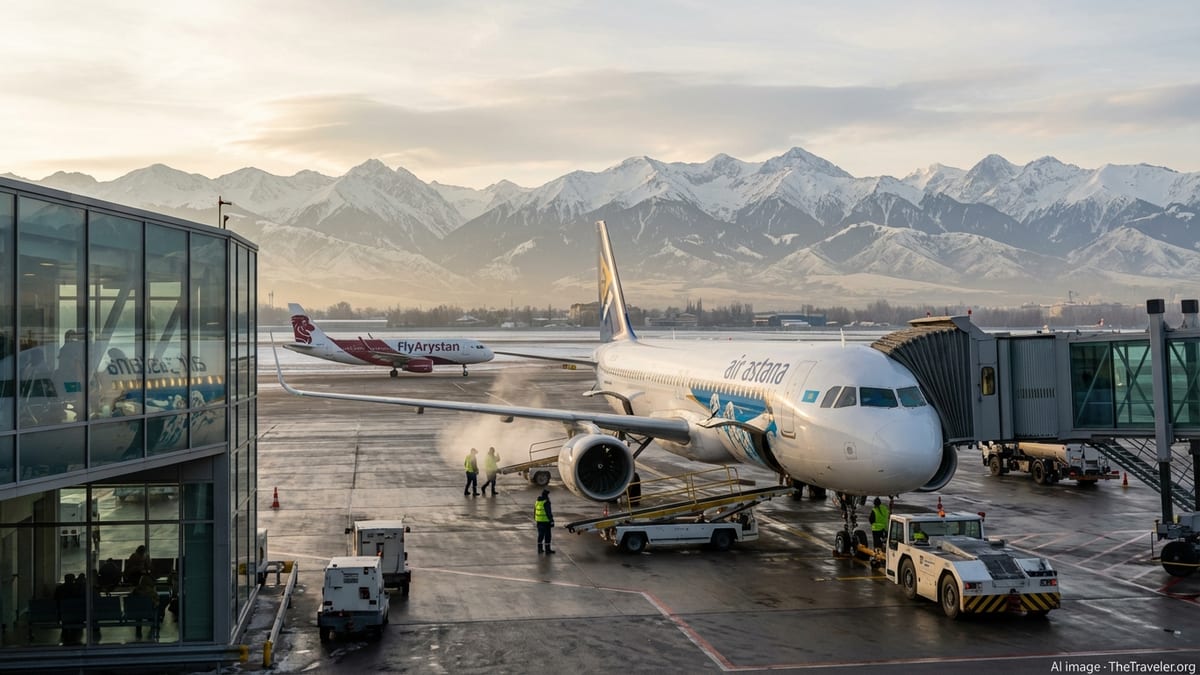
The growth of Kazakhstan’s flag carrier group is central to the country’s aviation strategy. Air Astana and its low-cost affiliate FlyArystan have been expanding and modernizing their fleets with new-generation Airbus single-aisle aircraft, while phasing out older regional jets. Company filings and specialist aviation coverage indicate that by 2024 the group had taken delivery of additional A320neo and A321LR aircraft and brought forward the retirement of Embraer E2 jets as part of a fleet simplification drive.
In early 2026, shareholders approved a major order for 25 Airbus A320neo and A321neo aircraft with purchase rights for 25 more, stretching potential deliveries into the next decade. The group has also signed leasing deals for seven A321neo LR aircraft, with deliveries scheduled from 2026 to 2028, and has committed to a long-term program for up to 18 Boeing 787-9 Dreamliners to replace older 767s and expand long-haul services. Aviation analysts note that this orderbook would lift the fleet toward 80 aircraft by around 2028, giving the carrier group the scale to pursue more intercontinental routes.
Network plans are evolving alongside fleet changes. Recent years have seen expanded services linking Kazakhstan to Europe, the Middle East, South Asia and East Asia, underpinned by new codeshare agreements with major Asian and Indian airlines. These partnerships extend the reach of Kazakhstan’s hubs into large origin and destination markets, while also channeling transfer traffic through Almaty and Astana on routes between Europe and Asia. As long-haul aircraft arrive, industry observers expect the country to target new destinations in North America and deepen frequencies on existing trunk routes.
Raising safety and service to global standards
Efforts to compete as a hub rely heavily on perceptions of safety and service quality. According to airline rankings and independent audit frameworks, Kazakhstan’s leading carriers have spent the past decade aligning operations with European Union Aviation Safety Agency and International Air Transport Association standards. Air Astana has consistently reported strong results in international safety audits and has received regional awards for service quality, helping shift perceptions of Central Asian aviation among global travelers.
Regulatory reforms have progressed in parallel. Public documentation from Kazakhstan’s Civil Aviation Committee indicates a sustained focus on harmonizing national regulations with International Civil Aviation Organization standards, strengthening oversight of airlines, airports and air navigation services. Participation in ICAO initiatives on SAF and environmental performance also ties Kazakhstan more closely into global reporting and compliance systems that large network carriers monitor when deciding on new destinations and partnerships.
Service levels on the ground are also being brought into line with international benchmarks as new infrastructure opens. The latest terminals at Almaty and Astana incorporate centralized security, expanded premium and family facilities, and upgraded baggage systems that shorten connection times. For travelers connecting between long-haul and regional services, these changes are intended to create a smoother experience that can compete with established hubs in the Gulf and Europe.
Balancing rapid growth with sustainability challenges
The scale of Kazakhstan’s aviation buildup presents a series of sustainability and execution challenges. Global studies on SAF emphasize that worldwide production remains far below projected demand trajectories, and Kazakhstan’s own SAF projects are still moving through feasibility and investment stages. Analysts caution that translating early agreements and pilot plants into large-scale, cost-competitive output will require long-term policy stability, coordination between agriculture and energy sectors, and access to international climate finance.
There are also questions about infrastructure pacing. While major terminals and navigation systems are coming online, passenger numbers across Central Asia are highly sensitive to macroeconomic shifts, currency volatility and geopolitical tensions that can disrupt transit flows. Overbuilding capacity could strain airport finances if traffic falls short of projections, while underinvestment in regional connectivity may limit the benefits of hub development to a few core routes.
Despite these risks, industry reports generally frame Kazakhstan’s aviation strategy as an attempt to seize a time-limited opportunity created by shifting global air corridors and decarbonization pressures. If SAF projects reach commercial scale, airport upgrades stay on schedule and safety oversight keeps pace with growth, the country’s hubs could capture a larger share of east west and north south traffic. That prospect is helping to sustain investor interest and regional competition as airlines and airports race to define the next generation of Eurasian gateways.