


More news on this day
Konya is quietly redrawing its city map as new tram extensions, digital navigation tools and smart-city projects change how residents and visitors move through the Central Anatolian hub.
Get the latest news straight to your inbox!
A Historic Core Encircled by Modern Mobility
Konya’s contemporary city map is anchored by its historic core around Alaaddin Hill, where remnants of the old citadel once ringed the settlement that grew into today’s metropolis. Modern maps still treat this elevated park and the surrounding streets as the reference point for orientation in the urban area.
Publicly available information shows that the wider metropolitan province now counts more than two million residents, with the urban population concentrated in the central districts of Selçuklu, Karatay and Meram. On most transit and tourism maps, this tri-district area appears as a continuous, fan-shaped city spreading north and east from the historic center.
City-scale cartography highlights a pattern common to many fast-growing Anatolian cities: a dense historic core threaded with narrow streets, surrounded by newer neighborhoods laid out on a more rectilinear grid. For visitors, the practical effect is that a stroll around Mevlana Museum or the bazaar feels compact and walkable, while reaching universities, hospitals and industrial zones quickly shifts the experience to broad avenues and long tram or bus corridors.
Konya’s climate and relative flatness have also shaped its maps. The city stretches out across the Konya Plain rather than climbing steep hillsides, so distance on a map often translates directly to distance on the ground. This encourages a heavier reliance on surface transportation such as trams, buses and bicycles, all of which now appear prominently in official and third-party mapping tools.
Tram Lines as the New Spine of the City Map
On most contemporary city maps, Konya’s tram network forms a clear north–south and east–west spine that simplifies orientation for newcomers. The backbone is Line 1, linking Alaaddin in the city center with Selçuk University and northern suburbs, and intersecting key hubs such as the bus terminal and high-speed rail station along its 40-kilometer reach.
Line 2, running between Alaaddin and the courthouse district, adds an east–west cross-axis that reinforces Alaaddin Square as the primary node. Diagrams produced by transport and mapping projects place Alaaddin at the center of a spoke-like system, where tram stops, major bus routes and pedestrian streets converge within a short walk of historic attractions.
Recent transport planning documents and local coverage describe additional tram projects that will further redraw Konya’s mobility map. New lines toward the city hospital, stadium and industrial areas are planned under a 2030 transport master plan, and tender announcements in 2025 signaled that construction on some sections has begun. As these corridors are completed, schematic maps are expected to shift from a simple T-shaped tram diagram to a more complex network.
For travelers, the immediate impact is that reading Konya’s city map increasingly starts with the tram lines. Hotel listings, student guides and digital travel blogs now routinely position destinations in terms of their nearest tram stop, while printed tourist maps tend to highlight Line 1 and Line 2 in contrasting colors against a paler street grid.
Digital Mapping, Smart-City Projects and New Wayfinding Tools
Konya has become a test bed for smart-city initiatives that feed directly into how its urban layout is visualized. Municipal and academic projects have produced land-use maps, transport accessibility diagrams and digital tourism maps that combine heritage sites, green spaces and public transport on a single interface.
One recent study framed Konya’s city map as a platform for a “digital travel map” integrating cultural hotspots, public transit and user-friendly design. The resulting prototypes emphasize layered information, allowing users to toggle between tram routes, walking paths in the historic core and services such as hospitals and universities.
Universities in Konya have also updated their own campus maps to reflect the current tram routes. A 2025 student guide for Necmettin Erbakan University, for example, presents orientation tables that link travel times between the city center, campuses and neighborhoods by tram, bus or taxi. This approach effectively embeds the city transport network into academic cartography and mirrors how daily life actually unfolds across the map.
These efforts are complemented by the city’s broader sustainable transport agenda. Reports on Konya’s rail and bicycle initiatives point to ambitions to make tram stops, bike lanes and pedestrian areas legible on a single, coherent map. Such integration is intended to help residents switch more easily between modes while giving visitors a straightforward visual guide to low-carbon travel options.
Tourism, Story Maps and the Visitor’s View of Konya
Beyond technical diagrams, new forms of storytelling are changing how Konya appears on the mental map of visitors. Digital “story maps” created by local cartographers and enthusiasts now plot dozens of touristic sites across the city, pairing images and descriptions with geolocated points on an interactive base map.
These narrative-driven maps often start from well-known landmarks such as Mevlana Museum, Alaaddin Hill and Sille, then extend outward along tram and road corridors to lesser-known mosques, museums and parks. For travelers, this format turns Konya’s map into an itinerary builder, highlighting how a day trip can move from the historic center to outlying districts without a private car.
Travel guides for remote workers and long-stay visitors also emphasize the tram as the organizing element of the city’s spatial experience. Accounts describe Line 1 as the workhorse route connecting the central Alaaddin stop to the university area, while calling attention to Konya’s reputation as one of Turkey’s more bicycle-friendly cities. Together, these narratives reinforce a picture of Konya where rail lines and bike routes are as central to orientation as main boulevards.
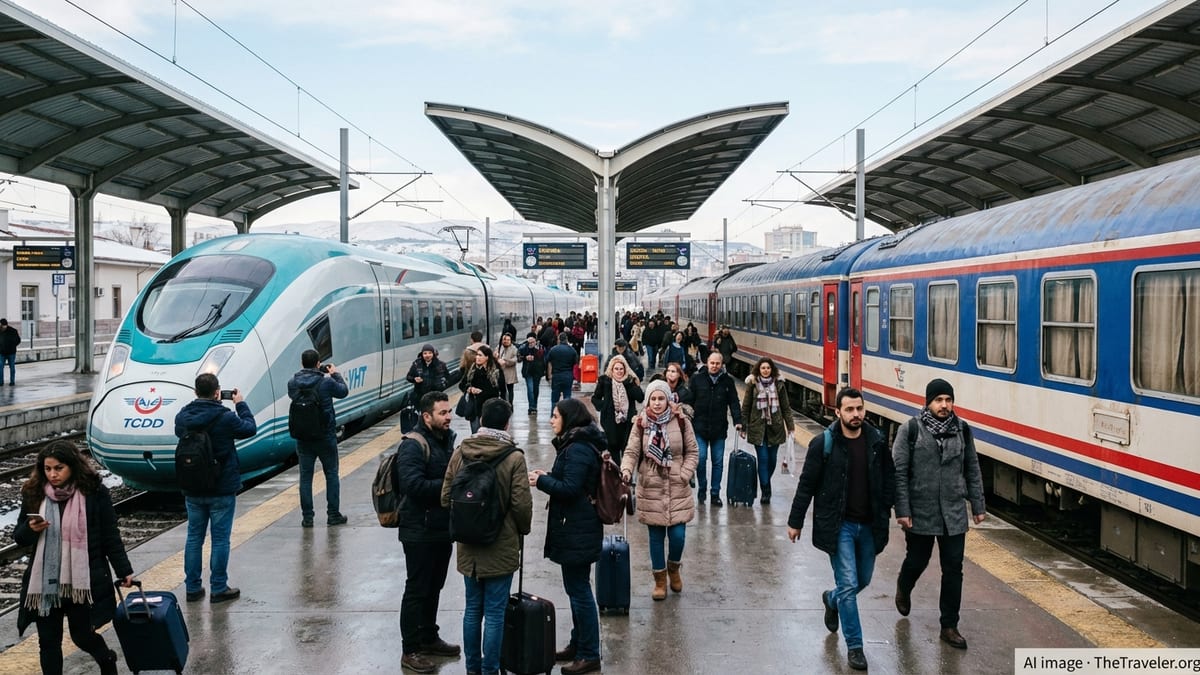
Printed tourist maps have begun to reflect these priorities by giving more visual weight to public transport stops, bike-friendly streets and pedestrianized squares. For first-time visitors arriving by high-speed train or intercity bus, the transition from station concourse to city map is increasingly framed around how to reach Alaaddin and the surrounding historic zone using trams and connecting services.
Future Rail Projects Poised to Redraw the Map Again
Planned rail projects suggest that Konya’s city map will continue to evolve over the coming decade. Public documents on the Konya Metro indicate that the first rapid transit line, now under construction, is scheduled to run across key urban corridors with more than twenty stations once completed.
Parallel efforts to expand the tram network toward the city hospital, new industrial zones and stadium are described in municipal project briefs and local reporting as among the largest rail investments in the city’s history. Groundbreaking ceremonies for certain segments in 2025 signaled a shift from planning to implementation, and early route diagrams show how the new lines will intersect with the existing Alaaddin-centered system.
Urban planning analyses argue that these additions could rebalance movement patterns across the metropolitan area by offering high-capacity routes that do not require a transfer through the traditional core. On future city maps, this could translate into multiple strong nodes, with the hospital district, industrial zones and university campuses gaining prominence alongside the long-dominant center.
For travelers studying a Konya city map today, these projects may appear as dotted or proposed lines. Yet as construction progresses, the city’s cartography is likely to become more polycentric, depicting a rail-and-road network that extends well beyond the familiar ring around Alaaddin Hill and reshapes how the Central Anatolian hub is navigated.