


Korčula’s old town is one of the Adriatic’s most atmospheric small walled cities, a compact peninsula of honey-coloured stone, stepped alleys, tiled roofs and constant sea views. Often compared to a pocket-sized Dubrovnik, it combines Gothic-Renaissance architecture, Venetian history and relaxed island life. This guide focuses on how to experience Korčula’s medieval streets, St. Mark’s Cathedral, Marco Polo sites, viewpoints, swimming spots, restaurants and the best walking route through the old town.
Get the latest updates straight to your inbox!
Understanding Korčula Old Town’s Medieval Layout
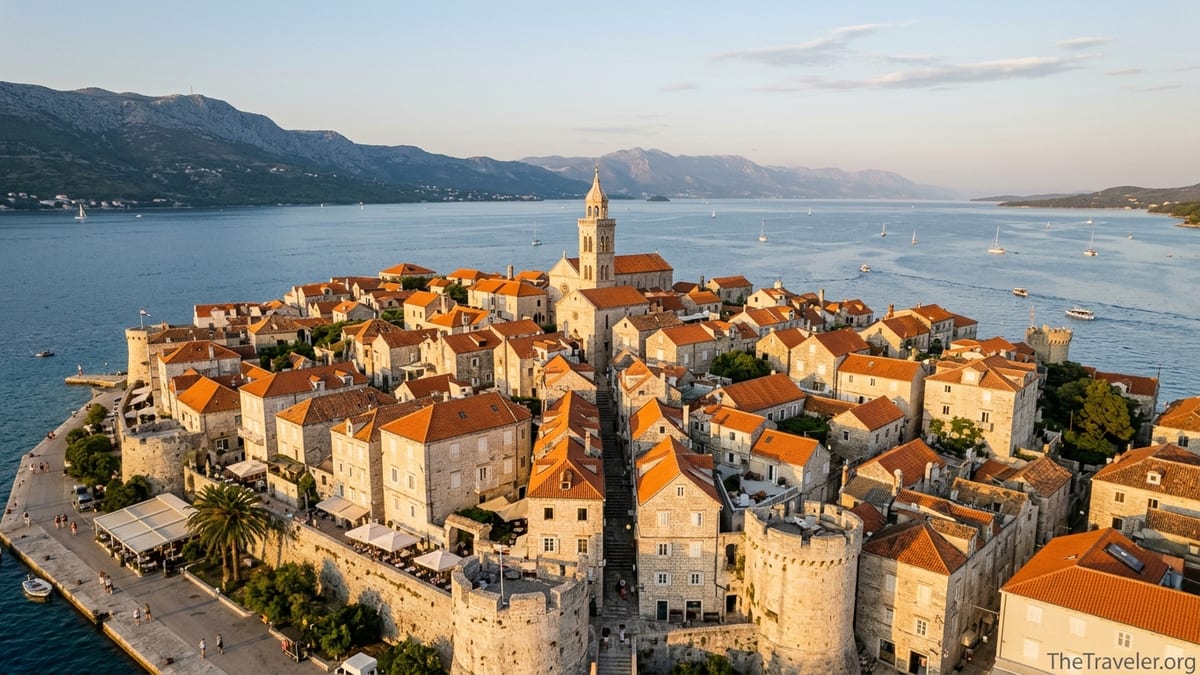
Korčula’s old town sits on a tiny oval peninsula, wrapped in defensive walls and towers, with a grid of narrow lanes running off a central spine. The city plan is famously herringbone-shaped, designed so that side streets either catch or block the prevailing winds, giving shade in summer and shelter in winter. Visitors notice how most streets are stepped, climbing gently toward the ridge, while a single lane along the southeastern wall remains flat, originally to help carts and supplies move through the town.
The walls and towers you see today were largely shaped during centuries of Venetian rule. The Land Gate is set in a crenellated tower called Veliki Revelin, topped by a Venetian lion carved above the arch. Inside, stone coats of arms and dates carved in lintels hint at noble families and long-ago town statutes that once regulated life here. The compact footprint means you can walk from one end of the old town to the other in less than ten minutes, yet it rewards slow exploration of every side lane and stairway.
Because the peninsula is so small, the sea is never more than a minute or two away. On one side, the Pelješac Channel shimmers, busy with small ferries and sailboats; on the other, quieter water laps rocky swimming spots used by locals. The combination of intact medieval fabric and constant contact with the sea is what gives Korčula its particular character and why it still feels like a lived-in town rather than an open-air museum.
St. Mark’s Cathedral and the Old Town’s Key Sights
At the highest point of the peninsula, the square in front of St. Mark’s Cathedral feels like the natural centre of Korčula. The cathedral is a Gothic-Renaissance structure built largely in the 15th century by local stonemasons using pale island limestone. Its façade includes sculpted figures of Adam and Eve and a detailed rose window, while inside you find a richly carved stone pulpit and artworks attributed to masters from the wider Dalmatian coast. The bell tower can usually be climbed for a small fee, rewarding you with a tight spiral staircase and wide views of terracotta roofs, offshore islets and the mountains on the Pelješac Peninsula.
Close by, the Abbatial Treasury holds religious art and artefacts from Korčula’s long history, including pieces from the 15th and 16th centuries. The Town Museum, housed in a Renaissance palace near the main square, presents the story of the island through maritime tools, wooden ship models and documents such as a copy of an ancient Greek inscription that records early settlement on the island. Together, these sights give context to the streets outside: you move from the cool stone interiors of churches and palaces back into lanes where daily life still unfolds.
Elsewhere in the old town, look for the loggia on the western edge, once a customs house and now an open arcade where traders and officials would have met. Several of the town’s medieval and early modern fraternities are still active, their houses marked by carved symbols and occasionally opening for exhibitions. If you are visiting on a summer festival day, you may see the Moreška sword dance performed in or near the old town, with costumed dancers enacting a centuries-old battle story to the sound of drums and brass.
Walking in Marco Polo’s Footsteps
Korčula is closely associated in local tradition with Marco Polo, the 13th-century merchant and explorer. While historians still debate whether he was born here or in Venice, Korčula embraces the connection. Near the cathedral, a house is presented as the Marco Polo House, with a small exhibition about his journeys and the wider maritime world of the time. Climbing the tower here, visitors find a lookout over the red roofs and sea channels that helps explain how this corner of the Adriatic produced skilled sailors and shipbuilders.
Several streets and businesses in the old town carry Marco Polo’s name, from small souvenir shops with maps and books to guesthouses and konobas that use his image on their signs. Even if you take the birthplace claim as legend, these references are a reminder that Korčula was once deeply connected to the trading networks of the Venetian Republic. Ships built on the island sailed as far as the eastern Mediterranean, bringing back ideas, art and influence that still show in the town’s architecture and layout.
For travellers, following the Marco Polo thread is a useful way to structure a morning: you might start at the Land Gate, walk up to St. Mark’s Cathedral, then visit the Marco Polo House, finishing with a coffee on the nearby wall while looking out at the same channel that medieval sailors would have navigated. It is a compact circuit, but it connects the myth, the documented history and the very real seafaring geography that shaped Korčula.
Best Walking Route Through Korčula Old Town
A satisfying walking route through Korčula’s old town begins at the Land Gate, which most visitors reach after getting off the ferry or bus outside the walls. You ascend the broad ceremonial staircase into Veliki Revelin tower, pass beneath the Venetian lion, then emerge onto a small square. From here, continue straight up the main stepped street, which aligns roughly with the peninsula’s central ridge and leads directly to St. Mark’s Cathedral. This climb is short but atmospheric, passing stone balconies, small shops and glimpses of the sea down each side lane.
After visiting the cathedral and its bell tower, step out onto the northern walls. Here, a promenade follows the edge of the peninsula above the rocks, shaded by trees in places. Walking east to west, you pass terraces of restaurants and cafés that make the most of the channel views. In summer, this side catches cooling breezes, so it is a pleasant section to explore in the afternoon. Continue to the western tip of the peninsula, where a tower top has been turned into a small bar that offers high views over the water for anyone comfortable with ladder-like stairs.
From the western point, drop down to the southern waterfront and loop back towards the Land Gate along the sea-level promenade. This side feels quieter, with lower stone walls, small jetties and a few spots where locals climb down for a swim. Side lanes lead back into the grid of the old town, so you can weave in and out, discovering tiny squares, chapels and residential streets. The entire loop can be walked comfortably in an hour, but many travellers take two or three hours with stops for coffee, photos and short museum visits.
Sea Views, Viewpoints and Sunset Spots
Because the old town rises from sea level to the cathedral square, almost every few minutes of walking brings a new viewpoint. The Land Gate platform itself offers a first wide-angle view of the waterfront and the channel, particularly in the late afternoon when the light softens. Climbing the bell tower of St. Mark’s Cathedral gives perhaps the most complete panorama, with the grid of streets directly below and the larger island landscape visible in all directions. The climb is narrow and steep, so it is best attempted in small numbers and avoided if you are uncomfortable with heights.
Along the northern wall, several restaurant terraces and café platforms sit just above the rocks, some shaded by awnings or pines. Even if you are not dining, the edges of these terraces and nearby benches are excellent places to watch sailboats and small water taxis move through the Pelješac Channel. On clear days, you can pick out the outline of the peninsula’s ridgeline and smaller islands dotting the water. In practice, many visitors end up returning to the same stretch more than once, using it as a reference point for orientation.
For sunset, the western end of the peninsula is particularly rewarding. The sun drops behind the hills of Pelješac, throwing warm light across the old town walls. A tower-top bar here serves cocktails and simple drinks; expect to pay a little more for the setting than in an inland café, but many travellers find the combination of views and atmosphere worth it. If you prefer a quieter, free option, nearby rocks and small concrete platforms along the west-facing shore provide equally fine colour, especially if you are content to sit close to the water with your feet dangling above the sea.
Swimming Spots and Seafront Promenades
Korčula’s old town does not have broad sandy beaches, but it does have several intimate swimming spots that are easy to fold into a day of sightseeing. On the northern side, below the walls, small pebble patches and flat rocks at places often referred to locally as Zakerjan and Puntin serve as ad hoc bathing areas. People spread towels on the stone, climb down metal ladders or step directly into the water, and swim in the clear channel with passing boats at a comfortable distance. These spots are popular with locals who work or live in the old town, so early mornings and late afternoons are the most atmospheric times.
On the eastern side just outside the peninsula, a small pebble beach near the town, sometimes called Banje, provides another convenient swimming option. It is within easy walking distance of the walls and offers views back towards the old town skyline. In season, a simple beach bar or kiosk may operate nearby, renting loungers or selling cold drinks. Because the shore here shelves gently, it is manageable for families with older children, though water shoes are useful on the pebbles and to protect against sea urchins that can gather around rocks.
Walkers who prefer to stay dry still benefit from the coastal setting. A seafront path leads from near the old town along the shore towards residential areas and further chapels, with benches placed at intervals under pines or tamarisk trees. In the opposite direction, towards the small marina and modern town, the promenade is more built up, with ice cream stands, cafés and moored boats. Many visitors combine a late-morning circuit of the old town with a swim at one of the nearby spots, then a slow stroll along the waterfront before dinner.
Eating and Drinking: Old Town Restaurants and Cafés
The old town has a dense concentration of restaurants, konobas and cafés, many of them taking advantage of the limited space on the walls and the narrow lanes between buildings. On the northern edge above the sea, a handful of higher-end places specialise in tasting menus built around local seafood, island olive oil and regional wines. Dining here can be one of the more expensive experiences on the island, but the combination of well-prepared dishes and views over the channel appeals to travellers marking a special night.
In the streets just behind the walls, mid-range konobas serve grilled fish, octopus, risotto and simple pasta dishes at more moderate prices. Many have a few outdoor tables tucked into small squares or on stepped terraces, allowing you to eat within arm’s length of carved stone portals and ivy-covered walls. Family-run places may recommend the catch of the day, often local species grilled and served with blitva, a mix of Swiss chard and potatoes common along the Dalmatian coast. House wines poured by the carafe are frequently from nearby vineyards, including the white Grk from the sandy fields around Lumbarda or reds from the Pelješac Peninsula.
Cafés and gelato counters dot the approaches to the Land Gate and line parts of the seafront promenade. Morning coffee culture is strong, and many visitors adopt the local rhythm of a leisurely espresso or cappuccino while watching ferries come and go. Prices are generally a little higher in the old town than in less central neighbourhoods, reflecting the setting, but they remain comparable to other Croatian coastal destinations. If you are visiting outside the busiest months of July and August, it is wise to check opening days; in shoulder seasons some seafront restaurants reduce hours while places in the main square continue to operate.
The Takeaway
Korčula’s old town offers a rare balance of architectural interest, maritime history and easy island pace. In a single day, you can walk through a herringbone of medieval alleys, climb a Gothic-Renaissance bell tower, trace the contested story of Marco Polo, swim from rocks below the walls and end with dinner on a terrace above the sea. The scale stays human throughout; there are no long distances, yet each corner reveals another carved doorway, chapel or view across the channel.
Travellers who get the most from Korčula are those who slow down. Rather than racing between sights, they linger in the cathedral square, watch the patterns of boats in the Pelješac Channel, and return to the same short seafront stretch at different times of day. Whether you arrive as a day-tripper from a larger coastal city or stay several nights in town, this compact walled peninsula repays attention. Its mixture of lived-in streets, layered history and constant sea views is what makes Korčula more than just another photogenic stop on an Adriatic itinerary.
FAQ
Q1. How long do I need to explore Korčula Old Town properly?
Most visitors can see the main sights, including St. Mark’s Cathedral, the walls and the Marco Polo House, in half a day, but a full day allows time for a swim, slow meals and repeat strolls at different times of day.
Q2. Is Korčula Old Town suitable for travellers with limited mobility?
The town has many steps and uneven cobblestones, and most lanes slope upwards to the cathedral, which can be challenging. However, the southeastern street and the seafront promenades are relatively level, so it is possible to experience part of the town without tackling the steepest sections.
Q3. Can I drive into Korčula Old Town or park nearby?
The old town itself is effectively car-free, with access restricted to residents and services. Visitors park in designated lots just outside the walls or in the modern part of town, then walk a few minutes to the Land Gate.
Q4. Are there good swimming spots close to the old town walls?
Yes, several rocky and small pebble areas such as those along the northern walls and near the eastern side of town are within easy walking distance and popular for quick swims between sightseeing.
Q5. When is the best time of day to visit St. Mark’s Cathedral and climb the bell tower?
Morning and late afternoon are generally best, when the light is softer and temperatures are lower. Midday in high summer can be very hot, especially on the steps and narrow staircase.
Q6. Do I need to book restaurants in Korčula Old Town in advance?
In July and August it is wise to reserve for popular seafront restaurants and fine-dining spots, especially for sunset tables, while more casual konobas in side streets may accept walk-ins earlier in the evening.
Q7. Is the Marco Polo House worth visiting if the birthplace claim is disputed?
Yes, many travellers enjoy it as a small museum about medieval travel and trade, and the tower offers a good rooftop view, even if you treat the birthplace story as local legend rather than historical fact.
Q8. What should I wear for walking around the old town and visiting churches?
Comfortable shoes with good grip are important for steps and cobblestones, and modest clothing that covers shoulders and knees is recommended when entering churches such as St. Mark’s Cathedral.
Q9. Is Korčula Old Town lively in the evening?
In summer the old town stays active into the evening, with restaurants busy, people strolling the walls and occasional live music, while outside peak season it becomes quieter but still pleasant for night walks.
Q10. Can I use Korčula Old Town as a base for exploring the rest of the island?
Yes, many visitors stay in or just outside the old town and use local buses, taxis, rental scooters or bikes and small boats to reach nearby beaches, Lumbarda’s vineyards and other villages during the day.