

More news on this day
A Korean Air Airbus A321neo approaching Tokyo Narita Airport executed a high-intensity go-around after strong crosswinds destabilized its final approach, with the jet later landing safely and no injuries reported among passengers or crew.
Get the latest news straight to your inbox!
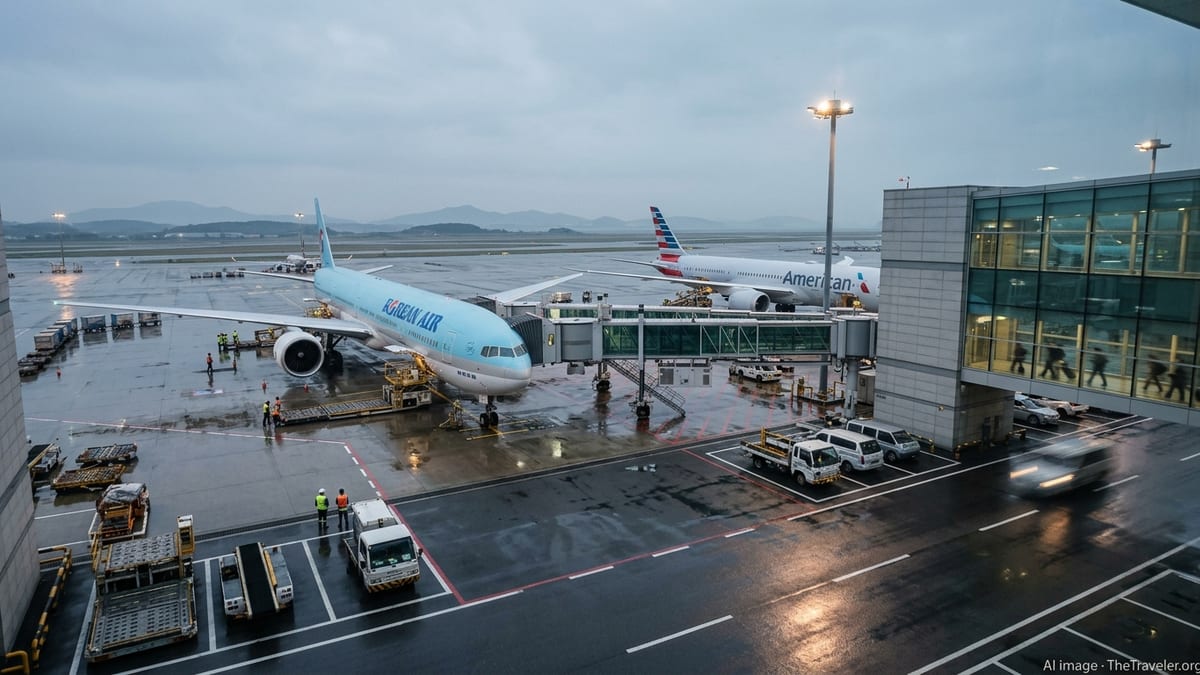
Crosswinds Force Sudden Go-Around at Narita
Video shared by aviation enthusiasts and passengers shows the Korean Air A321neo rocking sharply from side to side as it descended toward Narita’s runway, its wings tilting noticeably while the landing gear was already extended. As the crosswind component increased and the aircraft drifted off the runway centerline, the crew advanced the throttles and initiated a go-around, climbing away from the airport instead of continuing with the landing.
Flight-tracking data and publicly available flight-status records indicate that the aircraft had been operating a scheduled service from Seoul Incheon to Tokyo Narita and was configured to land when the maneuver occurred. The A321neo, a narrowbody workhorse on regional routes, remained under full control throughout the procedure, with no impact on the runway or surrounding airport infrastructure.
Reports from local and international outlets describe gusty, shifting winds near Narita at the time of the incident, a pattern that can create challenging crosswind conditions on approach. The footage suggests the aircraft encountered a lateral gust that caused a pronounced roll just as it neared touchdown, triggering the crew’s decision to discontinue the landing.
Despite the dramatic appearance of the maneuver from the ground and from passenger windows, there were no indications of injury, structural damage, or onboard emergency. After circling to set up for another approach in more stable conditions, the jet landed safely and taxied to the terminal.
Standard Safety Procedure, Not a Near-Miss
Aviation safety material and operational manuals emphasize that a go-around is a standard, trained response whenever a landing no longer appears fully stable. Pilots are expected to abandon an approach at any point, including very close to touchdown, if wind, aircraft alignment, or other variables move outside the limits set by airline procedures and aircraft manufacturers.
Industry data released in recent years by international safety organizations shows that go-arounds are relatively infrequent compared with the number of landings performed daily worldwide, but they remain a critical protective layer against runway overruns, hard landings, or loss-of-control events. In many cases, they occur because of factors such as changing wind, unexpected traffic on the runway, or instrument readings that do not match expectations.
In this case, publicly available information suggests the Korean Air crew acted in keeping with those safety principles. By rejecting the landing rather than attempting to salvage a difficult approach, the pilots preserved margins for the braking system, tires, and structural limits that could be stressed in an off-center or crabbed touchdown during strong crosswinds.
For passengers, a go-around can feel alarming because of the sudden surge in engine power and the rapid climb away from the runway, especially when an aircraft appears moments from landing. Airlines and regulators, however, generally regard the maneuver as a routine demonstration of caution rather than an indication of an imminent crash.
Narita’s Exposure to Coastal Weather
Narita International Airport, serving the greater Tokyo region alongside Haneda Airport, is located in Chiba Prefecture near Japan’s Pacific coast. The airport’s position exposes arriving and departing flights to shifting wind patterns, particularly when weather systems move across the Kanto region or when seasonal winds strengthen.
Local aviation observers note that crosswinds at Narita are not unusual, and visiting pilots prepare for these conditions through simulator training and route checks. Runway orientation can sometimes place aircraft in situations where the prevailing wind hits the fuselage from the side rather than the nose, increasing the skill and judgment required as an aircraft transitions from approach to touchdown.
Other recent events in Asia and globally have highlighted how wind shear and crosswinds can affect modern airliners at low altitude, prompting temporary diversions, missed approaches, and in a few cases structural inspections after rough landings. In response, airports and air navigation service providers have progressively expanded wind-sensing equipment around runways to provide real-time updates to cockpit crews on gusts and direction changes.
While Narita is equipped with modern navigation and weather-monitoring technology, the incident involving the Korean Air A321neo underscores that even with sophisticated systems, last-minute wind shifts can still force pilots to change plans in the interest of safety.
A321neo Performance and Crosswind Limits
The Airbus A321neo is the largest member of the A320neo family and is widely used by airlines in East Asia on short and medium-haul routes. The aircraft is certified with defined maximum crosswind limits for takeoff and landing, and airlines often impose their own operating thresholds that can be more conservative depending on training, experience, and runway conditions such as wet or contaminated surfaces.
Aviation reference material indicates that crosswind limits are established through a combination of flight testing and engineering analysis, taking into account the aircraft’s control authority, landing gear design, and braking performance. Airlines then integrate these numbers into their standard operating procedures, which guide pilots in deciding whether a given approach remains acceptable or whether a diversion or go-around is required.
Initial reporting on the Narita go-around suggests that winds may have approached or exceeded the conditions considered comfortable for a stable landing, even if they remained within absolute certification limits. In such situations, flight crews are encouraged to err on the side of caution, especially when there is sufficient fuel to hold, reposition for a different runway, or divert to an alternate airport if necessary.
The Korean Air incident adds to a broader global record of aircraft performing go-arounds in gusty conditions without injury or damage, reinforcing the industry view that rejecting a landing is often a sign of good airmanship rather than a failure of piloting skill.
Travelers Face Momentary Disruption but Lasting Confidence
For travelers on board the Korean Air flight, the sudden climb and extended time in the air likely caused anxiety and some delay in reaching the gate. Accounts shared on social platforms describe nervous moments as the aircraft powered away from the runway and circled for another approach, followed by relief once the landing was completed and the seatbelt sign was turned off.
Operationally, a single go-around rarely causes major disruption at a large hub such as Narita, although it can briefly affect spacing between arriving aircraft as air traffic controllers adjust sequences and approach paths. Published coverage indicates that other flights continued to operate around the same time, with some experiencing minor delays as crews and controllers managed the windy conditions.
For the broader flying public, the episode offers a reminder that the aviation system is designed with multiple layers of safety, including the option to discontinue a landing at virtually any point. Training, modern avionics, and clearly defined procedures combine to ensure that a destabilized approach becomes a story of a safe go-around rather than an accident.
As air traffic in Japan continues to grow and seasonal weather patterns bring shifting winds to the Tokyo area, travelers can expect occasional go-arounds and diversions to remain part of the landscape of modern air travel, even as the underlying safety record of commercial aviation remains strong.