


More news on this day
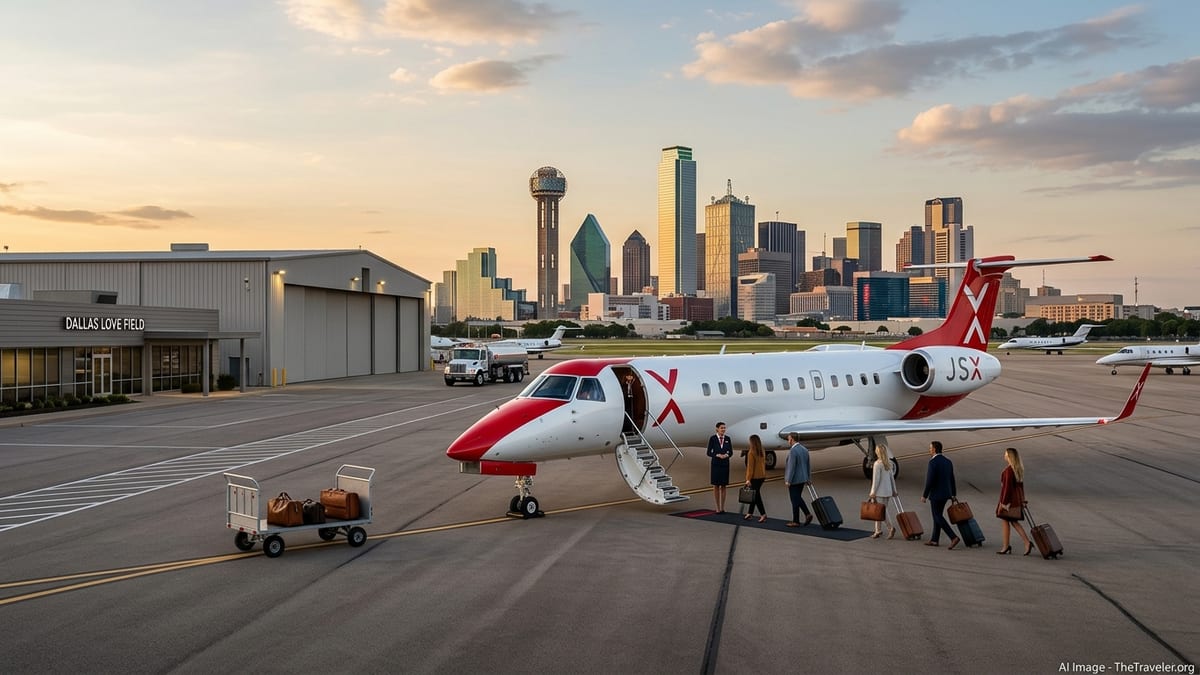
Dallas-based public charter carrier JSX has announced it will launch a new daily nonstop semi-private service between Dallas Love Field and the New York area from 17 February 2027, offering North Texas travelers a private-terminal alternative on one of the country’s busiest business corridors.
Get the latest news straight to your inbox!
What JSX Has Confirmed About The New Dallas–New York Service
JSX said in a 17 November announcement that it plans to begin daily nonstop public charter flights linking Dallas Love Field with the New York City area on 17 February 2027. Aviation trade publications that received the announcement report that the service will operate once per day in each direction and that introductory one-way fares are scheduled to start at about 799 US dollars, positioning the route firmly in the premium segment rather than as a low-cost option.
Local coverage in Dallas confirms that the flights will depart from JSX’s existing facility at Dallas Love Field, where the company already runs semi-private services to destinations such as Houston, West Texas and New Mexico. JSX markets itself as a hop-on jet service that uses smaller aircraft and private terminals while operating as a public charter, so these Dallas to New York flights will be bookable to the general public in the same way as its other routes rather than as a traditional private charter.
Industry reports citing JSX indicate that, at least initially, the new route will be available only to members of the carrier’s loyalty or membership program, with public sales expected to follow if the route performs well. That detail matters for early adopters planning to use the connection in 2027 because it means that access and pricing may differ from JSX’s standard publicly listed fares when bookings first open.
Which New York Airport Will Be Used And How The Route Fits JSX’s Network
The November announcement and subsequent coverage describe the destination as the New York City area rather than specifying a three-letter airport code, but multiple independent reports referencing JSX’s existing operations point to Teterboro Airport in New Jersey as the likely endpoint. JSX already serves Teterboro on other routes and has marketed those flights as a New York City product, using the airport’s proximity to Manhattan and its private-aviation infrastructure as key selling points.
JSX also has an established presence at Westchester County Airport north of New York City, where it operates semi-private charters to South Florida and other leisure destinations. However, current network maps and airport disclosures associate JSX’s main New York City business traffic with Teterboro, while Westchester is positioned more as a link to Florida. Because JSX has not publicly named the New York airport in its Dallas announcement, travelers should verify the exact airport and terminal when schedules appear in the booking system before making ground transport plans.
The Dallas to New York link fits into a broader expansion strategy that has seen JSX grow beyond its original western US footprint into Texas, the Mountain West and the East Coast. The airline already connects Dallas Love Field with airports such as Gunnison in Colorado and Santa Fe in New Mexico using private terminals, and in late 2026 it announced future semi-private services from Boston’s Hanscom Field to New York and Miami. The Dallas to New York route extends that strategy to one of the most heavily traveled business markets in the United States while avoiding the mainline terminals at Dallas Fort Worth, John F. Kennedy and LaGuardia.
How The Semi-Private Experience Will Differ From Traditional Airline Flights
JSX operates as a public charter, typically using 30-seat regional jets or turboprops configured with business-class style legroom, no middle seats and complimentary drinks and snacks. Rather than operating from the main airline concourse, the company flies from fixed-base operators or dedicated private terminals, including a hangar adjacent to the main facilities at Dallas Love Field. Travelers generally check in closer to departure than on standard airlines and pass through security screening processes designed for charter operations, which can reduce overall time spent at the airport.
For the Dallas to New York route, JSX has not yet released the exact timetable, aircraft type or block time, but comparable JSX sectors covered by independent analyses suggest that travelers can expect a schedule broadly similar to a standard transcontinental flight, with gate-to-gate times measured in a few hours rather than the longer end of regional operations. The difference is less about cruise speed and more about the ground experience: boarding smaller aircraft from a private facility, fewer passengers per flight and shorter queues at check-in and security.
Pricing will reflect that experience. Current coverage of JSX’s existing long-haul semi-private flights between New York and Florida cites one-way fares that can start in the mid hundreds of dollars when booked in advance and climb into four figures at peak times. The advertised starting level of about 799 dollars one way for Dallas to New York in February 2027 indicates that JSX is targeting travelers who might otherwise buy last-minute domestic first class or fully flexible economy tickets on major airlines, as well as high-income leisure travelers prioritizing convenience over price.
What The New Route Means In Practice For Dallas And New York Travelers
For Dallas-based travelers, the primary change is the ability to travel between North Texas and the New York area while entirely avoiding the main terminals at Dallas Fort Worth International and Love Field. Passengers will drive directly to JSX’s private facility at Love Field, park or arrange car service nearby and complete check-in and security at that location. On arrival in the New York region, they will land at a private-aviation airport such as Teterboro or at a private terminal within a secondary airport rather than entering the commercial terminal used by legacy airlines.
This can be particularly attractive for frequent business travelers commuting between Dallas and Manhattan or northern New Jersey, since Teterboro and Westchester have widely used private-aviation ground connections to key business districts. A traveler with morning meetings in Midtown or on Wall Street could, for example, bypass the traditional airline terminal entirely, reducing airport dwell time on both ends of the trip. However, because the JSX service will operate just one round trip per day at launch, scheduling flexibility will be limited compared with the near-hourly departures available on major carriers via Dallas Fort Worth and the large New York airports.
On the New York side, the new route adds a direct semi-private option to reach central Dallas itself, as opposed to the broader Dallas Fort Worth region. Love Field sits closer to the city’s urban core than Dallas Fort Worth International, so arriving on JSX could shorten onward travel times to downtown Dallas, Uptown and the Medical District. Travelers whose final destination is in the northern suburbs might still find Dallas Fort Worth more convenient, which keeps the new route as a niche option rather than a universal solution.
Key Limitations, Uncertainties And What Travelers Should Watch Next
While the Dallas to New York semi-private link is confirmed in JSX’s 17 November announcement, several operational details have not yet been publicly specified. These include the exact New York airport and private terminal, the published timetable, minimum connection times, checked baggage limits, pet policies for this specific route and whether the initial loyalty-member restriction will remain in place once operations begin on 17 February 2027. Until JSX posts full schedules and conditions of carriage for the route, travelers should treat these as open questions.
There are also structural limitations inherent to JSX’s public charter model. With only one round trip per day planned at launch, passengers will have fewer same-day alternatives in the event of a mechanical issue or disruption compared with the multiple daily flights available on major carriers between Dallas Fort Worth and airports such as LaGuardia and Newark. Travel industry commentary on JSX’s other routes notes that when problems occur, rebooking options can sometimes require passengers to use a different airport or even a different airline, which is important to consider when planning tight connections or critical business trips.
In the coming months, the most useful information for prospective passengers will be the publication of the detailed schedule, equipment assignment and full fare structure for dates after 17 February 2027. Travelers interested in using the route should monitor JSX’s booking channels for confirmation of the New York airport, verify how early they must arrive at the private terminals at both ends and check whether introductory fares remain available for their preferred dates. Because the service launches on a limited-frequency basis and targets a premium market, seats on peak business travel days may sell out quickly once general sales open.