


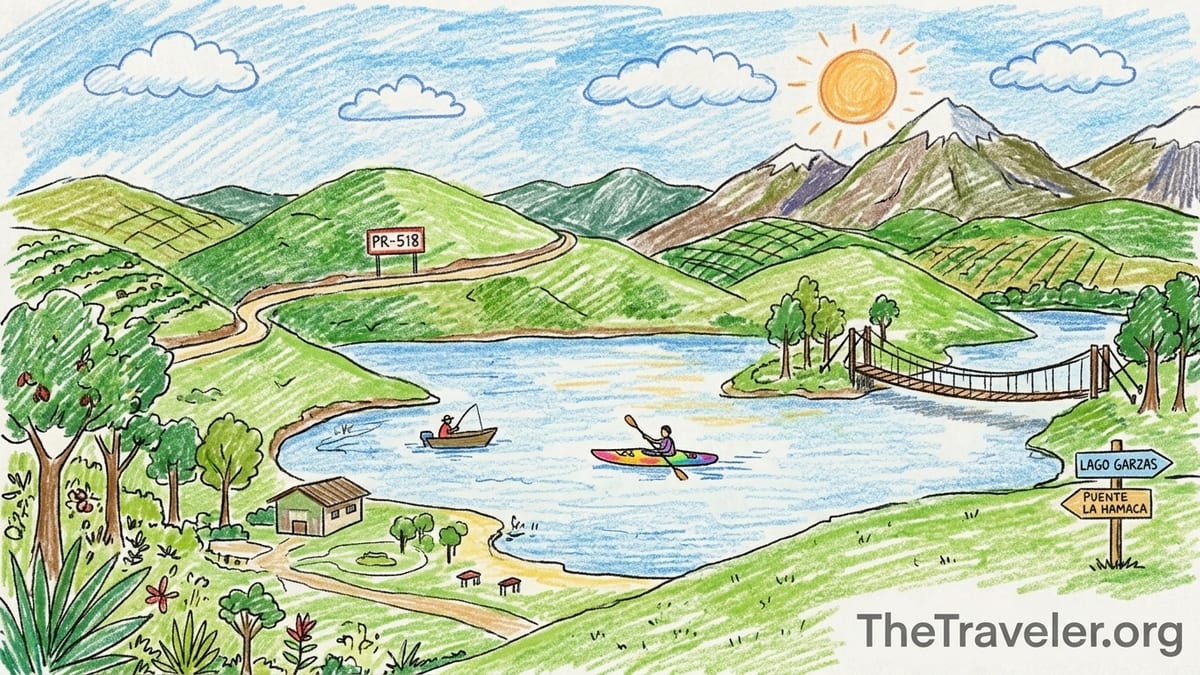
High in Puerto Rico’s Cordillera Central, Lago Garzas and the surrounding Garzas barrio of Adjuntas offer one of the island’s most atmospheric mountain-lake settings. Visitors come for the mirror-calm water, lush Guilarte forest slopes and the legendary Puente La Hamaca suspension bridge. This guide focuses on what you can realistically do today around the reservoir: where you can simply admire the views, where kayaking and fishing are legally arranged, how camping relates to nearby Guilarte State Forest, and what to know before venturing out to the hanging bridge.
Get the latest updates straight to your inbox!
Understanding Lago Garzas and Its Setting
Lago Garzas is a mid-20th-century reservoir created in 1943 by damming the Río Vacas in the highlands south of Adjuntas. It sits near the boundary of the Guilarte State Forest and is one of the main bodies of water in Puerto Rico’s central mountains used for hydropower and potable water storage. The lake’s high elevation and surrounding coffee country give it a much cooler feel than the coast, especially in the mornings and evenings.
The reservoir is administratively linked to Puerto Rico’s power and water infrastructure, historically overseen by agencies connected to the Puerto Rico Electric Power Authority. Because it plays a role in drinking-water and irrigation storage, recreation is tolerated only in certain zones and under restrictions. This practical reality explains why some picturesque coves are completely off limits, why you may see fences around infrastructure and why rules about boats, life jackets and fishing licenses are enforced more strictly than at a roadside river pool.
Garzas barrio spreads along the folds of the Cordillera Central, stitched together by narrow rural roads like PR‑518 and PR‑131. To the southwest, the protected forests of Guilarte rise toward Pico Guilarte, one of Puerto Rico’s highest peaks. From the driver’s seat this all looks like one uninterrupted green landscape, but jurisdiction varies: lakeshore facilities are one thing, Guilarte State Forest is another, and private fincas with their own lake access are something else again.
For visitors, the key is to understand the difference between public vantage points where you can pull over and enjoy the view, officially managed recreational areas where you can launch kayaks or camp with permission, and purely private property where access depends entirely on the landowner. Treating everything as public can lead to uncomfortable encounters with security staff or neighbors and, more importantly, unnecessary safety risks near deep water and steep slopes.
Getting There: PR‑518, Road Conditions, Parking and Facilities
Most travelers reach Lago Garzas via the town of Adjuntas on PR‑10. From downtown Adjuntas, you typically follow PR‑135 or local streets uphill to connect with PR‑518, then drive west through Barrio Garzas. PR‑518 is often described as part of the Ruta Panorámica, and it feels like it: the road is winding, narrow in stretches and bordered by steep drop-offs and dense vegetation. Standard passenger cars can navigate it in dry weather, but drivers should be comfortable with sharp curves, blind corners and slow speeds.
As you approach the lake area, several informal pullouts appear along PR‑518, especially near small restaurants and local houses. These are not engineered scenic overlooks; they are short gravel or dirt shoulders that can accommodate a few cars. Surfaces can be uneven or muddy after rain, so low-clearance vehicles should park conservatively. The safest approach is to use clearly established parking areas attached to businesses or the main recreational facilities rather than improvising roadside stops on tight curves.
Parking for lake access generally falls into three categories. First are the private business lots, such as the areas around roadside eateries near kilometer markers in the Bo. Garzas section. Second are lots attached to the formal recreational compound mentioned in tourism brochures, which include boat ramps and controlled access to the water, usually with a modest fee for day use or parking. Third are small trailhead-style spaces used by locals to begin short walks to viewpoints or the suspension bridge. Travelers should expect to pay a small amount for secure parking near the main facilities, while more informal pullouts remain technically free but offer no security or services.
Toilet access around Lago Garzas is limited. Public restrooms, where available, are typically inside recreational compounds or at Guilarte State Forest’s ranger station near the junction of PR‑518 and PR‑131. Visitors should not count on standalone public toilets on the roadside. Mobile reception is generally patchy: some higher spots along PR‑518 pick up a signal, while hollows and shore-level tracks may drop to zero coverage. For navigation, it is wise to download offline maps and save key points in advance. During the wet season and after storms, fog can descend quickly, further reducing visibility on PR‑518 and making cautious driving essential.
Scenic Viewpoints and Public Lakeside Access
Lago Garzas rewards even a simple drive-by visit with classic mountain-lake scenery. From PR‑518, several openings in the trees reveal the water framed by coffee farms and forest. These roadside vantage points are free and accessible without entering any gate or private compound, but they require defensive parking and patience. Pull fully off the pavement where possible, engage your hazard lights briefly if stopping on a narrow shoulder, and never block driveway entrances or narrow bridges.
Closer to the water, the main managed recreational area near the junction of PR‑518 and PR‑131 provides one of the best structured viewpoints. Promotional material distributed along Route 123 describes this zone as offering gazebos, electricity in some areas and lake-edge spots used for both fishing and picnicking. In practice, this translates to cleared spaces with a more open view of the lake, limited lawn or gravel pads and a more relaxed environment to sit with a coffee and watch the light move across the hills.
There is an important distinction between visually accessing the lake and physically entering the managed properties. From the public road you are free to look and photograph as long as you do not trespass beyond fences or signs. To use gazebos, picnic tables, ramps or electricity, you must enter through official gates or contact the managers of the facility, which might be a concessionaire or a community association authorized to maintain the area. Fees, when charged, are usually per vehicle or per group and help cover maintenance, trash collection and basic security.
For photographers who simply want golden-hour reflections or mist over the water, a half-day visit focused on viewpoints works well. Arrive early from Adjuntas to catch morning light, stop at two or three open pullouts along PR‑518, then continue to the main lakeside recreation area for a more stable vantage point. A compact tripod, polarizing filter and weather-resistant clothing are more useful here than water gear if you are not entering the lake.
Kayaking and Boating: Authorized Launch Points and Rules
Tourism information on Lago Garzas consistently mentions boating and kayaking as featured activities, often highlighting that the lake has ramps and is “perfect for kayaking.” At the same time, it is crucial not to assume that any stretch of shore is fair game for launching. Reservoirs that serve hydropower and drinking water usually channel legal boat access through one or two controlled launch points, where staff can monitor vessel types and safety practices and keep people away from intake structures and fragile slopes.
Recent regional guides describe the main recreational facility at Lago Garzas as having boat ramps, camping by permit and electric power. However, up-to-date confirmation on who currently manages kayak launches and whether they rent equipment is limited. Some older reports refer to small local operators running occasional kayak tours, but there is no reliable evidence that the same individuals still operate or accept bookings today. Travelers should treat any pre-2019 kayaking account as historical color rather than a guarantee of current services.
In practical terms, visitors who own or rent kayaks elsewhere should plan to use the formal ramp areas only after confirming access directly with the on-site management or, in their absence, through the municipal office in Adjuntas or the regional office of the Department of Natural and Environmental Resources. Expect to pay a modest day-use or parking fee, often in the range that local lakeside parks in Puerto Rico charge per vehicle. Boats must be non-motorized or use small electric trolling motors, in line with common restrictions on reservoirs with potable-water functions, and every paddler should have a properly fitted life jacket on board and, ideally, worn on the water.
Because dock staff and enforcement presence on remote mountain lakes can be sporadic, responsibility shifts to paddlers to behave as if rules were actively enforced at all times. This means staying well away from the dam structure, not approaching intake towers or marked exclusion zones, keeping group sizes manageable and avoiding the water entirely after major storm events when floating debris and rapid changes in water level make conditions unpredictable. If you arrive and find the managed launch closed or unstaffed with locked gates, do not try to carry boats through informal paths or fish camps to the water; shift your plans to shore-based activities instead.
Fishing at Lago Garzas: Licenses, Species and Ethics
Lago Garzas is particularly popular among freshwater anglers in Puerto Rico, with online fishing communities frequently posting catches of largemouth bass and other species. Evidence from local catch reports and agency studies shows that fisheries managers track fish communities here, which underscores the expectation that anglers respect licensing rules and conservation practices. The reservoir’s elevation and cooler temperatures can support healthy bass populations, which in turn draw serious recreational fishers from across the island.
Puerto Rico’s freshwater fishing regulations are administered by the Department of Natural and Environmental Resources and related wildlife divisions. While the official online resources focus heavily on marine species, the overarching principle applies to inland reservoirs too: recreational anglers are generally required to hold a valid local license for freshwater fishing, with specific bag and size limits set for stocked or managed species like largemouth bass. Because regulations and license vendors can change, travelers should verify current rules directly with DRNA or through the most recent government publications before fishing.
On the water, anglers should assume that any restriction related to the reservoir’s drinking-water or hydropower role takes precedence over convenience. That means no cleaning fish directly in the lake, no discarding bait containers or fishing line along the bank, and avoiding fuel-powered boats that risk spills where they are not explicitly allowed. Life jackets should be present on any craft, even when anglers are seated low in bass boats or small jon boats. Night fishing may be either restricted or discouraged on a working reservoir due to security concerns around dam infrastructure, so it is safer to concentrate outings during daylight hours.
When access to boat ramps is limited, shore fishing at designated spots within the recreational facilities remains a good alternative. Concrete or gravel clearings near gazebos and picnic areas often double as favored local casting points. Visitors who are not familiar with Puerto Rican freshwater rules can still enjoy a morning or afternoon on the bank by focusing on catch-and-release bass fishing with barbless hooks, minimizing handling time and prioritizing the health of the fishery.
Guilarte State Forest, Camping and Overnight Options
Lago Garzas sits just below Guilarte State Forest, one of Puerto Rico’s key central highland reserves. Approaching from the northeast, travelers first encounter the lake along PR‑518 before the road climbs toward the forest’s ranger station near the junction with PR‑131. This geography creates a natural pairing: day visitors often split their time between lakeside recreation and hikes to viewpoints and peaks inside the forest.
Official descriptions of Guilarte highlight its gazebos, interpretive trails and rustic cabins near Pico Guilarte. Importantly for campers, multiple recent references emphasize that camping is not permitted inside Guilarte State Forest. Overnight stays within forest boundaries take place in basic cabins managed through DRNA, which must be reserved in advance and lack electricity but have toilets and showers. Travelers interested in cabin stays need to contact DRNA directly and plan ahead rather than expecting a walk-in campsite or backcountry tent zone.
By contrast, the area around Lago Garzas outside the forest has long been associated with camping by permit. Recent tourism material notes that the lakeside recreation zone offers camping areas with electricity, subject to prior authorization. In practice, this usually means reserved sites or zones near the lake with access to power outlets, simple bathroom blocks and shared facilities like gazebos and grills. Because management arrangements can evolve, anyone considering overnight camping should confirm with the operator responsible for the recreation area, using local phone numbers or municipal contacts, and explicitly ask about current rules, capacity and cost per night.
One workable plan for visitors today is to separate the “forest lodging” and “lakeside day use” experiences. For instance, you might book a rustic cabin through DRNA inside Guilarte, use the cabin as your base, and spend one of your days driving down to Lago Garzas for kayaking, fishing or photography. Alternatively, you could arrange a permitted campsite in the lakeside compound if the operator confirms that tent camping is open, then explore the Guilarte trails by day and return to your tent each night. In both cases, advance confirmation is essential, as policy shifts or weather-related damage can temporarily close facilities.
Puente La Hamaca: History, Access and Safety
Puente La Hamaca, sometimes simply called the Puente Colgante of Lago Garzas, is one of Adjuntas’ most photogenic landmarks. Built in the early 1940s in connection with the construction of the lake, the suspension footbridge originally helped move materials and people across the reservoir. Today it is a magnet for adventurous visitors who want the experience of walking on a swaying bridge high above the water, surrounded by dense, humid forest.
The bridge is not visible from PR‑518, despite being relatively close. To reach it, drivers typically continue along PR‑518 in Barrio Garzas to a cluster of local businesses near the lake. From there, a short but sometimes muddy path leads downhill through the woods to the lakeshore and the bridge. Older accounts mention starting near a roadside restaurant and following a fifteen-minute trail; recent point-of-interest descriptions describe a roughly half-kilometer walk on dirt paths, followed by the crossing of a rickety rope-and-plank structure. Expect uneven ground, slippery roots after rain and occasional encroaching vegetation.
Reports in Puerto Rican media describe the bridge as a test of nerves, with noticeable side-to-side movement and gaps between old metal or wooden sections. Some sources list the bridge as in use as of the early 2020s, while others emphasize its age and lack of full modernization. These mixed signals highlight a critical point: travelers should treat Puente La Hamaca as an unsupervised, rustic structure and verify its current condition on arrival rather than assuming it meets formal engineering standards for public use.
Before stepping on the bridge, assess the state of the decking, handrails and cables. Look for missing planks, severe rust, broken boards or loose fasteners. If you see obvious structural damage, or if heavy rain and strong winds are sweeping across the lake, the safest decision is not to cross. There are no turnstiles or ticket booths checking your judgment, so personal risk tolerance and real-time evaluation matter. Even when conditions seem acceptable, limiting the number of people on the bridge at one time, spacing out crossings, keeping children closely supervised and avoiding unnecessary bouncing or swinging are basic precautions that make a real difference.
Planning Your Visit: Half-Day Stop vs Full Kayak or Camping Experience
Lago Garzas can be approached at several levels of commitment, from a quick scenic detour along PR‑518 to a fully planned multi-day program that combines Guilarte hiking, kayaking, fishing and possibly camping. For many travelers, a simple half-day stop fits neatly into a broader central-mountain road trip. In this scenario, you might leave Adjuntas in the morning, drive PR‑518 to two or three viewpoints over the lake, park at a lakeside recreation area for an hour of photos and a picnic, consider the walk to Puente La Hamaca if the trail is dry and you have sturdy shoes, then return to town by mid-afternoon.
A more immersive day or weekend revolves around water access. With prior confirmation that kayak launches are operating and day use is permitted, you could arrive early, pay the parking or day-access fee at the managed facility, and spend several hours paddling along the quieter arms of the reservoir. In calm conditions, this might involve packing a dry bag with snacks and extra layers, hugging the shoreline for safety, and occasionally pulling into coves to photograph reflections and birds. After lunch ashore, anglers in the group could focus on catch-and-release bass fishing while others rest under gazebos or explore short walking paths near the water.
For visitors who secure overnight arrangements, whether in a Guilarte cabin or a permitted campsite near the lake, planning extends to weather windows and gear. The highlands can be damp and cool at night; a proper rain jacket, warm mid-layer and dry sleeping setup are essential. Electricity at some lakeside camping spots is a convenience for lighting and charging devices but should not be relied on for heavy appliances. Equally, remote cabins in Guilarte with no grid power demand full self-sufficiency for cooking and comfort. Before committing to an overnight, it is wise to call both the forest administration and any lake facility to double-check current operating status, as budget constraints and storm damage occasionally cause temporary closures.
If you arrive to find that water access is closed or conditions are unsafe, Lago Garzas still anchors a worthwhile mountain outing. Alternatives include driving higher into Guilarte State Forest for short hikes to viewpoints, visiting nearby waterfalls and river pools outside restricted drinking-water zones, or spending extra time in coffee haciendas and small eateries in Adjuntas. In this way, the lake remains a scenic backdrop even when paddling or fishing are not viable, rather than a single point of failure for your trip.
The Takeaway
Lago Garzas rewards visitors who combine curiosity with caution. Its serene water, steep green slopes and hanging bridge make it one of Adjuntas’ signature natural attractions, but they are layered over working infrastructure for hydropower and potable water, and over a protected forest system that rightly prioritizes conservation. Understanding where public viewing ends and controlled recreational use begins is the key to a smooth visit.
For photographers, the lake is an excellent subject for soft dawn light and moody clouds rolling over the Cordillera Central. Families with children can enjoy a half-day of viewpoints, a gentle stroll near the lakeshore and, conditions permitting, a conservative look at Puente La Hamaca without needing to cross it. Paddlers and anglers will get the most from Lago Garzas by confirming launch and license details in advance, bringing their own well-maintained equipment and respecting water-quality-driven rules that may seem stricter than at a typical beach.
Those seeking a quiet mountain-lake experience without unnecessary risks will find that Lago Garzas pairs well with nearby Guilarte State Forest for low-intensity walks, birdwatching and cabin stays. By planning conservatively, verifying current information with local authorities and being willing to adapt plans to weather and infrastructure realities, travelers can enjoy one of Puerto Rico’s most atmospheric highland reservoirs in safety and with minimal impact on the fragile environment that surrounds it.
FAQ
Q1. Do I need a permit or reservation to kayak on Lago Garzas?
Kayaking itself does not usually require a separate permit, but using official launch ramps or entering managed recreational facilities often involves a day-use or parking fee. Because management arrangements can change, contact the lakeside facility or local authorities before your visit to confirm whether nonmembers are currently allowed to launch and what conditions apply.
Q2. Is camping allowed on the shores of Lago Garzas?
Free, informal camping along the lake is not allowed. Some recreation materials mention designated camping areas within managed lakeside facilities, available only with prior permission and subject to fees. Always confirm directly with the operator before planning to camp, and note that camping is not permitted inside Guilarte State Forest itself.
Q3. What are the current fishing license requirements at Lago Garzas?
Recreational freshwater anglers are expected to hold a valid Puerto Rico fishing license and to comply with local size and bag limits for species like largemouth bass. Because specific rules and license vendors can change, it is important to check with the Department of Natural and Environmental Resources or the latest official publications before fishing.
Q4. How do I reach Puente La Hamaca and is it safe to cross?
Drivers follow PR‑518 through Barrio Garzas to a small parking area near the lake, then walk roughly fifteen minutes along dirt paths through the forest to reach the suspension bridge. The structure is old and can feel unstable; visitors must assess its condition on arrival and decide personally whether to cross. If there are missing or severely damaged planks, visible cable problems or strong winds, the safest choice is to enjoy the view without stepping onto the bridge.
Q5. Are there public restrooms and reliable mobile reception at the lake?
Public restrooms are scarce around Lago Garzas and are generally found only in managed recreational compounds or at the Guilarte ranger station. Mobile phone reception varies from moderate on higher sections of PR‑518 to weak or nonexistent in some lakeshore hollows. Visitors should not rely on constant coverage for navigation or emergency calls.
Q6. Can families with young children safely enjoy Lago Garzas?
Yes, if the visit is planned around viewpoints, picnics and short supervised walks rather than riskier activities. Parents should keep children away from steep drop-offs along PR‑518, use established recreation areas for lakeside access and treat Puente La Hamaca cautiously, choosing to view rather than cross the bridge if there is any doubt about safety.
Q7. What weather conditions should I expect and how do they affect activities?
Lago Garzas sits in the central highlands, where temperatures are cooler and rain more frequent than on the coast. Afternoon showers, fog and low clouds are common, which can make PR‑518 slippery and reduce visibility. Paddling and bridge crossings are best attempted in calm, dry conditions; after major storms, elevated water levels and debris can temporarily make the lake unsafe for boating.
Q8. Are guided tours available for Lago Garzas or Puente La Hamaca?
In the past, some local guides and small operators offered informal tours that included kayaking and hikes to the suspension bridge, but there is no reliable, up-to-date confirmation that specific guides still operate on fixed schedules. Travelers interested in guided experiences should inquire locally in Adjuntas or through current tourism information rather than relying on older online anecdotes.
Q9. How does Lago Garzas relate to Guilarte State Forest for hiking and lodging?
Lago Garzas lies below Guilarte State Forest, and PR‑518 connects the lake to the forest’s ranger station and trailheads. Many visitors use cabins or day-use areas in Guilarte as a base for hiking, then drive down to the lake for scenic stops, fishing or paddling. The forest and lake are administratively distinct, so rules for camping, fires and water access differ and must be checked separately.
Q10. What are good alternatives if water access at Lago Garzas is closed?
If boating or lakeside facilities are temporarily unavailable, visitors can still enjoy the drive along PR‑518 for mountain views, explore trails and viewpoints in Guilarte State Forest, visit nearby waterfalls and river pools outside drinking-water zones, or spend time in Adjuntas tasting local coffee and exploring historic sites. Lago Garzas remains a scenic backdrop even when direct water activities are not an option.