


Lahemaa National Park is often sold as an easy day out from Tallinn, but its reality on the ground is very different. The park covers a wide swathe of forest, bog and jagged Baltic coastline spread across tens of kilometres. Arriving at one trailhead does not place you within walking distance of Palmse Manor, Käsmu, Võsu or the other postcard villages, and regional buses run only a handful of times per day. This guide uses current bus schedules and official trail information to show exactly what is realistic without a car, and what is better saved for a tour or rental vehicle.
Get the latest updates straight to your inbox!
Understanding Lahemaa’s Geography and Why Distances Matter
Lahemaa National Park stretches along Estonia’s northern coast east of Tallinn, covering roughly 70 kilometres of shoreline and large blocks of forest and bog inland. Key sights are strung out along and behind the main Tallinn–Narva highway, with clusters around Palmse, Sagadi and Vihula manors, the coastal villages of Käsmu, Võsu and Altja, and inland bogs such as Viru. Even though everything falls under the same park name, individual attractions can be 10 to 25 kilometres apart by road, with no safe or pleasant way to walk between them in a single day.
This matters for visitors relying on public transport because regional buses follow specific corridors rather than looping through all the highlights. A bus that lets you off at Viru Bog will not later appear at Palmse Manor or Käsmu Peninsula; you would need separate services or long local walks, which quickly becomes impractical. Planning Lahemaa with buses is about picking one hub area and seeing it well, instead of racing between three or four famous names and spending your day at roadside stops.
Tallinn is about 60 to 80 kilometres from most Lahemaa trailheads by road. Typical driving times are one to one and a half hours, but public buses add intermediate stops through Kuusalu, Kolgaküla and Loksa. On paper this still looks manageable. In practice, the limiting factor is not the journey time from Tallinn, but the long gaps between onward connections inside the park. A realistic bus-based trip therefore means accepting a slower rhythm and deeper focus on one area.
Before you commit to a tight itinerary, take a good look at a map that shows both villages and the Tallinn–Narva highway. You will see that Palmse sits on a side road several kilometres from the main line, Käsmu and Võsu lie even further out on separate peninsulas and coves, and Viru Bog occupies a forested zone with no settlement right at the boardwalk. Once you visualise those spaces, it becomes easier to understand why you cannot simply “hop” between them in a day by bus.
Getting From Tallinn to Lahemaa by Public Bus
Regional access to Lahemaa from Tallinn is provided by county buses serving the Loksa and Haljala directions. Several numbered routes run from Tallinn’s main bus station towards Kuusalu, Kolgaküla and Loksa, stopping on or near the edge of the national park. Routes 151, 152, 152A, 155 and 157A, operated for Harju County, are among the services that pass Kolgaküla and the Viru Bog stop on the Tallinn–Narva highway. According to recent county summaries, buses from Tallinn to the Kolgaküla and Loksa direction typically begin around 06:00 to 07:00 and then depart every one to three hours during the day, with reduced frequency late in the evening and on weekends.
Most Lahemaa-bound buses depart from Tallinn Bussijaam, the intercity bus station a short ride from the city centre. You can reach Bussijaam by city bus or tram from Viru Keskus and the Old Town area, paying with a contactless bank card or a local travel card. At the regional bus, drivers usually accept contactless bank card payment onboard. As of late 2026, Harju County regional buses charge inexpensive zone-based fares; a typical one-way ticket from Tallinn to the Viru Bog or Kolgaküla area generally lands around 3 to 5 euros, depending on zones and any concessions. Because fares and ticketing rules are updated regularly, travellers should confirm the exact current price using the national journey planner or the county transport portal shortly before travel.
Several compiled schedules for the “Loksa direction” show daily Tallinn departures that reach Kolgaküla and Viru Bog between about 06:00 and 22:00, but only some trips stop at every minor halt. On recent tables, Viru Bog (“Viru raba”) appears as an intermediate stop served by a subset of buses, with examples around 06:56, 08:32, 12:22, 14:44, 17:22, 19:21 and 22:01 from Tallinn on certain weekdays. These times are indicative and can shift with seasonal timetable changes, so travellers must re-check for their exact travel date using Peatus or another official schedule provider. Weekend service is broadly similar but with fewer departures and slightly different times.
Reaching other Lahemaa areas by bus often requires additional legs. Buses towards Haljala and Rakvere serve Palmse and Sagadi from the east, while some Loksa and Võsu services approach coastal villages from the west. For example, timetables show route 157A running Tallinn–Kuusalu–Kolga–Loksa–Võsu on certain days, which can be used to reach the Võsu side without walking from the Tallinn–Narva highway. Because these services are sparse and may not run at convenient hours for sightseeing, it is not safe to assume that name recognition in a guidebook automatically equates to easy bus access on your chosen date.
Viru Bog: The Most Practical Car-Free Highlight
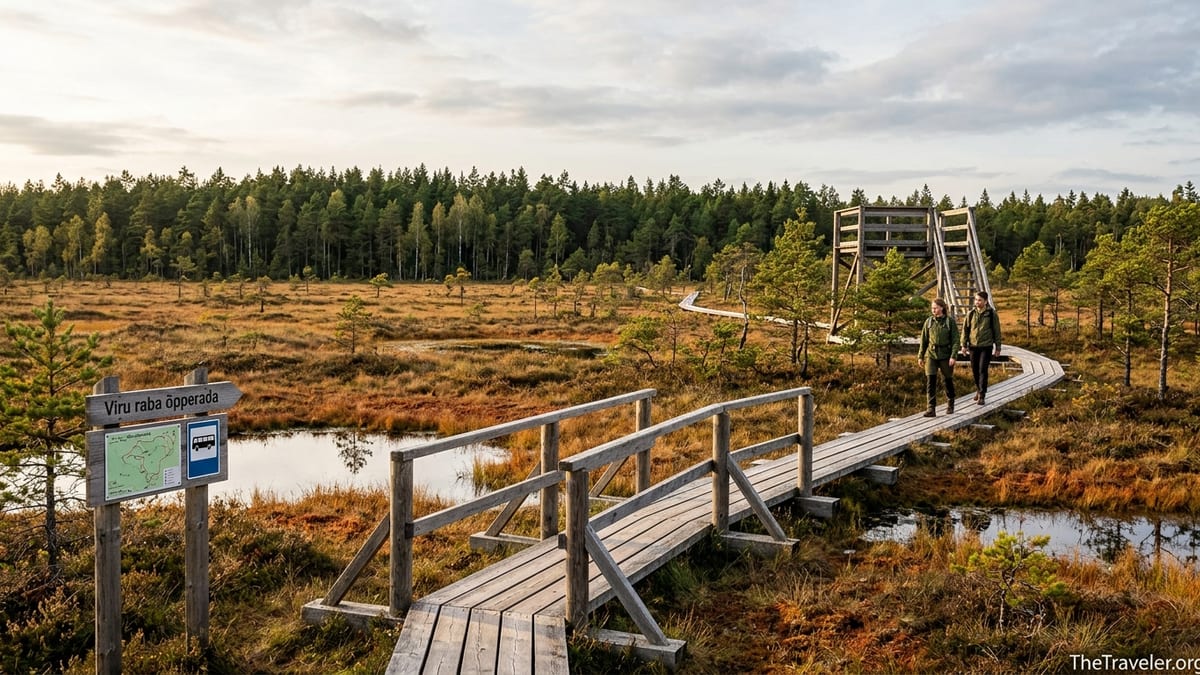
Viru Bog is the most accessible and popular nature walk in Lahemaa for visitors without a car. The trailhead lies directly off the Tallinn–Narva highway, on the forest side, and is within walking distance of the regional bus stop labelled “Viru raba” on county timetables. Depending on the exact stop position, you will walk roughly 300 to 600 metres along a signposted gravel path from the roadside parking and former rest area into the forest to reach the start of the boardwalk. The approach is flat and easily managed in sturdy walking shoes.
The official Viru Bog study trail is about 3.5 kilometres in its basic form, crossing pine forest and peat bog on a wooden boardwalk. Information panels introduce bog ecology and the traditional uses of peat. Maps published by the Estonian Environmental Board show that the route can be extended into a circular loop of roughly 5.5 to 6 kilometres, returning through forest paths to the initial approach road. This longer variant gives a fuller sense of Lahemaa’s mosaic of dry heath, raised bog and surrounding forest, yet still fits comfortably into half a day for anyone of moderate fitness.
Accessibility is one of Viru Bog’s strengths. A wide, wheelchair-friendly boardwalk is installed from the forest edge to the bog observation tower, a stretch of about 1.3 to 1.4 kilometres. This section includes both compact gravel and extra-wide wooden planks designed for wheelchairs and prams. The first platform of the tower is accessible without stairs, which means that visitors with limited mobility or families with strollers can enjoy classic bog views without tackling narrow or uneven sections. Beyond this point the boardwalk becomes normal width and can be slippery when wet, especially in autumn and winter, so people with limited balance or small children should take extra care.
Because Viru Bog sits right on a key regional bus corridor, it is entirely realistic to plan a bus-only day trip from Tallinn focused solely on this trail. A common pattern is to leave Tallinn Bussijaam on a mid-morning bus that stops at Viru Bog around 10:00 to 11:00, complete the loop in two to three hours with photo stops, have a packed lunch by the edge of the bog, and then catch an afternoon bus back between about 14:00 and 17:00. The precise timing depends on current schedules, but recent timetables show at least two or three afternoon return options on weekdays. Even so, you must always carry a screenshot of the day’s timetable and arrive early at the roadside stop, as there is no shelter and limited signage.
Other Trails: Käsmu, Oandu, Võsu and the Coastal Walks
While Viru Bog is the easiest target for car-free visitors, Lahemaa’s coastal zone offers some of its finest scenery. Käsmu Peninsula is beloved for its glacial boulders, ship captain’s village and a coastal nature trail that loops through forest and along the stony shore. The main marked trail here runs for several kilometres; exact route options vary, but typical day walks range from 4 to 8 kilometres on easy forest and coastal paths. The village itself has guesthouses and a maritime museum in season, though opening hours can be limited outside summer. The challenge is access. Käsmu sits off the main highway on a dead-end peninsula, and only a small number of regional buses connect it with Rakvere, Haljala or occasionally Tallinn, often timed around school and commuter needs rather than tourism.
Oandu, slightly inland from Altja village, is a hub for several forest trails of different lengths managed by the state forest agency RMK. Popular options include short educational loops of two to four kilometres and longer routes that form sections of Estonia’s national hiking trails. Terrain is mostly gentle but can be rooty and muddy after rain. Public transport to Oandu itself is limited; visitors usually reach it by car or bicycle from accommodation in Võsu, Altja or Sagadi. Without your own wheels, Oandu is best treated as a second-day objective when you already overnight in the park rather than something to tag on after arriving from Tallinn.
Võsu functions as a small resort centre on a sandy bay, with a broad beach, a few shops, summer cafes and access to both short seaside strolls and longer coastal walks towards Käsmu or Altja. Some regional buses, including variants of the Tallinn–Loksa–Võsu route, run directly into Võsu, particularly during the summer season. However, frequencies are modest, and shoulder-season service may be confined to a handful of trips per day in each direction. From Tallinn, this means carefully planning a morning bus that gets you into Võsu before midday, then structuring your walks so you are back in the village one hour before the last bus home, which may leave around 18:00 to 20:00 depending on the day.
Putting these pieces together, it becomes clear that you cannot reasonably combine Viru Bog, Käsmu coastal trail and an Oandu forest walk in a single day by bus. Each trailhead lies several kilometres from the others, often on different secondary roads. With regional buses only two to five times per day on each branch, there are no simple cross-links within the park, and walking between villages can mean two or three hours along roads without pavements. If you wish to hike both Viru Bog and Käsmu Peninsula, consider a two-day itinerary with one overnight in Käsmu or Võsu, using different bus lines on the way in and out.
Palmse, Sagadi and Vihula: Manor Grounds, Tickets and Access
Lahemaa is also famous for its restored Baltic German manor complexes, which combine architecture, formal gardens and small museums. Palmse, Sagadi and Vihula are the best known. All three have publicly accessible grounds where you can stroll, and selected interiors that require paid admission. At Palmse, the restored baroque manor house functions as a museum, with an entrance fee charged for the main building and certain outbuildings, while the wider park, ponds and avenues can usually be enjoyed without a ticket during the day. Sagadi operates both a forest museum and manor exhibitions, again with separate admission, while Vihula functions largely as a spa hotel with restaurants and paid activities set inside a historic estate.
Recent information from Vihula Manor’s restaurant notes that major Lahemaa attractions such as Sagadi and Palmse lie 6 to 14 kilometres away from Vihula by road, while the coast and Altja fishing village are another 4 to 6 kilometres from the manor. Distances of this order are too long to walk if you are also aiming to see interiors and catch a specific bus back to Tallinn. In practice, visitors either drive between the manors or join organised tours that include at least two of the estates plus a short stop at Viru Bog.
Reaching the manors by public bus is more involved than visiting Viru Bog. Some regional buses running between Rakvere, Haljala and Tallinn stop near Palmse and Sagadi, but these routes are more convenient if you are already elsewhere in northern Estonia. From Tallinn, bus combinations are possible, yet they often involve transfers in Haljala or Rakvere with long waiting times. Where direct services exist they may depart from Tallinn only once or twice daily in each direction. For example, county schedules show isolated departures towards Võsu and Haljala that could be used to reach Palmse in the late morning and return in the afternoon, with one-way travel of around one and a half to two hours.
Admission prices for manor interiors as of 2026 tend to fall in the range of 8 to 15 euros for adults per property, with discounts for children and families. Lunch in a manor restaurant or cafe usually costs about 10 to 20 euros per person for a main course and drink, while coffee and cake are around 5 to 8 euros. Overnight stays at Vihula or Sagadi manors can start near 80 to 120 euros per double room in shoulder season, climbing higher during summer weekends and holidays. These figures make it clear that a manor-focused visit is a different experience to a simple bus-and-bog hike, and that you may want to prioritise either culture or nature if travelling on a tighter budget.
Sample Itineraries: One-Day Bus Trip and Two-Day Stay
The most realistic one-day bus itinerary from Tallinn focuses on Viru Bog with perhaps a brief roadside stop elsewhere, depending on timings. For instance, you might take a regional bus from Tallinn Bussijaam departing around 08:30 to 09:30 and arriving at the Viru Bog stop roughly 60 to 80 minutes later. After walking from the stop to the trailhead, you complete the full 5.5 to 6 kilometre loop at a relaxed pace, allowing two and a half to three hours for walking, photography and time at the observation tower. If you bring a packed lunch or buy snacks in Tallinn beforehand, you can eat at the edge of the forest before returning to the highway in time for a mid-afternoon bus back to Tallinn, arriving in the city by late afternoon or early evening.
A ballpark cost for this day is 6 to 10 euros in bus fares for a return journey plus any food bought in Tallinn. There is no admission fee for the Viru Bog trail itself, although pay toilets or seasonal facilities may charge small amounts. This itinerary works well for budget travellers, solo hikers and photographers who prefer to avoid the structure of a guided tour and are comfortable checking timetables.
A more ambitious and satisfying two-day itinerary uses Viru Bog as your entry point and the Võsu or Käsmu area as an overnight base. On day one you travel from Tallinn to Viru Bog on a morning bus, hike the loop, then continue onward on an afternoon bus that runs deeper into the park, such as a departure towards Loksa and Võsu. You check into a guesthouse in Võsu or Käsmu, where off-season double rooms often fall in the 50 to 90 euro range, then spend the evening walking the beach or village lanes and dining in a local cafe or guesthouse restaurant for about 15 to 25 euros per person.
On day two, you devote the morning to a coastal trail from your base: for example, walking part of the Käsmu coastal loop with its boulders and forest, or exploring the shoreline near Võsu and Altja. In the afternoon you return by bus to Tallinn. With this plan you accept that the manors will wait for another trip, but you gain time for unhurried photography, birdwatching and sea views. Total transport cost remains modest, while accommodation and meals become the main expenses. A similar pattern is possible with a base near Palmse or Sagadi instead, reached by different bus lines, though timetables must be checked carefully to avoid awkward gaps.
Why You Cannot See “Everything” by Bus in One Day
Guidebooks and tour brochures sometimes suggest itineraries that combine Viru Bog, Palmse Manor, Sagadi, Vihula and one or two coastal villages in a single day. These plans assume a private car or minibus, not public transport. The reasons are straightforward. First, the distances between clusters are significant: Viru Bog to Palmse is about 14 kilometres by road, Palmse to Vihula another 14 kilometres, and Vihula to Käsmu around 20 kilometres using available roads. Second, regional buses are scheduled primarily around school and work patterns, which means morning and late afternoon peaks with thin service in the middle of the day.
If you tried to replicate a tour bus itinerary using public buses, you would spend long stretches at junctions like Kuusalu or Haljala waiting for the next connection. You might reach Viru Bog mid-morning, finish at lunchtime, then have to wait up to three hours for a bus that continues east towards Palmse. After touring Palmse for one to two hours you would again face sparse options back to Tallinn, in some cases necessitating a return via Rakvere instead of a direct line. Any delay or misreading of the schedule could leave you stuck until late evening.
Another practical obstacle is that many paths between manors and villages are not marked long-distance hiking trails but ordinary roads crossing farmland and forest. Walking from Palmse to Sagadi or Vihula is possible for fit hikers who are comfortable sharing the road with occasional traffic, yet distances of up to 14 kilometres between points quickly add up. Combining a 5.5 kilometre bog loop, two 10 to 14 kilometre road walks, and multiple manor visits within the daylight available outside midsummer is not realistic for most travellers.
The safest way to approach Lahemaa by bus is therefore to accept its limits and lean into depth rather than breadth. Use one day to fully explore Viru Bog and its surrounding forest. Use another day, if you have it, for either the manor triangle or the coastal villages, reached by different bus routes or starting from a different base. If your time in Estonia is very short and you strongly wish to see both bog and manors on the same day, then a guided tour or rental car will likely offer far better value for your limited hours.
Costs, Seasons, Conditions and Safety on the Trails
Weather and seasons shape the Lahemaa experience even more than transport. From May to early October, trails are usually snow free, and days are long. This is the main hiking season, but it also brings mosquitoes in forested and boggy areas, particularly in June and July after warm, wet spells. Carrying insect repellent and wearing long sleeves and trousers is highly recommended. Ticks are present in grassy and shrubby zones from spring to autumn, so visitors should check themselves after walks and consider discussing tick-borne encephalitis vaccination with a medical professional before travel.
Viru Bog’s boardwalk can be wet and slippery after rain year round, and in autumn the wooden planks may be covered with fallen needles and leaves. Sturdy footwear with good grip and a walking pole provide extra security. In winter, snow and ice can make both the boardwalk and access path treacherous. The trail is generally not cleared in the same way as an urban pavement. Around midwinter, parts may be icy, and regional bus schedules may include weather-related delays. If you plan a winter visit by bus, check both transport updates and local conditions with the national park or forest agency beforehand.
Access to drinking water in the field is limited. There are no reliable water taps at Viru Bog itself, and only some manors, visitor centres or village shops offer potable water. Visitors should carry at least one to two litres per person on warm days, and more if attempting longer coastal or forest routes. Small grocery shops in villages like Kuusalu and Võsu stock bottled water, snacks and simple takeaway items, usually priced similarly to Tallinn. Toilets are concentrated at visitor centres, manors and some popular parking areas; elsewhere, you must follow Leave No Trace principles.
Bicycles can help bridge gaps between bus stops and trailheads, but they are not a complete substitute for a car. Some regional buses are equipped to carry a limited number of bicycles, especially in summer, yet this is not universal, and rules can vary by operator. Renting a bicycle in Tallinn and bringing it on a bus to Lahemaa therefore requires careful confirmation of both the specific departure and the driver’s discretion. A more dependable strategy is to rent a bike from accommodation within the park, such as a guesthouse in Võsu or a manor hotel, then use it for local exploration while treating the bus solely as your access and exit from Tallinn.
Food, Facilities and Accessibility for Different Travellers
For car-free visitors, planning where to eat is almost as important as planning which bus to catch. Around Viru Bog there are no permanent cafes or shops at the trailhead. Occasionally, in peak summer, a mobile stand or food truck may appear near the parking area, but you cannot rely on it. The sensible approach is to buy sandwiches, snacks and water in Tallinn or Kuusalu before reaching the bog. In the manor zone, Palmse and Sagadi each have dining options inside or next to the estates, serving Estonian staples, soups and baked goods, although opening hours outside June to August can be limited to midday.
Coastal villages such as Võsu and Käsmu offer a handful of cafes and seasonal restaurants, often open from late morning through dinner in summer and sometimes only on weekends in the shoulder months. Menus feature local fish, simple grilled dishes and pastries, with main courses commonly in the 10 to 18 euro range. Self-catering travellers can stock up at small village shops that keep shorter hours than Tallinn supermarkets. Checking whether your accommodation includes breakfast can reduce stress when your bus out the next morning leaves before shops open.
For visitors with reduced mobility, Viru Bog’s accessible section and some manor grounds are the most welcoming options. The 1.3 to 1.4 kilometre wide boardwalk to the observation tower, together with its stair-free first platform, allows wheelchair users to experience bog scenery, provided someone can assist with any minor uneven spots on the approach path. Manor parks typically have gravel and lawn surfaces that may be moderately bumpy but manageable with an all-terrain wheelchair or sturdy stroller. By contrast, forest and coastal trails around Oandu and Käsmu often involve roots, rocks and narrow paths, which can be challenging or unsuitable for many users with mobility impairments.
Families with young children tend to appreciate the clear focus of a single key sight per day. Viru Bog is popular with families because its loop offers constant variety without extreme distance, and there is a natural midpoint at the tower for a snack break. Parents should keep children close on the narrower boardwalk sections, as falling off can mean stepping into deep, waterlogged peat. In coastal villages, sandy beaches and shallower shoreline sections offer more flexible play spaces, though the Baltic Sea water remains cool for much of the year.
Should You Consider a Guided Tour or Rental Car?
Once you understand Lahemaa’s scale and bus patterns, the appeal of private transport becomes clear. A rental car from Tallinn often costs around 40 to 70 euros per day for a compact model in shoulder season, plus fuel. Split between two or three travellers, this can be comparable in cost to a guided tour. With a car you can easily combine Viru Bog, Palmse Manor and one coastal village in a single long day, spending flexible time at each stop. The trade-off is the responsibility of driving unfamiliar rural roads and the need for a sober driver at the end of the day.
Organised day tours from Tallinn to Lahemaa, offered by several Estonian operators, typically cost in the region of 70 to 120 euros per person for a small-group trip. These often include transport to and from Tallinn, guided visits to at least one manor, a walk on the Viru Bog trail and a stop in a coastal village, though entrance tickets and lunch may be extra. For first-time visitors with only one spare day in Estonia, this packaged approach can deliver the greatest variety of sights with minimum logistical stress.
By contrast, travellers with more time and a strong interest in independent hiking or photography may find the bus-based approach more rewarding. If your goal is to spend three unrushed hours watching light change over a bog or to wait patiently for wildlife at the forest edge, then a slower itinerary centred on Viru Bog or a single coastal village, reached by public transport, makes sense. Budget-conscious backpackers, too, will appreciate the opportunity to keep transport costs low, accepting that they will see fewer distinct attractions in exchange.
In the end, the right choice depends on your priorities. Car-free hikers should plan a whole day around one main area, such as Viru Bog or Võsu, and treat manors and distant peninsulas as separate trips. Families might favour a guided minibus tour for a busy but diverse overview, or a slow Bog-only day by bus that avoids frequent transfers. Photographers who value dawn and dusk light will get the best results by overnighting in the park, reached either by a carefully timed bus or a rental car. Whatever your style, approaching Lahemaa with realistic expectations about distances, buses and conditions will ensure that its forests, bogs and manors feel spacious and serene rather than rushed.