


For many first-time visitors to Georgia, the choice comes down to Kazbegi or Svaneti. Both promise snow-streaked peaks, glacier valleys and old stone villages, but the experience on the ground is very different. For hikers with limited time, money or fitness, picking the right region matters more than chasing the most remote name on the map.
Get the latest updates straight to your inbox!
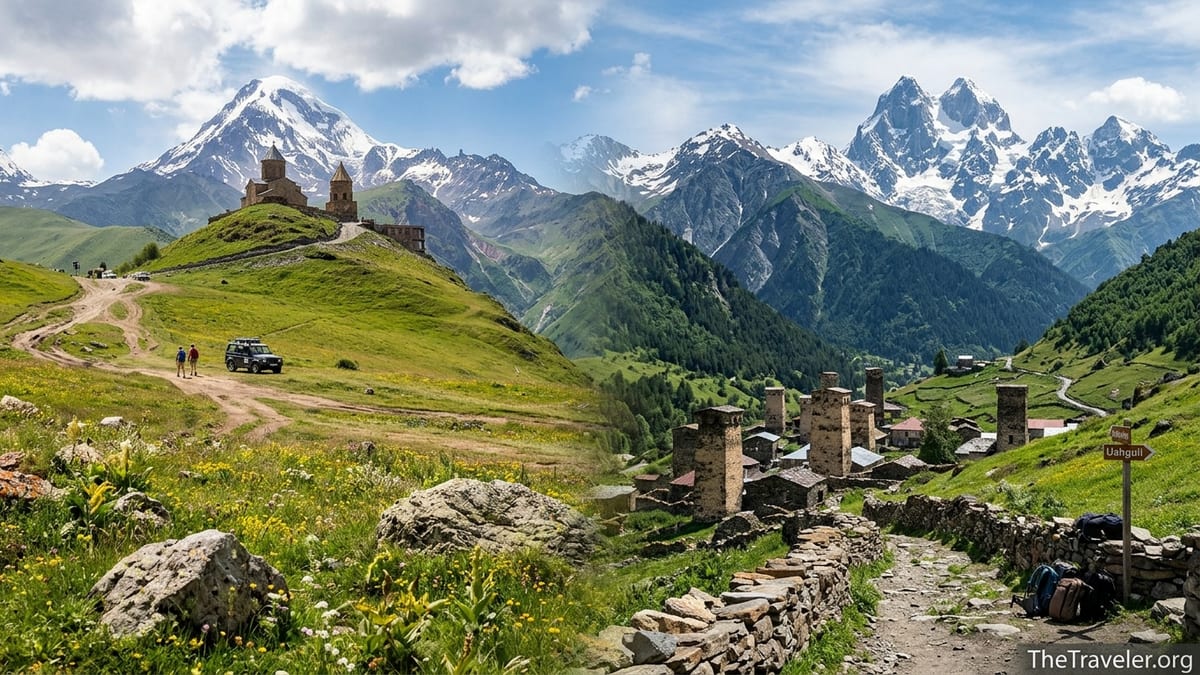
Kazbegi and Svaneti in a Nutshell
Kazbegi, centred on the small town of Stepantsminda, concentrates much of its mountain scenery within a short radius. The classic view of Mount Kazbek rising behind Gergeti Trinity Church, the Juta and Truso valleys and several glacier approaches all sit within roughly 30 minutes of town by road. For a first-time visitor, that means you can drop your bag at a guesthouse and be on a trail within an hour of arrival, without needing to relocate between villages.
Svaneti, by contrast, is a spread-out highland region where tourism hubs like Mestia and Ushguli are only the beginning. Medieval Svan defensive towers, multi-day trekking routes between remote hamlets, and separate valleys leading towards different glaciers and passes require more time and logistics. You can still do rewarding day hikes from Mestia, but Svaneti reveals its real character on three to five day routes such as Mestia to Ushguli, rather than quick overnight escapes.
For first-time hikers, the key difference is density versus depth. Kazbegi offers a compact cluster of beginner to intermediate walks that stack easily into a two or four day stay. Svaneti offers more ambitious itineraries and wilder landscapes, but travel time and route length mean your margin for error is smaller if you are trying to squeeze it into a long weekend.
Getting There: Travel Time, Transport and Weather Risks
From Tbilisi to Stepantsminda, marshrutkas and shared taxis leave from Didube bus station. Recent reports put the marshrutka fare in the region of 20 to 25 GEL one way, with a journey time of around three hours on the Georgian Military Highway in normal conditions. Shared taxis usually charge about 40 to 60 GEL per seat, while a full private car for two to four people generally costs in the range of 150 to 220 GEL one way depending on the operator and included photo stops at Ananuri, the Jvari Pass and other viewpoints. These options make Kazbegi an easy same-day transfer even after a slow breakfast in Tbilisi.
Reaching Mestia in Svaneti from Tbilisi is a different proposition. Direct marshrutkas from the capital to Mestia, advertised from both Navtlugi / Samgori and Didube, are usually priced around 50 to 60 GEL per person one way and can take nine to ten hours including mountain sections. Another widely used option is the morning train from Tbilisi to Zugdidi, which recent schedules show at around 17 to 20 GEL for a second-class seat and about six hours of travel, followed by a marshrutka from Zugdidi to Mestia for roughly 35 to 40 GEL and around four hours on a winding mountain road. Door to door, this still means at least ten hours of travel each way.
There is also a domestic flight option between the Tbilisi area and Mestia operated by a small airline using Natakhtari airfield near the capital. In 2026, one way fares have been advertised at about 90 GEL, which is an attractive price compared to a full-day bus. However, these small aircraft operate under visual-flight rules and cancellations due to cloud, snow or wind in the mountain valley around Mestia are well known. Travellers routinely report having to rebook onto ground transport at short notice when winter weather rolls in, so this should not be the only leg of a tight itinerary.
Once you factor in return journeys, a two night trip to Svaneti often means you will spend two long days on the road for one full hiking day in Mestia. By comparison, a two night Kazbegi trip gives you roughly one half day plus one full day on the trails with only three hours of initial travel. For visitors on a five or six day Georgia itinerary, or those nervous about very long bus rides, Kazbegi is usually the more practical mountain escape.
Trail Access and Difficulty: Gergeti, Juta and Truso vs Mestia and Ushguli
In Kazbegi, several headline hikes are either walkable from town or accessible with short local transfers. The hike from Stepantsminda up to Gergeti Trinity Church follows a well-used path from the edge of town, gaining roughly 450 to 500 meters of elevation over 3 to 4 kilometres one way depending on the chosen track. Many visitors who prefer not to hike up hire a local 4x4 or taxi to the church parking area for an agreed rate, often around 60 to 80 GEL return per vehicle for a small group, then explore the panoramic ridge on foot.
Stronger hikers often continue towards the Gergeti Glacier. The most common route from the church to the glacier viewpoint is a serious high-altitude hike. Route descriptions typically give total distances of 14 to 18 kilometres return from the church, with an additional 900 to 1,000 meters of elevation gain. Terrain above the Sabertse ridge is steep and can hold snowfields well into summer, and the actual glacier tongue and crevasses are not a place for unguided walkers. This is a full-day undertaking for experienced hikers with good conditioning and weather awareness.
Juta Valley, starting from the village of Juta about 30 minutes by rough road from Stepantsminda, offers gentler options and dramatic rock towers. Local taxis and 4x4s in high season typically quote 70 to 120 GEL return per car, so sharing with other hikers keeps the cost reasonable. Once in Juta, an undulating path follows the river towards Chaukhi Massif. A basic out and back to the seasonal lakes and meadows can be kept to around 8 to 10 kilometres with moderate elevation gain. More demanding passes around Chaukhi or towards Roshka require better fitness, navigation and sometimes dealing with loose scree or early summer snow.
Truso Valley, reached by a turnoff south of Stepantsminda, is another highlight. The main walking route follows a wide river valley with mineral springs and abandoned hamlets. Many hikers are dropped near Kobi village or the former border post and walk a relatively gentle track of roughly 14 to 18 kilometres return with modest elevation change. Parts of the valley lie within a controlled zone close to the administrative boundary with South Ossetia, so some side routes and the upper end of the valley can be restricted or subject to temporary closures; local guesthouses, drivers or the police checkpoint usually have current information before you set out.
In Svaneti, Mestia is the main trailhead town. A popular first walk is to Chalaadi Glacier, reached by a short vehicle transfer along the Mestiachala valley and then a hike through forest and river boulders. Local tourism information gives a total length from Mestia of up to 19 kilometres return if walked entirely from town, but many travellers shorten this by driving part of the access road. The glacier viewpoint sits near 1,900 to 2,000 meters above sea level with steady but manageable elevation gain. Rooty and rocky sections, especially after rain, make this an intermediate-level day hike rather than a casual stroll.
The Koruldi Lakes day hike rises more steeply above Mestia. Route notes describe a gain of more than 1,000 vertical meters, and side information from long-distance trail guides suggests another 350 meters of climb from the upper ridge to the lakes themselves. The reward is a high alpine basin reflecting Ushba and other Svaneti peaks, but the sustained ascent, exposure on some ridges and potential for afternoon storms mean that this route is better suited to fit hikers comfortable with long climbs.
Further afield, the road and trail to Ushguli, one of Europe’s highest permanently inhabited villages, form part of a classic four-day point-to-point hike from Mestia. Shorter visits use 4x4 jeeps on an unpaved and sometimes rough road that can include river crossings and landslide-prone slopes. From Ushguli, well-known trails head towards Shkhara Glacier or over passes towards the lower Imereti region, but these are significant mountain routes where distances, river levels and snow patches can turn a nominal “day hike” into an all-day challenge.
Seasonality, Hazards and Emergency Considerations
Both Kazbegi and Svaneti are real mountain environments where seasons matter. In Kazbegi, the road over the Jvari Pass can experience heavy snowfall from late autumn into early spring, occasionally closing for hours or longer. Trails to Gergeti Trinity Church are usually accessible on foot for most of the year, but the Gergeti Glacier route above 3,000 meters can hold snow, ice and unstable slopes into June or later. Afternoon thunderstorms build quickly in summer, and the exposed ridges offer little shelter, so early starts and strict turnaround times are prudent.
Svaneti sits higher and deeper in the Caucasus. Snow can linger on north-facing passes around Mestia and Ushguli well into June, and autumn storms have a greater impact on unpaved mountain roads. The access road between Zugdidi and Mestia has seen regular maintenance but remains vulnerable to landslides and temporary closures in very wet periods. River crossings on some trails, especially beyond the most frequented glacier paths, can become unsafe after rain or in peak snowmelt.
Neither region has dense on-trail infrastructure. In Kazbegi, phone coverage on the main day hikes is often present but patchy, and there are no staffed ranger stations along the Gergeti Glacier or Truso Valley routes. In Svaneti, some multi-day trails pass through villages with basic guesthouses, but rescue capacity is limited. Mountain rescue operations do exist in Georgia, often coordinated through emergency number 112, yet weather, daylight and access tracks can significantly slow response times. For demanding hikes, carrying proper layers, a basic first-aid kit, offline maps, and being willing to turn back is more realistic than relying on help arriving quickly.
Guides are widely available in both regions through guesthouses and local agencies. Rates vary, but a full-day private hiking guide might cost in the range of 150 to 250 GEL in Kazbegi or Mestia, potentially more for technical glacier approaches that require certified mountaineering skills. For first-time visitors attempting routes like the Gergeti Glacier, high passes around Juta or longer Svaneti traverses, this can be a sensible safety investment.
Accommodation, Food and Local Transport Costs
Stepantsminda has seen significant growth in guesthouses and small hotels. As of late 2026, double rooms in simple family guesthouses with breakfast often run in the ballpark of 80 to 150 GEL per night, while mid-range hotels with private bathrooms and views of Mount Kazbek may charge 200 to 400 GEL or more in peak season. Juta, functioning mainly as a summer village, has a smaller selection of basic guesthouses and camp-style lodges; prices for simple rooms or cabins tend to be slightly higher than in town for similar quality, reflecting the remote setting and short season.
Mestia offers a broad spread of options too. Updated local and regional sites list guesthouse doubles with breakfast typically around 90 to 160 GEL, with better-equipped hotels charging 220 GEL and upwards. Ushguli, at the road end, has more rustic guesthouses where a half-board package including dinner and breakfast is common, often priced per person rather than per room. Travellers report paying an approximate range of 70 to 120 GEL per person for simple rooms and two meals in recent seasons, though quality and heating can vary widely.
Food in both regions is relatively affordable by European standards. A basic café meal in Stepantsminda or Mestia, such as khachapuri, khinkali and salads, might cost 25 to 45 GEL per person without alcohol, while more substantial dinners in tour-oriented restaurants can reach 60 GEL or more. Guesthouse dinners are often generous set menus and can be good value when priced at 30 to 50 GEL per person. Beer and simple Georgian wine are widely available at moderate prices.
Local transport is a key budget line. In Kazbegi, a return 4x4 or taxi to Juta or Truso shared among three or four hikers might come to 20 to 40 GEL per person. In Svaneti, a shared seat on a jeep between Mestia and Ushguli is commonly quoted around 50 to 80 GEL per person return in main season, reflecting both the road condition and the longer driving time. Booking through your guesthouse or bargaining directly with drivers in the village square are standard approaches in both regions.
Sample Two-Day and Four-Day Itineraries
For a two-day Kazbegi visit without a car, a common plan is to take an early Tbilisi marshrutka to Stepantsminda on day one, check into a guesthouse, then hike or take a 4x4 up to Gergeti Trinity Church in the afternoon, spending sunset on the ridge before walking down. Day two can be dedicated to a Truso Valley hike, arranged through a local driver, before returning to Tbilisi on the evening marshrutka. This keeps walking distances moderate and avoids high-altitude glacier terrain while still feeling like a full mountain escape.
A four-day Kazbegi itinerary opens up more variety. One approach is to fit Gergeti Church and town exploration into the arrival afternoon, dedicate a full second day to the demanding Gergeti Glacier approach with a guide, spend day three in Juta Valley with a hike towards Chaukhi Massif, and keep day four flexible for either Truso Valley or a shorter leg-stretcher if weather or fatigue intervene. The key is to avoid stacking the longest, highest routes back to back without rest.
In Svaneti, a realistic two-day visit by ground transport is challenging. One option for those insisting on sampling the region in a short window is to take the train plus van combination from Tbilisi to Mestia on day one, arriving in the late afternoon, then enjoy a short walk around the Svan towers and museums. Day two could then be a full or half day hike to Chalaadi Glacier or an organised jeep excursion to Ushguli, with a return to Zugdidi or an overnight marshrutka starting the journey back. Even in this compressed scenario, two of your three calendar days are largely absorbed by transit.
A four-day Svaneti trip, by contrast, feels more balanced. One sample plan is to arrive in Mestia on day one and explore town, hike to Chalaadi Glacier on day two, take a jeep or start the multi-day trail towards Ushguli on day three, overnight in a village en route, and finish in Ushguli on day four before returning to Mestia by vehicle. Another option is to base yourself in Mestia for all three nights and focus on day hikes, combining Chalaadi Glacier, Koruldi Lakes and shorter tower village walks, leaving the full Mestia to Ushguli trek for a future, longer visit.
Indicative Budgets for Solo Hikers and Couples
For a solo hiker on a tight budget, a two night Kazbegi stay might look like this in late 2026 prices. Return marshrutka from Tbilisi at approximately 40 to 50 GEL total, two nights in a basic Stepantsminda guesthouse with breakfast at perhaps 160 to 220 GEL, simple café lunches and guesthouse dinners at roughly 120 to 180 GEL over two days, and shared local transport to one side valley, say 30 to 40 GEL for a seat in a taxi to Juta or Truso. Without hiring a guide, this produces a rough budget in the vicinity of 350 to 500 GEL for two nights excluding extra drinks or gear rental.
For a couple seeking a little more comfort in Kazbegi, a mid-range hotel at 260 to 400 GEL per night including breakfast would push the two-night lodging line to 520 to 800 GEL. Adding return marshrutka or a shared taxi for two at, say, 80 to 120 GEL total, two dinners in restaurants at 150 to 250 GEL overall, and a private driver for a full day combining Juta and viewpoints at 200 to 250 GEL, a realistic two-night budget climbs into the 1,000 to 1,400 GEL range, still excluding specialist guiding services.
In Svaneti, the longer journey and additional internal transfers raise costs. A solo hiker taking the Tbilisi to Zugdidi train at around 17 to 20 GEL and a Zugdidi to Mestia van at about 35 to 40 GEL in each direction might spend roughly 100 to 120 GEL on long-distance transport alone. Two nights in a Mestia guesthouse with breakfast could add 180 to 260 GEL, while food at cafés and guesthouse dinners might come to another 150 to 220 GEL for two days. Factoring in a jeep seat to Ushguli or a short local transfer to the Chalaadi trailhead for perhaps 40 to 80 GEL, a two-night Svaneti budget for a solo traveller can easily reach 470 to 680 GEL before any guide fees.
For a couple in Svaneti staying three or four nights, the numbers scale quickly. If two people share a mid-range guesthouse room at 200 to 240 GEL per night for three nights, that is already 600 to 720 GEL. Add roughly 200 to 240 GEL for combined train and van transport for two, perhaps 300 to 400 GEL for food including some guesthouse dinners, and 200 to 300 GEL for one or two shared 4x4 excursions and you approach 1,300 to 1,600 GEL, again excluding professional guides. Using the 90 GEL domestic flight where it operates can reduce travel time but does not radically lower total costs, and the risk of weather cancellations remains.
Who Should Choose Kazbegi, Who Should Choose Svaneti
For first-time hikers and visitors with limited time in Georgia, Kazbegi usually offers the better balance of access, effort and reward. The ability to reach Stepantsminda from Tbilisi in about three hours, settle into a guesthouse and choose between gentle and more demanding hikes all within one compact area makes it well suited to a two or three night stay. Those new to altitude, unaccustomed to long mountain approaches or travelling with children will appreciate the easier logistics and the option to shorten many outings with taxis or 4x4s.
Experienced trekkers, photographers and visitors primarily interested in multi-day routes may find Svaneti more compelling, provided they can allot at least four to six days including travel. The combination of medieval towers, high passes, glacier valleys and village-to-village trekking around Mestia and Ushguli creates deeper immersion in the Caucasus than a short Kazbegi stay can provide. For these travellers, the longer overland journey and rougher roads are part of the appeal rather than obstacles.
Budget-conscious travellers should look closely at hidden time costs. While marshrutka fares to Svaneti are not dramatically higher in absolute GEL than those to Kazbegi, the fact that you spend two full days sitting on buses for a two or three day stay can limit how far your accommodation and food savings go. Kazbegi’s shorter transfer time makes it easier to combine with other parts of Georgia on the same trip without feeling rushed.
Most importantly, a more remote destination is not automatically a better first experience. Choosing a region where you can match trail length and elevation to your fitness, adjust plans for weather, and reach help more easily if needed will make your first hikes in Georgia both safer and more enjoyable. For many visitors on their first Caucasus trip, that means starting with Kazbegi, then returning to Georgia another year to tackle the towers and long trails of Svaneti with the time and preparation they deserve.