


Landing at Las Vegas Harry Reid International Airport and heading straight to Downtown Las Vegas is a smart move if you love classic casinos, neon signs and a more local vibe than the Strip. The good news is that the airport sits only about 10 to 15 minutes from Fremont Street by car, but costs, travel times and convenience can vary a lot depending on how you travel. This guide breaks down every major option, what you can realistically expect to pay, and whether getting to Downtown is trickier than going to the Strip.
Get the latest updates straight to your inbox!
Airport to Downtown at a Glance
Harry Reid International Airport (LAS) is roughly 10 miles from Downtown Las Vegas, home to Fremont Street Experience, the Mob Museum and a growing lineup of boutique hotels and bars. In light traffic, the drive is often 15 minutes or less; in weekend or convention traffic, it can creep closer to 25 minutes. For most visitors, the decision is less about distance and more about comfort level with apps, budget and tolerance for waiting in lines.
Unlike trips between the airport and the Strip, which use a regulated flat-fare taxi zone system, rides to Downtown are meter-based. That alone makes Downtown feel a bit more complicated. You will see plenty of signs at the airport explaining the flat Strip fares, but there is no simple posted price for Downtown. Expect that difference to influence both cost and the conversations you have with taxi drivers.
Most independent travelers choose between a classic taxi, an Uber or Lyft ride, or a prebooked private transfer. Public buses are possible but have become less straightforward, especially with upcoming changes to airport-serving routes. Shared hotel shuttles are less common than they used to be and are now mainly run by a few private operators or by specific hotels.
For a typical couple with two checked bags landing at Terminal 1, the most practical options to Downtown are usually a rideshare or taxi. Solo travelers on tight budgets may consider the bus if they are comfortable walking a few blocks. Larger groups or those arriving late at night often find that private vans or SUVs offer a better price per person and less hassle.
Taxi from Harry Reid Airport to Downtown Las Vegas
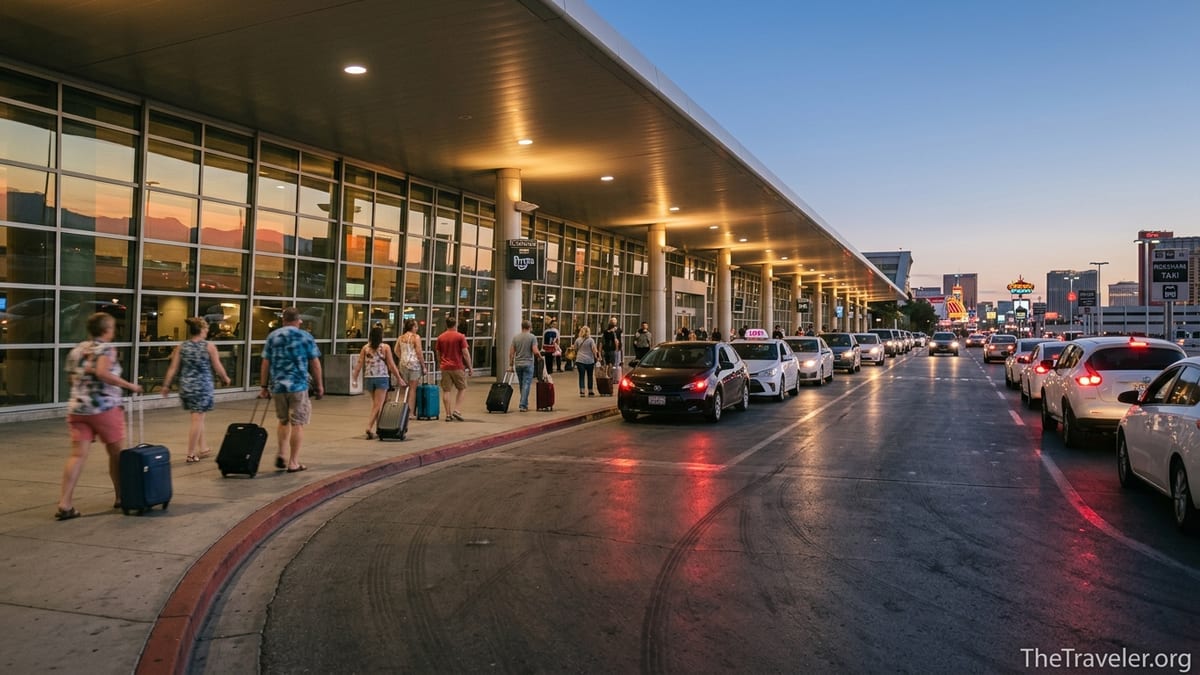
Las Vegas taxis queue in dedicated ranks at both Terminal 1 and Terminal 3, with airport staff directing you to the next available cab. This is the most old-school, straightforward way to reach Downtown: follow the “Taxi” signs, wait in line, and hop into the next car. You do not need to book ahead, and taxis run 24 hours a day.
Taxi fares from Harry Reid to Downtown are calculated on the meter, not a flat zone rate. Recent visitor reports commonly show totals in the range of about 30 to 45 dollars before tip for a direct ride to hotels like the Golden Nugget, Circa, Fremont or Downtown Grand, depending on traffic and any surcharges. Heavier traffic on Interstate 15 or Las Vegas Boulevard will quickly push that number toward the upper end of the range. Fuel surcharges, if in effect, are already incorporated into the metered total.
One concern visitors sometimes mention is “long hauling,” where drivers take a longer route, such as extended freeway loops, to increase the fare. Going Downtown, the most typical routes are via Interstate 15 or surface streets like Paradise Road and Main Street. If you want to keep it simple, you can politely say at the start of the ride, “Please take the most direct route to Fremont Street, no tunnels.” Downtown routes do not typically involve the airport tunnel in the same way Strip routes do, but stating your preference signals that you are paying attention.
In terms of convenience, taxis shine if you land during a busy period for rideshare apps. On some weekends, rideshare pickup zones fill with long lines of travelers staring at their phones while the taxi queue moves steadily. For a couple with luggage who arrives on a Friday evening, a taxi might cost a few dollars more than a perfectly timed rideshare, but it is often faster from baggage claim to hotel door.
Uber and Lyft: Rideshare from Airport to Downtown
Uber and Lyft are fully authorized at Harry Reid International. Pickup areas are in the parking garages connected to each terminal, not at the regular curb. From Terminal 1 baggage claim, you take the elevator near Door 2 to Level 2, walk across the pedestrian bridge to the garage and follow “Ride Share” signs. At Terminal 3, you go up from baggage claim to the bridge and then down to the valet level of the parking structure. Large signs and floor markings guide you, and airport staff can point you in the right direction.
Fares vary with demand, time of day and the type of car. Under calm conditions, it is common to see approximated prices for an UberX or standard Lyft from the airport to Downtown in the 25 to 40 dollar range. During peak weekend nights or major conventions, dynamic pricing can push a basic ride closer to 45 dollars or more. The app will show estimates before you confirm, including the airport rideshare fee that is passed on to passengers per trip.
In practice, many travelers report that rideshare to Downtown is often a bit cheaper than a metered taxi, especially outside of peak times, but not always dramatically so. For example, a Tuesday evening arrival might show a 28 dollar Lyft to the Fremont Street area, while a Friday night arrival during a major event could easily show 45 dollars. Because fares are quoted upfront, you at least know what you are agreeing to before you get into the car, something you will not see with the taxi meter until the end of the ride.
The main drawbacks of rideshare are the walking distance to the pickup zones and wait times at busy hours. On holiday weekends, dozens of people can be trying to meet drivers in the same garage areas. Drivers sometimes queue outside the airport for 20 to 40 minutes waiting for trips, which can make them unwilling to accept very short or cheap rides if there is surge pricing nearby. Still, for travelers who already use Uber or Lyft at home and do not mind using their phones after a long flight, rideshare remains one of the most flexible, familiar choices.
Public Bus and Budget Options to Downtown
Las Vegas is not a city where the airport bus is the instinctive choice, but budget-conscious travelers and some locals do use the Regional Transportation Commission (RTC) system. Historically, the Centennial Express (CX) route connected the airport, the Strip and Downtown in a single line. Current and planned changes are shifting that service pattern away from direct airport access, which makes using the bus less straightforward than in the past.
Today, the most common public transit strategy involves using a combination of airport-serving routes and the Deuce or other north–south lines that run up to Downtown. One example is riding a Maryland Parkway route near the airport area, then transferring to the Deuce, which runs 24 hours between the Strip and Downtown along Las Vegas Boulevard. Cash fares on RTC buses are generally modest compared with taxis or rideshare, and visiting riders can purchase short-duration passes from vending machines at major stops.
The trade-offs are significant. Bus journeys from the airport to Downtown can easily take 45 to 75 minutes, including walking to stops, waiting for buses and making transfers. If your hotel is directly on Fremont Street, you may still have to walk a few blocks from the nearest downtown transit center or stop with luggage in hand. Nighttime rides can feel slow and tiring after a long flight, and vehicles may be crowded during major events.
As a real-world example, a solo traveler arriving midday on a weekday, with only a cabin bag and a strict budget, might spend under ten dollars total by stitching together two RTC buses. The same person taking Uber could spend three to four times that amount. That trade-off makes sense for some, but most short-stay visitors who value time and convenience prefer to spend more on a direct car-based ride.
Shared Shuttles and Private Transfers
Shared hotel shuttles that once used to circle the terminals looking for passengers are far less visible than they were a decade ago. Some off-Strip and Downtown hotels still partner with private shuttle companies, but widespread, low-cost shared shuttles from Harry Reid to Downtown are no longer the default option. Where they do exist, they often run on set timetables and may require advance booking through specific operators or online travel agencies.
Private transfers, on the other hand, have become more popular. Prebooked sedans, SUVs and vans meet you at designated zones or limo loading areas and hold a sign with your name. These services are typically priced per vehicle, not per person. A pre-arranged sedan or SUV for up to three or four passengers going from the airport to a downtown property might fall into a range of roughly 60 to 120 dollars depending on the vehicle class, time of day and level of service. Larger vans for six to ten people will cost more overall, but far less per person than separate taxis or rideshare rides.
For example, a group of six friends arriving on a Thursday to celebrate at the Fremont Street Experience could book a private van that works out to about 20 dollars per person, including a short grocery or liquor stop on the way. The equivalent journey in two taxis might cost nearly the same but with less coordination and no guaranteed stop. For families with young children or older relatives, the appeal of having a known driver waiting, space for car seats and help with bags is often worth the premium.
Private transfers generally need to be arranged at least a day or two in advance, especially for late-night arrivals or busy weekends. If your flight is delayed, reputable providers track arrival times and adjust pickups, but it is always wise to keep an eye on your booking emails or messages and update the company if your schedule changes significantly.
Driving Yourself: Rental Cars and Friends or Family
While most visitors to Downtown Las Vegas do not need a rental car for their entire stay, some choose to pick up a vehicle at the airport because they plan to explore Red Rock Canyon, Hoover Dam or the wider region. The consolidated rental car center for Harry Reid is located a short shuttle ride from the terminals. From there, driving to Downtown is straightforward: major routes use Interstate 15 north and then exit toward downtown streets like Charleston or Bonneville.
If you are considering a rental car purely for the airport-to-downtown transfer, it rarely makes financial sense. Daily rental rates, insurance options and parking fees at downtown hotels quickly add up. Many Fremont-area hotels charge for parking or limit free parking to registered guests, and traffic along Las Vegas Boulevard can be slow at peak hours. For a short weekend focused on casinos and live music downtown, it is almost always cheaper and less stressful to rely on taxis or rideshare for your airport transfers and the occasional side trip.
Travelers being picked up by friends or family will find dedicated passenger pickup areas signed at each terminal. Your driver can wait in a nearby cellphone lot or short-term parking until you text that you are curbside. In practice, though, many locals still prefer that visitors simply grab a rideshare or taxi to Downtown, especially during heavy traffic or late-night arrivals when navigating airport roadways can be confusing.
As a real-world scenario, a local friend living near Summerlin might reasonably spend 30 to 40 minutes each way in traffic to pick you up and drop you in Downtown. If your flight lands at midnight on a Friday, that favor may cost them well over an hour of their night, while an Uber from the airport might be around 35 dollars. For some relationships, that trade-off is worth it; for others, paying for the ride is kinder.
Is Getting to Downtown Harder Than Getting to the Strip?
In one sense, no: both Downtown and the Strip are straightforward, short drives from Harry Reid along wide, well-marked roads. Car-based travel options are abundant for each. Yet from a cost and simplicity perspective, Downtown is a little less plug-and-play than the Strip. The main reason is the flat-fare taxi zones that apply only to Strip hotels, not Downtown. That means visitors going to the Strip see large signs with set taxi prices, while Downtown visitors must rely on meter-based fares and approximations.
Rideshare demand also skews toward the Strip, simply because most hotel rooms in Las Vegas are still clustered there. During certain peaks, more Uber and Lyft drivers position themselves between the airport and the Strip, completing quick loops. Trips to Downtown are slightly longer and may be less frequent, which can translate into marginally longer wait times or higher prices during surges. In normal conditions, however, the difference is often only a few minutes and a few dollars.
Public transit is clearly less convenient to Downtown from the airport than it is to some Strip resorts. While the Deuce provides a simple one-seat ride along the Strip to Fremont Street, you first have to get from the airport to a Deuce stop, usually by bus or rideshare. That added step is enough to push many visitors toward door-to-door options, especially in hot summer weather when even short outdoor walks can be uncomfortable.
In practical terms, consider this comparison. A first-time visitor landing at 3 p.m. on a weekday and staying at a mid-Strip resort can grab a flat-fare taxi with a known price and be at their hotel in 10 to 15 minutes. The same visitor staying at the Golden Nugget has to accept a metered taxi ride or an app-quoted rideshare price that might range from budget-friendly to surprisingly high depending on traffic and events. It is not dramatically harder to reach Downtown, but it does require a touch more price awareness and flexibility.
The Takeaway
For most travelers, the best way to get from Harry Reid International Airport to Downtown Las Vegas is a straightforward choice between taxis, rideshare apps and prebooked private transfers. Taxis excel for sheer simplicity and 24-hour availability, though they rely on the meter and can cost more in heavy traffic. Uber and Lyft usually provide transparent upfront pricing and slightly lower averages, balanced against the need to walk to pickup zones and navigate occasional surges.
Budget buses still serve the broader airport area and downtown corridor, but changing routes and the need for transfers make them a niche option best suited for experienced transit users or long-stay visitors trying to minimize costs. Shared hotel shuttles now play a smaller role than in the past, while private sedans and vans fill the gap for groups, families and travelers who value pre-arranged service.
Downtown is not dramatically harder to reach than the Strip, but the lack of flat taxi fares and a less polished transit connection mean that newcomers should arrive with realistic expectations about price and time. If you prioritize ease, follow the signs to the taxi or rideshare areas, confirm your destination clearly and allow 15 to 30 minutes for the journey. With a little planning, your first glimpse of Fremont Street’s neon canyon can be as smooth as the desert highway that gets you there.
FAQ
Q1. How long does it usually take to get from Harry Reid Airport to Downtown Las Vegas?
In normal traffic, the drive typically takes about 15 to 20 minutes by taxi, rideshare or car. During busy weekends, major conventions or rush hour, it can stretch closer to 25 or even 30 minutes, especially if there are delays on Interstate 15 or surface streets near Fremont Street.
Q2. Is taxi or Uber cheaper from the airport to Downtown?
Prices overlap, but a standard Uber or Lyft is often slightly cheaper on average, especially outside peak times. A typical rideshare might fall around the mid 20s to mid 30s in dollars, while a metered taxi could land in the low 30s to mid 40s depending on traffic. However, during price surges, Uber or Lyft can become as expensive as or more expensive than a taxi.
Q3. Why is there a flat taxi rate to the Strip but not to Downtown?
The flat-fare system was introduced by regulators for trips between the airport and designated Strip zones to simplify pricing and reduce complaints about long hauling. Downtown hotels are outside those defined airport zones, so taxis charge by the meter instead. That means visitors heading to Fremont Street do not get a published flat rate and must rely on normal metered fares.
Q4. Where do I meet my Uber or Lyft at Harry Reid Airport?
Rideshare pickups happen in the parking garages connected to each terminal, not at the regular curb. At Terminal 1, you go from baggage claim up to Level 2, cross the pedestrian bridge to the garage and follow “Ride Share” signs. At Terminal 3, you go to the bridge level from baggage claim, cross to the garage and then down to the valet level where the rideshare area is clearly signed.
Q5. Is there still a direct public bus from the airport to Downtown?
Service patterns have evolved, and the once straightforward express that linked the airport, Strip and Downtown has been reconfigured. You can still reach Downtown by combining airport-area routes with services like the Deuce that run up Las Vegas Boulevard, but this usually involves at least one transfer, more walking and significantly longer travel times than a taxi or rideshare.
Q6. Are private transfers or limos worth it for Downtown?
They can be, especially for groups, special occasions or travelers who want a stress-free arrival. A prebooked sedan, SUV or van will meet you at a designated pickup zone and often includes help with luggage and optional stops. While the total cost is higher than a single taxi, the price per person can be very reasonable if you fill the vehicle, and you avoid lines and app juggling after a long flight.
Q7. Is Downtown harder to reach from the airport than the Strip?
Physically, no: both are short drives on wide roads. In terms of pricing and simplicity, Downtown is slightly less straightforward because taxi flat fares do not apply and public transit is less direct. You will still find plenty of taxis and rideshare cars willing to go there, but you should be prepared for metered taxi pricing and possibly a few extra minutes on the road.
Q8. What is the safest option late at night from the airport to Downtown?
Late at night, taxis, Uber and Lyft, and reputable private transfers are all common choices. Taxis and prebooked drivers are easy because they are already on site and well regulated. If you use rideshare, verify the license plate, car model and driver name in the app before getting in, meet your driver only in the signed pickup areas and consider sharing your trip details with a friend or family member.
Q9. Can I stop at a store on the way to my Downtown hotel?
Many taxi and private transfer drivers are willing to add a quick stop for supplies, especially if you ask politely and understand that waiting time continues on the meter or is billed as extra. Some pre-arranged services explicitly include a short grocery or liquor stop in their pricing. Rideshare drivers may agree to stop briefly, but they are not obligated to, and making multiple unscheduled stops can be awkward in app-based services.
Q10. Do I need to tip for the ride from the airport to Downtown Las Vegas?
Tipping is customary in Las Vegas for both taxis and rideshare. Many travelers tip around 15 to 20 percent of the fare, adjusting up for excellent service, heavy luggage help or late-night pickups. You can tip taxi drivers in cash or by card on the in-car payment terminal, and rideshare apps allow you to add a tip after the trip is completed.