


Arriving at Toronto Pearson International Airport with luggage, kids or jet lag often means you just want a straightforward ride into the city. While the Union Pearson Express train is fast and popular, for many travelers a taxi or limousine is still the easiest way to get from the terminal curb to a hotel, meeting or home address. This guide explains how licensed airport taxis work at Pearson, what flat-rate fares you can expect in 2026, how limo services compare, where to find them in each terminal, and when a cab makes more sense than the train.
Get the latest updates straight to your inbox!
How Taxis and Limos Work at Toronto Pearson
Toronto Pearson is Canada’s busiest airport, and only vehicles licensed by the airport authority are allowed to pick up passengers at the terminals. These are usually referred to as “airport taxis” and “airport limos.” They operate from designated curbside ranks at Terminal 1 and Terminal 3 and charge flat-rate fares to most destinations in the Greater Toronto Area, rather than running a metered fare from the airport. In practice this means you know your approximate cost before you get in, which is reassuring after a long flight.
Airport taxis are typically regular sedans in neutral colors with roof lights and company branding, while limousines at Pearson are usually black sedans or SUVs marketed as “black car” or “executive” service. Both categories are regulated, insured, and vetted to operate on airport property. A typical ride to downtown Toronto in a standard airport taxi in 2026 might fall in the range of about 65 to 80 Canadian dollars for a sedan, while an SUV or limo for a family with several large suitcases can be in the 90 to 110 dollar range depending on the company and exact drop-off point.
These airport vehicles are distinct from city cabs and rideshare cars that you might hail or book in town. Local taxis licensed by the City of Toronto can legally drop travelers at Pearson but cannot join the official pickup line without an airport permit. Rideshare services like Uber and Lyft operate in dedicated pickup zones and use dynamic pricing, which can occasionally be cheaper than an airport taxi but can also surge sharply in bad weather or late at night. Many visitors still prefer the predictability of official taxis and limos, especially if the flight is arriving after midnight or with young children.
Pre-arranged car services make up a third category. These are companies you book in advance that have authorization to meet you at Pearson. Their drivers typically wait in a staging area and pull up to a designated pre-arranged pickup point when you land. For example, a downtown hotel might recommend a partner service that offers a pre-booked sedan at a fixed fare, such as 65 to 75 dollars from the financial district to the airport and a similar amount back again.
Understanding Flat-Rate Taxi Zones and Typical Costs
Unlike many airports where your taxi fare is entirely meter-based, Pearson uses a zone system with flat-rate tariffs for airport pickups. Destinations across Toronto and surrounding cities are grouped into zones, and each zone has a set fare for sedans and a higher one for larger vehicles. This system is managed by the airport authority and is designed to prevent overcharging. Official airport taxis have a laminated card or sticker inside the vehicle showing the zones and corresponding fares, and drivers are expected to quote the flat rate if you ask before departure.
In real terms, travelers in 2026 can expect a standard airport taxi from Pearson to downtown Toronto, such as the area around Union Station or the Entertainment District, to cost in the ballpark of 65 to 80 dollars for a sedan. Trips to central Mississauga, including the Square One area, tend to be slightly cheaper at roughly 45 to 60 dollars. Journeys to farther-flung suburbs like Markham, Richmond Hill or Oakville usually run higher, sometimes in the 80 to 120 dollar range depending on exact distance and whether you choose a larger vehicle for extra luggage.
For longer runs, such as from Pearson to Hamilton, Kitchener or Barrie, licensed airport taxis and limos still use zone-based flat rates. For example, a mid-range limo company might publish a flat fare in the low 100s of dollars from Pearson to downtown Hamilton and somewhat higher for Waterloo Region or Barrie. These longer trips are where limo services often compete strongly with taxis because a roomy SUV or executive sedan at a modest premium over a basic cab can be more comfortable when you have multiple people and bags on board.
If you are traveling within Toronto itself, it is worth knowing that city taxis leaving from downtown to the airport may offer their own flat rates, often in the 60 to 70 dollar range for a one-way trip from neighborhoods like the Financial District, Liberty Village or the Yonge and Bloor area. Many local flat-rate operators advertise approximate fares such as 60 to 70 dollars between downtown and Pearson, which usually compares favorably to a metered ride in heavy rush-hour traffic.
Where to Find Licensed Airport Taxis and Limos at Pearson
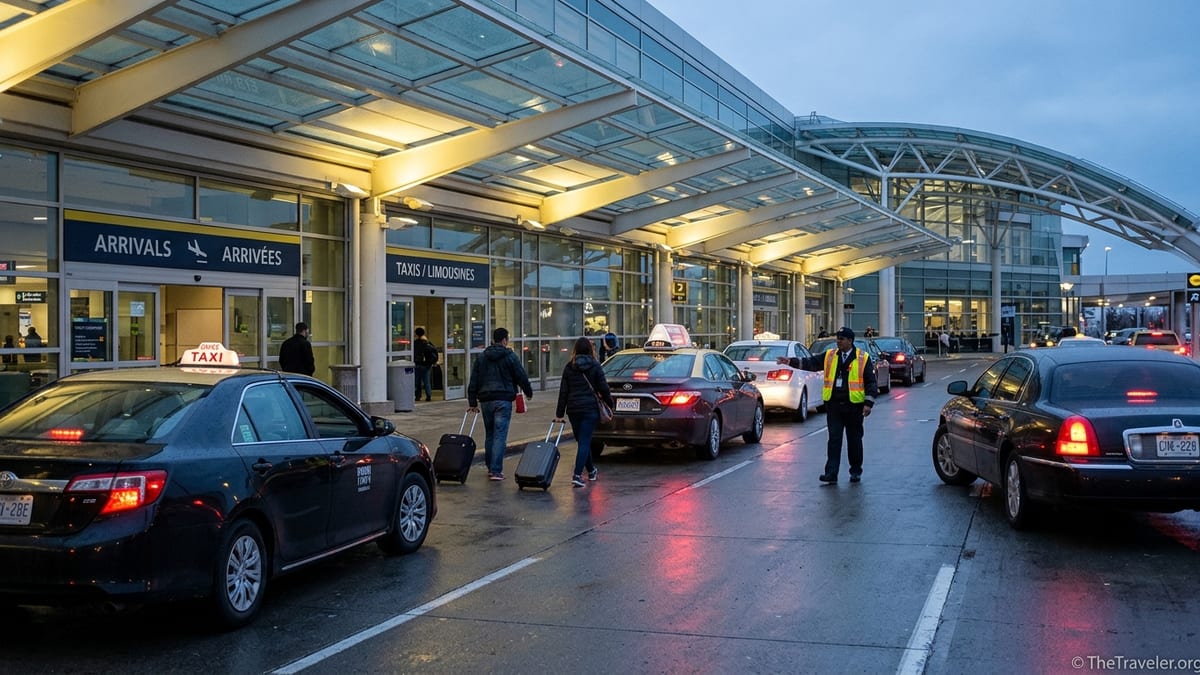
When you arrive at Pearson, the key is to ignore anyone approaching you inside the terminal offering a ride and instead follow the official signs. In both Terminal 1 and Terminal 3, licensed airport taxis and limos wait at the arrivals level outside the sliding doors, clearly marked by “Taxis” and “Limos” signage and staffed by curbside attendants who can direct you to the correct queue. The lines move steadily even at busy times because vehicles are staged nearby and waved forward as passengers arrive.
At Terminal 1, after clearing customs and collecting your luggage, you walk straight out to the arrivals curb. Signs overhead indicate “Ground Transportation,” and you will see separate lanes for regular taxis, limousines and rideshares. Uniformed airport staff are on hand to help organize the queues, answer questions about approximate fares to major districts like downtown, North York or Mississauga, and find larger vehicles for groups or travelers with mobility aids. The taxi queue here often feels long in the late afternoon, but with a continuous stream of cars it typically moves faster than most first-time visitors expect.
Terminal 3 operates on a similar pattern. Once you exit the baggage hall onto the arrivals level, look for the ground transportation area where official taxis and limos line up. Again, attendants are present to help you choose the right type of vehicle, whether you are a solo business traveler heading to a Bay Street hotel or a family of five going to a short-term rental in Etobicoke. If you have pre-booked a limo or town car, your company will usually instruct you to wait at a specific post or pre-arranged services point, and your driver will meet you there holding a sign or will text you when they are in position.
If you are connecting landside between terminals or coming from the airport’s parking structures, it can be tempting to follow someone who approaches you in a hallway saying “taxi, taxi.” These solicitations often lead to unlicensed vehicles that are not allowed in the official queue and may be parked in a distant lot. For peace of mind, particularly regarding insurance and safety, it is wise to decline these offers and instead head to the marked taxi and limo stands at the arrivals curb, where every vehicle is vetted and regulated.
Limo and Black-Car Options: When They Make Sense
Limousines at Pearson are not necessarily stretch cars; in most cases they are black sedans, crossovers or SUVs with leather interiors and uniformed drivers. They operate under similar flat-rate rules as airport taxis but typically charge a premium in exchange for a higher level of comfort and service. For example, in 2026 a typical black-car operator might quote about 90 to 110 dollars for a ride from Pearson to a downtown Toronto hotel in an SUV, compared with roughly 70 dollars in a standard airport taxi for the same route.
That premium can be worth paying in several situations. Families traveling with young children, grandparents and multiple large suitcases often prefer an SUV limo so that everyone and everything fits in a single vehicle. An executive arriving for meetings in the Financial District may value the quieter cabin and more spacious legroom of an executive sedan. Couples beginning a special trip might choose a black car as an indulgence, much like upgrading to business class on a short flight. Many limo companies also offer complimentary bottled water, phone charging cables and, in some cases, child seats upon request.
Pre-booked limo services can be especially useful for very early morning departures or late-night arrivals. If your flight is scheduled to land at 1:00 a.m., having a driver track your flight and wait for you in the arrivals hall can smooth out the experience considerably. These services usually monitor flight status and adjust pickup time if your plane arrives early or is delayed. A pre-arranged flat fare of around 65 to 75 dollars from a central downtown address to Pearson at 4:30 a.m., for instance, saves you from wondering whether a rideshare surge or shortage will drive the cost up at the last minute.
Some limo companies also specialize in cross-border or long-distance journeys, such as taking travelers from Pearson directly to Niagara Falls, Buffalo or even Detroit. In practice, many groups flying into Toronto for a Niagara wine tour will book a passenger van or SUV limo for a fixed price rather than renting a car and navigating themselves. While these longer distances obviously cost more, they demonstrate the flexibility of the black-car market compared with standard city taxis or trains, which usually focus on regional trips only.
Paying for Your Taxi: Credit Cards, Cash and Receipts
Licensed airport taxis and limos at Toronto Pearson are required to accept major credit cards, which is a relief for international visitors arriving with limited Canadian cash. Visa and Mastercard are almost universally accepted, and many cars will also take American Express and contactless payments. When you get in, you can confirm with the driver that you plan to pay by card, and at the end of the trip the payment terminal is brought to the back seat or handed over for you to complete the transaction and add a tip.
Cash in Canadian dollars is also widely accepted, though you may find that some pre-arranged services prefer card payment secured with an online booking. If you are arriving from abroad and have not yet visited an ATM, using a credit card with no foreign transaction fees is often the most straightforward choice. Tips are not automatically included in the flat rate, and a common range for taxi tipping in Toronto is about 10 to 15 percent of the fare, more if the driver provides extra assistance with luggage in snow or heavy rain.
For business travelers, a receipt is usually essential for expense claims. Airport taxis and limos can print or handwrite receipts that show the company name, vehicle number, pickup and drop-off locations, date, time and total fare. If you know you will need one, it is a good habit to mention this to the driver early in the ride so there is no oversight when you are rushing to a hotel check-in desk or catching an elevator to a meeting in the financial core.
It is also helpful to understand what is included in the flat rate and what might incur additional charges. Standard fares typically cover the direct route during normal traffic conditions. Extra charges can apply for intermediate stops, unusually long waiting times while you run an errand on the way, or for special requests like adding a child safety seat. These extras are not standardized across companies, so asking the driver or dispatcher in advance is the best way to avoid surprises, particularly if your plans include picking up keys from a rental office or stopping at a grocery store en route.
Staying Safe and Avoiding Unlicensed Operators
Safety at Toronto Pearson’s official taxi and limo stands is generally high, due in part to the strict permitting system for airport pickups. Licensed vehicles display airport-issued plates or decals, and drivers are subject to background checks and insurance requirements. The curbside lines are monitored by airport staff, which deters aggressive solicitation and helps organize passengers into vehicles efficiently. Choosing a cab or limo from the official queue is the simplest way to ensure you are in a regulated vehicle with proper coverage.
The main safety concern for new arrivals is unlicensed drivers approaching inside the terminal. These individuals often offer a ride while you are still in the baggage hall or just past customs, sometimes using phrases like “official taxi” without having any visible airport identification. They may lead you to a private car in a remote parking area, where pricing is vague and insurance coverage uncertain. To avoid this, it helps to adopt a simple rule of thumb: if someone approaches you inside the building offering a ride, politely decline and walk to the signed taxi and limo stands on the arrivals curb instead.
For solo travelers arriving late at night, especially women or younger passengers, the monitored ranks can feel more reassuring than wandering through parking garages in search of a rideshare vehicle. If you are uncomfortable at any point, you can speak to a curbside attendant, who can help you choose a taxi or limo and note the vehicle number for you. Taking a moment to text that vehicle number and your destination to a friend or family member adds an extra layer of peace of mind.
It is also wise to verify key details before the car moves off. Confirm the agreed flat rate and destination, check that the driver’s license photo matches the person behind the wheel, and make sure any luggage is securely loaded. In winter, when sidewalks can be icy and visibility poor, this quick check helps avoid mix-ups, such as getting into a car that is meant for another passenger with a similar-sounding name or hotel.
Taxi vs UP Express: When a Cab Is the Better Choice
The Union Pearson Express train is often advertised as the fastest way to downtown, and that is true for many travelers. In 2026, an adult one-way fare between Pearson and Union Station costs just over 12 dollars at the standard rate and around 9 to 10 dollars with a regional transit card, with higher discounts for seniors and occasional promotional fares on weekends. The ride takes about 25 minutes and runs frequently during the day, making it an attractive option for solo travelers with light luggage who are staying near Union Station or one of the intermediate stops at Bloor, Mount Dennis or Weston.
Even so, there are several scenarios where a taxi or limo is easier despite the higher price. Families with small children and multiple suitcases often prefer door-to-door service directly to a hotel in neighborhoods such as the Entertainment District, Yorkville or Midtown, avoiding transfers from Union to the subway or streetcars. Travelers arriving late at night or very early in the morning, when train frequency drops or engineering work introduces bus replacement services, may find that waiting in a taxi queue is both quicker and more comfortable than figuring out altered train schedules.
For example, consider two people landing at Pearson around 11:00 p.m. on a snowy Friday, heading to a boutique hotel near King and Spadina. The UP Express plus a short rideshare or streetcar journey from Union might cost each of them roughly 12 dollars for the train plus an extra 10 to 15 dollars for the final leg, and could involve 40 to 50 minutes of combined waiting, walking and transfers. A taxi directly from the airport to the hotel might cost around 70 dollars total including tip and take 30 to 40 minutes depending on conditions, while allowing them to stay warm and seated door to door.
Taxis and limos are also a strong option for destinations not easily reached by rail, such as suburban corporate campuses in Mississauga or hotel clusters near highway interchanges in Vaughan and Markham. In these cases, reaching your final destination from an intermediate train station would require additional buses or rideshares, which can erase any savings from the train fare and add complexity after a long international flight. When calculating what is “easier,” it is often helpful to factor in the value of your time, your energy level on arrival, and the convenience of having luggage handled only once.
The Takeaway
Choosing the right ground transport from Toronto Pearson comes down to balancing cost, convenience and comfort. Licensed airport taxis and limos provide predictable flat-rate pricing, regulated drivers and straightforward pickup at the arrivals curb, which is ideal if you are traveling with luggage, kids or late at night. While rideshares and the UP Express train can be cheaper for solo travelers, the value of a direct, door-to-door ride is hard to beat when your priority is minimizing hassle rather than saving every last dollar.
For many visitors, a sensible strategy is to stay flexible. If you land at midday with only a carry-on and are heading to a hotel a short walk from Union Station, the UP Express may be the fastest and best-value choice. If, however, your flight is delayed into the early hours or you are juggling two overtired children, a stroller and three large suitcases, stepping into a licensed airport taxi or pre-booked limo at the curb is likely worth the higher fare. Knowing how the flat-rate system works, where to find the official vehicles, and what payment methods and safety practices to expect will let you make that decision confidently.
FAQ
Q1. How much does a taxi from Toronto Pearson to downtown cost in 2026?
A standard licensed airport taxi from Pearson to central downtown Toronto typically costs in the range of about 65 to 80 Canadian dollars for a sedan, with larger vehicles or SUVs priced higher.
Q2. Do I need to book a taxi from Pearson in advance?
No. Licensed airport taxis and limos line up outside the arrivals area at both terminals, so in most cases you can simply walk out, join the queue and take the next available vehicle without a reservation.
Q3. Where exactly do I find the official taxi stand at Pearson?
After collecting your luggage and exiting customs, follow the signs for Ground Transportation or Taxis at the arrivals level. The official taxi and limo ranks are directly outside the terminal doors, staffed by airport attendants.
Q4. Are credit cards accepted in Pearson airport taxis?
Yes. Licensed airport taxis and limos are expected to accept major credit cards such as Visa and Mastercard, and many also take contactless payments. You can confirm with the driver before departing.
Q5. How do limo prices compare to regular taxis from Pearson?
Limos and black cars usually cost more than standard taxis, but the difference is often modest for common routes. For example, a downtown trip that costs around 70 dollars in a standard taxi might run 90 to 110 dollars in an SUV limo.
Q6. Is it safe to take a taxi from Toronto Pearson late at night?
Using the official airport taxi or limo rank is generally considered safe at any hour. The area is monitored, vehicles are licensed and insured, and you can note the car number and company name before departing.
Q7. When is it better to take a taxi instead of the UP Express train?
A taxi or limo is often easier if you have heavy luggage, are traveling with children or seniors, are staying far from Union Station, or are arriving very late, very early or during train disruptions.
Q8. Can I get a child seat in a Pearson airport taxi or limo?
Some pre-arranged limo and flat-rate taxi companies can provide child seats if you request them in advance. At the curbside taxi rank, availability varies, so it is best to ask an attendant and be prepared for a short wait.
Q9. Are there flat rates from downtown Toronto hotels to Pearson as well?
Yes. Many local taxi and limo companies offer flat rates from downtown to Pearson, often in the 60 to 70 dollar range for a standard sedan, which can be competitive with a metered fare in heavy traffic.
Q10. How can I tell if a driver at Pearson is licensed?
Licensed airport taxis and limos wait only at the signed curbside ranks and display airport-issued plates or decals. Anyone approaching you inside the terminal offering a ride to a car in a distant lot is likely unlicensed and should be avoided.